Calories and Energy Balance: How Weight Change Actually Works
ENERGY BALANCE: THE EQUATION BEHIND EVERY BULK AND CUT, AND WHY THE NUMBERS DRIFT
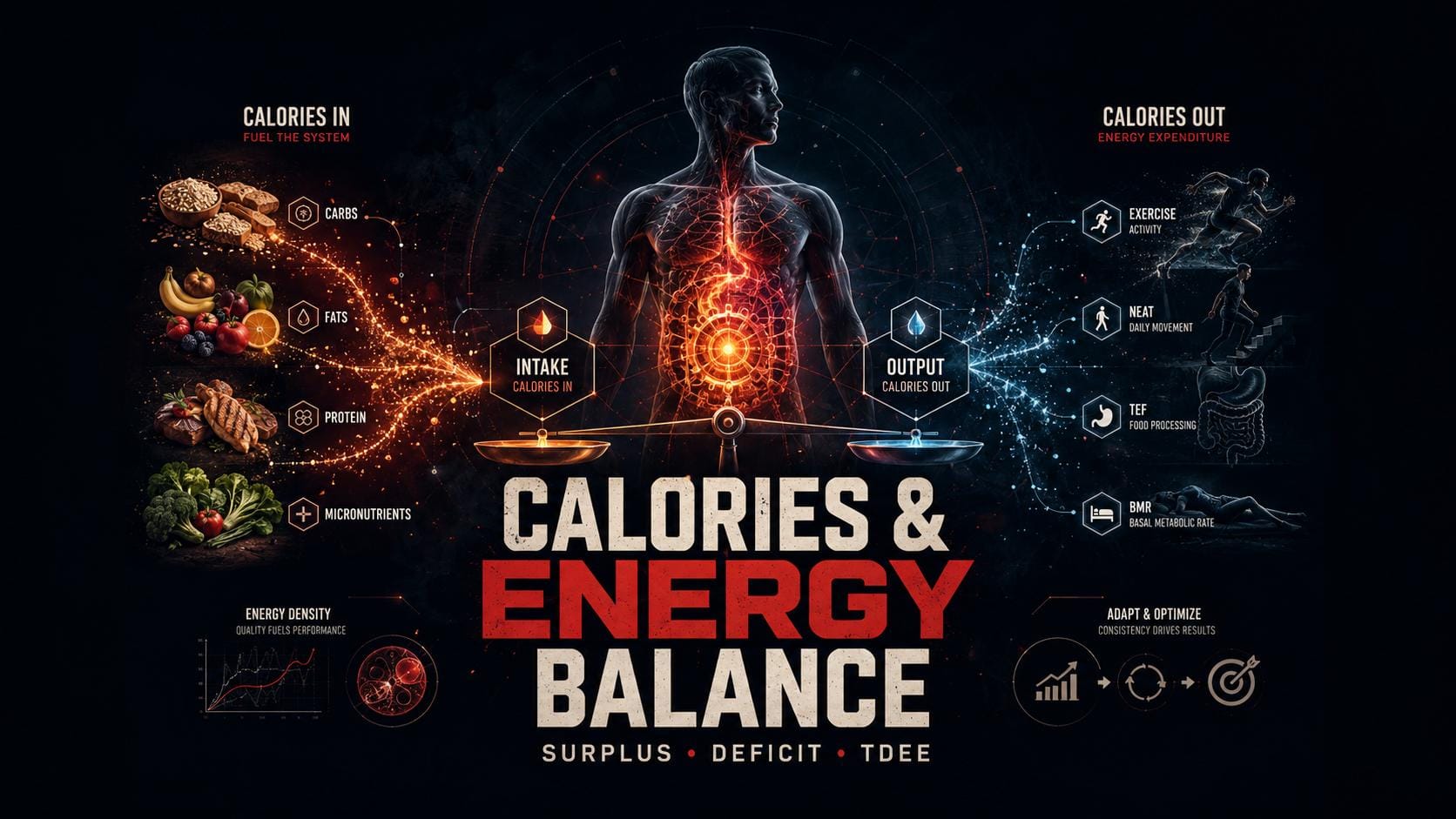
Energy balance is the difference between the calories you take in and the calories you spend. It is a law of physics, and it decides whether you gain or lose (PMID 35134825). The body answers a change in intake slowly, with a half time of about one year (PMID 21872751).
This guide covers the energy balance equation, where the calories go, how big a surplus or deficit lifters need, and why the body pushes back. More guides sit on the nutrition hub.
Energy balance in three numbers
Three study figures show how energy balance plays out in real people.
Weight response
How slowly weight settles after intake changes (PMID 21872751).
Deficit that stops gains
Lean mass gains from lifting stalled at this deficit (PMID 34623696).
Fat gain on overfeeding
Explained by fidgeting and daily movement (PMID 9880251).
Study figures come from PubMed papers. Where a number is a rule of thumb from practice rather than a trial, we say so.
What this energy balance guide covers
The energy balance equation and the four places calories go.
Calorie surplus and calorie deficit sizes that trials in lifters support.
Adaptive thermogenesis, and why calorie numbers are estimates.
Not covered
A meal plan. The calorie calculator gives you a starting number; this page explains what it means.
Medical weight loss. Drugs and surgery are outside this guide.
What is energy balance?
Energy balance is energy in minus energy out. Positive energy balance means you take in more than you spend and store the rest. Negative energy balance means you spend more than you take in and draw on stores.
The principle is a law of physics. It says nothing by itself about why people overeat or undereat (PMID 35134825).
The brain is the main organ that regulates body weight. It works mostly below conscious awareness, through hormones, metabolism and nerve signals that adjust food intake (PMID 35134825).
A small gap adds up. The United States adult obesity rise matches a persistent average imbalance of about 30 kJ, or about 7 kcal, a day (PMID 21872751).
Where the calories go: the four parts of energy out
| Component | What it is | What the studies say |
|---|---|---|
| Resting energy expenditure | Keeping organs running at rest | Falls under restriction: 266 kcal a day after 3 weeks at half intake (PMID 26399868) |
| Thermic effect of food | Energy used to digest and store a meal | Higher after larger meals, protein and carbohydrate than after fat (PMID 31021710) |
| Exercise | Planned training | High intensity work adds little to daily expenditure (PMID 15534427) |
| NEAT | Fidgeting, posture, walking, daily life | Explained 10 fold differences in fat gain on overfeeding (PMID 9880251) |
Total expenditure rarely exceeds 2.5 times basal metabolic rate. That upper limit was confirmed by training studies (PMID 15534427).
In adults, time spent at low and moderate intensity activity decides the activity level. High intensity exercise is not needed to raise daily expenditure (PMID 15534427).
NEAT: why two people on the same surplus gain differently
Levine and colleagues fed 16 non obese volunteers 1,000 kcal a day above maintenance for 8 weeks (PMID 9880251).
Two thirds of the rise in daily energy expenditure came from NEAT, the energy of fidgeting, posture and daily movement (PMID 9880251).
Changes in NEAT explained the 10 fold differences in fat storage between people. The more NEAT rose, the less fat was gained (PMID 9880251).
Calorie surplus: how much positive energy balance builds muscle
The ISSN position stand says diets for gaining lean mass are driven by a sustained calorie surplus. The size and composition of the surplus, and training status, shape what is gained (PMID 28630601).
How big the surplus should be is not settled. A 2019 review found the energy surplus needed for muscle growth is unknown and has never been validated in lifters (PMID 31482093).
A surplus is anabolic on its own, even without training. Textbook numbers ignore the extra energy cost of building tissue and the metabolic adjustments to overfeeding (PMID 31482093).
The best lifter trial used a modest surplus. Elite athletes on a planned surplus of 506 kcal a day gained 2.8% lean mass in 8 to 12 weeks. Athletes eating freely gained none (PMID 21851204).
A year later the counselled group was still up 4.4% in lean mass (PMID 21851204).
Calorie deficit: how negative energy balance drives fat loss
Fat loss diets are driven by a sustained calorie deficit. The higher the starting body fat, the more aggressive the deficit can be (PMID 28630601).
A deficit costs muscle gains. A meta-analysis of lifting trials found lean mass gains were impaired in a deficit, while strength gains were not (PMID 34623696).
The meta-regression put the line at about 500 kcal a day. At that deficit, lean mass gains from lifting stopped (PMID 34623696).
Protein protects. In a 40% deficit with hard training, men on 2.4 g per kg gained 1.2 kg lean mass and lost 4.8 kg fat. Men on 1.2 g per kg gained 0.1 kg and lost 3.5 kg (PMID 26817506).
How fast to lose: the rate of negative energy balance
Garthe and colleagues cut 24 elite athletes at two rates: 0.7% or 1% of body weight a week. All lifted 4 times a week (PMID 21558571).
Both groups lost about 5.5% of body weight. The slow group gained 2.1% lean mass; the fast group lost 0.2% (PMID 21558571).
Slower rates preserve lean mass better in leaner people (PMID 28630601).
Adaptive thermogenesis: why energy balance drifts
The body does not hold energy out constant. In 32 men on half their energy needs for 3 weeks, resting energy expenditure fell 266 kcal a day (PMID 26399868).
Of that, 108 kcal a day was adaptive thermogenesis, a fall beyond what lost tissue explains. It appeared within 3 days of restriction (PMID 26399868).
The extreme case is famous. Biggest Loser competitors lost 58.3 kg in 30 weeks, and resting metabolic rate fell 610 kcal a day (PMID 27136388).
Six years later they had regained 41 kg, yet resting metabolic rate was still 704 kcal a day below baseline (PMID 27136388).
Long term diet success depends on compliance and on handling adaptive thermogenesis (PMID 28630601).
Why calorie numbers are estimates
Intake is misreported. In 484 adults checked against doubly labelled water, underreporting on food questionnaires was common and linked to body mass index and dieting history (PMID 15113717).
Weight changes slowly. The response to a change in intake has a half time of about one year. People with more body fat lose more for the same change (PMID 21872751).
Expenditure moves. NEAT can swing by hundreds of kcal a day between people on the same diet (PMID 9880251).
Treat any calculator number as a first guess. Hold it for two to three weeks, compare the scale trend, then adjust by 100 to 200 kcal. No trial has tested that adjustment rule.
5 energy balance mistakes that stall progress
Cutting too deep while trying to grow
Lean mass gains from lifting stopped at about a 500 kcal a day deficit (PMID 34623696).
Losing too fast when lean
Athletes losing 1% of body weight a week lost lean mass; those at 0.7% gained it (PMID 21558571).
Ignoring protein in a deficit
2.4 g per kg beat 1.2 g per kg for lean mass and fat loss under a 40% deficit (PMID 26817506).
Trusting a logged intake
Underreporting was common even in a careful doubly labelled water study (PMID 15113717).
Expecting a fixed deficit to stay fixed
Resting expenditure fell 266 kcal a day within 3 weeks of restriction (PMID 26399868).
Verdict: 7 facts about energy balance
1. It is physics, not a theory. The principle is agnostic about why people overeat (PMID 35134825).
2. The brain runs it. Weight is regulated mostly below conscious awareness (PMID 35134825).
3. Weight responds slowly. About a one year half time after intake changes (PMID 21872751).
4. NEAT decides who gains. It explained 10 fold differences in fat gain on 1,000 kcal a day overfeeding (PMID 9880251).
5. About 500 kcal a day builds muscle. Athletes on that surplus gained 2.8% lean mass; free eaters gained none (PMID 21851204).
6. A 500 kcal deficit stops gains. Lean mass gains from lifting stalled there (PMID 34623696).
7. Metabolism adapts. Resting expenditure fell 266 kcal a day in 3 weeks of restriction (PMID 26399868).
Energy balance: frequently asked questions
What is energy balance?
Energy in minus energy out. Positive balance stores energy, negative balance draws on stores. It is a law of physics (PMID 35134825).
What is the energy balance equation?
Change in body energy stores equals energy intake minus energy expenditure. Expenditure has four parts: resting, food digestion, exercise and NEAT (PMID 31021710, 9880251).
How big a calorie surplus builds muscle?
The exact number is unknown (PMID 31482093). Athletes on a 506 kcal a day surplus gained 2.8% lean mass in 8 to 12 weeks (PMID 21851204).
How big a calorie deficit is too big?
Lean mass gains from lifting stopped at about 500 kcal a day (PMID 34623696). Lean athletes kept muscle at 0.7% of body weight a week, not at 1% (PMID 21558571).
Why did my weight loss stall on the same calories?
Resting expenditure falls under restriction, 266 kcal a day within 3 weeks in one trial (PMID 26399868). Logged intake is also often underreported (PMID 15113717).
Does metabolism recover after dieting?
Not fully in extreme cases. Biggest Loser competitors were 704 kcal a day below baseline six years later (PMID 27136388).
Does exercise burn many calories?
Less than most expect. Daily expenditure rarely exceeds 2.5 times basal rate, and low to moderate activity decides most of it (PMID 15534427).
Does protein change energy balance?
Protein and carbohydrate raise the thermic effect of food more than fat (PMID 31021710), and higher protein protected lean mass in a deficit (PMID 26817506).
Sources and further reading
Every study figure on this page comes from one of the 14 papers below, checked against PubMed on 4 November 2026. Practice notes are marked as practice. Reference links are dofollow to support open science.
Verified
Verified
Verified
Verified
Verified
Verified
Verified
Verified
Verified
Verified
Verified
Verified
Verified
Verified
Keep reading
Four pages that finish the job: the starting number, how to eat in each phase, how much protein, and whether timing matters.
Final Educational Note
This article is educational and is not medical or dietary advice. It reports what trials, meta-analyses and position stands say about energy balance in people who lift weights. The numbers are illustrations, not a plan written for any individual.
More guides sit on the nutrition hub. Read more on the about page and in the full disclaimer.