Protein Intake Explained: How Much Protein You Actually Need
How much protein you actually need
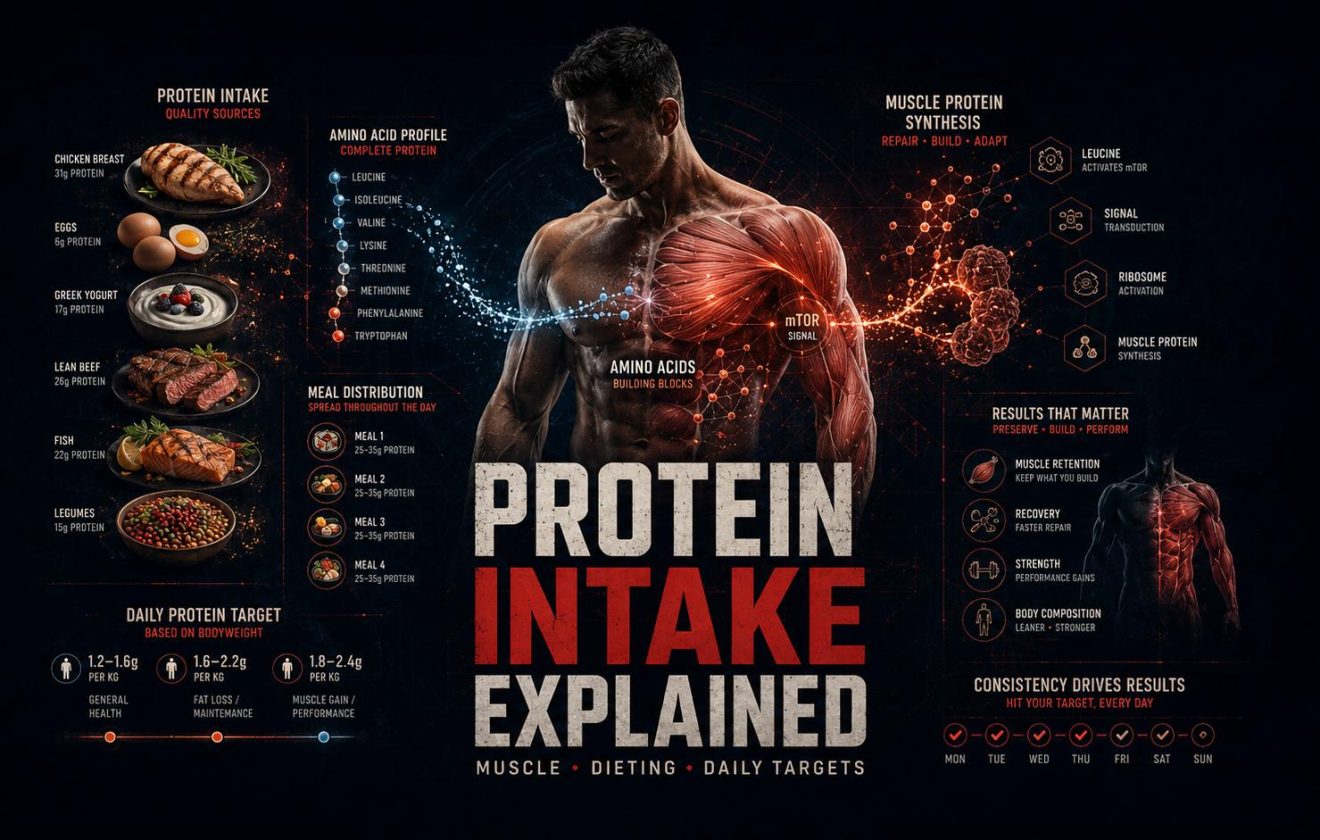
Protein intake is the most important dietary variable for body composition - more important than meal timing, food quality, or supplement use. Getting it right means understanding how many grams you need per kilogram of bodyweight, how that number changes based on your goal, and how to distribute meals across the day to support muscle protein synthesis consistently.
Protein Intake: Three Principles That Drive Muscle and Fat Loss
These three principles define how your daily protein target determines body composition outcomes.
The Research Range Is Settled
The evidence on optimal protein intake for resistance-trained individuals is consistent across multiple systematic reviews: 1.6-2.2 grams per kilogram of bodyweight per day covers the needs of nearly all trained individuals for muscle gain. During a calorie deficit, the daily target moves to the higher end - 2.0-2.4 g/kg - because the risk of muscle catabolism increases when total calories are restricted. Below 1.6 g/kg, muscle protein synthesis is suboptimal for anyone training with meaningful volume. Above 2.4-3.1 g/kg in a deficit, no additional muscle preservation benefit has been demonstrated, though high protein consumption remains safe for healthy individuals.
Protein Does More Than Build Muscle
Dietary protein affects body composition through multiple mechanisms beyond muscle protein synthesis. It has the highest thermic effect of the three macronutrients - digesting protein burns 20-30% of its caloric content in metabolic work, compared to 5-10% for carbohydrates and 0-3% for fats. High daily protein significantly reduces appetite and increases satiety, making calorie deficit adherence substantially easier. Adequate consumption during a cut also preserves lean mass by providing amino acids that prevent muscle protein breakdown from accelerating. These combined effects explain why protein is the highest-priority macronutrient in physique nutrition.
Distribution Across the Day Matters
Muscle protein synthesis responds to individual doses, not just daily totals. Research indicates that doses of 0.4-0.55 g/kg per meal maximally stimulate muscle protein synthesis in most trained individuals - roughly 30-50 grams per meal for a 75-90 kg person. Eating the entire daily protein intake in one or two meals leaves muscle protein synthesis suppressed for the remaining hours of the day. Distributing meals across 3-5 sittings spaced 3-5 hours apart sustains elevated synthesis throughout the day. Total daily protein intake remains the primary variable, but distribution determines how effectively that total is used.
What This Guide Covers
Covered in This Guide
- What protein intake does beyond muscle protein synthesis
- Evidence-based daily targets by goal and training level
- How protein needs change during calorie deficits vs surpluses
- Protein quality, complete vs incomplete sources, and the leucine threshold
- How to distribute meals across the day for maximum effectiveness
- Pre- and post-workout protein in context
- 5 common mistakes that stall muscle gain and fat loss
Not Covered Here
- Total calorie targets - covered in the Calories and Energy Balance guide
- Carbohydrate and fat - covered in separate Nutrition hub guides
- Specific protein supplement reviews - covered in the Supplements hub
- Protein and kidney health in clinical populations - consult a physician
- Protein needs during illness, injury recovery, or medical conditions
Protein intake and the broader nutrition picture. Daily protein targets only make sense in the context of total calorie intake. Read the Calories and Energy Balance guide first if you have not set a calorie target. For how protein interacts with training stimulus, see the Training hub. Supplement options are covered in the Supplements hub.
Six topics covering what protein does, how much to eat, and how to apply your daily target for your specific goal.
What Protein Intake Actually Does in the Body
Dietary protein supplies amino acids - the structural and functional units the body uses for muscle protein synthesis, enzyme production, hormone synthesis, immune function, and tissue repair. When protein intake is adequate, the body has the raw materials to build and maintain lean tissue, produce metabolic regulators including insulin and growth hormone precursors, and support the recovery systems that underpin training adaptation.
From a body composition perspective, protein intake exerts its effects through four distinct mechanisms. First, it provides the amino acids - particularly leucine - that trigger and sustain muscle protein synthesis after training. Second, a high-protein diet produces a substantially larger thermic effect than carbohydrate or fat, meaning a greater proportion of protein calories are spent on digestion rather than stored. Third, protein is the most satiating macronutrient per calorie, which directly supports adherence to calorie deficits. Fourth, sufficient daily protein during hypocaloric periods suppresses muscle protein breakdown, preserving lean mass at the expense of body fat rather than a mixed composition of fat and muscle.
Each of these mechanisms operates independently, which is why protein intake matters even for people whose primary goal is fat loss rather than muscle gain. The satiety and lean mass preservation effects are just as relevant - arguably more relevant - during a cutting phase than during a surplus.
Muscle Protein Synthesis
Protein intake supplies leucine and other essential amino acids that activate mTORC1 signalling and directly drive muscle protein synthesis. Without adequate daily protein, the anabolic stimulus from resistance training cannot be fully translated into new muscle tissue - the raw material is simply absent. Protein intake is the dietary prerequisite for the training-induced synthesis response to produce a net gain in muscle mass over time.
Thermic Effect and Body Fat
The thermic effect of food (TEF) for protein is 20-30%, meaning 20-30% of protein calories are consumed by the metabolic work of digestion and amino acid processing. A protein intake target of 160 g per day effectively costs 130-190 calories in metabolic work - calories that are not available for fat storage. High daily protein meaningfully increases total daily energy expenditure through TEF, independent of any other dietary change.
Satiety and Appetite Control
Protein intake produces stronger and more sustained satiety signals than equivalent calorie loads from carbohydrate or fat. High-protein diets suppress ghrelin (hunger hormone) and increase peptide YY and GLP-1 (satiety hormones), making it easier to sustain a calorie deficit without aggressive hunger. Studies comparing high- and moderate-protein conditions at the same calorie target consistently show lower reported hunger and better diet adherence when protein is higher.
Protein intake and kidney function. High protein intake does not damage kidney function in healthy individuals. The concern originates from research in patients with pre-existing chronic kidney disease, where dietary protein is restricted as a management strategy. In individuals with no renal pathology, eating in the ranges discussed in this guide - up to 3.1 g/kg during aggressive cuts - is well-supported as safe by the available evidence. If you have a diagnosed kidney condition, consult a physician before increasing daily protein significantly.
Daily Protein Targets by Goal and Training Level
Protein intake recommendations in mainstream health guidelines - typically 0.8 g/kg per day - are designed to prevent deficiency in sedentary adults, not to optimize muscle protein synthesis in resistance-trained individuals. For physique and performance goals, the evidence supports substantially higher daily targets than these baseline figures. The values below reflect current meta-analytic data and are specific to trained individuals with body composition goals.
Targets are expressed per kilogram of total bodyweight in most research, which is practical for individuals within a normal body composition range. For individuals with very high body fat percentages, using lean bodyweight or a realistic target bodyweight as the calculation basis is more appropriate, as adipose tissue has low protein turnover and does not contribute meaningfully to daily amino acid demand.
| Goal / Phase | Daily Protein (g/kg) | Daily Protein (g/lb) | Notes |
|---|---|---|---|
| Muscle gain (beginner) | 1.6-2.0 | 0.72-0.91 | Lower end is sufficient; beginners have high MPS sensitivity to training stimulus |
| Muscle gain (intermediate/advanced) | 1.8-2.2 | 0.82-1.0 | Higher end appropriate as training age increases and MPS requires greater stimulus |
| Calorie deficit (fat loss) | 2.0-2.4 | 0.91-1.09 | Higher daily protein reduces lean mass loss risk during hypocaloric dieting |
| Aggressive cut (>500 kcal deficit) | 2.4-3.1 | 1.09-1.41 | Maximum protective range during aggressive restriction; safe for healthy kidneys |
| Maintenance / body recomposition | 1.6-2.0 | 0.72-0.91 | Adequate for stable body composition and ongoing training recovery |
All values are for resistance-trained individuals with body composition goals. Based on evidence from systematic reviews and meta-analyses. Targets assume adequate total calorie intake.
Why Protein Needs Are Higher During a Deficit
During a calorie surplus, the anabolic environment supports muscle protein synthesis and the body is less inclined toward catabolism - requirements are lower relative to a cut. During a calorie deficit, the opposite applies: the body operates in a catabolic state where energy substrates are scarce, and amino acid availability from dietary protein is more critical for preventing muscle breakdown from accelerating. Higher daily protein during a deficit does not prevent all lean mass loss, but it substantially reduces the proportion of weight lost as muscle compared to fat. This is the primary reason targets differ by phase rather than being a single universal recommendation.
Practical starting point. For most trained individuals, targeting 2.0 g per kilogram of bodyweight per day covers muscle gain, maintenance, and mild deficit phases without recalculating for each goal shift. Adjust upward to 2.2-2.4 g/kg during more aggressive cuts. Use the Calorie and TDEE Calculator to set total calorie targets first, then fit your protein target within that calorie budget before allocating remaining calories to carbohydrate and fat.
Protein Quality, Complete Sources, and the Leucine Threshold
Not all protein intake is equivalent. Quality is determined by two factors: the completeness of the amino acid profile - whether the source contains all nine essential amino acids in meaningful quantities - and digestibility, which determines what proportion of ingested amino acids actually reach systemic circulation. These factors affect how effectively a given protein intake supports muscle protein synthesis, independent of the total gram count.
The key amino acid for triggering muscle protein synthesis is leucine. Leucine acts as the primary activator of mTORC1 signalling - the intracellular pathway that initiates the synthesis process. Research indicates that a leucine dose of approximately 2-3 grams per meal is required to maximally activate this response in trained individuals. This means source quality matters not just in terms of amino acid completeness but in terms of leucine content per gram consumed. Animal-based proteins - whey, eggs, beef, poultry, fish - are leucine-dense and complete. Many plant-based sources are leucine-poor relative to their total protein content, which is why plant-based diets require higher total gram targets to achieve an equivalent anabolic stimulus.
| Protein Source | Complete? | Leucine (g per 25g protein) | DIAAS Score |
|---|---|---|---|
| Whey protein | Yes | ~2.8-3.0 | 1.09-1.25 (excellent) |
| Eggs (whole) | Yes | ~2.2 | ~1.13 (excellent) |
| Chicken breast | Yes | ~2.1 | ~1.08 (excellent) |
| Beef (lean) | Yes | ~2.1 | ~1.0 (excellent) |
| Salmon | Yes | ~2.0 | ~1.0 (excellent) |
| Soy protein isolate | Yes | ~1.6 | ~0.90-1.0 (good) |
| Pea protein isolate | Partial (low methionine) | ~1.5 | ~0.60-0.82 (moderate) |
| Rice protein isolate | Partial (low lysine) | ~2.0 | ~0.40-0.60 (lower) |
| Legumes (lentils, beans) | Partial (low methionine) | ~0.9-1.2 | ~0.50-0.70 (moderate) |
DIAAS = Digestible Indispensable Amino Acid Score. Scores above 1.0 indicate excellent quality. Values are approximate and vary by preparation method and specific product.
Plant-based diet strategy. If plant sources make up most of your daily protein, increase total gram targets by 10-20% to compensate for lower DIAAS scores and leucine density. Combining complementary sources - rice with pea protein, legumes with grains - improves the overall amino acid profile. Soy protein isolate is the highest-quality plant option and the best direct substitute for animal-based protein intake in terms of muscle protein synthesis support.
Distributing Protein Intake Across the Day
Total daily protein intake is the primary determinant of muscle protein synthesis outcomes, but how it is distributed across meals meaningfully influences how effectively the total is utilized. Muscle protein synthesis does not remain elevated continuously after a single large dose - it rises, peaks, and returns to baseline within 3-5 hours regardless of how much was consumed in that sitting. Additional protein beyond a single meal's effective dose does not extend the synthesis period; it is either oxidized for energy or used for other metabolic functions.
The practical implication is that spreading protein intake across multiple meals maintains elevated muscle protein synthesis for more of the day compared to concentrating the daily total in one or two large servings. Research supports targeting 3-5 protein-containing meals spaced approximately 3-5 hours apart, with each meal providing a dose sufficient to exceed the leucine threshold. For most trained individuals, this translates to 30-50 grams of high-quality protein per meal.
0.4 g/kg per Meal
The research-supported minimum protein intake per meal to reliably exceed the leucine threshold and maximally activate muscle protein synthesis in most trained individuals. For a 75 kg person, this equals approximately 30 g of high-quality protein per meal. Lower doses may still support some synthesis but fall below the threshold for a full anabolic response in trained individuals with higher muscle mass.
0.4-0.55 g/kg per Meal
The effective range across 3-5 daily meals. For an 80 kg person targeting 2.0 g/kg of protein per day, this means 160 g total split across 4 meals of approximately 40 g each. This distribution pattern sustains muscle protein synthesis across the waking hours without excessive meal frequency that is difficult to maintain in practice.
3-5 Hours Between Meals
Muscle protein synthesis rises after a protein-containing meal and returns to near-baseline within 3-5 hours. Meals spaced closer than 3 hours provide no additional synthesis benefit. Meals spaced further than 5-6 hours leave synthesis rates suppressed for an extended period that accumulates into a meaningful net deficit in anabolic signalling across a full day.
30-40g Casein or Mixed Protein
Consuming protein before sleep takes advantage of the overnight fast - the longest period without dietary amino acids. Casein, which digests slowly and releases amino acids gradually over 5-7 hours, is well-studied in this context. Whole food sources such as cottage cheese, Greek yogurt, or a mixed meal before sleep also provide effective pre-sleep support and do not need to be replaced with casein specifically.
Pre- and Post-Workout Protein in Context
The concept of a narrow post-workout "anabolic window" - a short period during which protein is uniquely potent for muscle growth - has been substantially revised by more recent research. The window is real but wider than originally proposed: muscle sensitivity to dietary amino acids is elevated for at least 4-6 hours post-training, and some research suggests up to 24 hours. This means that the precision of workout protein timing matters far less than total daily protein intake and its overall distribution across meals.
That said, consuming food in the hours surrounding training is still a practical approach. Having a meal within 1-2 hours before training ensures amino acid availability during and immediately after the session. A post-workout dose of 20-40 grams within 2 hours after training takes advantage of elevated anabolic sensitivity without requiring precision to the minute. For individuals who train fasted or who have long gaps between meals and sessions, post-workout protein timing becomes more important relative to someone who ate a full meal 60-90 minutes before training.
When Workout Timing Matters More
Post-workout protein is most important in two specific scenarios: when training is performed in a fasted state (more than 4-5 hours since the last protein-containing meal) and when the daily total is at the lower end of the effective range. In both cases, getting amino acids in promptly after training minimizes the period during which muscle protein breakdown exceeds synthesis. For individuals already eating adequate daily protein distributed across 3-5 meals, the marginal benefit of optimizing workout timing is small compared to the benefit of simply hitting the daily target consistently.
Supplements vs whole food sources. Protein supplements - whey, casein, plant blends - are a convenient way to increase daily protein when whole food sources are difficult to access or when meal frequency is limited by schedule. They are not superior to whole food sources for muscle protein synthesis when amino acid quality is equivalent. Use supplements to fill gaps in a diet built primarily around whole foods, not as a replacement for structured meals. Options are covered in detail in the Supplements hub.
Protein Intake During Calorie Deficits: The Priority Macronutrient
When calories are reduced below maintenance, dietary protein becomes the highest-priority macronutrient to protect. During a deficit, the body is in a net catabolic state - energy substrates are scarce, and the body will increasingly draw on amino acids from muscle breakdown as an energy source if daily protein does not provide sufficient amino acids to meet metabolic demands. Higher consumption during a cut directly reduces the rate of muscle catabolism, preserving lean mass at the expense of stored body fat rather than a mixed composition of fat and muscle tissue.
The daily target during a calorie deficit is higher than during a surplus - not because muscle protein synthesis requires more protein, but because more is needed to suppress the elevated rate of muscle breakdown that accompanies calorie restriction. Research in resistance-trained individuals shows that targets of 2.0-2.4 g/kg during moderate deficits, and up to 3.1 g/kg during aggressive cuts, produce superior lean mass retention compared to lower amounts at the same calorie deficit. The additional daily protein acts as lean mass insurance - the calorie cost is recovered in part by protein's superior thermic effect and satiety compared to carbohydrate and fat at equivalent calorie levels.
During a cut, when total calorie intake is constrained, protein intake takes priority in calorie allocation. Set the daily protein target first - typically 2.0-2.4 g/kg - then allocate remaining calories to carbohydrate and fat based on preference and training demands. Carbohydrate supports training performance and glycogen availability, so reducing carbohydrate below the level that impairs training quality is generally counterproductive during a fat loss phase where maintaining lean mass and output is the goal.
5 Protein Intake Mistakes That Limit Muscle Gain and Fat Loss
- Mistake 01
Concentrating the Daily Total in One or Two Meals
Eating 150-180 grams of protein in two large meals - for example, a large dinner and a late-night shake - wastes the anabolic potential of that daily total. Muscle protein synthesis responds to individual doses, not just the cumulative amount consumed over 24 hours. The same daily protein intake split across four or five meals of 30-40 g each produces substantially more cumulative muscle protein synthesis over the course of the day than the same grams concentrated into two servings. Restructure meal distribution before adjusting total consumption.
- Mistake 02
Reducing Daily Protein During a Calorie Surplus
During a bulking phase, some individuals reduce their daily protein target to make calorie room for carbohydrates and fats, reasoning that the anabolic environment means needs are lower. While targets during a surplus are slightly below those during a cut, falling below 1.6 g/kg still impairs muscle protein synthesis relative to the training stimulus provided. The calorie surplus should be built on top of adequate daily protein - typically 1.8-2.2 g/kg - not partially funded by reducing it.
- Mistake 03
Using Total Bodyweight at High Body Fat Percentages
Protein intake targets expressed in g/kg bodyweight assume a body composition where lean mass makes up a large proportion of total weight. For individuals with body fat percentages above 25-30%, using total bodyweight inflates the calculation significantly - adipose tissue has very low protein turnover and does not contribute meaningfully to daily amino acid demand. Using lean bodyweight or a realistic target bodyweight as the basis produces a more accurate and appropriate daily target without excessive calorie allocation to protein.
- Mistake 04
Relying on Low-Quality Sources Without Adjusting Totals
Plant-based and mixed sources with lower DIAAS scores and leucine content require higher gram-for-gram consumption to achieve equivalent muscle protein synthesis stimulation compared to high-quality animal proteins. Using standard daily targets - for example, 2.0 g/kg - with a diet based primarily on legumes, rice, and grains without adjustment will produce suboptimal results, because the leucine threshold may not be reliably reached at each meal. If plant proteins dominate the diet, increase total targets by 10-20% and combine complementary sources to cover all essential amino acids across each meal.
- Mistake 05
Prioritizing Timing Over Consistency in Hitting the Daily Target
Spending effort on optimizing post-workout timing, protein cycling protocols, or complex meal-timing strategies while routinely falling short of daily protein intake targets is a misalignment of priorities. Total daily consistency - hitting the target across 7 days a week - has a larger impact on body composition outcomes than any timing refinement. A person consistently hitting 2.0 g/kg without any timing optimization will progress faster than a person optimizing workout timing while averaging 1.2 g/kg. Get the daily total right and consistent first; refine timing once the target is being hit reliably.
Published Research on Protein Intake
- Morton RW et al. A systematic review, meta-analysis and meta-regression of the effect of protein supplementation on resistance training-induced gains in muscle mass and strength in healthy adults. Br J Sports Med. 2018;52(6):376-384. pubmed.ncbi.nlm.nih.gov/28698222
- Stokes T et al. Recent perspectives regarding the role of dietary protein for the promotion of muscle hypertrophy with resistance exercise training. Nutrients. 2018;10(2):180. pubmed.ncbi.nlm.nih.gov/29414855
- Witard OC et al. Myofibrillar muscle protein synthesis rates subsequent to a meal in response to increasing doses of whey protein at rest and after resistance exercise. Am J Clin Nutr. 2014;99(1):86-95. pubmed.ncbi.nlm.nih.gov/24257722
- Helms ER et al. A systematic review of dietary protein during caloric restriction in resistance trained lean athletes: a case for higher intakes. Int J Sport Nutr Exerc Metab. 2014;24(2):127-138. pubmed.ncbi.nlm.nih.gov/24092765
- Churchward-Venne TA et al. Leucine supplementation of a low-protein mixed macronutrient beverage enhances myofibrillar protein synthesis in young men: a double-blind, randomized trial. Am J Clin Nutr. 2014;99(2):276-286. pubmed.ncbi.nlm.nih.gov/24284442
Protein Intake Is the One Dietary Variable Worth Getting Right First
The evidence is settled: 1.6-2.2 g/kg per day for trained individuals in a surplus, 2.0-2.4 g/kg during a calorie deficit, and up to 3.1 g/kg during aggressive cuts. Distribute the daily total across 3-5 meals of 30-50 grams each to maximize how effectively it is used. Source quality matters - prioritize leucine-dense complete proteins and increase plant-based targets by 10-20% to compensate for lower amino acid scores.
If only one dietary variable is tracked consistently, this is the one that produces the clearest and most predictable body composition results. Set the daily target, distribute it across the day, and build the rest of the diet around it. Everything else - meal timing precision, carbohydrate periodization, fat ratios - is refinement on top of a foundation that adequate daily protein provides.
- Calories and Energy Balance - set your calorie target before allocating protein within your total budget
- Calorie and TDEE Calculator - calculate your maintenance calories and daily calorie target
- Nutrition Hub - complete library covering carbs, fats, meal timing, and bulking vs cutting nutrition
- Training Hub - how resistance training interacts with dietary protein to drive muscle protein synthesis
- What Builds Muscle - the full picture of hypertrophy beyond protein alone
- Cutting vs Bulking Training - how training structure changes between phases alongside daily protein adjustments
- Supplements Hub - protein supplement reviews and evidence assessments for whey, casein, and plant blends
- Fitness Calculators Hub - all nutrition and training calculation tools in one place
- Start Here - site overview and recommended reading order for evidence-based physique training
- Ethan Walker - Training and Nutrition Editor - author profile and editorial scope
For Educational Purposes Only
This article discusses dietary protein and nutrition for educational purposes. The information provided reflects published nutritional science research and is intended to support informed decision-making about diet and training. It does not constitute medical or dietary advice and is not a substitute for consultation with a qualified physician or registered dietitian, particularly for individuals with pre-existing kidney, liver, or metabolic conditions.
MuscleScience.org does not sell any compounds, supplements, or products. All author names are pseudonyms. Author photographs are stylized portraits, not images of real individuals. See our About page and Disclaimer for full disclosure on editorial policy and anonymity.