Dietary Fat and Testosterone: 7 Critical Facts by Type
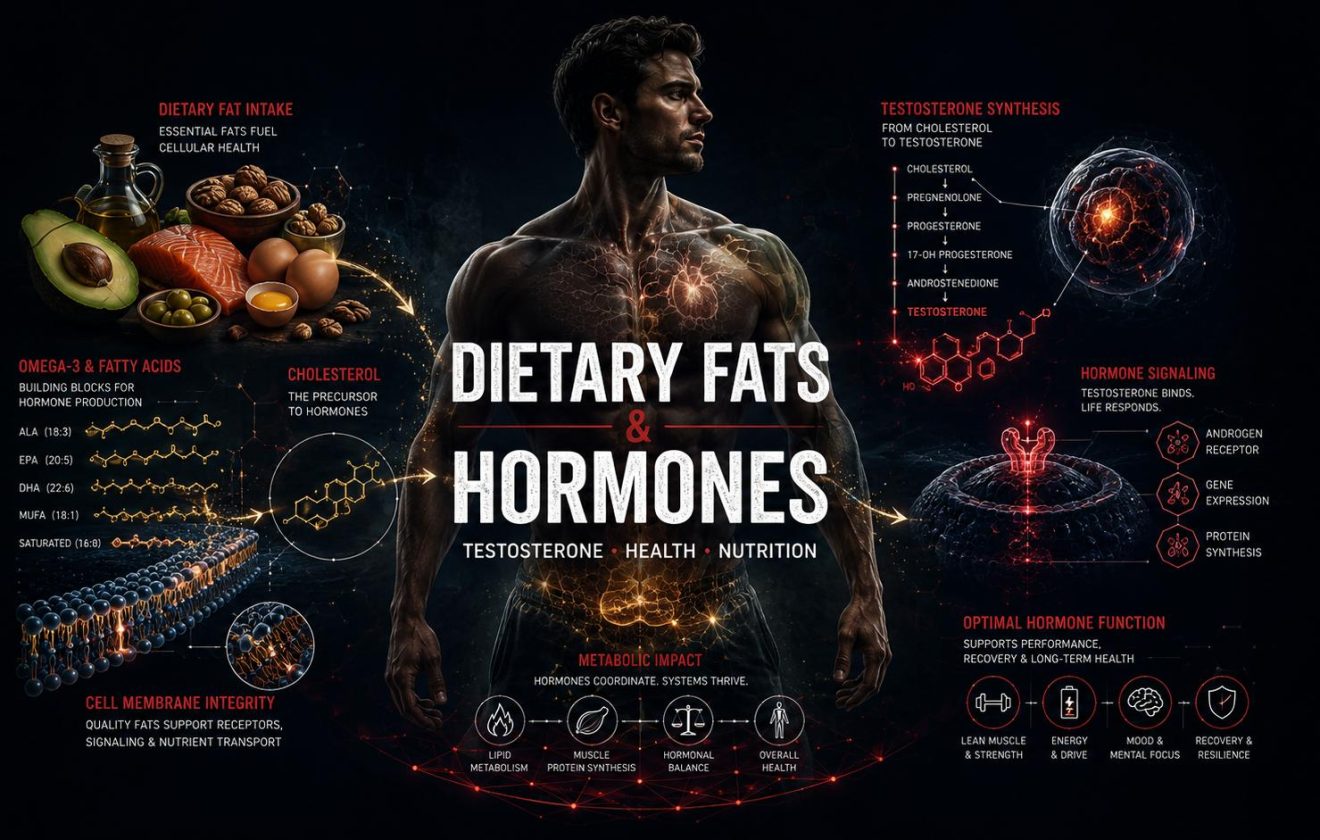
DIETARY FAT AND TESTOSTERONE: 7 CRITICAL FACTS BY TYPE
Dietary fat is the macronutrient people expect to move male hormones, and most of what is written about it online is louder than the data. The measured picture is smaller and stranger: low fat diets are associated with modestly lower testosterone, the fat classes do not behave alike, and no trial has shown that adding dietary fat lifts a healthy man into a range that changes how he looks or performs. This guide reads the evidence one fat class at a time with the numbers and the PubMed identifiers attached, and pairs with our total and free testosterone explainer for what a lab report actually says.
What dietary fat does to male hormones
A 2021 meta-analysis of six intervention studies in 206 men reported a standardised mean difference of -0.38 for total testosterone on low fat versus high fat diets, with the interval reaching -0.01 (PMID 33741447). Small, and close to no effect at all.
Saturated and monounsaturated intake tracked resting testosterone most closely in 12 resistance trained men (PMID 9029197), while in 209 young Spanish men monounsaturated intake tracked it the opposite way (PMID 27834316). One fat class, two opposite signs.
Every dataset compares a lower fat diet with a higher fat one in men already eating enough. Not one shows that pushing dietary fat above a normal intake raises a healthy man's testosterone into a range that changes body composition, strength or symptoms.
Direction of effect is reasonably consistent. Size of effect is small, the trials are small, and energy balance and body fat confound almost every dataset in this field.
What this guide covers
Fat class by fat class. Saturated, monounsaturated, polyunsaturated split into omega-6 and omega-3, and trans fat, each against what was measured and in whom.
The primary studies by name and number. Volek 1997, Hamalainen 1983, Dorgan 1996, Wang 2005, Fantus 2020 and the Whittaker meta-analysis, with volumes, pages and PubMed identifiers on the page.
What is unsupported. Popular claims about dietary fat and testosterone that have no measured basis are marked as unsupported rather than repeated.
Not covered. Calorie targets live in calories and energy balance, protein targets in protein intake explained, and carbohydrate around training in carbs for training. Treatment of low testosterone is not discussed here.
Do fats increase testosterone?
Dietary fat intake is associated with testosterone, the association is small, and the direction that has actually been tested is downward rather than upward. Studies that cut dietary fat in men eating a normal amount saw testosterone fall roughly 10 to 15 percent. Studies asking whether adding dietary fat to an already adequate intake pushes testosterone up barely exist, and the few that touch it show no useful rise.
That asymmetry matters more than any single number. Removing something can reveal it was needed without implying more is better. The honest version of the dietary fat story is that fat looks like a floor rather than a lever.
Effect size is the second thing to hold on to. The pooled standardised mean difference for total testosterone was -0.38 across six intervention studies in 206 men, with an upper bound of -0.01 (PMID 33741447). An interval brushing zero is a signal, not a settled quantity. Free testosterone moved -0.37, urinary testosterone -0.38 and dihydrotestosterone -0.30, while luteinising hormone and sex hormone binding globulin did not move significantly at all.
Confounding is the third. Almost every low fat diet here was also a high fibre diet, several produced small weight loss, and body fat itself changes aromatase activity and hormone binding. Wang and colleagues moved 39 middle aged men to an isocaloric low fat, high fibre diet for eight weeks; androgens fell about 12 percent and body weight still fell 1 kg despite matched calories (PMID 15741266). Isolating it from everything travelling with it is the unsolved problem here.
Dietary fat by class: saturated, monounsaturated, polyunsaturated and trans
This is the part of the dietary fat question worth answering carefully, because the classes were measured separately and the results disagree with each other in ways popular summaries hide. Each row states what was measured, in whom, and under which study number, so the claim can be traced rather than trusted.
| Fat class | Typical sources | What was measured, and in whom | Direction for testosterone | Status |
|---|---|---|---|---|
| Saturated | Beef fat, dairy fat, egg yolk, coconut oil, palm oil | Saturated fatty acid intake per 1,000 kcal correlated with resting total testosterone at r 0.77 in 12 resistance trained men over 17 days of food records (PMID 9029197). No intervention has isolated saturated fat and measured testosterone. | Positive correlation only, never tested causally | ● Mixed |
| Monounsaturated | Olive oil, avocado, most nuts, beef and pork fat | Correlated r 0.79 with resting testosterone in the same 12 men (PMID 9029197). In 209 healthy young Spanish men, monounsaturated intake was associated with lower total and calculated free testosterone and lower inhibin B (PMID 27834316). | Two datasets, opposite signs | ● Conflicting |
| Polyunsaturated, omega-6 | Sunflower, soybean, corn oil, most seed oils | A higher ratio of polyunsaturated to saturated fat correlated with lower resting testosterone, r -0.63, in the Volek sample (PMID 9029197). In the Spanish cohort, omega-6 intake was associated with higher luteinising hormone and smaller testicular volume (PMID 27834316). | Slightly unfavourable in both datasets, small and indirect | ● Mixed |
| Polyunsaturated, omega-3 | Oily fish, fish oil, algae oil, flaxseed | Omega-3 intake was positively related to testicular volume in 209 men (PMID 27834316). Among 1,679 Danish men, those using fish oil for 60 days or more had 20 percent lower FSH, 16 percent lower LH, 1.5 mL larger testes and 0.64 mL more semen volume (PMID 31951274). Testosterone itself was not raised. | Gonadotrophins down, testosterone not shown to rise | ● Not a testosterone effect |
| Trans | Partially hydrogenated oils, some fried and baked goods | Trans fat intake was associated with lower total and calculated free testosterone, P for trend 0.01 and 0.02, and smaller testicular volume in 209 men (PMID 27834316). In the same cohort, total sperm count fell across quartiles of trans fat intake from 144 to 89 million, P for trend 0.03 (PMID 24419496). | Consistently unfavourable across two outcomes | ● Avoid |
| Total dietary fat as percent of energy | All of the above combined | Percent of energy from dietary fat correlated r 0.72 with resting testosterone in 12 men (PMID 9029197) and r 0.55 in 18 strength athletes and active controls (PMID 15532008). Cutting total fat from 41 to 19 percent of energy in a 43 man crossover lowered total testosterone by 13 percent (PMID 8942407). | Lowering dietary fat below roughly 20 percent of energy lowers testosterone | ● Supported |
Read whole, the table says something specific. The only fat class with a consistent unfavourable signal is trans fat, and its clearest effect is on sperm rather than testosterone. The only well supported statement about total dietary fat concerns what happens when you take dietary fat away. Every claim that one particular class is the testosterone fat rests on correlations in a dozen men.
What happened when researchers actually cut the dietary fat
Four controlled studies form the backbone of the dietary fat restriction side of this question, and all four moved in the same direction. Hamalainen and colleagues switched 30 healthy middle aged men to a diet lower in dietary fat, higher in the polyunsaturated to saturated ratio and higher in fibre. Serum total testosterone fell from 22.7 to 19.3 nmol/L and free testosterone from 0.23 to 0.20 nmol/L (PMID 6298507). The changes reversed when the men went back.
Dorgan and colleagues ran the tighter version: a controlled feeding crossover in 43 men aged 19 to 56, ten weeks per arm, energy matched near 3,170 kcal per day. The low arm gave 18.8 percent of energy as dietary fat, the high arm 41.0 percent. Total testosterone and the fraction bound to sex hormone binding globulin were 13 and 15 percent higher on the higher dietary fat diet (PMID 8942407), while urinary oestrogens and their metabolites ran 12 to 28 percent lower.

The figure above is the whole dietary fat restriction literature in one picture. Four androgen outcomes fell by a similar small amount, and the two pituitary and binding measures did not move. In men of European and North American ancestry the total testosterone estimate was larger at -0.52 (PMID 33741447).
A different dataset: how strongly each nutrient variable tracked resting testosterone in 12 resistance trained men across 17 days of food records. Bars show the absolute correlation coefficient. Green is a positive correlation with testosterone, red a negative one. Volek 1997, PMID 9029197.
Wang and colleagues supplied the cleanest androgen number in the set. Thirty nine healthy men aged 50 to 60 moved from a usual high fat, low fibre diet to an isocaloric low dietary fat, high fibre diet for eight weeks. Testosterone, free testosterone, dihydrotestosterone, androstenedione and DHEA sulfate all fell. The authors summarised it as a consistent 12 percent lowering of circulating androgens with no change in metabolic clearance (PMID 15741266). Production went down, not disposal.
Volek 1997 on dietary fat and testosterone, read properly
If you have read that saturated fat raises testosterone, this is the source. Volek JS, Kraemer WJ, Bush JA, Incledon T, Boetes M. Testosterone and cortisol in relationship to dietary nutrients and resistance exercise. Journal of Applied Physiology 1997;82(1):49-54, PubMed identifier 9029197. That is the study, and those are the pages.
Twelve men performed a bench press protocol and a jump squat protocol, gave blood before and five minutes after, and kept 17 days of food records. Testosterone rose 7.4 percent after the bench press session and 15.1 percent after the jump squats, and cortisol did not change. Resting testosterone then correlated with percent of energy from dietary fat at r 0.72, saturated fatty acids r 0.77, monounsaturated fatty acids r 0.79, the polyunsaturated to saturated ratio r -0.63, percent of energy from protein r -0.71 and the protein to carbohydrate ratio r -0.59.
What it did not do: assign anyone to a diet, change anyone's dietary fat intake, or follow anyone over time. A correlation of 0.79 in twelve men carries an interval wide enough to include unimpressive values, and the fat and protein coefficients are two sides of one arithmetic, because percentages of energy must sum to a hundred. The authors wrote only that dietary nutrients may be capable of modulating resting testosterone.
Sallinen and colleagues later reproduced the shape of it: basal testosterone correlated with dietary fat at r 0.55 as a percent of energy and r 0.65 in grams per kilogram across 18 men, and the relationship held only in the strength athlete subgroup, where fat in grams per kilogram reached r 0.77 (PMID 15532008). Same design, same limitation.
What each popular dietary fat claim actually rests on
The most useful thing a page on this topic can do is separate claims with an intervention behind them from claims with only a correlation, and both from claims with nothing behind them at all.
| Claim | Strongest evidence behind it | Design | Status |
|---|---|---|---|
| Cutting dietary fat lowers total testosterone | Pooled SMD -0.38 across 6 interventions, 206 men (PMID 33741447); 13 percent gap in a 43 man feeding crossover (PMID 8942407); 12 percent androgen drop in 39 men (PMID 15741266) | Meta-analysis plus controlled feeding | ● Supported |
| Men on a low dietary fat diet have lower testosterone than men who do not restrict | NHANES, 3,128 men. Low fat 410.8 versus non-restrictive 443.5 ng/dL, adjusted beta -57.2 ng/dL (PMID 31393814) | Cross-sectional, adjusted | ● Supported |
| Adding dietary fat above a normal intake raises testosterone | No study tested it. Every dataset compares restriction against habitual intake | Untested | ● Unsupported |
| Saturated fat is specifically the testosterone fat | r 0.77 in 12 men (PMID 9029197), with monounsaturated fat scoring higher in the same sample | Correlation, n 12 | ● Weak |
| Monounsaturated fat raises testosterone | r 0.79 in 12 men (PMID 9029197) against an inverse association in 209 men (PMID 27834316) | Two datasets that disagree | ● Conflicting |
| Seed oils crash testosterone | A polyunsaturated to saturated ratio correlation of -0.63 in 12 men (PMID 9029197). No feeding trial exists | Correlation only | ● Unsupported as stated |
| Fish oil is a testosterone booster | Users had lower FSH and LH and larger testes (PMID 31951274). Testosterone was not reported as higher | Cross-sectional, self-reported use | ● Unsupported |
| Trans fat is bad for male reproductive measures | Lower total and free testosterone by intake quartile, sperm count falling 144 to 89 million (PMID 27834316, PMID 24419496) | Cross-sectional, two outcomes | ● Reasonable |
| There is a dietary fat threshold below which hormones suffer | The lowest arms studied sat near 19 percent of energy. No dose-response trial has looked for a threshold | Not established | ● Unknown |
| Very low carbohydrate plus very high protein lowers testosterone | Resting total testosterone SMD -1.08, about 5.23 nmol/L, 27 studies, 309 men (PMID 35254136) | Meta-analysis of interventions | ● Supported, protein driven |
Two rows deserve a second look. The NHANES analysis found men on a Mediterranean pattern also had lower testosterone, 412.9 against 443.5 ng/dL (PMID 31393814), despite that pattern being rich in monounsaturated fat. If dietary fat quantity alone drove the hormone, that result should not exist. The final row is a reminder that the low carbohydrate diets people blame mostly displace fat with protein, which is the variable the data actually indicts.
Optimal fat intake for hormones, and why nobody can name a number
People arrive here wanting a gram target. The literature cannot supply one, and pages printing a precise figure are inventing it. What the studies supply is a set of tested boundaries.
The restricted arms that produced measurable androgen drops sat at 18.8 percent of energy as dietary fat in the Dorgan crossover (PMID 8942407) and at similarly low intakes in the Hamalainen and Wang studies. The comparison arms sat near 40 percent. Nobody has fed men 25, 30 and 35 percent of energy as fat and measured where the curve bends, so the dose-response shape is unknown.
A reasonable reading for someone eating to train rather than to be studied: a dietary fat intake somewhere in the twenties to mid thirties as a percentage of energy sits above every restricted arm that produced a hormonal drop, leaves room for protein, and has nothing against it. That is a floor argument, not an optimisation. Pushing dietary fat to half of energy has never been shown to buy anything hormonal and crowds out carbohydrate that training uses.
One more constraint comes from the binding side. Reed and colleagues fed six men over 100 g of dietary fat per day for two weeks, then under 20 g per day for two weeks. Sex hormone binding globulin fell on the high intake and rose on the low one, and that rise came with a fall in both the free testosterone fraction and free testosterone concentration (PMID 3558725). Six men is a very small study, but it points at a mechanism that needs no change in testicular output at all.
For what those numbers mean on a blood panel rather than on a plate, start with the difference between total and free testosterone. Phase specific eating is covered in bulking versus cutting nutrition.
Six confident claims about dietary fat and testosterone that are not true
More dietary fat means more testosterone
The tested direction is removal. Six interventions cut dietary fat and saw androgens fall a little (PMID 33741447). Not one took men on an ordinary intake and raised it to watch testosterone rise. Treating a floor effect as a dose-response is the central error here.
Saturated fat is the hormone fat
In the one sample where it was measured, monounsaturated fat correlated slightly more strongly than saturated, 0.79 against 0.77 (PMID 9029197). The data cannot separate the two classes and neither was manipulated. The saturated fat and testosterone claim is a correlation in twelve men wearing a lab coat.
Seed oils are why testosterone is falling
The only supporting number is a polyunsaturated to saturated ratio of -0.63 in twelve men, and a ratio moves when either side moves. No trial has fed omega-6 fat and measured testosterone. The claim is unsupported as usually stated, which is not the same as saying omega-6 intake is irrelevant.
Keto raises testosterone because it is high in dietary fat
The meta-analysis of 27 studies in 309 men found no consistent effect of low carbohydrate diets on resting testosterone while protein stayed under 35 percent of energy, and a large drop of about 5.23 nmol/L when protein went above it (PMID 35254136). Dietary fat was not the variable that mattered.
Fish oil raises testosterone
In 1,679 young men, fish oil users had 20 percent lower FSH, 16 percent lower LH, larger testes and more semen volume (PMID 31951274). Those are fertility markers, the design was cross-sectional, and testosterone was not reported as higher. Selling omega-3 as a testosterone booster misreads a real finding about a different outcome.
A 12 percent shift in testosterone changes how you look
Twelve percent of 450 ng/dL is about 54 ng/dL, inside the day to day and assay to assay variation of one man. No study in this literature measured muscle, strength or body composition as an outcome. Treating a within-range hormone shift as a physique variable is not supported.
Five mistakes people make with dietary fat and hormones
1. Driving dietary fat to single digit percentages during a cut. This is the one scenario where the evidence genuinely applies to a lifter. Aggressive cuts squeeze fat first because it is calorie dense, and the restricted arms that lowered androgens sat near 19 percent of energy with added fibre. Squeeze carbohydrate or total calories instead and keep a floor.
2. Reading a correlation as an instruction. Volek 1997 measured what twelve men happened to eat and what their testosterone happened to be. It did not tell anyone to eat more saturated fat, and its own conclusion is hedged. Any page that turns r 0.77 into a gram target has added information the study does not contain.
3. Ignoring energy balance and body fat. Most diets here changed fibre, weight or both alongside dietary fat, and Wang's men lost a kilogram on matched calories (PMID 15741266). Body fat itself alters aromatase activity and binding globulin, so a man who gains fat while eating more of it can end up with a worse profile, not a better one.
4. Chasing dietary fat while protein sits above 35 percent of energy. The largest measured effect in this area is not dietary fat at all. High protein, low carbohydrate arms lowered resting total testosterone with a standardised mean difference of -1.08 (PMID 35254136), several times anything fat did. Fixing protein distribution is the bigger lever.
5. Expecting a hormone change to show up as a physique change. None of these studies measured muscle mass, strength or symptoms. A man at 430 rather than 480 ng/dL after a dietary fat restriction has a laboratory difference and no demonstrated functional one. If symptoms are the real concern, that is a clinical question, not a macronutrient one.
Questions people actually ask about fat and testosterone
Do fats increase testosterone?
Not in the way the question implies. What has been tested is the reverse: cutting dietary fat in men eating a normal amount lowered total testosterone by a pooled standardised mean difference of -0.38 across six interventions in 206 men (PMID 33741447), roughly 10 to 15 percent in the individual trials. No study has taken men on an adequate intake, raised their dietary fat and shown testosterone rise usefully. Fat behaves like a floor, not a lever.
Does saturated fat raise testosterone in men?
The saturated fat and testosterone link comes from one correlational study of twelve resistance trained men, where saturated fatty acid intake tracked resting testosterone at r 0.77 (PMID 9029197). Monounsaturated fat in the same men scored slightly higher at r 0.79, so the data cannot single saturated fat out. No trial has fed saturated fat specifically; the controlled feeding studies changed total fat, fibre and fat ratio at once.
What does polyunsaturated fat do to testosterone?
Two signals, both weak. A higher polyunsaturated to saturated ratio correlated with lower resting testosterone at r -0.63 in the Volek sample (PMID 9029197), and in 209 young Spanish men omega-6 intake was associated with higher luteinising hormone and smaller testicular volume (PMID 27834316). Omega-3 behaved differently, relating positively to testicular volume, while fish oil users showed lower FSH and LH rather than higher testosterone (PMID 31951274). Neither subtype has been fed in a trial.
Does monounsaturated fat raise testosterone?
This is the clearest example of the field disagreeing with itself. Monounsaturated intake correlated with resting testosterone at r 0.79 in twelve men (PMID 9029197), yet was associated with lower total testosterone, lower calculated free testosterone and lower inhibin B in 209 men (PMID 27834316). A national survey adds a third point against the simple story: men on a Mediterranean pattern, high in monounsaturated fat, had lower testosterone than men who did not restrict at all (PMID 31393814).
What is the optimal fat intake for hormones?
No study has established one, and any specific gram figure you read is an extrapolation. The restricted arms that produced measurable androgen drops sat near 19 percent of energy from dietary fat, and their comparison arms near 40 percent (PMID 8942407). Nothing has been tested between those points, so the shape of the curve is unknown. Staying comfortably above the restricted arms, in the twenties to mid thirties as a percentage of energy, is a floor argument rather than an optimum.
What did the Volek 1997 study actually find?
Volek JS and colleagues, Journal of Applied Physiology 1997;82(1):49-54, PMID 9029197. Twelve men did a bench press protocol and a jump squat protocol and kept 17 days of food records. Testosterone rose 7.4 and 15.1 percent after the two sessions. Resting testosterone correlated with percent energy from dietary fat r 0.72, saturated fatty acids r 0.77, monounsaturated fatty acids r 0.79, the polyunsaturated to saturated ratio r -0.63, percent energy from protein r -0.71 and the protein to carbohydrate ratio r -0.59. It was observational: no diet was assigned or changed.
Do trans fats lower testosterone?
This is the most consistent unfavourable finding in the area. In 209 healthy young men, trans fat intake was associated with lower total and calculated free testosterone, P for trend 0.01 and 0.02, and with smaller testicular volume (PMID 27834316). In the same cohort, adjusted mean total sperm count fell across rising quartiles of trans fat intake from 144 to 113 to 100 to 89 million, P for trend 0.03 (PMID 24419496). Both analyses are cross-sectional, so causation is not established.
Is there an NIH indexed review of fat and testosterone in men?
Yes. The systematic review and meta-analysis most people are looking for is Whittaker J and colleagues, Journal of Steroid Biochemistry and Molecular Biology 2021;210:105878, PubMed identifier 33741447, indexed in PubMed and available in PubMed Central. It pooled six intervention studies totalling 206 participants and reported decreases in total testosterone, free testosterone, urinary testosterone and dihydrotestosterone on low dietary fat diets, with no significant change in luteinising hormone or sex hormone binding globulin. The companion low carbohydrate meta-analysis is PMID 35254136.
References and further reading
All citations are peer-reviewed studies verified via PubMed. Reference links are dofollow to support open science. Every correlation coefficient, percentage and effect size quoted in this article on dietary fat and male hormones is taken directly from the primary publications listed below.
Keep reading
All guides are evidence-based, PMID-verified, and written for people who train and want to know what the nutrition research does and does not show.
Final Educational Note
This article is educational and is not medical or dietary advice. It describes what published studies measured about dietary fat and male sex hormones, including where the evidence is thin, conflicting or absent. It does not recommend a diet, prescribe an intake, or offer a way to raise testosterone. More nutrition guides sit on the nutrition hub.
If you have symptoms you believe are hormonal, that is a clinical question for a physician and a blood panel, not a macronutrient question. Read more about how this site works on the about page and in the full disclaimer.