Turinabol: Dangerous Liver Risks, 10 Studies
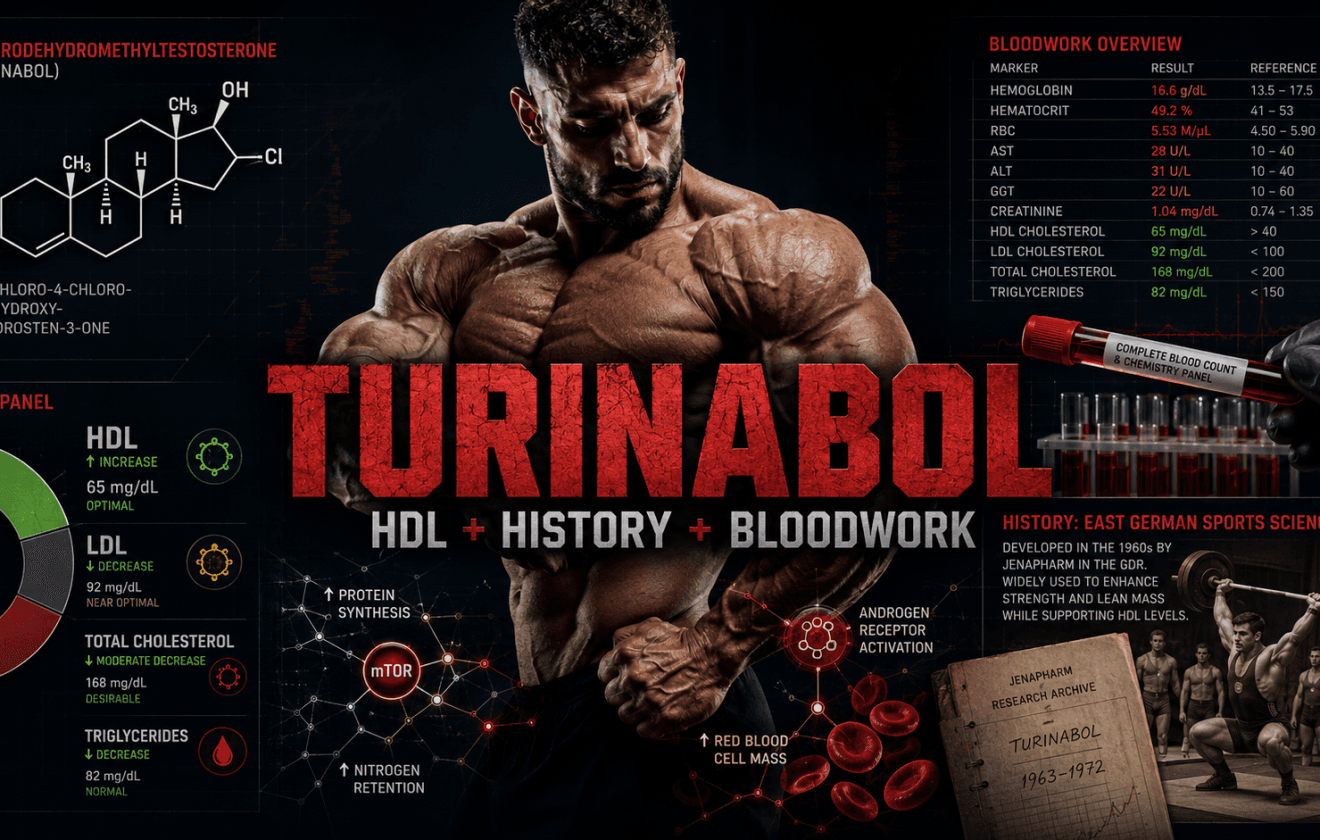
Turinabol: Dangerous Liver Risks, 10 Studies
Turinabol is an oral, non-aromatizing anabolic steroid built for the East German state doping program, and its reputation as a "mild" compound obscures a hepatotoxic and lipid-suppressive profile that overlaps heavily with the risks covered in our guide to testosterone suppression on steroids.
The Data in Brief
Turinabol carries a 4-chloro substitution that blocks aromatase, so it does not convert to estrogen the way testosterone or Dianabol can.
It is orally active because of a 17-alpha-alkyl group, and that same modification is what makes the compound hepatotoxic and detectable by liver enzyme panels.
The drug was manufactured by Jenapharm and administered to thousands of East German athletes under a documented state doping program from the 1970s through the 1980s.
The figures on this page come from published pharmacology, hepatotoxicity, and anti-doping metabolite studies. They describe population-level patterns, not a guarantee of any individual outcome.
What This Turinabol Guide Covers
Structure and mechanism. What separates it from Dianabol and from testosterone at the molecular level, and why that structure changes its risk profile.
Doping history. How this steroid became the signature compound of East Germany's State Plan 14.25, and what that history tells modern users about long-term dosing patterns.
Detection science. The 2015 discovery of long-term metabolites and what it means for anyone assuming a short detection window.
Bloodwork monitoring. The specific liver and lipid markers a cycle should be tracked against, and where those numbers tend to move.
Risk framing. How its risks compare with Anavar and with injectable testosterone, so the compound is evaluated on its actual pharmacology rather than its reputation.
What Turinabol Is: Structure and Mechanism
Turinabol, chemically dehydrochlormethyltestosterone (DHCMT), is a synthetic derivative of methandienone (Dianabol) with two structural changes: a chlorine atom added at the 4 position and a double bond at the 1,2 position of the steroid nucleus. Both changes matter clinically. The 4-chloro substitution blocks the aromatase enzyme from converting it into an estrogenic metabolite, which is why the compound does not produce the water retention or gynecomastia risk associated with testosterone or Dianabol. The 1,2-dehydrogenation also prevents 5-alpha reduction, so it does not amplify into a stronger androgen the way testosterone converts to dihydrotestosterone.
The compound is also 17-alpha-alkylated, meaning a carbon group is attached at the 17-alpha position of the steroid molecule so it survives first-pass metabolism in the liver and remains orally active instead of being broken down before reaching circulation. That same modification is the direct mechanism behind its hepatotoxicity. Structural work on human steroid-synthesizing cytochrome P450 enzymes has mapped exactly how the liver processes this steroid, and that processing pathway is the reason bloodwork monitoring during a cycle centers on liver enzymes rather than estrogen management (Schiffer LM et al, Drug Metab Dispos, 2016).
The net pharmacological picture: it produces anabolic effects without the aromatization-driven side effects common to testosterone or Dianabol, at the cost of a 17-alpha-alkylated hepatotoxicity burden and, as later sections cover, a pronounced effect on HDL cholesterol.
The drug has a relatively short plasma half-life, which historically supported the twice-daily oral dosing pattern documented in East German program records. That same short half-life is part of why the 2015 discovery of long-term detectable metabolites was so significant for anti-doping science. The parent molecule itself clears quickly, but its downstream metabolites do not, and it is those metabolites, not the parent compound, that modern testing panels are built to find. Understanding this distinction matters because it explains why the compound earned a reputation for being hard to detect decades ago, and why that reputation is now outdated.
State Plan 14.25: Why East Germany Built Turinabol for Systematic Doping
Turinabol is inseparable from its doping history. East Germany's State Plan 14.25 was a state-run program that administered anabolic steroids, primarily this compound produced by the state pharmaceutical company Jenapharm, to thousands of athletes from the early 1970s through the fall of the Berlin Wall. The program was documented in detail after German reunification, when internal Stasi files and medical records were reviewed by researchers. A landmark 1997 paper in Clinical Chemistry reconstructed the scope of the program from those files: systematic administration of the drug to elite and junior athletes, often without full disclosure of what they were being given, across a wide range of sports (Franke WW, Berendonk B, Clin Chem, 1997).
It was chosen for state doping specifically because of its pharmacological profile described above. A non-aromatizing oral compound produced fewer visible feminizing side effects in female athletes, which mattered to a program that doped women's sports extensively, and its oral route avoided the logistical complications of mass injectable administration. That history is not a footnote. It is the reason this compound has one of the longer continuous human-use records of any anabolic steroid, and the East German cohort data is part of what modern hepatotoxicity and endocrine research on Turinabol draws from.
The scale of State Plan 14.25 is part of what makes its human-use record unusually well documented compared with many other anabolic steroids. Researchers who later reviewed the East German program's medical files found systematic dosing schedules, adjusted by sport and by athlete age, with it as the default compound for both male and female athletes. That systematic, decades-long administration under monitored conditions is a large part of why the drug shows up so consistently in the pharmacology and hepatotoxicity literature relative to its actual current popularity in recreational use. The compound's notoriety comes from history and detection science more than from any claim that it is uniquely potent among oral anabolic steroids.
The 2015 Discovery: Why Turinabol's Detection Window Is Not What It Was
For years, Turinabol was assumed to clear the body within roughly a few weeks based on early metabolite screening methods. That assumption was overturned starting in 2014 to 2015, when long-term metabolites, stored in fat tissue and released slowly over time, were identified and validated for anti-doping testing. A 2018 study characterized one of these long-term metabolites, 20-beta-hydroxy-nor-DHCMT, using combined chemical and biotechnological production methods to confirm its structure and detectability (Liu J et al, J Inorg Biochem, 2018).
A more recent controlled-administration study went further, giving the compound to human subjects under monitored conditions and tracking urinary excretion of these long-term metabolites over an extended follow-up period. That study confirmed detection windows for its metabolites can extend far beyond the days-to-weeks range assumed under older testing methods, in some tracked cases persisting for many months after the last dose (Loke S et al, J Steroid Biochem Mol Biol, 2021).
This is the scientific basis behind several high-profile doping cases in the mid-2010s where athletes tested positive for its metabolites long after any plausible recent use, and it is a critical fact for anyone evaluating this drug against a testing calendar rather than a calendar based on outdated detection-window estimates.
7 Bloodwork Markers to Monitor on a Turinabol Cycle
Because it is 17-alpha-alkylated and suppresses HDL cholesterol more aggressively than most non-alkylated injectables, the monitoring panel for a cycle leans heavily on liver and lipid markers rather than estrogen management. The table below lists the markers referenced most often in the hepatotoxicity and lipid literature on oral anabolic steroids.
| Marker | What It Reflects | Typical Pattern on Turinabol | Status |
|---|---|---|---|
| ALT (alanine aminotransferase) | Hepatocyte injury | Frequently elevated on 17-alpha-alkylated orals including this one | ● |
| AST (aspartate aminotransferase) | Hepatocyte and muscle stress | Elevated alongside ALT; muscle-source elevation can confound readings | ● |
| GGT (gamma-glutamyl transferase) | Cholestatic liver stress | Rises with cholestasis, a documented pattern in 17-alpha-alkylated steroid users | ● |
| Total bilirubin | Bile processing capacity | Can climb in cholestatic hepatotoxicity, historically documented with 17-alpha-alkylated compounds | ● |
| HDL cholesterol | Cardioprotective lipid fraction | Substantial, dose-dependent suppression is one of the best-documented effects of oral AAS use | ● |
| LDL cholesterol / Total cholesterol | Atherogenic lipid load | Often rises as HDL falls, worsening the overall lipid ratio | ● |
| Estradiol | Aromatization byproduct | Not directly driven by the compound itself since it does not aromatize | ● |
HDL Suppression on Turinabol: Mechanism and Magnitude
17-alpha-alkylated oral steroids are the class most consistently linked to sharp HDL cholesterol declines, and it falls squarely in that class. The chart below illustrates the general shape of that decline across a short oral course, based on the pattern reported across lipid studies of 17-alpha-alkylated androgens rather than a single trial.

Reported ranges from the hepatotoxicity and lipid literature on oral AAS (separate data points from the chart above)
Turinabol Risk Profile at a Glance
Hepatotoxicity
Turinabol shares the 17-alpha-alkylated hepatotoxicity mechanism documented across this drug class, including elevated liver enzymes and, in rare severe cases, cholestasis or peliosis hepatis (Ishak KG, Zimmerman HJ, Semin Liver Dis, 1987).
Lipid Disruption
HDL suppression on this steroid is well documented and often more pronounced than with injectable testosterone alone, worsening the overall cardiovascular lipid ratio for the duration of use.
HPTA Suppression
Like other anabolic steroids, it suppresses endogenous testosterone production, which is why the recovery principles in our post-cycle therapy guide apply directly to its use.
Extended Detection
Long-term metabolites can be detected for months after the last dose, a finding that overturned older, much shorter detection-window assumptions (Loke S et al, J Steroid Biochem Mol Biol, 2021).
Turinabol and Post-Cycle Recovery
Turinabol suppresses the hypothalamic-pituitary-testicular axis the same way other anabolic steroids do, even though it does not aromatize to estrogen. Suppression and aromatization are separate mechanisms, and a non-aromatizing profile does not mean natural testosterone production is spared. Anyone finishing a course of this steroid should expect the same broad recovery timeline questions that apply after any suppressive steroid, covered in detail in our guide to testosterone suppression on steroids and our PCT bloodwork guide.
Because its liver and lipid effects can persist for weeks after the compound itself has cleared, post-cycle bloodwork after such a course should recheck liver enzymes and a lipid panel alongside the hormonal markers a standard PCT panel already tracks. A recovery plan that only monitors testosterone, LH, and FSH will miss the hepatic and lipid side of the drug's risk profile entirely, which is why compound-specific monitoring extends past the point where suppression markers alone have normalized.
Turinabol vs Anavar: The Non-Aromatizing Oral Comparison
Turinabol and Anavar (oxandrolone) get grouped together constantly because both are non-aromatizing oral steroids with comparatively mild androgenic ratings, and that grouping causes real confusion. The two compounds are not interchangeable in terms of hepatotoxicity. Anavar is broadly reported across the hepatotoxicity literature as one of the gentler 17-alpha-alkylated orals on liver enzymes at typical doses, while this compound's East German dosing history and the structural data on its hepatic metabolism point to a comparatively heavier liver burden (Schiffer LM et al, Drug Metab Dispos, 2016; Kicman AT, Br J Pharmacol, 2008).
Both compounds avoid the estrogenic water retention seen with aromatizing steroids, and both still meaningfully suppress natural testosterone production and HDL cholesterol. The practical takeaway for anyone comparing the two is that "non-aromatizing" and "mild" are not the same claim. Its non-aromatizing structure genuinely removes estrogen-driven side effects, but it does not remove the 17-alpha-alkylated liver and lipid burden that bloodwork monitoring exists to catch.
Dosing history also differs between the two. Its State Plan 14.25 records point to sustained, higher-volume administration patterns, while Anavar has a longer history of use in lower-dose, shorter-duration contexts including some documented clinical applications for muscle-wasting conditions. Neither history is a safety endorsement. Both compounds still require the same bloodwork discipline: liver enzymes, a full lipid panel, and awareness that "non-aromatizing" only rules out one category of side effect, not hepatotoxicity or cardiovascular lipid strain.
5 Mistakes in How Turinabol Is Used and Understood
1. Treating "non-aromatizing" as "low risk." Its inability to convert to estrogen says nothing about its hepatotoxicity or HDL suppression, which are separate mechanisms entirely.
2. Skipping a lipid panel. Many users track liver enzymes but never pull a full lipid panel, missing the HDL and LDL shifts that are among the best-documented effects of its use.
3. Assuming the old, short detection window still applies. The 2015 discovery of long-term metabolites extended the realistic detection window from weeks to months in some tracked cases.
4. Stacking multiple oral 17-alpha-alkylated compounds. Combining this drug with another oral steroid compounds hepatic stress rather than simply adding effects.
5. Ignoring post-cycle recovery planning. It suppresses the HPTA like other anabolic steroids, and the recovery timeline questions it raises are covered in our hormonal recovery after steroids guide.
Frequently Asked Questions
Is Turinabol safer than other oral steroids?
It is non-aromatizing, so it avoids the estrogen-driven side effects seen with testosterone or Dianabol, but it is still 17-alpha-alkylated and carries the hepatotoxicity and HDL suppression risks common to that entire class of oral steroids. "Safer in one respect" is not the same claim as "low risk overall."
What made Turinabol central to East German state doping?
It was manufactured domestically by Jenapharm and used under State Plan 14.25 because its non-aromatizing, oral profile produced fewer visible feminizing side effects in athletes, including women, while avoiding the logistics of mass injectable administration (Franke WW, Berendonk B, Clin Chem, 1997).
How long can Turinabol be detected in drug testing?
Older assumptions put the detection window at a few weeks. Research published from 2015 onward identified long-term metabolites stored in fat tissue that can be detected for months after the last dose, which is why several doping cases involving this drug have surfaced long after apparent last use (Loke S et al, J Steroid Biochem Mol Biol, 2021).
Does Turinabol cause water retention or gynecomastia?
Its 4-chloro structure blocks aromatization, so it does not convert to estrogen and typically does not produce the water retention or gynecomastia associated with aromatizing steroids like testosterone or Dianabol.
What liver enzyme levels should be monitored on a Turinabol cycle?
ALT, AST, GGT, and total bilirubin are the core liver markers referenced in the hepatotoxicity literature on 17-alpha-alkylated oral steroids like this one, since this drug class is consistently linked to elevated liver enzymes and, less commonly, cholestatic patterns.
How does Turinabol affect cholesterol?
It is associated with substantial HDL cholesterol suppression, a pattern well documented across 17-alpha-alkylated oral androgens, and this effect is often more pronounced than what is seen with injectable testosterone alone.
Is Turinabol the same as Dianabol?
No. It is a structural derivative of Dianabol (methandienone) with an added 4-chloro group and a 1,2 double bond. Those changes block aromatization and prevent 5-alpha reduction, giving it a meaningfully different side-effect profile than Dianabol despite the shared parent structure.
Does Turinabol suppress natural testosterone production?
Yes. Like other anabolic steroids, it suppresses the hypothalamic-pituitary-testicular axis, which is why the same post-cycle recovery principles that apply to other compounds in our post-cycle therapy and hormonal recovery guides also apply to a course of this steroid.
References and Further Reading
All citations are peer-reviewed studies verified via PubMed. Reference links are dofollow to support open science. The pharmacology, hepatotoxicity, and detection data cited in this article are sourced directly from the primary publications below.
Related Guides
All guides are evidence-based, PMID-verified, and written for people navigating anabolic steroid risk, liver health, and post-cycle recovery.
For Educational Purposes Only
This guide summarizes published pharmacology, hepatotoxicity, and anti-doping research on Turinabol. It is not medical advice and does not endorse anabolic steroid use outside of a licensed clinical context. Turinabol is not FDA-approved for human use in the United States, and non-prescribed use carries legal and health risks beyond the mechanisms described here.
For a broader overview of anabolic steroid classes and risk, see our what are anabolic steroids guide, or visit our about page and disclaimer for how this site handles PED-education content.