Palumboism Explained: 6 Truths About Roid Gut
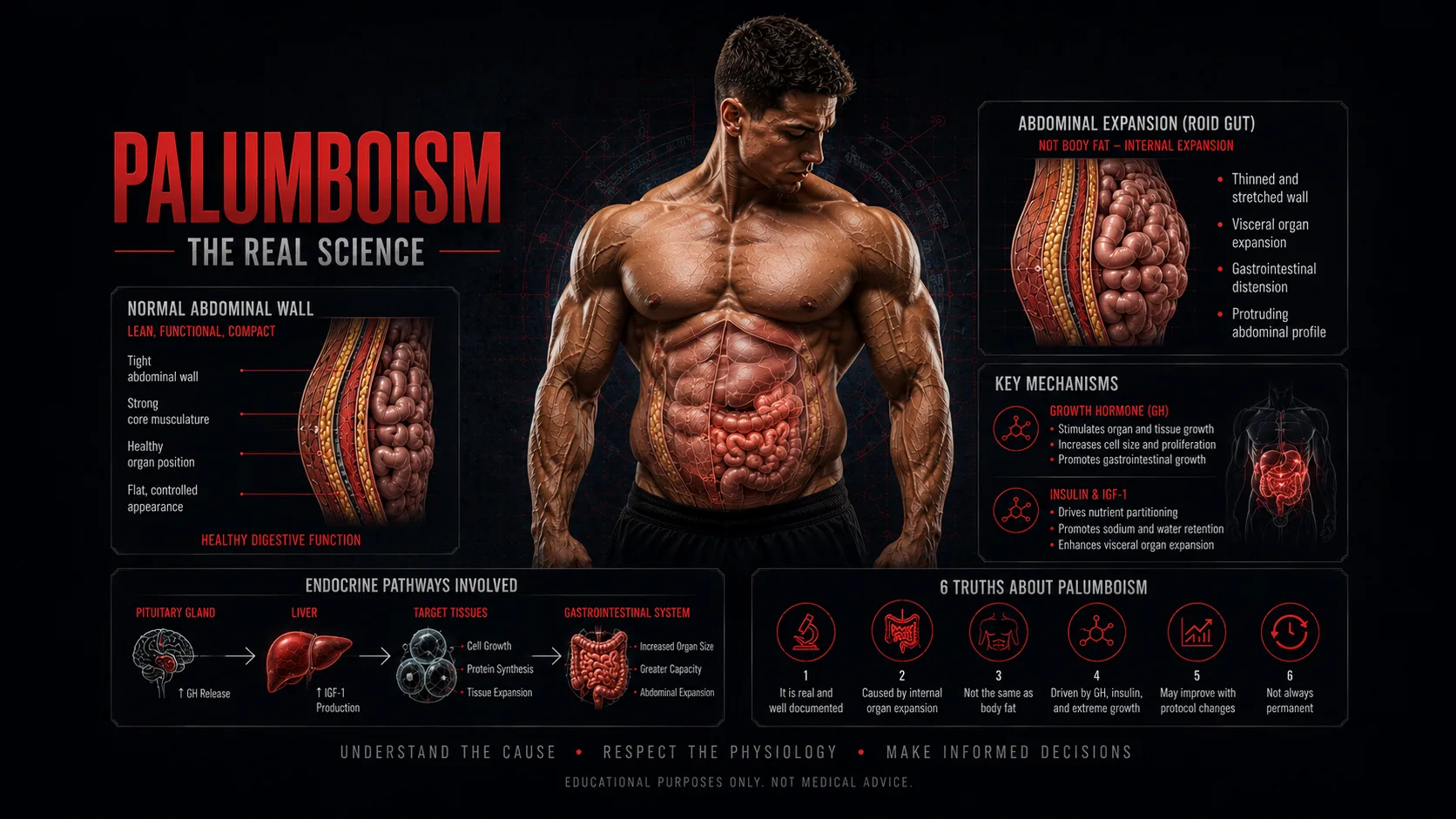
PALUMBOISM: WHAT GH GUT IS, 18 STUDIES
Palumboism is the distended, lean midsection seen on some of the largest bodybuilders, also called roid gut, bubble gut or HGH gut. No study has measured palumboism itself. What has been measured is what growth hormone excess does to the bowel, to body water and to fat. That is what this page uses (PMID 15730414, 15807876).
This guide uses 18 PubMed papers. It covers what palumboism is and the gut findings in growth hormone excess. It then covers the water and fat trials, insulin and food volume, how to tell it from bloat and fat, and whether it reverses. More side effects sit on the PED side effects hub.
Palumboism in three numbers
Palumboism has no trial of its own. The three figures below come from the closest measured data. One source is patients with growth hormone excess, the other is healthy adults given high dose growth hormone under placebo control.
GH excess vs controls
Total large bowel length was 20 percent longer in 25 acromegaly patients than in 41 controls (PMID 15730414).
Elongated colon, 107 patients
Dolichocolon was found in 34 percent of acromegaly patients, odds ratio 12.4 against matched controls (PMID 20215398).
Extracellular, one month of GH
Extracellular water rose 9.6 percent in 20 healthy adults on supraphysiological GH (PMID 15807876).
Study figures come from the 18 PubMed papers in the sources list. Where the link from acromegaly or trial data to a bodybuilder on stage is an inference, the text says so.
What this guide covers
What palumboism is and why the name exists, with the terms people search: roid gut, bubble gut, HGH gut, steroid gut.
What growth hormone excess does to the gut, water and fat, from acromegaly studies and placebo controlled GH trials (PMID 15730414, 15807876, 18940879).
Insulin and food volume, what is measured and what is assumed, how to tell palumboism from bloat and fat, and whether it reverses.
Not covered
Protocols. No doses, no stacks, no timing. The GH doses in the cited trials are quoted as study conditions, not as a plan.
Prednisone belly. Corticosteroids change fat distribution by a different route and are a prescription decision.
What palumboism actually is
Palumboism describes a midsection that stays pushed out and round on a physique that is otherwise lean and heavily muscled. The abdominal wall is visible, body fat is low, and the belly still protrudes. The name comes from a pro bodybuilder of the 1990s whose photographs made the look famous.
Gym language has several names for the same thing: roid gut, bubble gut, HGH gut, GH gut, steroid gut and HGH belly. They all point at one picture, so this page treats them as one subject and calls it palumboism.
Palumboism is a look, not a diagnosis. There is no laboratory test for it, no imaging study of competitors with it, and no trial that produced it on purpose. That matters, because most of what is written about roid gut is inference, and this page labels inference as inference.
What is agreed is the context. Palumboism appears in people using growth hormone at the far end of the range, usually alongside anabolic steroids and insulin. Add the food intake needed to hold a very large body (PMID 18376417, 24423981).
The useful question is not what to call it. It is which of the three suspects, growth hormone, insulin and food volume, has measurements behind it. Growth hormone does, and that is where the next section starts.
What growth hormone excess does to the gut
The closest thing to a human experiment on palumboism is acromegaly, the disease of growth hormone excess from a pituitary tumour. It is the model the pharmacology literature uses for GH abuse in sport (PMID 18376417).
The bowel grows. In 25 patients with acromegaly undergoing colonoscopy, total large bowel length was 20 percent longer than in 41 controls. The confidence interval was 9 to 31 percent (PMID 15730414).
The same study found more complex pelvic loops in the acromegaly group, 5 of 25 against 1 of 41. Reaching the caecum took longer too (PMID 15730414).
A larger case control study screened 107 patients and 214 matched controls. Dolichocolon, an abnormally long colon, was present in 34 percent of patients, with an odds ratio of 12.4. Colonic diverticula were present in 37 percent, odds ratio 3.6 (PMID 20215398).
Dolichocolon and polyps tracked IGF-I concentration at diagnosis. The authors read this as an irreversible effect of GH or IGF-I on collagen in the colon. The known effects on joints and heart valves work the same way (PMID 20215398).
The gut also slows. Orocecal transit time was 170 minutes in 41 acromegaly patients against 107 minutes in 30 controls. Small intestinal bacterial overgrowth was present in 18 of 41 patients against 1 of 30 (PMID 17405840).
Transit stayed slow whether or not the disease was controlled. The authors read that as a change that does not undo itself once established (PMID 17405840).
A longer colon, slower transit and more gas forming bacteria describe a bowel that holds more and empties more slowly. That is a measured chain in acromegaly. Applying it to a bodybuilder on exogenous GH is an inference, and a reasonable one, since the hormone and the receptor are the same.
Growth hormone and water: the part that is measured in healthy people
Acromegaly takes years. Palumboism can appear within one contest season, so the short term effects of growth hormone in healthy people matter too. Those have been measured under placebo control.
Thirty healthy, active adults aged 18 to 35 were randomised to placebo or one of two supraphysiological GH doses for one month. In the 20 on GH, IGF-I rose 134 percent, body weight 2.7 percent and fat free mass 5.3 percent (PMID 15807876).
The fat free mass gain was water. Total body water rose 6.5 percent and extracellular water 9.6 percent, while intracellular water did not change. Body fat fell 6.6 percent. Fluid retention symptoms occurred in the majority of participants (PMID 15807876).
A systematic review of 27 study samples, 303 participants on GH, found lean body mass up 2.1 kg. Strength and exercise capacity did not improve. GH treated participants had more soft tissue oedema and fatigue (PMID 18347346).
A later meta-analysis of 11 placebo controlled trials, 254 subjects, found the same pattern. More lean mass, less fat mass, no improvement in muscle strength or maximum oxygen uptake (PMID 28514721).
In adults with obesity, GH therapy raised the odds of peripheral oedema five fold and of arthralgia six fold across the pooled trials (PMID 18940879).
Extracellular water sits between cells and in the gut wall, not inside muscle fibres. Where the extra litre goes in a very large man who eats constantly is not measured, but the abdomen is a large compartment.
The fat paradox: GH removes belly fat, so roid gut is not fat
A common explanation for palumboism is that the drugs add fat around the organs. The growth hormone data say the opposite, and that is the single most useful fact for telling a bubble gut from a fat belly.
In abdominally obese men, nine months of GH treatment reduced visceral adipose tissue by 18.1 percent and total body fat by 9.2 percent. Insulin sensitivity was better by the end (PMID 9062473).
A meta-analysis of GH trials in obese adults found visceral adipose area down 22.8 square centimetres and fat mass down 0.9 kg. Lean mass was up 1.8 kg (PMID 18940879).
In active acromegaly, visceral and subcutaneous fat were lower than predicted, and both increased after surgery removed the GH excess. The authors called it a lipodystrophy of reduced central fat storage (PMID 26037515).
GH drives lipolysis and raises free fatty acid flux, which is also why it causes insulin resistance (PMID 19240267). A hormone that strips visceral fat cannot be adding visceral fat at the same time.
So the protruding midsection in palumboism is not a fat depot. The candidates left are extracellular water, a longer and slower bowel, its contents, and the organs behind the wall. Only the first two have measurements.
Insulin and food volume: measured or assumed?
Insulin is the second suspect in every palumboism explanation. It is used alongside GH in sport because GH raises blood glucose and insulin counters that while driving nutrients into muscle (PMID 18376417, 19240267).
How common the stack is has been measured. In a survey of 500 anabolic steroid users, 25 percent admitted adjuvant use of growth hormone and insulin (PMID 16679978).
In 92 recreational bodybuilders studied in 2024, 43 percent regularly used hormones. Among them, 95 percent used anabolic steroids, 30 percent added GH and 38 percent added insulin (PMID 38536564).
That study measured blood, not waistlines. Insulin or GH users had lower HDL, higher transaminases, and a changed fatty acid profile in red cell membranes (PMID 38536564). Nothing in it links insulin to abdominal size.
The same applies to food volume. A competitor at 120 kg eats several times what an untrained man eats, and a longer, slower bowel holds more of it. That is arithmetic, not a study. No paper has weighed the gut contents of a bodybuilder.
Insulin has one more measured effect that matters here: at high doses it can cause profound hypoglycaemia, as can IGF-I (PMID 18376417). The Endocrine Society lists metabolic and endocrine harm among the documented consequences of this class of drug use (PMID 24423981).
| Suspect | What is measured | Status |
|---|---|---|
| Growth hormone, bowel | Bowel 20% longer, dolichocolon 34%, transit 170 vs 107 min in acromegaly | Measured in GH excess |
| Growth hormone, water | Extracellular water up 9.6% in one month in healthy adults | Measured, placebo controlled |
| Growth hormone, fat | Visceral fat down 18.1% in obese men, down 22.8 cm² in meta-analysis | Measured, rules fat out |
| Insulin | Use prevalence 25% to 38%; lipid and liver changes | Use measured, gut effect assumed |
| Food volume | None | Assumed |
| Palumboism itself | None | No study |
Sources for the table: PMID 15730414, 20215398, 17405840, 15807876, 9062473, 18940879, 16679978, 38536564.
Palumboism vs bloat vs body fat
Three things make a midsection stick out, and they behave differently over a day, a week and a diet. The differences are the practical test, because no lab test exists.
Body fat is soft, pinchable, and matches the rest of the body. It goes down with a calorie deficit over weeks. GH lowers it rather than raising it (PMID 9062473).
Water bloat changes within days. It follows sodium, carbohydrate and the drugs that hold extracellular water. Supraphysiological GH raised extracellular water 9.6 percent in a month, and steroid water retention covers the rest of the list (PMID 15807876).
Palumboism is the distension that stays. It sits on a lean frame and it is hard rather than soft. It is worst after meals, and it does not follow a diet or a water cut. That pattern fits a bowel that is longer and slower, as measured in GH excess (PMID 15730414, 17405840).
| Feature | Body fat | Water bloat | Palumboism |
|---|---|---|---|
| Feel | Soft, pinchable | Soft, puffy | Hard, round |
| Rest of body | Also carries fat | Puffy face and ankles | Lean, visible abs |
| Time scale | Weeks of deficit | Days of sodium or drug change | Months, stays |
| Worst when | Always | High sodium, high carbs | After large meals |
| Responds to | Calorie deficit | Lower sodium, stopping the drug | Stopping GH, slowly |
Fat and water rows from PMID 9062473, 15807876. The palumboism column is the clinical pattern, not a study.
Is palumboism reversible?
Nobody has followed bodybuilders with palumboism off drugs, so the honest answer is built from what reversed and what did not in the GH literature.
Water reverses. The extracellular water gain in healthy adults came in one month and explained the fat free mass gain. It is the component expected to leave fastest after stopping (PMID 15807876).
Fat distribution reverses, in the other direction. After surgery for acromegaly, visceral and subcutaneous fat increased as GH fell. A former GH user may see a softer midsection rather than a flatter one (PMID 26037515).
The bowel may not reverse. Colonic diverticula and dolichocolon in acromegaly were read as an irreversible effect of GH on collagen. Slow transit persisted whether or not the disease was controlled (PMID 20215398, 17405840).
So palumboism probably has a reversible layer and a fixed layer. The water and the eating pattern are under the user's control. A colon that grew 20 percent longer is not (PMID 15730414).
The same irreversibility applies to other GH effects. GH excess changes the collagen of joints and cardiac valves (PMID 20215398, 14769829). The peptide side effects guide covers the GH secretagogue versions of the same risks.
Who gets roid gut and who does not
Palumboism is a pro level problem. Most people who search for it will never be near the drug exposure, body size or food intake involved. The prevalence data put that in proportion.
Among members of 92 fitness centres, performance enhancing drug use was 8.2 percent with a randomised response technique. Direct questioning gave 0.4 percent (PMID 24019293). GH use was a fraction of that.
Among people who do use anabolic steroids, 25 percent reported adding GH and insulin in one survey. In the 2024 bodybuilder cohort, 30 to 38 percent of hormone users did (PMID 16679978, 38536564).
Even within that group, the trial doses that raised extracellular water 9.6 percent were given for one month (PMID 15807876). The acromegaly bowel changes took years of exposure (PMID 15730414, 20215398).
Individual response varies too. In eight trained adults on GH, body composition change tracked the relative dose, and five of seven had suppressed endogenous GH afterwards (PMID 3170408). In eight bodybuilders using GH, dermal viscosity was raised while elasticity stayed normal (PMID 8864388).
Skin and connective tissue responding to GH is the same mechanism the colon studies describe. Whether a given person gets the gut version depends on dose, duration, body size and factors nobody has measured.
Five palumboism mistakes the sources rule out
Calling it visceral fat
GH lowered visceral fat 18.1 percent in obese men and 22.8 square centimetres in the pooled trials. The hard gut on a lean frame is not a fat depot (PMID 9062473, 18940879).
Expecting GH to build strength
Across 303 participants, GH added 2.1 kg lean mass and no strength. In the one month trial the lean mass gain was water (PMID 18347346, 15807876).
Assuming it fully reverses
Dolichocolon and diverticula in GH excess were read as irreversible collagen effects, and slow transit persisted after disease control (PMID 20215398, 17405840).
Ranking the three causes
Only growth hormone has measurements. Insulin and food volume are assumed, so any percentage split between them is invented.
Treating the stack as low risk
The Endocrine Society statement lists metabolic, endocrine and cardiovascular harm, and GH and insulin add hypoglycaemia to the list (PMID 24423981, 18376417).
Verdict: palumboism in 18 studies
1. Palumboism has never been measured directly. Every number comes from GH excess or GH trials.
2. GH excess lengthens the bowel. 20 percent longer, dolichocolon in 34 percent (PMID 15730414, 20215398).
3. GH excess slows the bowel. Transit 170 vs 107 minutes, bacterial overgrowth in 44 percent (PMID 17405840).
4. High dose GH adds water within a month. Extracellular water up 9.6 percent in healthy adults (PMID 15807876).
5. GH removes visceral fat. Down 18.1 percent in obese men, so roid gut is not fat (PMID 9062473, 18940879).
6. GH does not add strength. 2.1 kg lean mass, no performance gain, more oedema (PMID 18347346, 28514721).
7. The stack is common among users. 25 percent add GH and insulin; 30 to 38 percent of hormone users (PMID 16679978, 38536564).
8. Insulin and food volume are assumed causes. Use is measured, the gut effect is not.
9. Part of it may be permanent. Colon collagen and transit changes did not reverse with disease control (PMID 20215398, 17405840).
10. Fat comes back when GH stops. Central fat rose after acromegaly surgery (PMID 26037515).
11. It is a pro level problem. PED use was 8.2 percent of gym members, GH a fraction of that (PMID 24019293).
12. The mechanism is the acromegaly mechanism. Same hormone, same receptor, same collagen targets (PMID 14769829, 18376417).
Palumboism: frequently asked questions
What is palumboism?
Palumboism is a hard, round, protruding midsection on an otherwise lean, muscular physique, named after a 1990s pro bodybuilder. It is a look, not a diagnosis, and no study has measured it directly.
What causes HGH gut?
The measured part is growth hormone. Bowel length was up 20 percent and dolichocolon present in 34 percent of acromegaly patients. Extracellular water rose 9.6 percent in one month of high dose GH in healthy adults (PMID 15730414, 20215398, 15807876).
Is roid gut just fat?
No. GH lowered visceral fat 18.1 percent in obese men and 22.8 square centimetres in a meta-analysis. The protrusion sits on a lean frame and is hard rather than soft (PMID 9062473, 18940879).
Does insulin cause bubble gut?
Insulin use is common in the stack, 25 to 38 percent of users in surveys, but no study links it to abdominal size. Its gut effect is assumed, not measured (PMID 16679978, 38536564).
Is palumboism reversible?
Partly. Extracellular water leaves in weeks. Colonic changes in GH excess were read as irreversible collagen effects, and slow transit persisted after disease control (PMID 15807876, 20215398, 17405840).
How do I tell palumboism from bloat?
Bloat is soft and changes within days with sodium and drugs. Palumboism is hard, stays for months, is worst after meals and does not follow a water cut (PMID 15807876).
Can you get GH gut from peptides?
GH secretagogues raise your own GH, so the direction is the same at a smaller scale. No study has measured gut size on them. The growth hormone peptides guide covers what they do.
Does growth hormone make you stronger?
Not in the trials. Across 303 participants GH added 2.1 kg lean mass and no strength, and in the one month trial the gain was water (PMID 18347346, 15807876).
Sources and further reading
Every figure on this page comes from one of the 18 papers below, checked against PubMed on 7 November 2026. Acromegaly and trial figures are labelled as such; nothing here measured palumboism directly. Reference links are dofollow to support open science.
Verified
Verified
Verified
Verified
Verified
Verified
Verified
Verified
Verified
Verified
Verified
Verified
Verified
Verified
Verified
Verified
Verified
Verified
Keep reading
Four pages that finish the job: the water question, the peptide version of GH, what the stack does to blood, and the other side effects.
Final Educational Note
This article is educational and is not medical advice. MuscleScience does not prescribe, sell or supply steroids, growth hormone or insulin and does not give cycle protocols. Non medical use of these drugs is illegal in many countries.
A midsection that is hard, painful or changing quickly needs a doctor, not a forum. More guides sit on the PED side effects hub. Read more on the about page and in the full disclaimer.