How Long to Rest Between Sets for Muscle Growth and Strength
HOW LONG TO REST BETWEEN SETS FOR MUSCLE GROWTH AND STRENGTH
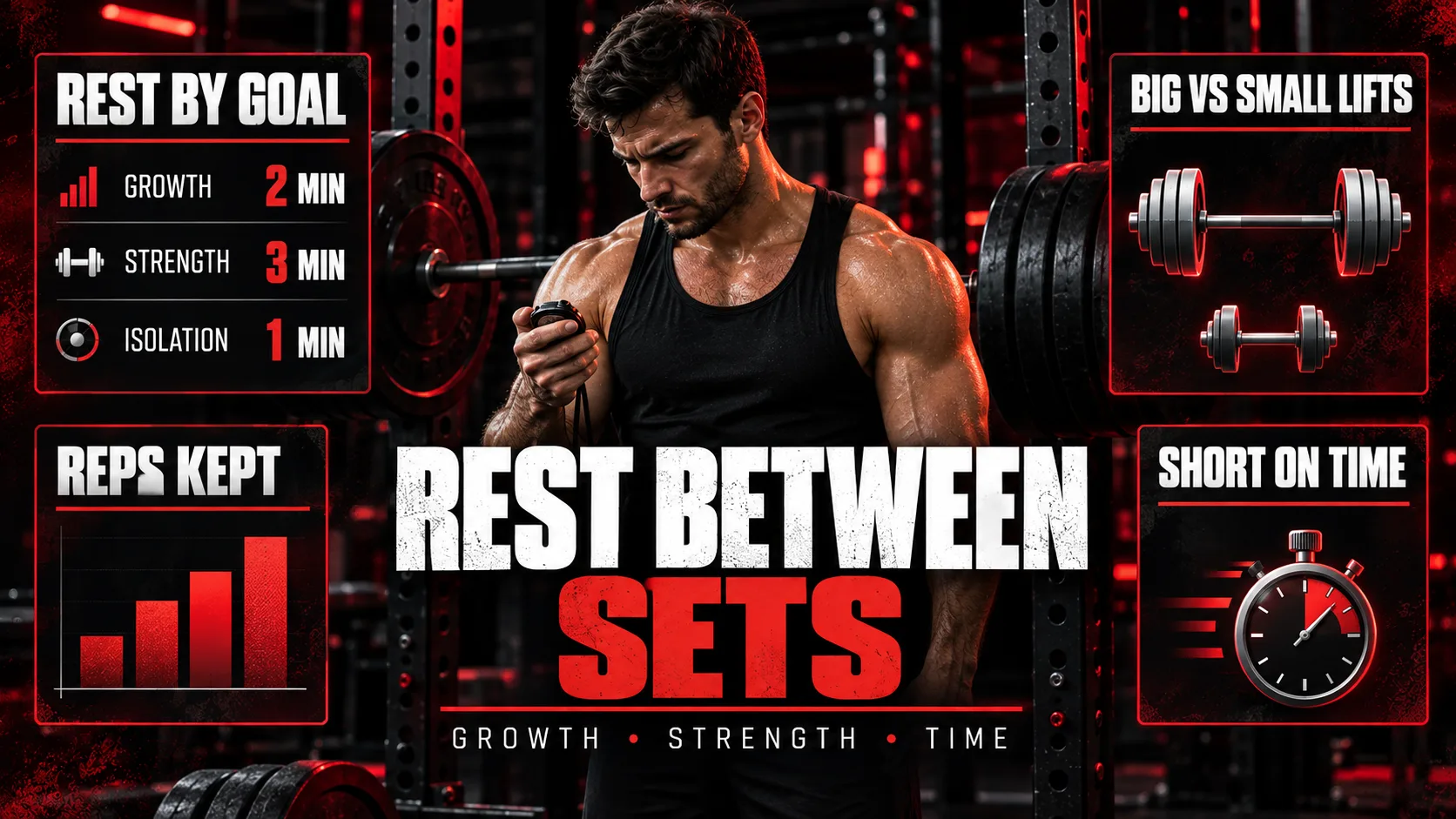
How long should you rest between sets? Most people guess, check their phone, and start again when they feel like it. The research gives a simpler answer than the gym myths. For muscle growth, rest at least a minute and a half; past that, more rest changes little (PMID 39205815). For heavy strength work on big lifts, two to three minutes or more. And when time is short, there are smart ways to rest less without losing the work.
This page explains rest time between sets the way a coach would, in plain words. Why rest matters at all, how long to rest for growth and for strength, why squats need more rest than curls, and what to do when you are short on time. Every number comes from a PubMed abstract listed at the end. How many sets to do sits on training volume explained.
Rest between sets in brief
Three numbers sum up the research on rest between sets. Where the benefit stops, how many reps longer rest saves, and what short rest does inside the muscle.
Past this point, longer rest made no clear difference to muscle growth
A 2024 review pooled 9 studies. Resting more than 60 seconds gave a small edge for growth. Past 90 seconds, the extra rest showed no clear benefit (PMID 39205815).
More bench press reps over 5 heavy sets with 5 minutes of rest instead of 1
Trained men did 12.9 reps in total with 5 minutes of rest and 7.6 reps with 1 minute, using the same weight (PMID 26907842). Short rest steals reps from the next set.
Muscle building rate after a workout with 5 minutes of rest, compared with 1 minute
Four hours after leg training, muscle protein building rose 152 percent with 5 minute rests and 76 percent with 1 minute rests (PMID 27126459).
Every figure on this page comes from a PubMed abstract listed at the end. The rest plan near the end is a coaching rule of thumb built from those studies, and it is labelled as such.
What this guide covers
How long to rest between sets for muscle growth and for strength, with the studies behind each answer.
Why rest matters: the reps you keep, and what short rest does inside the muscle.
Big lifts and small lifts, and why a squat needs more rest than a curl.
Short on time: supersets, paired sets and resting by feel.
A simple rest plan you can use in your next workout.
Not covered
Rest between workouts. How many days to leave between sessions sits on recovery and fatigue.
Cardio intervals. Rest in running or cycling intervals follows different rules.
How long should you rest between sets? The short answer
Here is the answer in one table. The rest of the page explains where each line comes from.
| Your goal | Rest between sets | What the studies found |
|---|---|---|
| Muscle growth | At least 90 seconds; 2 to 3 minutes is fine | A small edge above 60 seconds and no clear gain past 90 (PMID 39205815) |
| Strength, trained lifter | More than 2 minutes | Longer rest needed to get the most strength (PMID 28933024) |
| Strength, beginner | 1 to 2 minutes | Short to moderate rest was enough (PMID 28933024) |
| Heavy compound lift (bench, squat) | 3 to 5 minutes | Reps held up best with 3 to 5 minutes (PMID 26907842) |
| Small isolation lift (fly, curl) | About 2 minutes | 2 minutes was enough on the chest fly (PMID 26907842) |
| Short on time | Pair exercises or rest by feel | Supersets roughly halve session time (PMID 34125411) |
Notice what is missing: there is no magic 60 seconds for muscle growth. That old advice came from hormone spikes, and the hormone spikes turned out not to matter much. More on that in the myth section.
Why rest between sets matters: the reps you keep
Rest is not wasted time. During rest your muscles refill their fast energy store and clear some of the fatigue from the last set. Cut rest short and you start the next set tired, so you get fewer reps with the same weight.
The chart shows how big that effect is. Fifteen trained men did 5 heavy sets of bench press, resting 1, 2, 3 or 5 minutes on different days. With 1 minute of rest they managed 7.6 reps in total. With 5 minutes they managed 12.9 (PMID 26907842).
An older study found the same thing with squats and bench press over 4 sets of 8. Five minutes of rest gave the most total reps, then 2 minutes, then 1 minute (PMID 15705039). Another found 3 minutes beat 90 seconds on bench press reps, speed and fatigue (PMID 24665790).

Rest between sets for muscle growth
How long to rest between sets for hypertrophy, the scientific word for muscle growth? For years the gym rule was 30 to 60 seconds. The best evidence now says that rule is too short.
The biggest analysis so far pooled 9 studies and 19 measurements of muscle size. Both short and long rest built muscle. Resting more than 60 seconds gave a small edge. Past 90 seconds, the analysis found no clear extra gain. Going to failure or stopping short did not change the picture (PMID 39205815).
One well known trial tested 1 minute against 3 minutes in trained men. They did 3 sets of 8 to 12 reps on 7 exercises, three times a week for 8 weeks. The 3 minute group gained more front thigh muscle and more strength on squat and bench press (PMID 26605807).
Why would rest change muscle growth? Mostly through the work you get done. A 2022 study gave each leg of 28 people a different plan for 10 weeks. The second chart shows the result.
Long rest grew the thigh 13.1 percent and short rest 6.8 percent. But when short rest got extra sets to match the work of long rest, it grew 12.9 percent. When long rest was held down to the work of short rest, it grew only 6.6 percent (PMID 35622106). The workload decided growth, not the clock.
Short rest can still work in one setting: light weights for many reps. In one study, 30 second rests with 20 rep sets grew the arm 9.93 percent in 8 weeks. Three minute rests with 8 rep sets grew it 4.73 percent, with the work matched (PMID 28032435). It was a small study, so treat it as a possibility, not a rule.
Rest between sets for strength
Strength is about lifting heavy weights well. Tired muscles cannot do that, so strength training needs more rest.
A review of 23 studies and 491 people looked at rest and strength gains. Even short rests under 60 seconds built strength. But trained lifters needed more than 2 minutes to get the most out of it. Beginners did fine with 1 to 2 minutes (PMID 28933024).
An earlier review of 35 studies reached a similar answer. With loads from 50 to 90 percent of a one rep max, 3 to 5 minutes allowed more reps over several sets. Over time, that rest gave bigger strength gains (PMID 19691365).
Resting by feel also works for strength. Thirty three trained men either rested 75 seconds or chose their own rest for 8 weeks. Both got stronger by similar amounts, about 6 to 8 percent. The fixed rest group finished their workouts 37 percent faster (PMID 32826830).
Big lifts need more rest than small ones
A squat works your legs, hips and back at once. A curl works one muscle. It makes sense that the squat needs more recovery, and the research agrees.
In the bench press study, trained men also did a machine chest fly with the same 5 heavy sets. On the fly, 2 minutes of rest was enough to keep reps up. On the bench press, they needed 3 to 5 minutes. With 1 minute of rest, their reps started dropping from the second set (PMID 26907842).
| Rest | Bench press reps | Chest fly reps |
|---|---|---|
| 1 minute | 7.6 | 10.3 |
| 2 minutes | 9.5 | 12.6 |
| 3 minutes | 11.7 | 13.7 |
| 5 minutes | 12.9 | Not clear in the abstract |
Compare the columns. From 2 to 3 minutes of rest, the fly gained about one rep while the bench press gained more than two. The bench press kept improving up to 5 minutes. Big lifts with heavy loads are where long rest pays off most.
Short on time? Rest less without losing the work
Long rest makes workouts longer. If you only have 45 minutes, there are better options than cutting every rest to 30 seconds.
Supersets and paired sets. Do a set of one exercise, then a set of another that uses different muscles, then rest. A review found supersets, drop sets and rest pause sets roughly halve training time while keeping volume (PMID 34125411). In one study, trained men alternated bench pulls with bench presses. In the same 10 minutes they kept more total work than doing one exercise at a time (PMID 20847705).
There is a cost. Tri sets felt harder. Supersets and tri sets raised a muscle damage marker and left jump performance lower the next day (PMID 28698987). The review also notes these methods are probably better for size than for strength (PMID 34125411).
Rest by feel. Experienced lifters who chose their own rest did as many reps as with a fixed 2 minutes, and spent less time resting (PMID 27050709). Start the next set when your breathing has settled and you feel ready to match your last set.
The hormone myth behind short rest
Where did 30 to 60 seconds of rest for growth come from? From hormones. Short rest makes growth hormone spike after a workout, and people assumed a bigger spike meant more muscle. A 2009 review still suggested 30 to 60 second rests for growth for this reason (PMID 19691365).
Later studies tested that idea directly. In one, growth hormone rose by about 7,700 percent after a short rest workout. Yet the spike did not track with how much muscle people built (PMID 28032435).
Another study took muscle samples. One minute rests raised testosterone in the blood after training. But the rise in muscle building over the first 4 hours was half as big as with 5 minute rests (PMID 27126459).
A simple rest plan for your next workout
Here is a rest plan that puts the studies above into practice. It is a coaching rule of thumb, not a prescription from a single study. Adjust it to how you feel.
| Exercise type | Examples | Rest | Why |
|---|---|---|---|
| Heavy compound, 1 to 6 reps | Squat, bench press, deadlift | 3 to 5 minutes | Reps held up best (PMID 26907842); trained lifters need 2+ min for strength (PMID 28933024) |
| Compound, 6 to 12 reps | Rows, presses, lunges | 2 to 3 minutes | No clear growth gain past 90 seconds (PMID 39205815) |
| Isolation, 8 to 15 reps | Curls, raises, flyes | 1 to 2 minutes | 2 minutes was enough on the fly (PMID 26907842) |
| Light sets, 15 to 25 reps | Machines, cables | 30 seconds to 1 minute | Short rest worked with light loads in one study (PMID 28032435) |
| Paired sets | Push plus pull | Rest after each pair | Keeps work and saves time (PMID 20847705) |
One simple test helps. If your reps drop by more than two from one set to the next with the same weight, you probably rested too little. Add 30 to 60 seconds and see if the reps hold. This is a rule of thumb, not a tested cut off.
5 mistakes people make with rest between sets
1. Resting 30 seconds on heavy sets "for growth". Short rest cuts reps on heavy sets (PMID 26907842), and lost reps mean less growth (PMID 35622106).
2. Chasing the pump or the hormone spike. Short rest raised hormones, but the rise in muscle building was half as big over the first hours (PMID 27126459).
3. Using the same rest for every exercise. Big lifts need more rest than small ones (PMID 26907842).
4. Treating long rest as lazy. Three minute rests built more muscle and strength than one minute rests in trained men (PMID 26605807).
5. Scrolling until you forget the set. Ten minutes is not needed. No clear growth gain showed up past 90 seconds (PMID 39205815), and a long session costs time you could spend on one more set.
Verdict: rest long enough to keep your reps
So how long should you rest between sets? For muscle growth, about 90 seconds to 3 minutes; past 90 seconds the extra rest showed no clear benefit (PMID 39205815). For strength, more than 2 minutes for trained lifters (PMID 28933024), and 3 to 5 minutes on heavy compound lifts (PMID 26907842). The old 30 to 60 second rule came from hormone spikes that did not predict growth (PMID 28032435, PMID 27126459).
The rule underneath it all is simple: rest long enough to keep your reps, and use supersets when you are short on time. Pair this page with training volume, progressive overload and what builds muscle for the full picture.
Rest between sets: frequently asked questions
How long should you rest between sets?
Rest time between sets for muscle growth: about 90 seconds to 3 minutes. A 2024 review of 9 studies found a small benefit above 60 seconds and no clear extra gain past 90 seconds (PMID 39205815). For strength, trained lifters need more than 2 minutes (PMID 28933024). Heavy bench press reps held up best with 3 to 5 minutes (PMID 26907842).
How long to rest between sets for muscle growth?
Rest at least 60 to 90 seconds, and longer if your reps drop. Growth followed the total work done. Short rest with extra sets grew the thigh 12.9 percent, close to long rest at 13.1 percent (PMID 35622106).
Is 3 minutes of rest between sets too much?
No. In trained men, 3 minute rests built more thigh muscle and more strength than 1 minute rests over 8 weeks (PMID 26605807). For heavy compound lifts, 3 to 5 minutes kept the most reps (PMID 26907842). It only costs time.
Is 30 seconds of rest between sets enough?
For heavy sets, usually not. Bench press reps fell from 12.9 to 7.6 over 5 sets when rest dropped from 5 minutes to 1 (PMID 26907842). With light weights and 20 rep sets, 30 second rests did build muscle in one small study (PMID 28032435).
How long to rest between sets for strength?
More than 2 minutes if you are trained; 1 to 2 minutes is usually enough for beginners (PMID 28933024). A review of 35 studies found 3 to 5 minutes gave bigger strength gains. That held for loads of 50 to 90 percent of a one rep max (PMID 19691365).
Should I rest longer on squats than on curls?
Yes. On a machine chest fly, 2 minutes of rest kept reps up; on the bench press it took 3 to 5 minutes (PMID 26907842). Multi joint lifts like squats and presses need more recovery than single joint moves like curls.
Can I rest by feel instead of using a timer?
Yes, if you are experienced. Lifters who chose their own rest did as many reps as with a fixed 2 minutes and rested less (PMID 27050709). Over 8 weeks, self chosen and fixed 75 second rests gave similar strength gains (PMID 32826830).
Do supersets work if I am short on time?
Yes. Supersets, drop sets and rest pause sets roughly halve training time while keeping volume, though they are probably better for size than strength (PMID 34125411). Pairing a pull with a push kept more total work in the same time (PMID 20847705).
Sources and further reading
Every figure on this page about rest between sets comes from one of the 16 papers below. Each was checked against its PubMed abstract on 25 October 2026. The rest plan and the two rep drop test are coaching rules of thumb and are labelled as such in the text. Reference links are dofollow to support open science.
Verified
Verified
Verified
Verified
Verified
Verified
Verified
Verified
Verified
Verified
Verified
Verified
Verified
Verified
Verified
Verified
Keep reading
Four pages from the training series: how many sets a week, how to keep progressing, how to recover, and how to lay out your week.
Final Educational Note
This article is educational and is not medical advice or a personal training prescription. It reports what trials and reviews found about rest between sets in healthy adults. The rest plan is a rule of thumb built from those studies. If you have a heart condition, high blood pressure or an injury, ask your doctor how hard and how long you should train. More guides sit on the training hub.
Read more about how this site works on the about page and in the full disclaimer.