Deadlift 1RM
Calculator
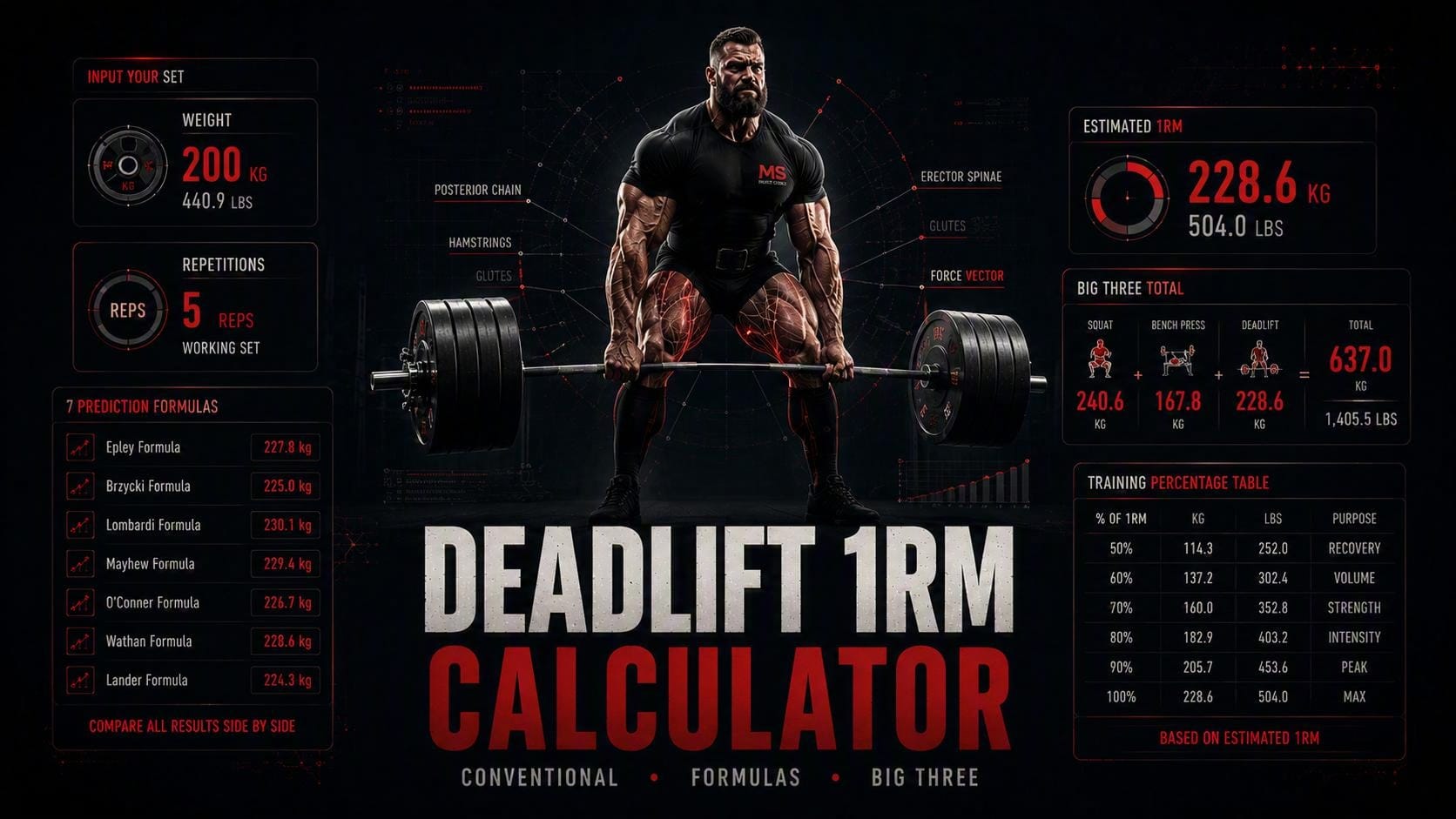
Calculate your conventional deadlift one-rep maximum from a working set weight and rep count. Seven validated prediction formulas compared side by side with a Big Three powerlifting total when combined with your bench and squat results.
Estimate your deadlift one-rep max from a set you’ve hit, then read off training loads for every intensity. Averaged over seven validated formulas. Drag the sliders to update live.
Weight you pulled (kg)
Reps to failure (1-15)
Enter a weight and rep count to estimate your 1RM and training loads.
Averages Epley, Brzycki, Lander, Lombardi, Mayhew, O’Conner and Wathan. A 1RM estimate is only as honest as the set behind it - a hard set of 3-8 reps predicts best. Warm up and use a spotter before testing near-maximal loads.
What This Deadlift 1RM Calculator Computes
This deadlift 1RM calculator estimates your conventional deadlift one-rep maximum from a submaximal working set. Enter the weight lifted and reps completed - the calculator applies seven validated prediction formulas and displays each result, the seven-formula average, ready-to-use training load percentages, and an optional Big Three powerlifting total when bench and squat 1RMs are provided.
The deadlift is the most accurately predicted of the Big Three lifts by submaximal equations - partly because the movement has fewer technique variables than the squat and less equipment influence than the bench press. For bench press 1RM: Bench Press 1RM Calculator. For squat 1RM: Squat 1RM Calculator. For strength programming principles: Progressive Overload Explained.
Seven 1RM Prediction Formulas for the Deadlift
The seven formulas used in this calculator were originally validated across the Big Three lifts - bench press, squat, and deadlift. LeSuer et al. (1997) compared all seven against actual 1RM performance and found that no single formula was consistently most accurate across all three lifts and all rep ranges. Using multiple formulas and averaging reduces the effect of individual formula biases.
| Formula | Equation | Notes |
|---|---|---|
| Epley | W × (1 + R/30) | Default recommendation. Linear, widely validated. |
| Brzycki | W × 36/(37−R) | Best accuracy at 1-6 reps. Degrades above 10 reps. |
| Lombardi | W × R0.10 | Conservative power function. Lower estimates at high reps. |
| Mayhew | 100×W / (52.2 + 41.9×e−0.055R) | Exponential model. Derived from athletic populations. |
| O’Conner | W × (1 + 0.025×R) | Linear, slightly conservative. Close to Epley at low reps. |
| Wathen | 100×W / (48.8 + 53.8×e−0.075R) | Exponential. Common in conditioning. Similar to Mayhew. |
| Lander | 100×W / (101.3 − 2.67×R) | Linear denominator. Reliable in moderate rep ranges. |
Deadlift 1RM in Strength Programming
Training Load Percentages
Standard deadlift loading zones: 90-95% for heavy singles and peaking work (1-3 reps), 80-87% for primary strength development (3-5 reps), 70-79% for volume accumulation and technique refinement (5-8 reps), 60-69% for speed work, technique sessions, and deloads. The calculator outputs training percentages at 70%, 80%, 85%, and 90% automatically. Round to the nearest 2.5kg or 5lb plate increment available.
Big Three Total
The Big Three powerlifting total - squat + bench press + deadlift - is the primary performance metric in raw powerlifting competition. Enter your bench and squat 1RMs into the optional fields above to calculate your combined total. For reference: an intermediate raw lifter (male, 83kg class) typically totals 450-550kg. Advanced competitors in the same class total 600-700kg. Elite open-level lifters exceed 750kg in this weight class.
Deadlift Frequency and Volume
The deadlift is the most neurally demanding of the Big Three and recovers more slowly than the squat or bench press - particularly for the lower back extensors and grip. Most intermediate lifters program the deadlift once or twice per week at high intensity, with total weekly volume lower than squat or bench volume. Attempting to increase deadlift frequency without adequate recovery produces accumulated fatigue rather than strength progress. For volume and recovery context: Training Volume Explained.
Conventional vs Sumo - Does Variation Affect the Estimate?
The seven prediction formulas do not distinguish between conventional and sumo deadlift. Both use the same weight-and-reps input. The formulas estimate 1RM for whichever variation you performed your working set in - they make no assumptions about stance. Do not mix results: if your working set was sumo, the estimated 1RM applies to sumo. If you compete in conventional, test your 1RM with a conventional working set.
Most lifters who are proficient in both stances find a 5-15% difference in 1RM between conventional and sumo, depending on individual leverages, hip structure, and training history. Neither variation is inherently stronger - the advantage depends on the individual. Use the variation you intend to compete in or primarily train for consistent tracking.
Romanian Deadlift (RDL) and Trap Bar
The formulas in this calculator are validated for the conventional and sumo deadlift performed from the floor. Applying them to Romanian deadlift, stiff-leg deadlift, or trap bar deadlift will produce estimates that do not reflect your conventional deadlift capacity. These variations use different ranges of motion, muscle recruitment patterns, and load distributions. Always use a floor deadlift working set for 1RM estimation.
References
- LeSuer DA, McCormick JH, Mayhew JL, Wasserstein RL, Arnold MD. (1997). The Accuracy of Prediction Equations for Estimating 1-RM Performance in the Bench Press, Squat, and Deadlift. Journal of Strength and Conditioning Research.
- Banyard HG, Nosaka K, Haff GG. (2017). Reliability and Validity of the Load-Velocity Relationship to Predict the 1RM Back Squat. Journal of Strength and Conditioning Research. PMID: 27669192.
- Macarilla CT, et al. (2022). Accuracy of Predicting One-Repetition Maximum from Submaximal Velocity in the Barbell Back Squat. Journal of Human Kinetics.
- Brzycki M. (1993). Strength Testing-Predicting a One-Rep Max from Reps-to-Fatigue. Journal of Physical Education, Recreation & Dance.
Deadlift 1RM Calculator - Key Takeaways
Use a 3-8 rep set at RPE 8-9 for the most reliable estimate. Apply the Epley formula result for programming, check against the seven-formula average. Add bench and squat 1RMs to see your Big Three total. Retest every 4-8 weeks as training loads increase.
Final Educational Note
1RM estimates are mathematical predictions. Actual performance varies with daily readiness, fatigue, nutrition, and sleep. Use the result as a programming reference point, not a performance expectation for any given session. Never attempt a true maximal single without proper warm-up, spotting where applicable, and full recovery from prior training.
Nothing on this page constitutes coaching or medical advice. See our Disclaimer.