Full Body Dumbbell Workout: Complete Program Guide
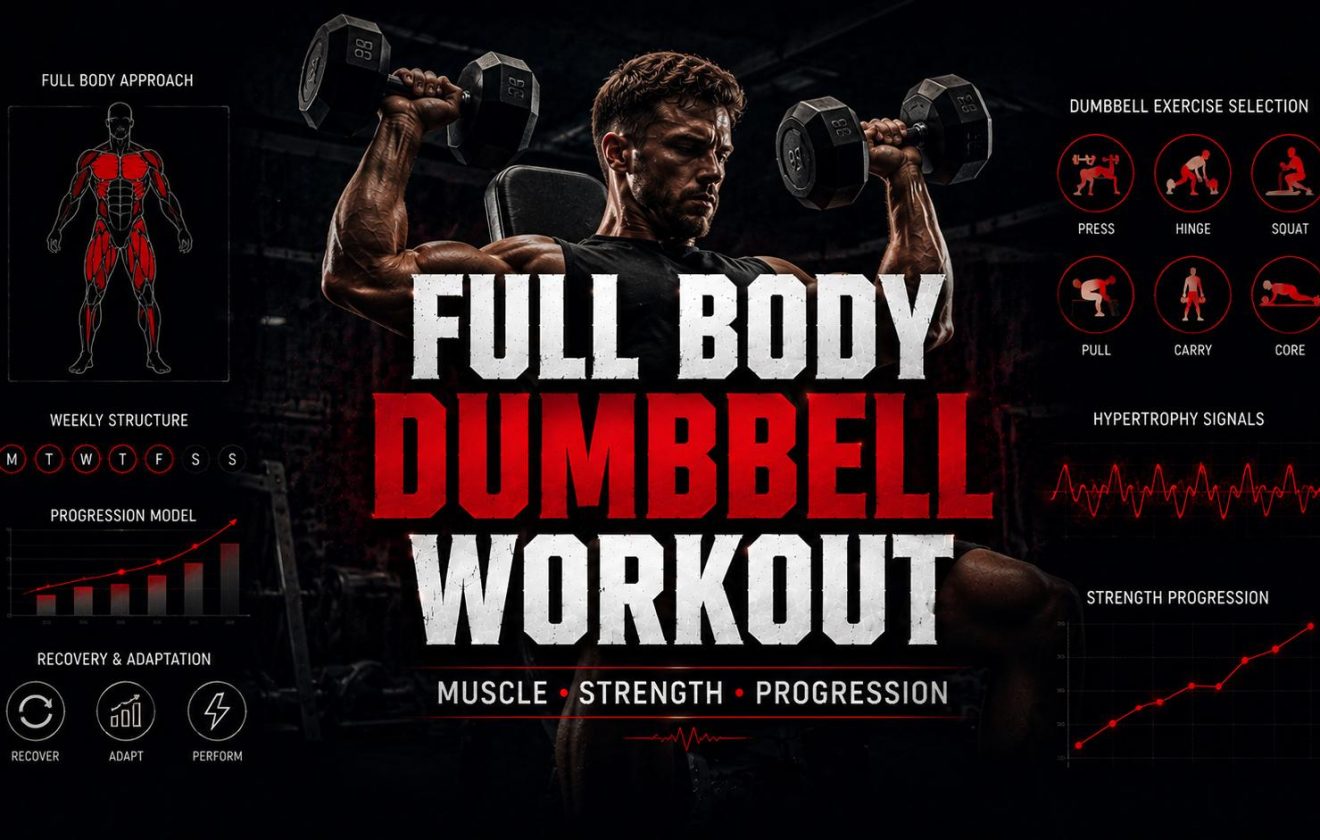
A full program with just dumbbells
A full body dumbbell workout builds genuine muscle and strength across all major muscle groups using nothing but a set of dumbbells - no barbell, no cables, no machines required. The full body dumbbell workout is not a compromise training format or a beginner-only approach: with correct exercise selection, progressive overload, and a structured program, a dumbbell-based full body session delivers the mechanical tension and metabolic stress needed to drive hypertrophy at beginner through intermediate level, and serves as an effective maintenance or travel program for advanced lifters.
This guide covers why a full body dumbbell workout works, the best dumbbell exercises by muscle group, complete 3-day and 4-day programs with sets, reps, and loading logic, progressive overload strategies for limited equipment, and the specific errors that cause dumbbell-based training to underdeliver. Whether you are training at home with a fixed set of dumbbells or in a commercial gym without access to barbells, this is the complete reference for building a productive full body dumbbell workout.
What a Full Body Dumbbell Workout Delivers
Real Hypertrophy With Minimal Equipment
A full body dumbbell workout delivers sufficient mechanical tension for muscle growth when programmed correctly. Dumbbell exercises allow full range of motion, natural joint tracking, and unilateral loading - stimuli that barbell-only programs do not always provide.
Every Muscle Group, Every Session
A properly structured full body dumbbell workout trains all major muscle groups in each session - chest, back, shoulders, arms, and legs - giving three or four weekly stimulation events per muscle group across a standard 3- or 4-day program.
Home, Gym, or Travel
The full body dumbbell workout requires only dumbbells and a bench or flat surface - making it the most accessible structured program for home training, hotel gyms, and any setup where a full barbell rack is not available.
What This Guide Covers
This is a complete reference for building and running a full body dumbbell workout program. It does not cover bodyweight-only training, resistance band programming, or barbell-based full body programs.
What You Will Learn
- Why a full body dumbbell workout produces real muscle growth
- Best dumbbell exercises for every major muscle group
- 3-day and 4-day full body dumbbell programs with sets and reps
- Progressive overload methods with fixed or limited dumbbell sets
- How to structure a full body dumbbell workout session
- Who benefits most from dumbbell-based full body training
- Common mistakes that reduce dumbbell program effectiveness
Outside This Article
- Barbell split programs - see 3-Day Workout Split
- 4-day barbell programs - see 4-Day Workout Split
- Progressive overload science - see Progressive Overload Explained
- Training volume fundamentals - see Training Volume Explained
- Calorie targets - see Calorie Calculator
Why a Full Body Dumbbell Workout Builds Muscle
Muscle growth requires three primary stimuli: mechanical tension from load, metabolic stress from repeated muscle contraction, and muscle damage from lengthened-position loading. A full body dumbbell workout can deliver all three. Dumbbells allow a longer range of motion than barbells on most exercises - particularly pressing and fly movements - which means greater stretch under load at the lengthened position. Research consistently identifies the stretched position as the most mechanically productive point of a repetition for hypertrophic stimulus.
The specific advantage of a full body dumbbell workout over split programs is frequency. Training every muscle group in each session - three or four times per week - provides multiple weekly stimulation events. Research by Schoenfeld, Ogborn, and Krieger (2016) confirmed that twice-weekly muscle stimulation significantly outperforms once-weekly in hypertrophy outcomes for most natural lifters. A 3-day full body dumbbell workout hits every muscle group three times per week, exceeding the minimum effective frequency threshold without requiring high per-session volume that creates excessive fatigue.
Unilateral Loading: The Structural Advantage of Dumbbells
Every dumbbell exercise is inherently unilateral - each limb works independently. This has two significant training effects. First, it eliminates side-to-side strength imbalances that develop over years of barbell training, where the dominant side compensates for the weaker side without the lifter realizing it. Second, unilateral loading increases the stabilizer demand on each rep - the rotator cuff, hip stabilizers, and core musculature work harder to control independent loads than they do during barbell movements where the bar itself provides lateral stability. A full body dumbbell workout builds this stabilizer strength as a byproduct of every session.
A full body dumbbell workout is not a limitation imposed by equipment - it is a training structure with specific advantages in range of motion, unilateral balance, and stabilizer development that barbell-only programs do not replicate.
Progressive Overload Without a Barbell
The most common concern about committing to a full body dumbbell workout is progressive overload - specifically, how to increase load when dumbbells come in fixed increments and the next available weight is a jump of 2 to 4 kilograms. The answer is rep progression before load progression: when you reach the top of your target rep range with a given dumbbell weight, add reps until you exceed the range by two to three reps, then move to the next dumbbell weight. This approach maintains progressive overload across weeks of a full body dumbbell workout without requiring fractional plates or microloading equipment. Full progression strategies are covered in the program section and in Progressive Overload Explained.
For the underlying science of what triggers muscle growth beyond the mechanics of loading, see What Builds Muscle. For how weekly volume targets apply to a full body dumbbell workout structure, see Training Volume Explained.
Best Dumbbell Exercises by Muscle Group
A full body dumbbell workout requires a core library of exercises that cover all major muscle groups with sufficient loading potential and range of motion. The following exercises are organized by muscle group and ranked by effectiveness within a dumbbell-only training context. Each section includes primary and secondary options so the full body dumbbell workout can be rotated without repeating identical sessions every training day.
Pressing and Fly Movements
- Dumbbell Bench Press - primary horizontal chest exercise; allows deeper bottom position than barbell
- Incline Dumbbell Press - upper chest emphasis; 30-45 degree incline optimal
- Dumbbell Fly - lengthened-position chest stimulus; best used as a finishing exercise at 3-4 sets of 12-15
- Decline Dumbbell Press - lower chest variant; useful for full chest development across a weekly full body dumbbell workout rotation
Rowing and Pulling Movements
- Dumbbell Row (Unilateral) - primary back exercise; chest-supported or knee-braced variant removes spinal load
- Chest-Supported Dumbbell Row - eliminates lower back fatigue; allows higher back-specific volume in a full body dumbbell workout
- Dumbbell Pullover - lat stretch under load; pairs well with pressing exercises in full body sessions
- Rear Delt Dumbbell Row - horizontal pull with elbow flared; targets upper back and rear delt simultaneously
Press and Raise Movements
- Dumbbell Overhead Press - primary shoulder compound; seated or standing, strict form required
- Dumbbell Lateral Raise - medial delt isolation; non-negotiable in any full body dumbbell workout for shoulder width
- Dumbbell Front Raise - anterior delt; useful when overhead pressing volume is low
- Bent-Over Rear Delt Raise - posterior delt; critical for shoulder balance and injury prevention
Squat, Hinge, and Lunge Patterns
- Goblet Squat - primary dumbbell squat pattern; single heavy dumbbell held at chest; excellent quad stimulus
- Dumbbell Romanian Deadlift - hamstring and glute hinge; easily loads to high intensity in a full body dumbbell workout
- Dumbbell Walking Lunge - unilateral quad and glute; high metabolic cost; excellent volume tool
- Bulgarian Split Squat - single-leg squat with rear foot elevated; highest quad and glute stimulus available in dumbbell-only training
- Dumbbell Step-Up - unilateral alternative when lunges are contraindicated; adjustable height changes emphasis
Curl and Extension Patterns
- Dumbbell Bicep Curl - standard supinating curl; full range of motion and independent arm loading
- Hammer Curl - neutral grip; targets brachialis and brachioradialis alongside bicep long head
- Incline Dumbbell Curl - shoulder behind hip; maximum bicep stretch under load; most productive curl variant in a full body dumbbell workout
- Overhead Dumbbell Triceps Extension - long head tricep stretch; highest tricep hypertrophy stimulus available with dumbbells
- Dumbbell Kickback - lateral and medial tricep head; best performed strict with full elbow extension at top
Loaded Abdominal and Stability Work
- Dumbbell Crunch / Weighted Crunch - dumbbell held at chest adds resistance to standard crunch
- Dumbbell Russian Twist - rotational core work; single dumbbell held with both hands
- Dumbbell Side Bend - oblique isolation; unilateral loading creates lateral flexion resistance
- Plank with Dumbbell Row - anti-rotation stability plus back work; high stabilizer demand per rep
Full Body Dumbbell Workout Programs: Complete Templates
The following full body dumbbell workout templates cover two training frequencies: a 3-day program for beginners and early intermediates, and a 4-day Upper/Lower dumbbell program for intermediates who need more weekly volume. All sets listed are working sets. Rest 90 to 120 seconds between compound sets, 60 seconds between isolation sets.
Full Body - Strength Focus
- Goblet Squat4 × 6-8
- Dumbbell Bench Press4 × 6-8
- Dumbbell Row (Unilateral)4 × 6-8 per side
- Dumbbell Romanian Deadlift3 × 8-10
- Overhead Dumbbell Press3 × 8-10
- Dumbbell Lateral Raise3 × 12-15
- Incline Dumbbell Curl3 × 10-12
- Overhead Triceps Extension3 × 10-12
Full Body - Volume Focus
- Bulgarian Split Squat3 × 10-12 per leg
- Incline Dumbbell Press4 × 10-12
- Chest-Supported DB Row4 × 10-12
- Walking Lunge3 × 10-12 per leg
- Dumbbell Lateral Raise3 × 15-20
- Bent-Over Rear Delt Raise3 × 15-20
- Hammer Curl3 × 12-15
- Dumbbell Kickback3 × 12-15
Full Body - Balanced
- Dumbbell Romanian Deadlift4 × 8-10
- Dumbbell Bench Press4 × 8-10
- Dumbbell Row (Unilateral)4 × 8-10 per side
- Goblet Squat3 × 12-15
- Dumbbell Overhead Press3 × 10-12
- Dumbbell Fly3 × 12-15
- Dumbbell Curl3 × 12-15
- Overhead Triceps Extension3 × 12-15
Upper A - Strength
- Dumbbell Bench Press4 × 6-8
- DB Row (Unilateral)4 × 6-8 per side
- Overhead DB Press3 × 8-10
- Chest-Supported DB Row3 × 8-10
- Lateral Raise3 × 12-15
- Incline Curl + OH Extension3 × 10 each
Lower A - Strength
- Bulgarian Split Squat4 × 6-8 per leg
- Romanian Deadlift4 × 6-8
- Goblet Squat3 × 10-12
- Walking Lunge3 × 10 per leg
- Dumbbell Step-Up3 × 10 per leg
- Calf Raise (DB)4 × 12-20
Upper B - Volume
- Incline DB Press4 × 10-12
- Chest-Supported Row4 × 10-12
- Overhead DB Press3 × 10-12
- DB Pullover3 × 12-15
- Rear Delt Raise + Lateral Raise3 × 15 each
- Hammer Curl + Kickback3 × 12 each
Lower B - Volume
- Romanian Deadlift4 × 8-10
- Goblet Squat4 × 10-12
- Walking Lunge3 × 12 per leg
- Bulgarian Split Squat3 × 10 per leg
- Leg Curl (Nordic/DB)3 × 10-12
- Seated Calf Raise (DB)4 × 15-20
6 Rules for a Productive Full Body Dumbbell Workout
A full body dumbbell workout follows the same fundamental programming rules as any resistance training program - with a few specific adjustments for the equipment constraints and session structure of dumbbell-based training.
Lead Every Session With a Compound Movement
Each full body dumbbell workout session must open with a compound movement - goblet squat, Romanian deadlift, dumbbell bench press, or dumbbell row. These exercises produce the most mechanical tension across the most muscle mass. Performing them first, before fatigue accumulates from isolation work, ensures the highest quality stimulus on the sets that matter most.
Use Rep Progression Before Load Progression
With fixed dumbbells, load jumps between weights are often 2 to 4 kilograms - too large to make safely on most exercises. The correct progression in a full body dumbbell workout is: add reps within the target range each session until you consistently exceed the top of that range by two to three reps, then move up to the next dumbbell weight. This keeps progressive overload continuous without unsafe load jumps.
Rotate Exercises Across Sessions
A 3-day full body dumbbell workout running three identical sessions provides less stimulus variety than three distinct sessions using different exercises for the same muscle groups. Use Day A, Day B, Day C rotation - for example, flat press on Day A, incline press on Day B, fly superset on Day C. This variation maintains session quality, prevents accommodation, and provides a broader hypertrophic stimulus across the week.
Control the Eccentric Phase on Every Rep
The eccentric (lowering) phase of each repetition is the highest-tension portion of the movement and the primary driver of muscle damage-related hypertrophy. In a full body dumbbell workout, where loads are often lower than barbell equivalents, controlling the eccentric for two to three seconds per rep compensates for lower absolute load by increasing time under tension and stimulus per rep. Rush the eccentric and you halve the effectiveness of every set.
Reach the Top of Your Rep Range With Effort
The most common error in a full body dumbbell workout is selecting weights that allow five to six reps in reserve at the end of each set. Each working set must end with one to three reps remaining before muscular failure - not eight. If you can complete every rep of every set in your full body dumbbell workout with energy to spare, the weight is too light. Adjust load or increase reps until the final reps are genuinely challenging.
Track Every Session
Progressive overload in a full body dumbbell workout is only possible when you know exactly what you lifted in the previous session. Record weight, reps, and sets for every exercise in every session. Without a training log, you are guessing - and guessing rarely leads to consistent progression. A simple training log, even a phone note, is the difference between a full body dumbbell workout that progresses and one that stagnates within six weeks.
Who Should Use a Full Body Dumbbell Workout
A full body dumbbell workout is appropriate for a wider range of lifters than it is commonly given credit for. The assumption that dumbbell training is only for beginners is incorrect - the limitation is equipment, not training stimulus.
Ideal Starting Point
For lifters starting from zero, a full body dumbbell workout provides sufficient stimulus to drive beginner-level linear progression across all muscle groups simultaneously. Three sessions per week hitting every major muscle group produces more total weekly stimulation events than any split program at the same frequency. Beginners do not need barbells to make exceptional early progress.
Equipment Constraint Solution
Lifters without gym access who own adjustable dumbbells or a set of fixed dumbbell pairs can run a structured full body dumbbell workout program that delivers genuine results. The key is owning dumbbells heavy enough to challenge major compound movements - particularly legs. Light dumbbells (under 20 kg per hand) limit lower body training significantly.
Maintenance and Continuity
Advanced lifters who travel frequently or lose gym access benefit significantly from having a structured full body dumbbell workout as a maintenance program. Three to four weeks of well-executed dumbbell training maintains most training adaptations and prevents the fitness decline that results from completely unstructured training during travel or facility transitions.
Common Mistakes in Full Body Dumbbell Workout Programming
Most failures in dumbbell-based training come from the same small set of errors. All of them are correctable with simple adjustments to program design or execution.
- Load Error Training With Weights That Are Too LightThe single most common failure in a full body dumbbell workout is selecting dumbbells that feel comfortable rather than challenging. Comfortable weights do not produce sufficient mechanical tension to drive hypertrophy. Every compound set in a full body dumbbell workout must end with one to three reps remaining before failure - not five or six. If you are completing every set feeling like you could do ten more reps, the stimulus is insufficient regardless of how many sets you do.
- Volume Error Running Identical Sessions Every Training DayA full body dumbbell workout that uses the same exercises, the same sets, and the same rep ranges in every session produces rapid accommodation. The nervous system learns the movement pattern quickly and reduces the stimulus required to complete it. Use an A/B/C rotation with different exercises covering the same muscle groups. Variety within a full body dumbbell workout is a training tool, not randomness.
- Structure Error Skipping Legs Because Dumbbells Feel InsufficientThe most frequently neglected area in a full body dumbbell workout is lower body training - specifically because the weights available often feel inadequate for squats and deadlifts. Bulgarian split squats and Romanian deadlifts with heavy dumbbells produce substantial leg stimulus. If goblet squats feel too easy at the heaviest available dumbbell, load the Bulgarian split squat and walking lunge instead - unilateral loading dramatically increases effective difficulty per rep.
- Progression Error Staying at the Same Weight for Weeks Because the Next Dumbbell Jump Feels Too LargeMoving from a 20 kg dumbbell to a 24 kg dumbbell on the bench press is a 20 percent load increase - far larger than the 2.5 to 5 percent weekly increments used on a barbell. The solution is not to avoid the jump: it is to build reps with the lighter weight until you are performing the target exercise for three to four reps above the top of your rep range, then make the jump. The first one or two sessions with the heavier dumbbell will feel hard - that is the stimulus working.
- Selection Error Prioritizing Isolation Work Over Compound MovementsA full body dumbbell workout built primarily around curls, lateral raises, and triceps kickbacks will not build significant muscle across the body - regardless of volume. The foundation of any productive full body dumbbell workout is compound movements: dumbbell press, dumbbell row, goblet squat, Romanian deadlift. Isolation work is supplementary. Three to four compound sets per major movement pattern, followed by two to three isolation sets, is the correct exercise hierarchy within each session.
Research and Authoritative Sources
Exercise selection, loading strategies, range-of-motion recommendations, and resistance-training frequency targets throughout this guide are supported by peer-reviewed exercise physiology and hypertrophy research.
- Schoenfeld BJ, Ogborn D, Krieger JW. Effects of resistance training frequency on measures of muscle hypertrophy: a systematic review and meta-analysis. Sports Medicine. 2016. - PubMed
- Schoenfeld BJ. The mechanisms of muscle hypertrophy and their application to resistance training. Journal of Strength and Conditioning Research. 2010. - PubMed
- Kassiano W et al. Which ROMs Lead to Rome? A systematic review of the effects of range of motion on muscle hypertrophy. Journal of Strength and Conditioning Research. 2023. - PubMed
- Suchomel TJ, Nimphius S, Stone MH. The importance of muscular strength in athletic performance. Sports Medicine. 2016. - PubMed
- Grgic J et al. Effect of resistance training frequency on gains in muscular strength: a systematic review and meta-analysis. Sports Medicine. 2018. - PubMed
- American College of Sports Medicine. Progression models in resistance training for healthy adults. Medicine & Science in Sports & Exercise. 2009. - PubMed
Full Body Dumbbell Workout: What to Take Away
A full body dumbbell workout is a legitimate, evidence-based training structure that builds real muscle and strength for beginners, intermediates training at home, and advanced lifters maintaining fitness during travel or equipment transitions. The equipment constraint is real - you will reach a load ceiling eventually - but within that ceiling, a properly programmed full body dumbbell workout outperforms poorly executed barbell training at any frequency.
The 3-day A/B/C full body dumbbell workout is the strongest starting point for most lifters using this format: three stimulation events per muscle group per week, session variety through exercise rotation, and sufficient volume at moderate per-session length. The 4-day Upper/Lower dumbbell program suits intermediates who need more total weekly volume and prefer separating upper and lower body work.
The factors that determine whether a full body dumbbell workout produces results are identical to any other training program: load that is genuinely challenging, progressive overload applied every session, sufficient total weekly volume per muscle group, and a training log that makes progression visible and trackable. Equipment is a constraint on method, not on outcome.
Related: 3-Day Workout Split · 4-Day Workout Split · What Builds Muscle · Progressive Overload · Training Volume · Recovery and Fatigue · Training Hub · Start Here
For Educational Purposes Only
The programs and exercise recommendations in this article are based on published research in exercise science and are intended for general educational purposes only. Individual responses to training vary based on genetics, training history, equipment available, recovery capacity, and nutrition. Nothing in this article constitutes personalized exercise advice.
If you have an existing injury, joint condition, or limited training experience, consult a qualified exercise professional before beginning any resistance training program. For more on how this site approaches evidence-based content, see our About page and Disclaimer.