Glutathione Injections
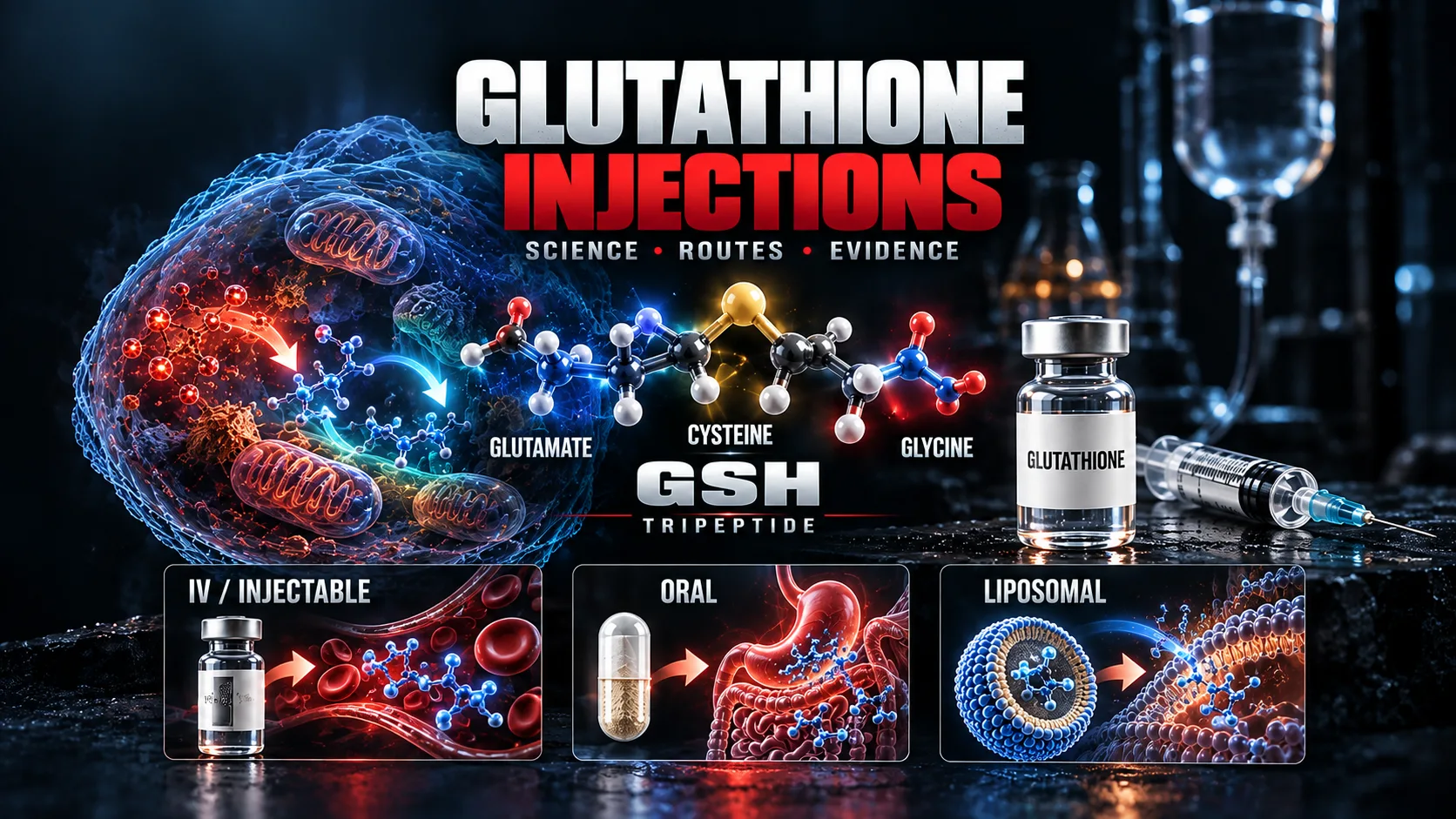
GLUTATHIONE INJECTIONS: 7 MEASURED FACTS, BENEFITS, SIDE EFFECTS
Glutathione injections put the body's most abundant antioxidant, a three-amino-acid peptide the liver makes on its own, straight into a vein or a muscle. Clinics sell them for brighter skin, IV bars sell them for recovery and detox, research vendors sell the powder to people who reconstitute it at home, and almost none of that use has been measured.
What has been measured is precise: an intravenous dose raises plasma glutathione about 47-fold and half of it is gone in 14 minutes (PMID 1907548); the only placebo-controlled trial of intravenous glutathione for skin lightening did not reach significance (PMID 39444151); and the FDA traced a run of chills, vomiting and low blood pressure after glutathione injections to a dietary-supplement powder with five times the endotoxin limit (FDA compounding alert, 2019).
This page reads the whole record: what glutathione is and why it counts as a peptide, what an injection does to blood levels, the randomised trials on skin, the medical intravenous trials where the doses actually come from, how people in the gym world describe using it, the glutathione injection side effects on file, and how the injectable compares with oral, liposomal and N-acetylcysteine. Doses appear only as a trial abstract or a regulator states them. For the arithmetic of turning a vial into a syringe there is the peptide calculator; this page is about whether the injection does anything worth the needle.
Glutathione injections in brief
Three numbers frame glutathione injections: how fast the body clears it, what the one controlled skin trial found, and what was in the vials that sent people to hospital.
After an infusion of 2 g per square metre in 10 healthy adults, total plasma glutathione rose from 17.5 to 823 micromoles per litre and then fell with a half-life of 14.1 plus or minus 9.2 minutes; urinary glutathione excretion rose 300-fold in the next 90 minutes (PMID 1907548). The injection is a surge, not a level.
A 2025 systematic review found five randomised trials of oral glutathione that lowered the melanin index against placebo, and exactly one placebo-controlled trial of the intravenous route: 6 of 16 responded against 3 of 16, p equal to 0.054. The reviewers concluded that intravenous glutathione is contraindicated for skin lightening because of the lack of efficacy and its side effects (PMID 39444151).
In 2019 the FDA reported that a repackager had supplied a dietary-supplement grade L-glutathione powder for sterile injectables; seven patients at one clinic developed nausea, vomiting, lightheadedness, chills and body aches after intravenous glutathione, one with low blood pressure and breathing difficulty, and a separate patient was hospitalised with chills, fever and shaking (FDA compounding alert, 2019).
Every figure on this page is taken from a PubMed abstract or from a regulator's published notice, all listed at the end. Glutathione doses are quoted only where a trial abstract or the FDA states them; how people in gyms describe using the injectable is reported as their description, not as a protocol.
What this glutathione injections guide covers
What glutathione is: the tripeptide, reduced and oxidised forms, why it is classed as a peptide, and why the body makes it rather than absorbing it.
What glutathione injections do in the blood: the intravenous pharmacokinetics, the oral trials that found nothing, the oral trials that found something, and liposomal and whey data.
Skin lightening: every randomised trial, oral, topical and intravenous, and what two regulators said about the intravenous route.
The medical intravenous trials: cisplatin neuropathy, Parkinson's disease and contrast kidney injury, which are where the measured doses come from.
Glutathione injections in the gym world: what users and vendor guides describe, matched against what has been measured in exercise.
Glutathione injection side effects and the two regulatory warnings, plus injectable against oral, liposomal, N-acetylcysteine and glutamine.
Not coveredA dose, schedule or protocol for glutathione injections. No regulator has approved an injectable glutathione product in the United States for any cosmetic, athletic or wellness use, and this page gives none.
Chemotherapy and Parkinson's disease as diseases. The trials in those patients are cited for what they measured about glutathione; the treatment of those conditions belongs to oncologists and neurologists.
The rest of the peptide field. That sits on what are peptides and the peptides hub; this page stays on one molecule.
What is glutathione, and is it a peptide?
Before glutathione injections make sense, the molecule needs a paragraph. Glutathione is a tripeptide made of three amino acids, cysteine, glycine and glutamate, and it functions as the major antioxidant of human cells; it is synthesised inside the body, protects the thiol groups of proteins from oxidation, and takes part in the detoxification reactions that keep the cell environment stable (PMID 25378941). It is the most abundant endogenous antioxidant and a critical regulator of oxidative stress and immune function (PMID 24791752).
So the answer to the question people type into search boxes is yes: glutathione is a peptide, the shortest kind, three residues long, which is why it appears under types of peptides on this site next to molecules ten times its size.
Two forms matter. Reduced glutathione, written GSH, is the working antioxidant; when it donates an electron it pairs up into oxidised glutathione, GSSG, and the ratio between the two is what laboratories use as a readout of oxidative stress in blood (PMID 21875351). Nearly all of the body's glutathione is intracellular. Plasma carries very little, about 6 micromoles per litre in one set of healthy volunteers (PMID 1362956), which is the first clue to why an injection behaves the way it does: a vein is not where the molecule normally lives or works.
Glutathione injections come in three shapes. In hospitals, reduced glutathione for injection is a licensed drug in several countries and is given intravenously, typically as a sodium salt, in oncology and cardiology protocols (PMID 39242322, PMID 37374173). In the United States no glutathione injection is FDA approved; what clinics and IV bars administer is compounded from bulk powder, and what research vendors ship is lyophilised powder in vials that the buyer reconstitutes with bacteriostatic water, the same operation the peptide calculator is built for. The three kinds of glutathione injections are the same molecule with three different levels of quality control, and the section on side effects shows what happens when the wrong powder ends up in a syringe.
What is measured on glutathione injections, and in whom
Glutathione injections have a longer research history than most peptides sold online, but almost all of it is in patients receiving chemotherapy, in neurology, or in cardiology, and almost none of it is in the people who now buy it. The table sorts every source on this page by what it can support. The green rows are the only ones that compare glutathione against a placebo.
| Finding | Route and population | Weight |
|---|---|---|
| High-dose glutathione injections: plasma 17.5 to 823 micromoles per litre, half-life 14.1 minutes, cysteine 8.9 to 114, urinary glutathione up 300-fold (PMID 1907548) | IV, 10 healthy volunteers | Pharmacokinetics |
| Single oral dose of 3 g: no significant rise in plasma glutathione over 270 minutes (PMID 1362956) | Oral, 7 healthy volunteers | Pharmacokinetics |
| Oral 250 or 1,000 mg daily for 6 months: blood glutathione up 30 to 35 percent at the high dose, natural killer cytotoxicity more than doubled, back to baseline after 1 month off (PMID 24791752) | Oral, 54 healthy adults | Randomised, 6 months |
| Oral 500 mg twice daily for 4 weeks, the pill against which glutathione injections are sold: no change in erythrocyte glutathione or oxidative stress markers (PMID 21875351) | Oral, 40 healthy adults | Randomised, negative |
| Liposomal oral 500 or 1,000 mg for 1 month: whole blood glutathione up to 40 percent, mononuclear cells up 100 percent, 8-isoprostane down 35 percent (PMID 28853742) | Oral liposomal, 12 adults | Pilot, no placebo |
| Oral 500 mg daily for 4 weeks: melanin index lower than placebo at 2 of 6 sites (PMID 20524875) | Oral, 60 healthy students | Randomised, skin |
| Oral 250 mg daily GSH or GSSG for 12 weeks: melanin index tended lower, wrinkles significantly reduced at some sites (PMID 28490897) | Oral, healthy women | Randomised, skin |
| Oral 500 mg L-cystine plus 250 mg glutathione for 12 weeks: skin lightening and smaller dark spots, better than either alone (PMID 33834608) | Oral, 124 Asian women | Randomised, skin |
| Topical 2 percent oxidised glutathione for 10 weeks: melanin index lower than placebo, p below 0.001 (PMID 25378941) | Topical, 30 women | Randomised, split face |
| Oral plus topical glutathione for 8 weeks: lower melanin index than placebo; combination possibly superior to either (PMID 33871071) | Oral and topical, 46 adults | Randomised, skin |
| Only placebo-controlled trial of glutathione injections for skin: 6 of 16 responders against 3 of 16, p equal to 0.054; IV route judged contraindicated for lightening (PMID 39444151) | IV, 32 adults, via systematic review | Randomised, not significant |
| Cisplatin chemotherapy with intravenous and intramuscular glutathione: neuropathy in 4 of 24 against 16 of 18 on placebo, p equal to 0.0001 (PMID 7799029) | IV plus IM, 50 cancer patients | Randomised, phase 3 |
| Parkinson's disease, 1,400 mg intravenously three times a week for 4 weeks: well tolerated, no significant difference in motor scores (PMID 19230029) | IV, 21 patients | Randomised, negative |
| Parkinson's disease, 600 mg intravenously twice daily for 30 days: 42 percent decline in disability, open label (PMID 8938817) | IV, 9 patients | No placebo |
| Contrast angiography: intravenous glutathione abolished the rise in urinary lipid peroxides, oral N-acetylcysteine did not (PMID 21127883) | IV, 21 patients | Small, three arms |
| Heart attack angioplasty: contrast kidney injury 10 percent with glutathione infusions against 38 percent on placebo (PMID 37374173) | IV, 100 patients | Randomised, subgroup analysis |
| Oral 1 g daily for 2 weeks before 60 minutes of cycling: blood lactate 2.9 against 3.4 mmol per litre, less fatigue (PMID 25685110) | Oral, 8 healthy men | Crossover, small |
| Oral 1,000 mg daily for 3 weeks in obese men with and without diabetes: insulin sensitivity by clamp (PMID 33740389) | Oral, 20 men | Randomised, metabolic |
| Whey protein 45 g daily for 2 weeks: plasma glutathione up 44 percent in glutathione-deficient HIV patients (PMID 11168457) | Oral precursor, 30 patients | Randomised, precursor |
| Glutathione injections incompatible with 11 of 44 intravenous drugs at the Y-site (PMID 39242322) | In vitro | Compatibility |
| Dietary-supplement L-glutathione powder used in sterile injectables; endotoxin up to five times the limit; adverse events in eight patients (FDA compounding alert, 2019) | Compounded IV, United States | FDA notice |
| Philippine FDA public warning against intravenous glutathione for skin lightening after adverse effects (PMID 27088927) | IV, cosmetic use | Regulatory warning |
| Glutathione injections in athletes, bodybuilders or steroid users | No study exists | Not measured |
Read the route column against the weight column. Every placebo-controlled win for glutathione injections or pills is either oral, topical, or an intravenous protocol wrapped around chemotherapy or a contrast dye. Glutathione injections on their own, given to healthy people for a cosmetic or wellness reason, have one controlled trial and it did not reach significance. That is the shape of the evidence, and the rest of the page stays inside it.
What a glutathione injection does in the blood
The pharmacokinetic study that every discussion of glutathione injections should start from was published in 1991. Ten healthy volunteers received 2 g per square metre of body surface as an intravenous infusion; total plasma glutathione rose from 17.5 to 823 micromoles per litre, the volume of distribution was 176 millilitres per kilogram, and the elimination half-life was 14.1 minutes (PMID 1907548). Plasma cysteine rose from 8.9 to 114 micromoles per litre while total cysteine plus cystine in plasma fell, which the authors read as cells pulling cysteine in; urinary glutathione excretion rose 300-fold and cystine excretion 10-fold in the following 90 minutes (PMID 1907548).
Two conclusions follow. First, glutathione injections are a spike: within an hour most of the peptide is either broken into its amino acids or in the bladder. Second, what the injection actually delivers to tissues is cysteine, the rate-limiting building block of the glutathione that cells make for themselves (PMID 1907548). That is the mechanism by which the intravenous drug protects against cisplatin, and it is also why oral cysteine donors such as whey protein and N-acetylcysteine keep appearing in the same conversation.
The oral route is where the story of glutathione injections turns. A single 3 g dose in seven volunteers did not raise plasma glutathione at all over 270 minutes (PMID 1362956), and a four-week trial of 500 mg twice daily in 40 healthy adults changed neither erythrocyte glutathione nor urinary markers of oxidative stress (PMID 21875351).
But the longest trial found the opposite: 54 non-smoking adults randomised to 250 or 1,000 mg daily for six months raised their glutathione by 30 to 35 percent in erythrocytes, plasma and lymphocytes and by 260 percent in buccal cells at the high dose, with a doubling of natural killer cell cytotoxicity at three months, and levels returned to baseline after a one-month washout (PMID 24791752). A pilot of liposomal glutathione at 500 or 1,000 mg daily in 12 adults reported increases of up to 40 percent in whole blood and 100 percent in mononuclear cells after two weeks, without a placebo group (PMID 28853742).
Put together, the data say that blood glutathione can be raised slowly by mouth over months, raised within two weeks by a precursor such as 45 g of whey protein daily in people who are deficient (PMID 11168457), or raised for a few minutes by glutathione injections. Whether any of those changes in a blood compartment translate to the skin, the liver or a muscle is the question the next three sections answer with what exists.
Glutathione injections for skin whitening: what the trials found
Skin lightening is the reason most glutathione injections are sold, and the mechanism is real: glutathione inhibits tyrosinase directly and indirectly and shifts melanin synthesis from dark eumelanin toward lighter pheomelanin (PMID 27088927). The clinical question behind glutathione injections for skin is whether that mechanism, delivered by a needle, changes skin colour more than a placebo.
A 2025 systematic review in the International Journal of Dermatology answered it for each route. Five randomised trials and one open-label study of oral glutathione at 250 mg once a day, 250 mg twice a day or 500 mg once a day showed a significant reduction in melanin index against placebo (PMID 39444151); topical 0.5 percent beat 0.1 percent and placebo; combining 2 percent topical with oral was superior to either. There was only one placebo-controlled study of the intravenous route, with 6 of 16 responders against 3 of 16, p equal to 0.054, and the reviewers concluded that intravenous glutathione is contraindicated because of the lack of efficacy and side effects (PMID 39444151).
| Trial | What was measured | Result |
|---|---|---|
| Arjinpathana 2012, oral 500 mg daily, 4 weeks, 60 medical students (PMID 20524875) | Melanin index at six sites | Lower at 2 of 6 sites, p 0.021 and 0.036 |
| Watanabe 2014, topical 2 percent GSSG lotion, 10 weeks, 30 women (PMID 25378941) | Melanin index, moisture, wrinkles, split face | Lower melanin, p below 0.001; more moisture, fewer wrinkles |
| Weschawalit 2017, oral 250 mg GSH or GSSG, 12 weeks, healthy women (PMID 28490897) | Melanin index, UV spots, wrinkles, elasticity | Trend to lower melanin; wrinkles significantly reduced at some sites |
| Wahab 2021, oral plus topical, 8 weeks, 46 adults (PMID 33871071) | Melanin index and L* by colorimeter | Combination lower than placebo and than topical alone |
| Duperray 2022, oral 500 mg L-cystine plus 250 mg glutathione, 12 weeks, 124 women (PMID 33834608) | Skin colour by spectrophotometry, dark spot size | Lightening and smaller spots, better than either alone |
| Intravenous glutathione, placebo-controlled, 32 adults, via Sarkar 2025 (PMID 39444151) | Responders | 6 of 16 vs 3 of 16, p 0.054 |
| Dilokthornsakul 2019, systematic review of 4 studies (PMID 30895708) | Melanin index, exposed and protected sites | Effect only on sun-exposed skin; evidence inconclusive |
The pattern across the table is consistent: oral and topical glutathione produce small, measurable, reversible reductions in melanin index, mostly on sun-exposed skin, and the intravenous route has one trial that did not reach significance. Two earlier reviews of glutathione injections had already said as much.
Sonthalia and colleagues wrote in 2016 that although intravenous glutathione injections are popular there is no evidence to prove their efficacy, and that the adverse effects caused by intravenous glutathione led the Food and Drug Administration of the Philippines to issue a public warning condemning its use for off-label indications such as skin lightening (PMID 27088927). A South African review the same year found no studies of intravenous glutathione for skin lightening at all, no studies of chronic intravenous use for any indication, and raised a mechanism-based concern of its own: the switch from brown to red melanin may increase the risk of sun-induced skin cancer in people whose skin had been protected (PMID 27499402).
An evidence-based case report from Indonesia adds the line on glutathione injections that separates the routes on safety: across three randomised trials, glutathione was well tolerated in oral preparations but not in parenteral ones, and the reviewers judged it not beneficial enough as a whitening agent because the effect was limited to some body parts and did not last (PMID 32373172).
The most recent narrative review, which is the first result Google returns for glutathione injections, reaches the same conclusion from the other side: oral administration shows significant but variable decreases in melanin with limited side effects, while intravenous glutathione, although rapid, is associated with serious safety concerns such as anaphylaxis and hepatotoxicity, made worse by the lack of standardised dosing (PMID 40013212).
The medical intravenous trials: where glutathione injection doses come from
Every real dose of glutathione injections in the literature comes from medicine, not cosmetics, and the two fields use the drug for the same reason: to load cells with cysteine before an oxidative insult. The strongest trial of glutathione injections is in oncology. Fifty patients with advanced gastric cancer on weekly cisplatin were randomised to glutathione or saline; the glutathione arm received 1.5 g per square metre intravenously over 15 minutes immediately before cisplatin and 600 mg by intramuscular injection on days 2 to 5 (PMID 7799029).
After 15 weeks, 4 of 24 assessable patients on glutathione had neuropathy against 16 of 18 on placebo, p equal to 0.0001; nerve conduction fell in the placebo arm but not the glutathione arm; the glutathione group needed fewer transfusions, 32 against 62, and had a higher response rate, 76 against 52 percent, so the antioxidant did not blunt the chemotherapy (PMID 7799029). Those are the glutathione injection benefits that exist in a randomised trial, and they belong to cancer patients.
Cardiology supplies the second set of glutathione injections data. In 21 patients with reduced kidney function undergoing coronary angiography, glutathione at 100 mg per minute for 30 minutes before the procedure completely abolished the rise in urinary lipid hydroperoxides that reached 299.5 percent of baseline in controls, while oral N-acetylcysteine only blunted it to 196.8 percent (PMID 21127883). A randomised subgroup analysis of 100 heart attack patients given glutathione sodium salt infusions before angioplasty and at 24, 48 and 72 hours found contrast-associated acute kidney injury in 5 of 50 against 19 of 50 on placebo, 10 against 38 percent (PMID 37374173).
Neurology is where the hope for glutathione injections was highest and the controlled result the flattest. An open-label study in nine patients with early Parkinson's disease gave 600 mg intravenously twice daily for 30 days and reported a 42 percent decline in disability that lasted two to four months after stopping (PMID 8938817).
The randomised, double-blind follow-up gave 1,400 mg intravenously three times a week for four weeks to 11 patients against 10 on placebo: glutathione was well tolerated, adverse events were similar in both groups, and there were no significant differences in Unified Parkinson's Disease Rating Scale scores, with a 2.8-point difference in the glutathione direction during treatment, p equal to 0.32, and a 3.5-point difference in the wrong direction over the following eight weeks, p equal to 0.54 (PMID 19230029).
| Setting | Dose and route as stated | Source |
|---|---|---|
| Healthy volunteers, pharmacokinetics | 2 g per square metre, single intravenous infusion (PMID 1907548) | 10 adults |
| Cisplatin chemotherapy, gastric cancer | 1.5 g per square metre intravenously over 15 minutes before cisplatin, then 600 mg intramuscularly on days 2 to 5 (PMID 7799029) | 50 patients |
| Parkinson's disease, controlled | 1,400 mg intravenously three times a week for 4 weeks (PMID 19230029) | 21 patients |
| Parkinson's disease, open label | 600 mg intravenously twice daily for 30 days (PMID 8938817) | 9 patients |
| Coronary angiography, kidney protection | 100 mg per minute intravenously for 30 minutes before contrast (PMID 21127883) | 7 per arm |
| Heart attack angioplasty | Glutathione sodium salt infusion over 10 minutes before the procedure and at 24, 48 and 72 hours; dose not stated in the abstract (PMID 37374173) | 100 patients |
| US clinics, compounded intravenous glutathione | 200 mg to 2,400 mg per dose in the adverse event reports the FDA used to calculate endotoxin limits (FDA compounding alert, 2019) | FDA, 8 patients with reactions |
Two features of that table matter for anyone reading it as a guide to glutathione injections. Every controlled dose is intravenous and large, gram-scale, given over minutes by staff, with a half-life that makes a single injection a 15-minute event (PMID 1907548). And the intramuscular 600 mg in the cisplatin trial is the only intramuscular dose of glutathione injections in a randomised trial anywhere on this page, given as a follow-on to a 1.5 g per square metre infusion, in cancer patients, for four days (PMID 7799029). No trial has given glutathione subcutaneously to anyone.
Glutathione injections in the gym: how people describe using them, and what is measured
This is the section on glutathione injections that the literature cannot write, so the page reports two things separately: how users and the vendors who sell to them describe glutathione injections in practice, and the small amount of exercise data that exists. Nothing in the first half is evidence; it is a description of a pattern, and the rule of the site is that a pattern people describe is not a dose anyone should copy.
What users describe. On bodybuilding forums and in research-vendor guides glutathione injections are sold as lyophilised powder, typically in 600 mg or 1,200 mg vials, and the guides describe reconstituting a 600 mg vial with 3 ml of bacteriostatic water to get 200 mg per ml, or with 6 ml for 100 mg per ml (vendor guide). The use those guides and forum threads describe is 200 to 400 mg drawn from that vial and injected subcutaneously or intramuscularly, usually into the shoulder or the abdomen, two or three times a week, in blocks of a few weeks (vendor guide, forum posts).
The reasons users give for glutathione injections are consistent: users describe running it during cycles of oral steroids as what they call liver support, alongside N-acetylcysteine or tauroursodeoxycholic acid; they describe it after a cycle as a way to, in their words, clear out; and a smaller group describe weekly intravenous drips of 600 to 2,000 mg bought at IV bars for recovery, skin and jet lag (vendor guide, forum posts). Older bodybuilding sites describe an oral version instead, 100 mg of glutathione inside a multi-ingredient support supplement taken daily on cycle (bodybuilding site).
What the reasons rest on. The liver-support case for glutathione injections borrows from medicine, where the intravenous drug is licensed in some countries as a hepatoprotectant and appears in oncology and cardiology protocols (PMID 39242322, PMID 37374173), but no study has given glutathione by any route to a person taking an oral anabolic steroid, and the hepatotoxicity of those drugs is a different mechanism from the oxidative injury glutathione was tested against; what has been measured about steroids and the liver is on do steroids damage your liver.
The detox case for glutathione injections rests on glutathione's role in cellular detoxification reactions (PMID 25378941), which is a description of an enzyme system, not a trial showing that injecting the peptide speeds anything up. The recovery idea has one small human study behind it, and it was oral.
None of the glutathione injection benefits that users describe, liver, detox or recovery, has been measured in a trial of the injectable.
What is measured in exercise. Eight healthy men aged about 36 took 1 g of oral glutathione or placebo daily for two weeks in a double-blind crossover, then cycled for 60 minutes at 40 percent of maximal heart rate; blood lactate after exercise was 2.9 millimoles per litre on glutathione against 3.4 on placebo and fatigue-related psychological scores were lower (PMID 25685110).
The mouse arm of the same study showed less muscle acidification and higher mitochondrial markers (PMID 25685110). That is the whole of the exercise literature relevant to glutathione injections: eight men, a low-intensity ride, an oral dose, and a half-millimole difference in lactate. A three-week randomised trial of 1,000 mg oral glutathione daily in 20 obese men with and without type 2 diabetes measured insulin sensitivity with the clamp technique and skeletal muscle glutathione by biopsy (PMID 33740389), which is the closest anyone has come to asking what the supplement does inside a muscle.
The honest summary for a lifter is short. The glutathione injections users describe are a route with no pharmacokinetic study, at doses a fifth to a tenth of the medical ones, for reasons that have not been tested, using a powder whose quality is the subject of the next section. The oral trials say blood glutathione can be raised over months by mouth (PMID 24791752) and that a cysteine-rich protein raises it within two weeks in people who are low (PMID 11168457), which is not a case for the needle. How to tell research-chemical marketing from a trial is on peptide research vs human use.
Glutathione injection side effects by the evidence
Glutathione injection side effects come from three places: the molecule, the route, and the powder. The molecule itself was well tolerated at gram-scale intravenous doses in every controlled medical trial on this page; adverse events were similar to placebo in the Parkinson's trial (PMID 19230029) and glutathione did not reduce the effect of chemotherapy (PMID 7799029). The route and the powder are where the recorded harm sits.
The 2019 FDA cluster: what happened to eight patients after glutathione injections compounded from a dietary-supplement grade powder (FDA compounding alert, 2019).
The FDA calculated the endotoxin limit from the 200 to 2,400 mg doses in the reports; the manufacturer confirmed its L-glutathione was marketed in the United States only for dietary supplements and was not intended for sterile drugs (FDA compounding alert, 2019).
| Effect | Strongest evidence | Read as |
|---|---|---|
| Endotoxin reactions: chills, fever, vomiting, hypotension | Eight patients after compounded glutathione injections from supplement-grade powder with up to five times the endotoxin limit (FDA compounding alert, 2019) | The powder, not the molecule |
| Anaphylaxis and hepatotoxicity | Listed as the serious safety concerns of intravenous glutathione in the 2025 narrative review, aggravated by the absence of standardised dosing (PMID 40013212) | Reported, not quantified |
| Parenteral intolerance | Across three randomised skin trials, glutathione was well tolerated in oral preparations but not in parenteral ones (PMID 32373172) | Route effect |
| Regulatory warnings | Philippine FDA public warning against intravenous use for skin lightening after adverse effects (PMID 27088927); US FDA alert on supplement-grade powder in injectables (2019) | Two regulators |
| Sun-related skin cancer risk | Hypothesis: the shift from eumelanin to pheomelanin may raise the risk of sun-induced skin cancer in previously protected skin; no long-term study exists (PMID 27499402) | Mechanism, not measured |
| Drug incompatibility in a drip | Glutathione for injection at 24 mg per ml was physically incompatible with 11 of 44 intravenous drugs at a simulated Y-site (PMID 39242322) | In vitro |
| Tolerability of the molecule at medical doses | Adverse events similar to placebo at 1,400 mg intravenously three times a week (PMID 19230029); no reduction in chemotherapy activity at 1.5 g per square metre (PMID 7799029) | Reassuring, supervised |
| Long-term intravenous use | No published study of chronic use for any indication as of the 2016 review (PMID 27499402) | Not measured |
| Subcutaneous or intramuscular glutathione injections at home | No pharmacokinetic or safety study | Not measured |
The honest summary of glutathione injection side effects is that the peptide itself has behaved well in supervised trials at doses far above what clinics use, and that the recorded harm has come from what was in the vial and from giving a hospital drug outside a hospital. That distinction is not comfort for a home user of glutathione injections; a research vendor's vial is exactly the supplement-grade powder the FDA was writing about, with no endotoxin test between the bag and the syringe. The general page on peptide side effects covers the injection-site and sterility problems shared by every reconstituted peptide.
Injectable vs oral vs NAC vs glutamine: what the head-to-head data show
Four comparisons come up in every search around glutathione injections, and each has at least one measurement behind it. The claimed glutathione injection benefits over pills rest on the first of them.
Glutathione injections
Plasma glutathione rises about 47-fold within minutes and falls with a 14-minute half-life; the tissue payload is cysteine (PMID 1907548). Wins against placebo only inside chemotherapy and contrast protocols (PMID 7799029, PMID 37374173). One controlled skin trial, not significant (PMID 39444151). No pharmacokinetics for subcutaneous or intramuscular use.
Oral glutathione
A single 3 g dose does nothing measurable (PMID 1362956) and 4 weeks at 1 g changed nothing (PMID 21875351), but 6 months at 250 to 1,000 mg raised blood glutathione 17 to 35 percent (PMID 24791752). Five randomised trials show a small melanin reduction (PMID 39444151). Well tolerated in every trial (PMID 32373172).
NAC vs glutathione. N-acetylcysteine is an oral cysteine donor, so it feeds the same synthesis that an intravenous glutathione dose feeds by a different door. The one direct comparison is in kidney protection: before coronary angiography, intravenous glutathione abolished the rise in urinary lipid peroxides, which reached 299.5 percent of baseline in controls, while oral N-acetylcysteine left it at 196.8 percent and did not prevent the fall in serum glutathione (PMID 21127883). In 21 patients that is a win for glutathione injections over the pill for an acute insult, and it says nothing about weeks of oral use.
Glutamine vs glutathione. They are different molecules with similar names. Glutamine is a single amino acid; glutathione is a tripeptide whose glutamate residue can be derived from glutamine, but the limiting ingredient for making glutathione is cysteine, which is why the intravenous drug raises plasma cysteine 13-fold (PMID 1907548) and why cysteine-rich whey protein raised plasma glutathione 44 percent in two weeks in deficient patients (PMID 11168457). No trial compares glutamine with glutathione on any outcome.
Liposomal glutathione. The pilot data are the most impressive numbers on the page, up to 40 percent in whole blood and 100 percent in mononuclear cells within two weeks, but they come from 12 people with no placebo group and no difference between doses (PMID 28853742). The six-month placebo-controlled trial of plain oral glutathione remains the better evidence (PMID 24791752). Which of these belongs in a supplement stack, if any, is a question for health support supplements, which ranks what has trial data.
Five mistakes people make about glutathione injections
Each of these comes from reading a mechanism as if it were a trial, or a clinic menu of glutathione injections as if it were a label.
1. Assuming glutathione injections last. The half-life of intravenous glutathione in healthy volunteers was 14.1 minutes and urinary excretion rose 300-fold in the following 90 minutes (PMID 1907548). A weekly drip is a weekly 15-minute spike.
2. Citing the medical trials of glutathione injections as evidence for cosmetic or gym use. The cisplatin trial gave 1.5 g per square metre intravenously plus 600 mg intramuscularly to cancer patients before a nerve-damaging drug (PMID 7799029). Its result says nothing about the 200 mg under the skin that forum posts describe in a healthy person.
3. Believing glutathione injections beat oral for skin. The controlled data say the opposite: five oral randomised trials lowered the melanin index, the single intravenous trial did not reach significance, and the reviewers called the intravenous route contraindicated (PMID 39444151).
4. Treating the powder as interchangeable. The 2019 cluster of chills, vomiting and hypotension came from supplement-grade L-glutathione with up to five times the endotoxin limit, repackaged for injection (FDA compounding alert, 2019). A research-vendor vial has the same provenance and no test.
5. Mixing glutathione injections into a drip with everything else. Reduced glutathione for injection was physically incompatible with 11 of 44 intravenous drugs at the Y-site (PMID 39242322); the vitamin and NAD cocktails sold alongside it have not been tested with it.
Verdict: a real hospital drug, a weak cosmetic, and an untested gym habit
Glutathione injections, after the abstracts rather than the clinic menus, are a licensed intravenous drug in some countries with a real record in oncology and cardiology, where gram-scale infusions before cisplatin cut neuropathy from 16 of 18 patients to 4 of 24 (PMID 7799029) and infusions around angioplasty cut contrast kidney injury from 38 to 10 percent (PMID 37374173). Outside those settings the record thins fast: no effect on Parkinson's motor scores in the one controlled trial (PMID 19230029), one non-significant skin trial and a reviewers' verdict of contraindicated (PMID 39444151), two regulatory warnings, and a molecule that is gone from plasma in minutes (PMID 1907548).
For readers here the practical conclusion on glutathione injections is that the oral route has the placebo-controlled data the injectable lacks, that the reasons users give for injecting it have never been tested, and that the only recorded harm has come from the powder and the setting rather than the peptide. The arithmetic of a vial is on the peptide calculator; the reason to be careful with any reconstituted peptide is on peptide side effects; and the wider class is on what are peptides.
Glutathione injections: frequently asked questions
What do glutathione injections do?
Glutathione injections raise plasma glutathione for a few minutes and deliver cysteine to cells. In 10 healthy volunteers an intravenous dose of 2 g per square metre raised total plasma glutathione from 17.5 to 823 micromoles per litre, raised cysteine 13-fold, and was cleared with a half-life of 14.1 minutes (PMID 1907548). In controlled trials that surge protected nerves during cisplatin chemotherapy (PMID 7799029) and kidneys during contrast procedures (PMID 37374173); in the one controlled cosmetic trial it did not significantly lighten skin (PMID 39444151).
Are glutathione injections FDA approved?
No. Glutathione injections are not FDA approved in the United States for any use. What clinics administer is compounded from bulk powder, and in 2019 the FDA warned that a repackager had supplied dietary-supplement grade L-glutathione for sterile injectables, with endotoxin up to five times the limit and adverse reactions in eight patients (FDA compounding alert, 2019). The Philippine FDA issued a public warning against intravenous glutathione for skin lightening after adverse effects (PMID 27088927).
Do glutathione injections work for skin whitening?
The controlled evidence says glutathione injections do not: the only placebo-controlled trial found 6 of 16 responders against 3 of 16, p equal to 0.054, and a 2025 systematic review concluded that intravenous glutathione is contraindicated for skin lightening (PMID 39444151). Oral glutathione at 250 to 500 mg daily lowered the melanin index against placebo in five randomised trials, and topical 2 percent oxidised glutathione lowered it with p below 0.001 (PMID 25378941). The effect is small, mostly on sun-exposed skin, and reverses after stopping (PMID 30895708).
What glutathione injection dosage was used in studies?
Only medical trials of glutathione injections state doses: 1,400 mg intravenously three times a week for four weeks in Parkinson's disease (PMID 19230029); 600 mg intravenously twice daily for 30 days in an open-label Parkinson's study (PMID 8938817); 1.5 g per square metre intravenously before cisplatin followed by 600 mg intramuscularly on days 2 to 5 (PMID 7799029); and 2 g per square metre in the pharmacokinetic study (PMID 1907548). The FDA adverse event reports involved 200 to 2,400 mg per dose at US clinics. No trial has given glutathione subcutaneously, and none of these figures is a dose for cosmetic or athletic use.
What are the side effects of glutathione injections?
In supervised trials of glutathione injections the molecule was well tolerated, with adverse events similar to placebo at 1,400 mg three times a week (PMID 19230029). The recorded harm comes from the powder and the route: chills, fever, vomiting, low blood pressure and breathing difficulty in eight patients given compounded glutathione contaminated with endotoxin (FDA compounding alert, 2019); anaphylaxis and hepatotoxicity listed as the serious concerns of intravenous use (PMID 40013212); poor tolerability of parenteral compared with oral forms in the skin trials (PMID 32373172); and a hypothetical rise in sun-related skin cancer risk from the shift to lighter melanin (PMID 27499402).
Is glutathione a peptide?
Yes, and so the contents of glutathione injections are a peptide. Glutathione is a tripeptide of cysteine, glycine and glutamate, synthesised inside human cells, that functions as the major cellular antioxidant and protects protein thiol groups from oxidation (PMID 25378941). It is the shortest molecule commonly called a peptide, and its reduced form GSH and oxidised form GSSG are used together as a laboratory readout of oxidative stress (PMID 21875351).
NAC or glutathione: which raises glutathione more?
For an acute insult, the vein: before coronary angiography, intravenous glutathione abolished the rise in urinary lipid peroxides while oral N-acetylcysteine only reduced it, 5.5 against 196.8 percent of baseline, and only the glutathione group kept its serum glutathione level (PMID 21127883). Over months, oral glutathione at 1,000 mg daily raised blood glutathione 30 to 35 percent in a six-month placebo-controlled trial (PMID 24791752), and cysteine-rich whey protein raised plasma glutathione 44 percent in two weeks in deficient patients (PMID 11168457). No trial compares oral NAC with oral glutathione over months.
How do bodybuilders use glutathione injections?
Forum threads and vendor guides describe glutathione injections as reconstituting 600 mg or 1,200 mg vials with bacteriostatic water and injecting 200 to 400 mg subcutaneously or intramuscularly two or three times a week, usually during a cycle of oral steroids as what users call liver support, sometimes with N-acetylcysteine or TUDCA, and sometimes as weekly intravenous drips at IV bars (vendor guide, forum posts). That is a description of practice, not evidence: no study has given glutathione by any route to a steroid user or an athlete, and the only exercise trial was 1 g orally for two weeks in eight men, with blood lactate 2.9 against 3.4 millimoles per litre after a 60-minute ride (PMID 25685110).
Sources and further reading
Every figure on this page comes from one of the 27 sources below: 25 papers checked against their PubMed abstracts on 30 September 2026, the FDA compounding alert, and one research-vendor guide cited only for how the product is described to users, marked as such. Forum descriptions of use are reported as descriptions and carry no reference number. Reference links are dofollow to support open science.
Keep reading
Four pages around glutathione injections: the arithmetic of a reconstituted vial, what peptides are, what the whole class does at the injection site, and which support supplements have trial data.
Final Educational Note
This article is educational and is not medical advice. It reports what randomised trials, pharmacokinetic studies, systematic reviews and two regulators say about glutathione injections, and it reports how some users describe using them as a description of practice, not as guidance. Doses appear only as a trial abstract or the FDA states them; the page gives no schedule, cycle or protocol, does not recommend injecting glutathione for any cosmetic, athletic or wellness purpose, and is not an encouragement to use research chemicals or performance-enhancing drugs, which carry serious health and legal risks. More guides sit on the PED side effects hub.
Chills, fever, vomiting, a fall in blood pressure, breathing difficulty or a spreading reaction at an injection site after any injection are clinical findings that a physician should assess at once. Read more about how this site works on the about page and in the full disclaimer.