Injectable vs Oral Steroids
How the two forms really differ
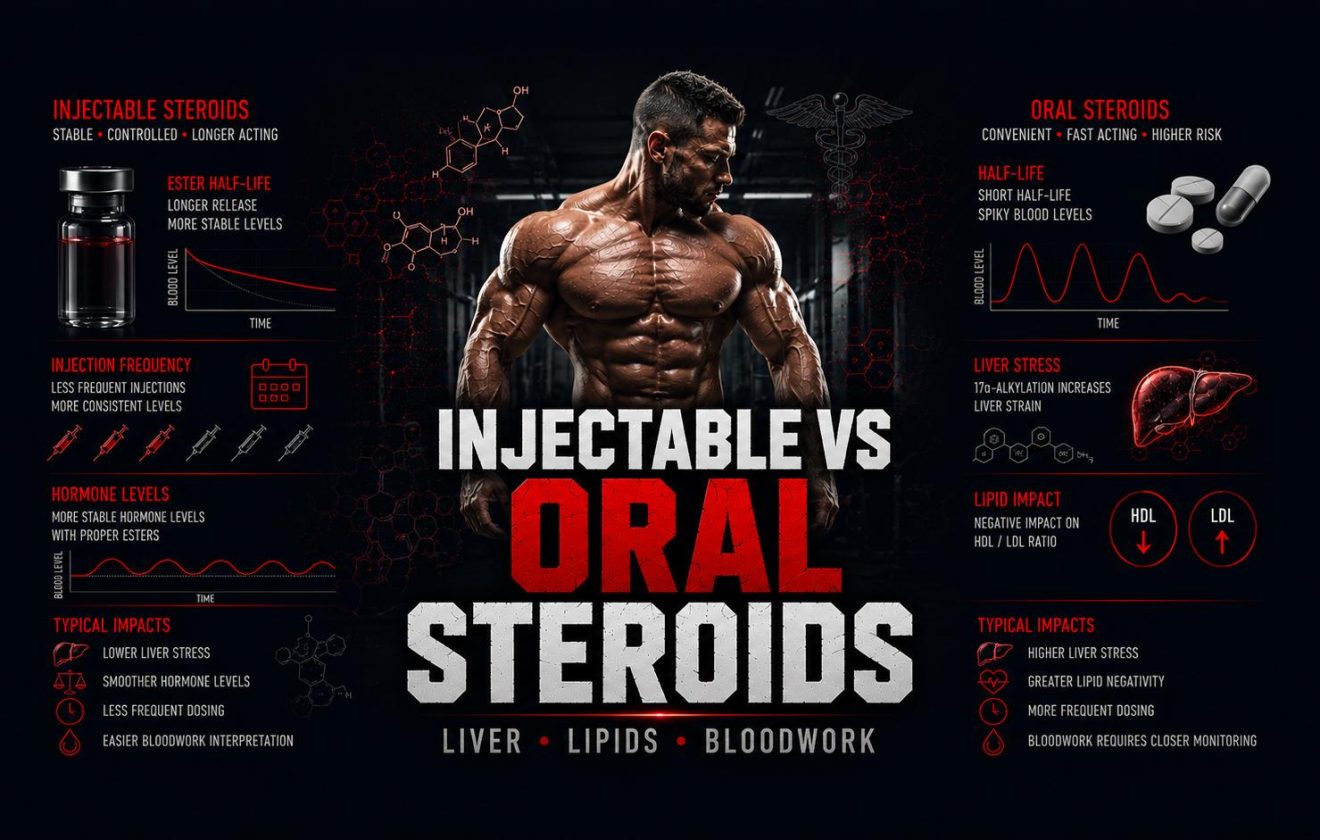
When comparing injectable vs oral steroids, the central question is not which one works better — it is what each category does to the liver, the lipid panel, and the hormonal axis. Oral steroids are swallowed and processed by the liver before reaching the bloodstream. Injectable steroids bypass that first-pass liver event entirely. This single pharmacological difference drives every practical distinction between the two categories: hepatotoxicity, HDL suppression, half-life, bloodwork monitoring schedule, and post-cycle timing all originate from it.
This guide covers the biochemistry behind both routes of administration, the specific harm markers each category raises, how bloodwork differs between them, and the five most consequential mistakes people make when they do not understand the distinction. The goal is not to evaluate which option to use — it is to give the reader an accurate pharmacological picture of what each category actually does.
Three Critical Differences Between Injectable and Oral Steroids
Liver Stress
Most oral steroids are 17-alpha-alkylated — chemically modified to survive liver metabolism. That modification is directly hepatotoxic. Injectable compounds bypass the liver on first pass and carry dramatically lower hepatic burden.
HDL Suppression
Oral steroids suppress HDL cholesterol far more aggressively than injectables. Stanozolol and oxymetholone can reduce HDL to single-digit values within weeks. This is the primary cardiovascular risk marker specific to the oral route.
Half-Life
Oral steroids have half-lives of 4–24 hours, requiring daily dosing with fluctuating blood levels. Injectable esters form a slow-release depot, extending half-life to days or weeks and producing stable systemic concentrations.
What This Comparison Covers
Covered Here
- 17-alpha-alkylation and why it causes liver stress
- First-pass hepatic metabolism explained
- Oral steroids and HDL — mechanism and magnitude
- Ester length and half-life of injectable compounds
- 6 key pharmacological differences
- Bloodwork comparison table by marker
- 5 harm-reduction mistakes and why they happen
- Blood Tests Before Steroids: 7 Markers to Check — the 7-marker baseline panel to run before starting
Not Covered Here
- Specific dosing or scheduling of any compound
- Cycle structure or stacking protocols
- Injection technique or site selection
- PCT protocols in detail
- Legal sourcing or purchasing guidance
- Brand or vendor comparisons
Foundation: What Are Anabolic Steroids. Bloodwork context: Bloodwork & Health hub. Post-cycle context: PCT hub.
The Route of Administration — Why It Changes Everything
The fundamental difference between injectable and oral steroids is not the compound — it is what happens between administration and the systemic bloodstream. When a person takes oral steroids, the compound is absorbed through the gastrointestinal tract and travels through the hepatic portal vein directly to the liver before entering general circulation. This is first-pass hepatic metabolism. The liver attempts to break down the ingested substance, and without chemical modification, it would succeed almost entirely — leaving negligible active compound in the blood.
Injectable steroids work differently. Administered intramuscularly or subcutaneously, they absorb from the injection site into the systemic bloodstream and completely bypass the liver on first pass. The liver still metabolizes injectable steroids eventually — all hormones are processed hepatically — but without the concentrated initial exposure that defines the toxicity profile of the oral route.
Every practical clinical difference between the two categories — elevated liver enzymes, aggressive lipid disruption, short half-lives, altered bloodwork monitoring windows — is a downstream consequence of this single absorption difference. Understanding it is the starting point for interpreting any bloodwork result on a cycle involving either category.
- Swallowed — absorbed via GI tract
- First-pass liver metabolism — hepatotoxic
- 17-alpha-alkylation required for bioavailability
- Half-life 4–24 hours — requires daily dosing
- Severe HDL suppression via hepatic lipase disruption
- Faster bloodwork changes onset and offset
- Most DHT-derived compounds — minimal aromatization
- Lower hematocrit elevation than testosterone esters
- Intramuscular or subcutaneous injection
- No hepatic first-pass — low liver burden
- Ester-dependent slow release from injection depot
- Half-life days to weeks — less frequent dosing
- Moderate HDL suppression — less than oral route
- Slower bloodwork changes with prolonged offset
- Testosterone esters aromatize — estradiol management required
- Greater hematocrit elevation via EPO stimulation
Oral Steroids — 17-Alpha-Alkylation, Liver Stress, and HDL
Almost all performance-context oral steroids are 17-alpha-alkylated (17aa). This chemical modification — a methyl or ethyl group added at the 17-alpha carbon — makes the steroid molecule resistant to hepatic degradation during first-pass metabolism. Without it, oral steroids would be nearly completely eliminated by the liver before reaching systemic circulation. The modification preserves bioavailability at a direct physiological cost: the liver experiences cell-level stress reflected in AST, ALT, and GGT elevation.
GGT (gamma-glutamyltransferase) is typically the earliest bloodwork signal of hepatic stress from oral steroids — it rises before AST and ALT reach clinically notable levels. All three markers require monitoring before and during any use of 17aa compounds. For detailed reference ranges and interpretation, see Liver Markers: AST, ALT, GGT.
How Oral Steroids Damage HDL Cholesterol
The hepatic route creates a second major consequence beyond liver enzyme elevation. The liver is the primary site of lipoprotein synthesis and regulation, including HDL. When oral steroids pass through at concentrated first-pass levels, they interfere directly with hepatic lipase activity — an enzyme central to HDL metabolism and reverse cholesterol transport. The result is HDL suppression far more severe than what injectable testosterone produces at equivalent androgenic doses.
Stanozolol is the most studied example among oral steroids: it can reduce HDL to single digits within four to six weeks at standard doses. Oxymetholone shows a similar pattern. Even oxandrolone — frequently described as one of the milder oral steroids — produces meaningful HDL reduction. There is no 17aa compound that is HDL-neutral. The degree varies by compound, but the direction is consistent. See Lipid Panel: HDL, LDL, Triglycerides.
Half-Life and Bloodwork Timing for Oral Steroids
17-alpha-alkylation delays hepatic metabolism — it does not prevent it. This means oral steroids still have relatively short half-lives: stanozolol approximately 9 hours, oxandrolone 9–10 hours, oxymetholone 8–9 hours. Daily or twice-daily dosing is required to maintain stable blood concentrations. Blood levels rise after each dose and fall before the next, producing a fluctuation pattern that injectable ester protocols avoid.
This pharmacokinetic profile has a specific consequence for bloodwork monitoring. Liver enzyme and lipid tests taken 48–72 hours after the last dose of oral steroids may underrepresent peak hepatic exposure. Mid-cycle monitoring — not immediately post-dose or post-cycle — gives the most representative picture of the burden these compounds are producing on the liver and cardiovascular system.
Not all oral steroids are 17-alpha-alkylated. Testosterone undecanoate in oral capsule form absorbs via the lymphatic system, avoiding hepatic first pass. Mesterolone (Proviron) is not 17aa and has minimal hepatotoxicity. These are meaningful exceptions — but the majority of oral steroids encountered in performance contexts are 17aa compounds, and the hepatotoxic and lipid risk applies to the class as a whole.
How Injectable Steroids Work — Esters, Depots, and Pharmacokinetics
Injectable steroids are modified with an ester — a fatty acid chain attached at the 17-beta-hydroxyl position. This makes the compound lipophilic and creates a slow-release oil depot at the injection site. As the oil is gradually absorbed from the muscle or subcutaneous tissue, esterase enzymes in the bloodstream cleave the ester bond and release active hormone into circulation. The ester chain length determines how quickly or slowly this release occurs — and therefore the compound’s effective half-life and dosing frequency.
Testosterone propionate is a short ester: half-life approximately 2 days, requiring injections every one to two days for stable levels. Testosterone enanthate and cypionate are long esters: half-lives of 4–7 days, typically injected once or twice per week. The ester only controls pharmacokinetics — it does not change the androgenic or anabolic activity, the aromatization rate, or the degree of HPTA suppression. The parent compound is identical regardless of which ester is attached.
Liver and Hematocrit Profile of Injectable Steroids
Injectable steroids that are not 17aa have substantially lower hepatotoxicity because first-pass liver exposure does not occur. This does not mean the liver is completely uninvolved at high doses — trenbolone has been associated with liver enzyme elevation through mechanisms unrelated to 17aa alkylation — but for the majority of injectable testosterone esters, hepatic burden is far lower than for oral steroids at equivalent doses.
On hematocrit, the picture reverses. Injectable testosterone esters are more potent stimulators of red blood cell production than most oral compounds because they deliver full testosterone load that drives renal EPO output. Hematocrit above 50–52% meaningfully increases blood viscosity and cardiovascular event risk. Regular CBC monitoring is required on any protocol involving testosterone esters. See Hematocrit & Hemoglobin (CBC).
6 Key Pharmacological Differences — Injectable vs Oral Steroids
- 1
Hepatotoxicity — The Defining Risk of the Oral Route
Liver toxicity is the most clinically significant difference between the two categories. Oral steroids — specifically 17aa compounds — are directly hepatotoxic by structural design. AST, ALT, and GGT elevation is expected, dose-dependent, and begins within the first weeks of use. Injectable testosterone esters bypass first-pass liver metabolism and carry dramatically lower hepatic burden. This single difference shapes monitoring protocols, cycle duration limits, and risk stratification for either category.
- 2
HDL Cholesterol — Oral Steroids Are Significantly Worse
By disrupting hepatic lipase activity during concentrated first-pass exposure, oral steroids suppress HDL cholesterol far more severely than injectable testosterone at equivalent doses. Stanozolol can reduce HDL to single-digit values within four to six weeks. Injectable testosterone at moderate doses typically reduces HDL by 10–25%. This gap is the primary lipid risk distinguishing the two categories. See Lipid Panel: HDL, LDL, Triglycerides.
- 3
Half-Life — Short Oral Window vs Long Injectable Depot
The short half-lives of oral steroids (4–24 hours) versus the extended half-lives of injectable esters (2 days to several weeks) produce fundamentally different pharmacokinetic profiles. The oral category creates daily blood concentration peaks and troughs. Long-ester injectables maintain stable systemic concentrations over the injection interval, making blood levels and bloodwork results more consistent and predictable throughout the cycle.
- 4
HPTA Suppression Timeline
Both categories suppress LH and FSH rapidly once systemic levels rise. The critical difference is what happens after the last dose. Because oral steroids clear within 24–48 hours of stopping, the suppressive load begins lifting quickly. Long-ester injectables continue releasing active compound from the depot for weeks after the last injection, maintaining full HPTA suppression throughout. In cycles combining both, the injectable ester determines when meaningful hormonal recovery can begin. See PCT hub.
- 5
Estradiol and Aromatization
Most DHT-derived oral steroids — stanozolol, oxandrolone, oxymetholone — have minimal to no aromatization and do not convert to estradiol at meaningful rates. Injectable testosterone esters aromatize significantly via the aromatase enzyme, requiring estradiol monitoring and potentially AI management. In any cycle combining the two categories, estradiol is driven by the injectable component regardless of which oral compound is included. See Estradiol Before Steroids.
- 6
Hematocrit — Greater Elevation With Injectable Testosterone
Injectable testosterone esters stimulate red blood cell production more potently than most oral steroids because they deliver full testosterone load that drives renal EPO output. Most oral compounds produce moderate hematocrit elevation — oxymetholone is a significant exception and can raise hematocrit substantially. For any protocol involving testosterone esters, CBC monitoring including hematocrit and hemoglobin is non-optional. See Hematocrit & Hemoglobin (CBC).
Oral Steroids and Bloodwork — What Changes and Why
The bloodwork impact of oral steroids versus injectable compounds differs across multiple marker categories. The table below reflects directional patterns based on pharmacological mechanism and published clinical data. Individual outcomes vary with compound choice, dose, baseline values, and genetics — these are starting points for understanding what to monitor and why each marker moves the direction it does.
| Marker | Oral Steroids (17aa) | Injectable Steroids |
|---|---|---|
| AST / ALT | Significant elevation — expected, dose-dependent, begins within weeks | Minimal to moderate — low baseline risk except high-dose trenbolone |
| GGT | Early elevation — typically first marker to rise | Usually minimal elevation |
| HDL Cholesterol | Severe suppression — can reach single-digit values | Moderate suppression — typically 10–25% reduction |
| LDL Cholesterol | Often elevated — compound-dependent | Mild to moderate elevation |
| Hematocrit | Moderate — oxymetholone is a notable exception | Greater elevation — driven by EPO stimulation from testosterone |
| LH / FSH | Rapid suppression — clears within days of stopping | Rapid suppression — maintained weeks post-cycle via depot |
| Estradiol | Minimal change — DHT-derived compounds do not aromatize | Elevated — testosterone esters aromatize via aromatase enzyme |
| Creatinine / eGFR | Generally stable — monitor baseline | Generally stable — monitor with high-dose trenbolone |
Pre-cycle baseline bloodwork is mandatory for both categories. Without values for liver enzymes, HDL, hematocrit, and kidney markers before starting, on-cycle changes cannot be meaningfully assessed. See Bloodwork & Health hub for full monitoring context.
5 Critical Mistakes When Using Oral Steroids or Injectables
- Mistake
Assuming No Needle Means Lower Risk
The absence of injection does not make oral steroids the safer option. 17aa compounds impose significantly greater hepatic and lipid burden than injectable testosterone at equivalent effective doses. AST, ALT, GGT, and HDL are all affected more severely by the oral route. Convenience of administration is not a clinical safety indicator — the pharmacological burden is higher with oral compounds, not lower.
- Mistake
Treating All Oral Steroids as Equivalent
Oral steroids differ substantially from each other. Oxandrolone, stanozolol, and oxymetholone are all 17aa compounds — but their hepatotoxicity magnitude, HDL suppression severity, androgenic burden, water retention, and appetite effects differ considerably at comparable doses. Grouping the entire oral category into a single risk profile produces inaccurate expectations. Each compound requires individual assessment rather than a class-level assumption.
- Mistake
Skipping Liver Bloodwork During a Cycle
Hepatotoxicity from 17aa oral steroids can progress to meaningful hepatocellular damage without producing clear symptoms. Fatigue, nausea, and right upper quadrant discomfort are late indicators — not early warnings. Checking liver markers only post-cycle removes the ability to detect and respond to escalating hepatic stress mid-cycle when dose reduction or stopping still matters clinically. See Liver Markers: AST, ALT, GGT.
- Mistake
Starting PCT Based on When the Oral Compounds End
In cycles combining oral steroids with long-ester injectables, PCT timing must account for the half-life of the longest-acting compound in the stack — not the last oral dose taken. If a long-ester injectable is still releasing active compound from the depot, beginning PCT immediately after the oral phase ends means attempting hormonal recovery under full HPTA suppression. The injectable component determines when recovery can meaningfully begin. See PCT hub.
- Mistake
Ignoring Estradiol Because the Oral Compound Does Not Aromatize
Most DHT-derived oral steroids do not aromatize. But in cycles that pair them with injectable testosterone, estradiol is still produced — driven entirely by the injectable component. Users who rely on the non-aromatizing property of their oral compound and skip estradiol monitoring on testosterone-inclusive cycles expose themselves to estrogenic complications that are entirely preventable. See Estradiol Before Steroids.
Authoritative Sources
- NCBI StatPearls — Anabolic Steroids: Classification, Mechanism, Monitoring, and Adverse Effects
- NCBI LiverTox — Androgenic Steroids: Liver Injury and 17α-Alkylated Oral Steroids
- PubMed — Atherogenic Effects of Anabolic Steroids on Serum Lipid Levels
- PubMed — Testosterone Dose-Response Relationships in Healthy Young Men
- MedlinePlus — Anabolic Steroids: Health Risks Overview
- Endocrine Society — Hypogonadism in Men: Testosterone Physiology and Clinical Context
What the Injectable vs Oral Steroids Comparison Actually Means
The injectable vs oral steroids distinction is not a matter of preference — it is a pharmacological difference with direct, measurable consequences for liver health, lipid panels, hematocrit, bloodwork monitoring schedules, and recovery timing. Oral steroids impose greater hepatic and lipid burden by structural necessity: without 17-alpha-alkylation, they cannot survive first-pass metabolism. Injectable steroids trade that hepatic burden for greater hematocrit elevation and a longer suppression tail after the cycle ends.
Neither category is categorically safer. Both require pre-cycle baseline bloodwork, on-cycle monitoring targeted to the specific markers each category affects, and a clear understanding of what to measure, when, and what the numbers indicate. The comparison only becomes actionable within a broader harm-reduction framework grounded in accurate bloodwork interpretation.
This article is published for educational and harm-reduction purposes only. Anabolic steroids — both oral and injectable — are controlled substances in many jurisdictions. Nothing in this guide constitutes medical advice, a recommendation to use any compound, or guidance on sourcing or legal compliance. Readers assume full responsibility for any decisions made on the basis of information presented here.
All content on MuscleScience.org is produced by contributors working under pseudonyms for editorial independence and personal privacy. Author photographs are stylized portraits, not real images of the writers. See our About page for full editorial and anonymity disclosure.
We do not sell. We do not supply. We educate.