TRT and Fertility: 4 Ways to Protect It on Testosterone
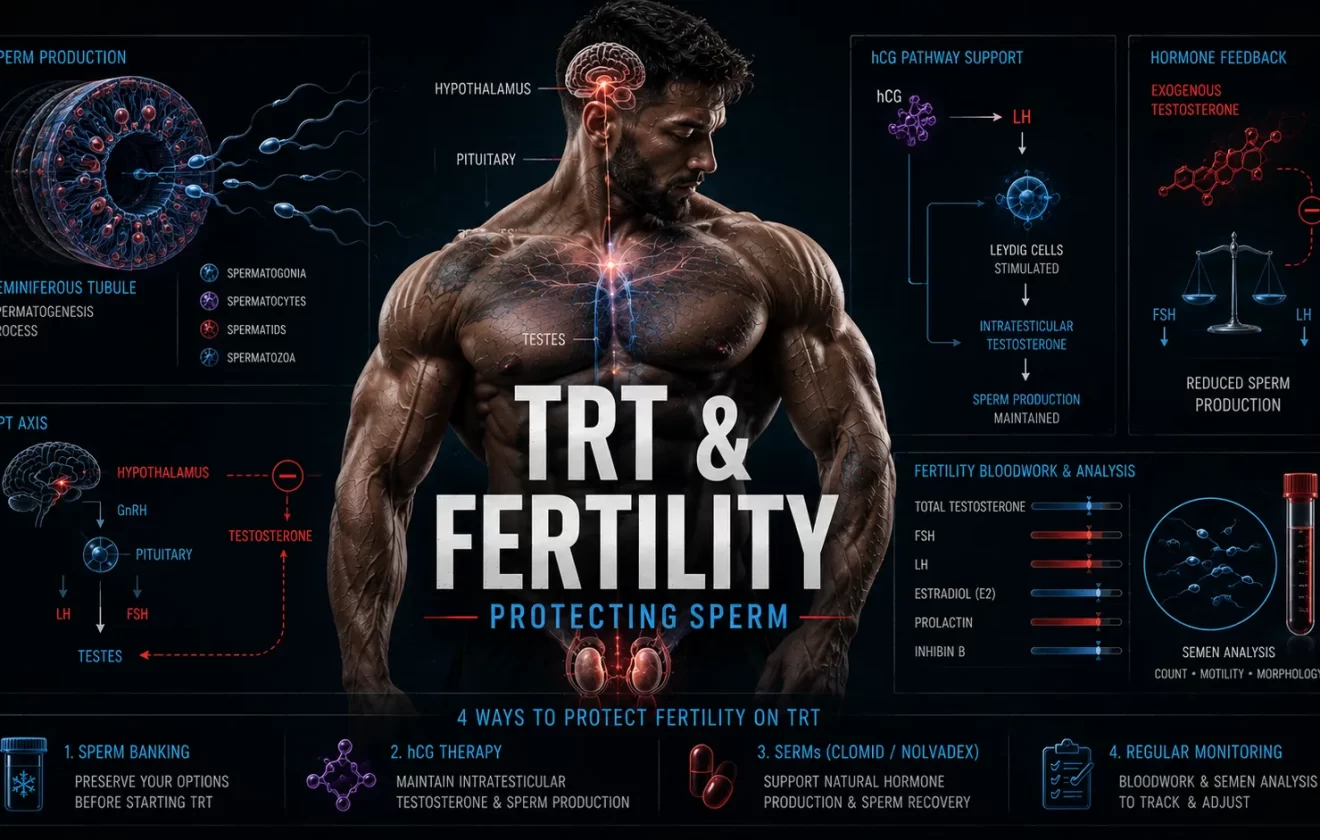
TRT and fertility, planned the right way
Here is the paradox that catches men off guard: the testosterone that makes you feel great can quietly switch off your ability to have children. TRT and fertility pull in opposite directions, because the body reads an outside testosterone supply as a signal to stop the hormones the testes need to make sperm. The good news is that this is usually reversible and, more importantly, entirely plannable - with sperm banking, hCG, or fertility-sparing alternatives to TRT. This guide explains how testosterone suppresses sperm, how fast and how completely, what recovery really looks like, and exactly how to protect TRT and fertility at the same time.
TRT and fertility in one screen
Outside testosterone shuts down LH and FSH, so sperm production falls - often to zero - within weeks to months.
Most men recover sperm after stopping, but timing varies and recovery is not guaranteed for everyone.
Bank sperm first, run hCG to preserve production, or use a SERM instead of TRT if you want kids soon.
The core message on TRT and fertility: if you may want biological children, do not start standard testosterone without a plan. Testosterone is so reliable at suppressing sperm that it has been studied as male contraception. That does not make it safe to rely on for birth control, and it does not make the suppression permanent - but it does mean the fertility conversation has to happen before the first injection, not after.
This page covers therapeutic TRT. High-dose anabolic-steroid cycles suppress fertility harder and recover slower - if that is your situation, see our guide to fertility and suppression on steroids. For the bigger picture of therapy itself, start with what is TRT.
Why TRT and fertility conflict - the HPG axis

Sperm production is controlled by a feedback loop between the brain and the testes. Normally your pituitary releases LH and FSH; LH tells the testes to make testosterone right where sperm are produced, and FSH supports the sperm-making machinery directly. When you add testosterone from outside, the brain senses plenty of hormone and switches LH and FSH off. This is the heart of the TRT and fertility problem.
Here is the part most explanations skip: sperm production depends on intratesticular testosterone - the concentration inside the testes, which is roughly fifty to a hundred times higher than the level in your blood. That local supply comes from LH stimulation, not from your injection. So even though your blood testosterone is high on TRT, the concentration where it actually matters collapses, and spermatogenesis grinds to a halt. That single fact explains why taking more testosterone can never fix fertility.
How fast does TRT lower sperm count?
In TRT and fertility terms, sperm are made on a production line that takes roughly ten weeks from start to finish, so changes are not instant - but they are steady. On TRT, counts typically fall over the first two to three months, and many men reach azoospermia (no measurable sperm) within a few months, though the timing and depth vary between individuals. Gels and injections both suppress sperm; the route matters less than the fact that gonadotropins are switched off.
Because suppression is gradual and incomplete at first, TRT sits in an awkward middle ground: it is strong enough to wreck your chances of conceiving reliably, yet not consistent enough to trust as contraception. The practical takeaway for TRT and fertility is simple - assume your fertility is compromised on therapy, but never assume you are sterile.
Is TRT-related infertility reversible?
For most men, yes - TRT and fertility loss is usually temporary. The largest analysis of men who stopped exogenous androgen found that sperm production recovered in the large majority - roughly ninety percent or more within about a year, and nearly all given enough time - with a median recovery measured in months rather than years. But "most men" is not "all men," and recovery depends on identifiable factors.
- Duration and dose - longer and higher testosterone exposure means slower, less certain recovery.
- Age - younger testes bounce back faster.
- Baseline fertility - your sperm count and testicular volume before TRT strongly predict the after.
- Anabolic-steroid history - prior high-dose cycles slow and blunt recovery compared with therapeutic TRT.
This uncertainty is exactly why the TRT and fertility plan should never rely on "I will just recover later." You probably will - but if you are among the minority who do not, you want a frozen sample and a specialist already in your corner.
How to protect TRT and fertility at the same time
You are not forced to choose between feeling well and having children: TRT and fertility can coexist with the right plan. There are several evidence-backed paths, and the right one depends on your timeline.

| Option | What it does | Best for |
|---|---|---|
| Sperm banking (cryopreservation) | Stores healthy sperm before suppression | Anyone starting TRT who may want kids |
| Low-dose hCG with TRT | Mimics LH, keeps intratesticular testosterone up, preserves sperm | Men who want to stay on TRT and keep fertility |
| SERM instead of TRT (clomiphene / enclomiphene) | Raises your own testosterone while keeping LH/FSH on | Men who want near-term fertility and symptom relief |
| hCG (± FSH) restart | Restarts the testes after stopping TRT | Men already suppressed who now want to conceive |
The two ideas that change the TRT and fertility conversation most: first, low-dose hCG taken alongside testosterone can preserve sperm production, with studies showing men kept measurable sperm and achieved pregnancies while continuing therapy. Second, if you want children soon, the smarter choice is often not TRT at all but a SERM such as clomiphene or enclomiphene, which raises your own testosterone by stimulating LH and FSH - restoration instead of replacement. Both approaches belong in a conversation with a clinician who does fertility work.
Recovering fertility after TRT - the restart protocol
If you are already on testosterone and now want to conceive, stopping is the first step, but a structured "restart" usually speeds and improves recovery rather than waiting passively. The backbone is hCG to wake the testes, often combined with a SERM (clomiphene or tamoxifen) to boost your own LH and FSH, and sometimes FSH itself for men who do not respond - a combination shown to recover sperm production in men rendered azoospermic by testosterone.
Recovery is tracked with periodic semen analyses, typically every couple of months, because the ten-week production cycle means you cannot judge success in a few weeks. How long it takes varies with the same predictors above. The key point for TRT and fertility planning is that a restart is a medical protocol with monitoring, not a matter of simply stopping and hoping - and it is run by a reproductive urologist or fertility specialist.
The baseline workup TRT and fertility both need
Most men start TRT with no fertility baseline at all, which undermines any later TRT and fertility decision, which makes later problems hard to interpret. Before your first dose, if children are anywhere in your future, get a simple baseline: a semen analysis, FSH and LH, total and free testosterone, and a testicular exam noting volume. This tells you whether a fertility issue already exists, gives you a reference point for recovery, and informs whether a SERM might treat your low testosterone without sacrificing fertility.
Fold this into your regular TRT bloodwork plan and revisit it whenever your family plans change. If your low testosterone symptoms are the reason you are considering therapy, that same workup helps decide between TRT and a fertility-sparing alternative in the first place.
Sperm banking before TRT - cheap insurance
If there is any chance you will want children, the simplest move in the whole TRT and fertility conversation is to bank sperm before your first dose, while your production is still at baseline. It is a low-cost, low-effort hedge against the minority chance that recovery is slow or incomplete, and it removes the pressure from every decision that follows.
In practice it is straightforward: you provide one to a few samples at a fertility clinic or sperm bank, they run a semen analysis, and the samples are frozen and stored for years. Two or three samples are commonly banked to give enough vials for future attempts, including IVF or ICSI if needed later. The cost is modest next to fertility treatment, and unlike your own recovery it is guaranteed. Even men who plan to run hCG alongside TRT benefit from banking as a backstop - it is the one part of a TRT and fertility plan that never depends on biology cooperating. If cost or logistics are a concern, that is a conversation to have with a reproductive urologist, who can also advise whether a fertility-sparing alternative to TRT fits you better in the first place.
TRT is not reliable birth control
Because testosterone suppresses sperm, some men assume TRT and fertility loss makes it a contraceptive. It does not. Suppression is variable and often incomplete, sperm can persist or return, and there is no reliable way to know you are azoospermic without testing - so a pregnancy on TRT is entirely possible. At the same time, you should not count on TRT for conception either. The honest summary of TRT and fertility is that testosterone makes you less fertile without making you safely infertile, which is the worst of both worlds if you are guessing. Use real contraception if you are avoiding pregnancy, and a real fertility plan if you are seeking it.
TRT and fertility: FAQ
Does TRT make you permanently infertile?
How long does it take for sperm to come back after stopping TRT?
Can I get my partner pregnant while on TRT?
Does hCG preserve fertility while on TRT?
Should I take clomiphene or enclomiphene instead of TRT if I want kids?
How fast does TRT lower sperm count?
What should I check before starting TRT if I want children?
Sources & further reading
The bottom line on TRT and fertility
TRT and fertility conflict by design, but the conflict is manageable if you plan ahead. Decide where you stand on children before you start: trying now points toward a SERM or hCG-based approach instead of standard TRT; wanting kids later means bank sperm and consider hCG alongside therapy; done having children makes standard TRT straightforward. Get a baseline semen analysis and gonadotropins, never treat TRT as birth control, and run any restart with a reproductive specialist and your TRT bloodwork in view.
This article is published for educational purposes only. It explains how testosterone replacement therapy affects male fertility, drawing on publicly available clinical guidelines and peer-reviewed research on spermatogenesis, gonadotropins and recovery. Nothing here is medical advice, a treatment recommendation, or a substitute for care from a licensed clinician or reproductive specialist. MuscleScience.org does not sell, supply, prescribe, or affiliate with any testosterone product, medication, pharmacy, or clinic.
Fertility outcomes vary by dose, duration, age, baseline sperm production and individual biology, and medications such as hCG, FSH and SERMs (clomiphene, enclomiphene, tamoxifen) are prescription treatments. Do not start, stop, change, or add any medication, and do not rely on testosterone for contraception, without the clinician who manages your care - and see a reproductive urologist or fertility specialist for conception planning. Related hormone markers are covered at the bloodwork hub.
This contributor writes under a pseudonym. The photograph above is a stylized portrait, not a real image of the writer. See our About page for details on our editorial team and anonymity policy.