Training Volume Explained
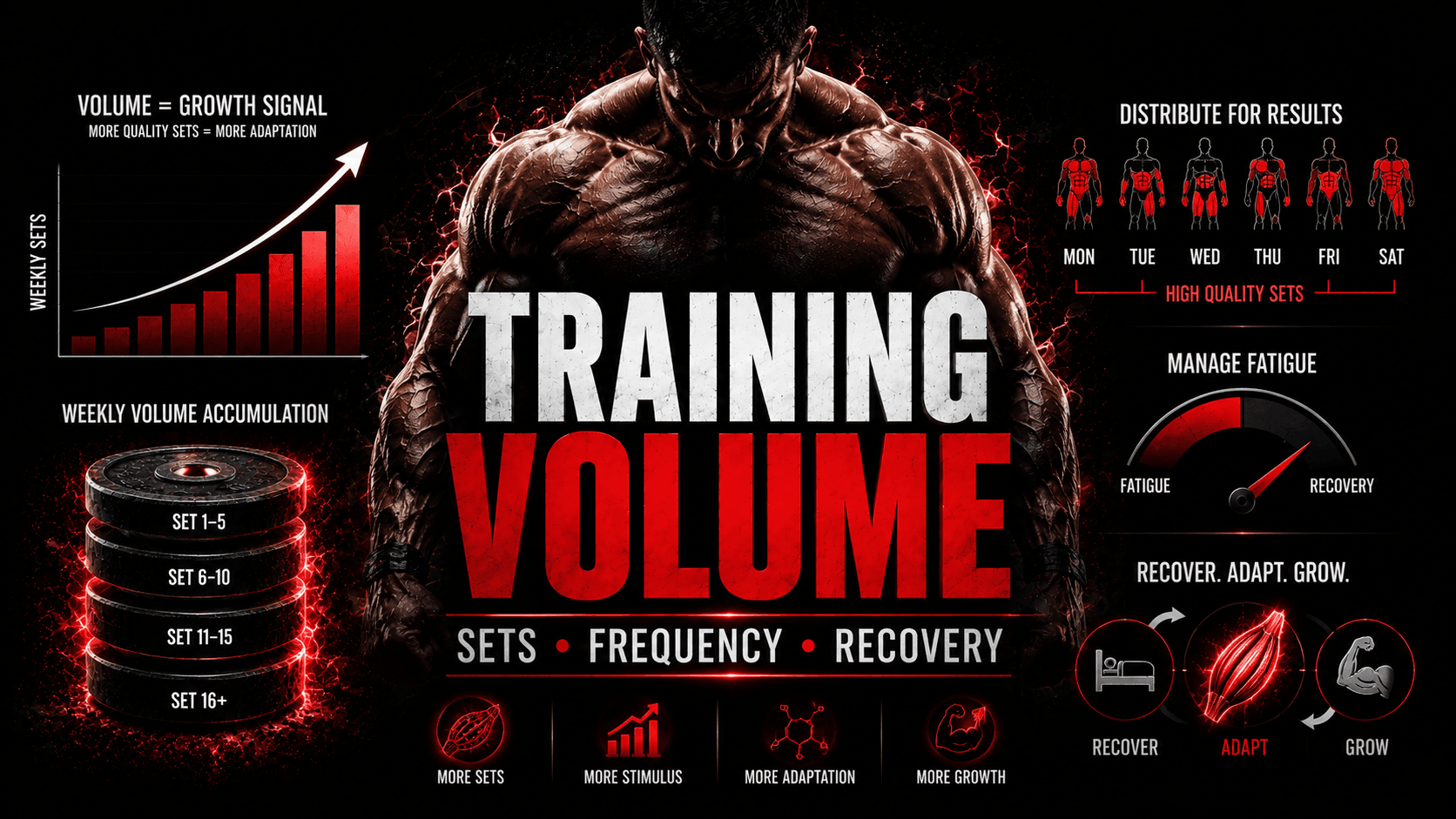
TRAINING VOLUME EXPLAINED: SETS PER WEEK THAT BUILD MUSCLE
Training volume is the number of hard sets a muscle gets each week, and it is the one programming variable with a measured dose-response curve behind it. Across 34 treatment groups, each extra weekly set added about 0.37 percent of muscle growth, and higher-volume arms of the same studies gained 3.9 percent more than lower-volume arms (PMID 27433992). A 2026 meta-regression of 67 studies and 2,058 participants found that size and strength keep rising as volume rises, with diminishing returns that are much steeper for strength than for size (PMID 41343037). The question how many sets per muscle group per week has a real answer in the training volume literature, and it is a curve, not a number.
This page reads the training volume record rather than the coaching slogans: what counts as a set, where the curve bends, what the trials that compared 9, 18 and 27 or 12, 18 and 24 weekly sets actually found, how much a muscle needs to be maintained, how frequency, load and proximity to failure change the count, and how men on anabolic steroids describe their volume against what has been measured. Every figure comes from a PubMed abstract listed at the end. The series lives on the training hub.
Training volume in brief
Three numbers frame the training volume question: what one more set is worth, what the smallest dose that still builds strength looks like, and how little it takes to keep what you built.
Weekly sets as a continuous variable predicted muscle growth, with each additional set worth an effect size of 0.023, about 0.37 percent more gain; within the same studies the higher-volume arm beat the lower-volume arm by an effect size of 0.241, about 3.9 percent (PMID 27433992). Multiple sets per exercise produced 40 percent larger hypertrophy effects than one set in an earlier meta-regression (PMID 20300012).
A single set per exercise performed one to three times a week was enough for significant strength gains in every study reviewed: 12.09 kg overall, 17.48 kg on the squat and 8.25 kg on the bench press (PMID 31797219). Three 13-minute sessions a week matched a much larger time commitment for strength and endurance in trained men over 8 weeks, while muscle size still favoured the higher training volume (PMID 30153194). If time is your limit, how long to rest between sets shows how to save minutes without losing reps.
After 16 weeks of training three days a week, young adults who cut their weekly dose to one third or one ninth kept the fibre hypertrophy they had built, and the one-third dose added more; older adults did not hold size at either dose, though their strength stayed at or above untrained young levels (PMID 21131862). Volume to build and volume to keep are different numbers.
Every figure on this page about training volume is taken from a PubMed abstract listed at the end. Coaching terms such as minimum effective volume or maximum recoverable volume are described as coaching terms; the set counts in the trials are quoted as the trials used them, not as a prescription for you. Where men describe their own volume on forums, it is reported as a description.
What this training volume guide covers
What counts as training volume: hard sets, direct and fractional sets, why tonnage misleads, and the proximity-to-failure evidence that decides which sets to count.
The dose-response curve: the meta-regressions of 2010, 2017 and 2026, the trials that compared 9, 18 and 27 or 12, 18 and 24 weekly sets, and the one-leg study that explains why people differ.
How many sets per muscle group per week by training status and goal, frequency, load and failure, progression and deloads, the maintenance dose, and training volume on anabolic steroids against what was measured.
Not coveredA full programme. Set counts here are the ones the trials used; the splits that carry them are on 3 day workout split, 4 day workout split and 5 day workout split.
Load progression and recovery in depth. Those have their own pages: progressive overload explained and recovery and fatigue.
The biology of growth. Mechanical tension, protein synthesis and what builds muscle at the fibre level are on what builds muscle and muscle growth.
What training volume actually is: hard sets, not tonnage
Training volume can be counted three ways, and only one of them predicts growth, which is why the first step in any training volume discussion is the unit. Tonnage, sets multiplied by reps multiplied by load, produces a large precise-looking number that treats 20 reps at 40 percent and 6 reps at 80 percent as the same work. Total reps ignores load entirely. The count the research uses is weekly sets per muscle group, because that is the variable the meta-regressions were built on: 34 treatment groups coded by weekly sets gave the 0.37 percent per set slope (PMID 27433992), and the 2026 analysis of 67 studies used weekly set volume and frequency as its two dosage variables (PMID 41343037).
The 2026 training volume analysis settled a second definitional question: how to count a set that trains a muscle indirectly. Before pooling, every set in every study was classified as direct, for the muscle being measured, or indirect; indirect sets were then scored as 1, as 0.5, or as 0, and the half-credit model fitted the data best (PMID 41343037). In plain terms, a set of rows counts as about half a set for the biceps, and a set of bench press as about half a set for the triceps. A back-and-biceps day with 12 sets of rows and 6 sets of curls is roughly 12 training volume units for the biceps, not 6 and not 18.
| Count | What it captures | Read as |
|---|---|---|
| Weekly hard sets per muscle | The variable behind the 0.37 percent per set slope (PMID 27433992) and the 2026 dose-response models (PMID 41343037); sets taken close to failure, with indirect sets at half credit | The working definition |
| Fractional sets | Indirect sets scored 0.5; the quantification with the strongest evidence across 67 studies (PMID 41343037) | How to count compound lifts |
| Sets per exercise per session | The unit in the single-versus-multiple-set literature: multiple sets gave 40 percent larger effects than one, with 4 to 6 sets per exercise trending above 2 to 3 (PMID 20300012) | Convert to weekly sets per muscle |
| Proximity to failure | Training to momentary failure gave no hypertrophy advantage over stopping short, effect size 0.12; any set-failure definition gave a trivial edge of 0.19 (PMID 36334240). Sets left far from failure are not counted in the trials above | Hard means close, not necessarily to failure |
| Tonnage (sets by reps by load) | Hypertrophy was load independent across 28 studies when sets went to failure (PMID 33433148), so a tonnage figure can double without the stimulus changing | Not a hypertrophy dose |

Two consequences follow. A lifter who counts only isolation work undercounts training volume for the arms and shoulders, and a lifter who counts every compound set as a full set for every muscle it touches overcounts it. The second error is the one that produces 30-set weeks on paper that are 15-set weeks in effect. The rep-range side of the definition, why 8 and 20 reps to failure build the same muscle, is covered under load below and in depth on progressive overload explained.
The training volume dose-response curve: what the meta-analyses measured
The shape of the training volume curve has been estimated three times by meta-analysis, each with more data. In 2010, 55 effect sizes from 8 studies showed multiple sets per exercise beating a single set by an effect size of 0.10, with effects rising from 0.24 for one set to 0.34 for 2 to 3 sets and 0.44 for 4 to 6 sets, a 40 percent larger hypertrophy effect for multiple sets in trained and untrained people alike (PMID 20300012).
In 2017, 34 groups from 15 studies gave the per-set slope: 0.023 effect size, 0.37 percent of growth, per additional weekly set, with a trend across fewer than 5, 5 to 9 and 10 or more weekly sets per muscle (PMID 27433992).
In 2026, 67 studies and 2,058 participants, 79 percent male and averaging 25 years, were pooled with every set classified as direct or indirect. The probability that more volume means more muscle was 100 percent, and the probability that more volume means more strength was also 100 percent, but both best-fit curves bent: returns diminish as weekly sets rise, and they diminish far faster for strength than for size (PMID 41343037). That is the whole shape in one sentence. For strength, a few hard sets get most of what is available; for size, the curve keeps rising longer before it flattens.


The individual training volume trials inside those pools show why the curve is an average. In 49 trained men, 9, 18 or 27 weekly sets of biceps work for 6 weeks grew the muscle 4.3, 9.5 and 5.4 percent; no between-group difference reached significance, but the effect sizes for 18 and 27 against 9 were moderate to large, and only the 27-set group gained isometric strength (PMID 30160627). In 35 lifters who squatted more than twice their body weight, 12, 18 or 24 weekly lower-body sets for 8 weeks produced the same thigh growth, 7.7, 6.7 and 6.1 percent, and the middle dose gained the most on the squat, 25.5 kg against 18.3 and 9.5 (PMID 32058362).
The cleanest demonstration is within one body. Thirty-four untrained people trained one leg with 3 sets per exercise and the other with 1 set for 12 weeks: the 3-set leg gained 5.2 percent cross-sectional area against 3.7, and 3.4 to 7.7 percent more strength. Thirteen of 34 showed a clear size benefit from the higher training volume and sixteen a clear strength benefit, and the responders were the ones whose muscle accumulated more total RNA, the raw material for ribosomes, in the first weeks (PMID 31813190). The dose-response is real on average and uneven between people, and the unevenness has a biological signature.
One training volume trial pulls the other way and deserves its place. Nineteen men did a modified German Volume Training programme, 10 sets of 10 on compound lifts, or 5 sets of 10, three times a week for 6 weeks; trunk and arm lean mass and bench and pull-down strength favoured the 5-set group, and the authors recommended 4 to 6 sets per exercise because gains seemed to plateau beyond that and might regress (PMID 27941492). At 10 sets of 10 per exercise, the curve had already turned down.
How many sets per muscle group per week: the trials, by lifter and goal
How many sets per muscle group per week should a lifter do? The table answers with the set counts the trials actually used, grouped by who was training and what was measured. Coaching frameworks that name a minimum effective, a maximum adaptive and a maximum recoverable volume are useful shorthand, but they are coaching terms, not measured quantities, and nothing below is a prescription; it is a map of where the evidence sits.
| Situation | What the trials used and found | Read as |
|---|---|---|
| Strength, trained lifters, minimum | One set per exercise, one to three times a week, raised 1RM in every study reviewed: 12.09 kg overall, 17.48 kg squat, 8.25 kg bench (PMID 31797219). Three 13-minute sessions a week matched larger programmes for strength over 8 weeks (PMID 30153194) | About 1 to 3 hard sets a week per lift |
| Size, beginners | 3 sets per exercise beat 1 set in the same person, 5.2 against 3.7 percent cross-sectional area over 12 weeks at 2 to 3 sessions a week (PMID 31813190); multiple sets gave 40 percent larger effects than one across 8 studies (PMID 20300012) | Roughly 6 to 9 weekly sets per muscle |
| Size, trained, moderate dose | 9 weekly biceps sets in one session grew the muscle 4.3 percent in 6 weeks; 18 sets over two sessions grew it 9.5 percent (PMID 30160627). The 2017 pool trended upward from under 5 to 5 to 9 to 10 or more weekly sets (PMID 27433992) | 10 or more weekly sets is where the pooled curve favours size |
| Size, trained, high dose | Trained men doing 1, 3 or 5 sets per exercise three times a week gained more size in the elbow flexors and thigh at higher volume (PMID 30153194); 27 biceps sets did not beat 18 (PMID 30160627); 24 lower-body sets did not beat 12 or 18 in strong squatters (PMID 32058362) | Above about 18 to 20, trials stop finding more |
| Size, very high dose | 10 sets of 10 per exercise, split three times a week, lost to 5 sets of 10 on lean mass and strength in 6 weeks (PMID 27941492) | 10 sets per exercise did not beat 5 |
| Size, individualised dose | In 16 trained lifters, one leg at a standard 22 weekly sets and the other at 1.2 times the lifter's own logged volume: the individualised leg gained 1.08 square centimetres more cross-sectional area and more lifters responded (PMID 32108724) | Your own log plus 20 percent beat a textbook number |
| Size and strength, progressive dose | Adding 4 or 6 lower-body sets every 2 weeks for 12 weeks gave more squat strength than a constant volume, with a possible small size benefit that plateaued at the highest volumes (PMID 37796222) | Rising volume within a block |
| Maintenance | One third or one ninth of the building dose preserved fibre size in young adults for 32 weeks; older adults needed more (PMID 21131862) | A few sets a week keeps it |
Read across the rows of the training volume table and a pattern appears that no single row states. The strength curve flattens first: one to three hard sets per lift per week already move 1RM in trained people (PMID 31797219), and the 2026 model found strength returns diminishing much sooner than size returns (PMID 41343037). The size curve keeps rising through roughly 10 to 18 weekly sets per muscle in the trials that measured it (PMID 27433992, PMID 30160627) and stops showing an advantage somewhere around 20 to 24 (PMID 32058362), with 10 sets per exercise going backwards against 5 (PMID 27941492).
Per muscle, the training volume evidence is uneven. The biceps have a three-dose trial (PMID 30160627), the thigh has four trials, three of them three-dose (PMID 30153194, PMID 32058362, PMID 37796222) and one two-dose (PMID 31813190), and chest, back and shoulders are covered only indirectly, through whole-body programmes where the bench and pull-down improved more at 5 sets than at 10 (PMID 27941492). Anyone offering an exact weekly set count for the rear delts is extrapolating. How the sets are arranged into a week is on 3 day workout split, 4 day workout split and 5 day workout split; the arm-specific case is on arm day workout.
Frequency: does splitting training volume across more days change the result?
Frequency, how many times a week a muscle is trained, interacts with training volume in a way that took a decade to untangle. The first meta-analysis, in 2016, compared muscles trained one to three days a week and found higher frequency produced larger effects, 0.49 against 0.30, concluding that major muscle groups should be trained at least twice a week (PMID 27102172). The 2019 update with 25 studies separated the two variables and found that when weekly sets were equal, frequency made no significant difference to growth, in trained or untrained people, upper or lower body; the earlier advantage had come from the higher-frequency groups doing more total training volume (PMID 30558493).
The 2026 training volume model agreed for size and disagreed for strength. The probability that frequency helps hypertrophy independently of volume was below 100 percent, compatible with no effect; for strength, the probability was 100 percent, with diminishing returns (PMID 41343037). The strength-specific meta-analysis of 22 studies had found the same gradient, effect sizes of 0.74, 0.82, 0.93 and 1.08 for one, two, three and four or more sessions a week, which disappeared when training volume was equated and held only for multi-joint lifts (PMID 29470825).
| Outcome | Evidence | Read as |
|---|---|---|
| Muscle size | No significant difference between frequencies when volume is equated, across 25 studies (PMID 30558493); frequency effect on hypertrophy compatible with zero in the 2026 model (PMID 41343037) | Choose by preference |
| Strength on big lifts | Effect rises with sessions per week, 0.74 to 1.08, driven by multi-joint 1RM tests (PMID 29470825); 100 percent probability of a positive frequency effect with diminishing returns (PMID 41343037) | Practise the lift more often |
| Getting the sets done | 18 biceps sets in two sessions grew the muscle more than 9 in one (PMID 30160627); 5 sets per exercise three times a week delivered 15 weekly sets per lift in 8 weeks (PMID 30153194) | High volume needs more days to be hard sets |
| Older lifters, maintenance | One session a week at one ninth of the dose did not hold fibre size in 60 to 75 year olds; it did in 20 to 35 year olds (PMID 21131862) | Frequency floor rises with age |
The practical reading is that frequency is a delivery system for training volume rather than a stimulus in itself. Twelve hard sets for the quads can be done in one session or three; the growth is the same if all twelve are genuinely hard, and the reason to spread them is that the eleventh and twelfth set of a single session are rarely hard. A full-body template that touches every muscle two or three times a week, as on full body dumbbell workout, and a body-part split that touches each once, deliver the same curve at different quality per set.
Load, reps and failure: what changes the value of a set
A set counts toward training volume only if it is hard, and three variables decide whether a set of training volume is hard. Load first: across 28 studies of 747 adults in which every set went to failure, muscle growth did not differ between loads above 15 reps, 9 to 15 reps, and 8 or fewer, while strength gains were larger with moderate and heavy loads (PMID 33433148).
In 49 trained men, 12 weeks of 20 to 25 reps at 30 to 50 percent of 1RM or 8 to 12 reps at 75 to 90 percent, all to failure, produced the same lean mass and fibre growth; only bench press strength favoured the heavier group, 14 against 9 kg (PMID 27174923). For size, a hard set is a hard set from 6 to 25 reps.
Failure second. The proximity-to-failure meta-analysis of 15 studies found a trivial advantage for any definition of set failure over stopping short, effect size 0.19, and no advantage for true momentary failure over non-failure, 0.12, with no moderating effect of load; higher velocity-loss thresholds did not reliably grow more muscle either (PMID 36334240). The sets in the volume trials above were taken close to failure, which is why they counted; a set stopped with five reps in reserve is not the same unit and the curve does not apply to it.
Load and training volume together third. The 2023 network meta-analysis of 178 strength studies and 119 hypertrophy studies ranked every combination: higher-load, multiset, thrice-weekly training ranked first for strength, standardised difference 1.60 against control, and higher-load, multiset, twice-weekly training ranked first for size, 0.66, while all prescriptions grew muscle comparably and every one beat not training (PMID 37414459). The word that appears in both winning rows is multiset. Load decides strength; sets decide size; both beat nothing.
How this plays out on the bar, from the loading side, is on progressive overload explained; the calculators that turn a rep set into an estimated max are the bench press calculator and squat 1RM calculator.
Progressing training volume across a block, deloads and the maintenance dose
The trials that progressed training volume within a block did better on strength than the trials that held it flat. In 31 lifters with five years of experience, adding 4 or 6 lower-body sets every 2 weeks across 12 weeks produced more squat 1RM than a constant volume, with 6 added sets beating 4, and a possible small size benefit that plateaued at the top (PMID 37796222). Individualising the starting point matters as much: a leg trained at 1.2 times its owner's logged weekly sets grew more than a leg at a standard 22 sets, and more people responded (PMID 32108724).
The first weeks of a block are not where the growth is, which changes what early training volume is for. Myofibrillar protein synthesis after a session was highest in week one and lowest by week ten, but only the responses at weeks three and ten correlated with fibre growth, because the early surge was repairing damage rather than adding protein (PMID 27219125). Volume in a first week on a new programme buys soreness, not size; the sets that build are the ones after the damage response has faded.
Deloads and breaks in training volume cost less than lifters fear. Fourteen men trained the bench press three times a week for 24 weeks either continuously or in three cycles of 6 weeks training and 3 weeks off; total chest and triceps growth and strength were the same, and the growth rate in each retraining cycle matched or beat the continuous group, whose gains had slowed (PMID 23053130). Over a 24-week horizon, 9 weeks of not training did not reduce the result.

Maintenance training volume is a different dose from building. After 16 weeks at three sessions a week, young adults kept their fibre hypertrophy for 32 weeks on one third or one ninth of the training volume, the one-third group grew further, and strength held through 32 weeks of complete detraining with only a small drop at the end; adults aged 60 to 75 held strength but not fibre size at either reduced dose (PMID 21131862). A lifter who must drop to one hard session a week for a season keeps most of what he built; a lifter over 60 should not cut that far.
How fatigue accumulates and when a planned reduction is due is on recovery and fatigue; the eating side of a block is on calories and energy balance and protein intake explained.
Training volume on anabolic steroids: what men describe and what was measured
Enhanced lifters are assumed to tolerate more training volume, and the assumption rests on one well-known trial and a great deal of description. The trial: 43 normal men were assigned to placebo or 600 mg of testosterone enanthate weekly for 10 weeks, with or without a standardised lifting programme three times a week; testosterone plus exercise gained 6.1 kg of fat-free mass and 1,174 square millimetres of quadriceps area, more than either no-exercise group, and the testosterone-only group gained more muscle and strength than the placebo group that trained (PMID 8637535).
The study did not vary training volume, so it measures what the drug adds to a fixed dose of sets, not how many sets the drug lets a man recover from.
What men describe. On bodybuilding forums, enhanced lifters describe weekly training volume of 20 to 30 hard sets per muscle, body-part splits with a muscle trained once a week at very high session volume, faster recovery between sessions and the ability to add sets without the strength losses a natural lifter would see (forum posts). They also describe joint and tendon problems arriving before muscular recovery runs out, and a return to natural volume tolerance within weeks of stopping (forum posts).
What is measured. No training volume trial on this page has compared different weekly set counts in men on anabolic steroids, so the dose-response curve above is a natural curve and its ceiling is a natural ceiling. What is measured is that the drug adds muscle on top of training at a fixed volume (PMID 8637535) and that the maintenance dose for muscle already built is small in natural young men (PMID 21131862). Whether the curve shifts right, bends later, or simply sits higher at every point on anabolic steroids is not known from randomised data.
The pharmacology of what the forum descriptions rest on is on what are anabolic steroids and the steroids hub; what the axis does afterwards, and why volume tolerance is described as collapsing after a cycle, is on post-cycle therapy. Nothing here is a protocol, for training or for anything else.
What lifters describe about training volume that no trial has counted
The forum version of training volume has a vocabulary the training volume trials do not use, and some of it points at real gaps. Nothing in this section is evidence; it is a description of what lifters report, kept apart from the measured record.
What lifters describe. Junk volume, sets so far from failure or so late in a session that they add fatigue without stimulus; a per-muscle sweet spot somewhere between 10 and 20 weekly sets that moves as the lifter gets stronger; the feeling that arms and shoulders tolerate more sets than quads and lower back; pump and soreness as proxies for whether a session had enough volume; and a volume reset after a deload that lets the same sets feel productive again (forum posts).
What is measured. The 10 to 20 range is where the pooled curve rises and flattens (PMID 27433992, PMID 41343037), and the individual trials sit inside it (PMID 30160627, PMID 32058362). The per-muscle differences are not measured; the biceps and thigh have dose trials and the rest do not. Soreness is measured, and it is the wrong proxy: muscle damage was highest in week one and unrelated to growth, while the protein synthesis that did predict growth came later, after damage had faded (PMID 27219125). The reset after a break is measured: retraining after 3 weeks off grew muscle as fast as or faster than continuous training (PMID 23053130).
Five training volume mistakes the trials expose
Each comes from reading one training volume number without its curve.
1. Counting tonnage. Hypertrophy was independent of load across 28 studies when sets went to failure (PMID 33433148), so sets times reps times kilograms measures time under a bar, not stimulus. Count hard sets per muscle per week.
2. Giving compound lifts full credit for every muscle. Indirect sets fitted the data best at half credit across 67 studies (PMID 41343037). Twelve sets of rows are six biceps sets, and a 30-set paper week is often a 15-set week.
3. Chasing the top of the curve. 27 biceps sets did not beat 18 (PMID 30160627), 24 lower-body sets did not beat 12 in strong squatters (PMID 32058362), and 10 sets of 10 per exercise lost to 5 sets of 10 in a split done three times a week (PMID 27941492). The curve bends, and for strength it bends early (PMID 41343037).
4. Judging a block by its first week. Early soreness and the early protein synthesis surge were unrelated to growth; the responses at weeks three and ten were (PMID 27219125). Hold the training volume steady until the damage response fades, then progress it (PMID 37796222).
5. Fearing a break. Three weeks off every six weeks matched 24 weeks of continuous training for size and strength (PMID 23053130), and one ninth of the dose held fibre size in young adults for 32 weeks (PMID 21131862). Volume to keep is a fraction of volume to build.
Verdict: training volume is a curve with a floor, a bend and a maintenance dose
Read from the meta-regressions and the dose trials rather than from any single framework, training volume works like this. Growth rises with weekly hard sets per muscle at about 0.37 percent per set (PMID 27433992), keeps rising with diminishing returns (PMID 41343037), and in the trials that tested it stops showing an advantage somewhere between 18 and 24 weekly sets in trained lifters (PMID 30160627, PMID 32058362), with 10 sets per exercise losing to 5 in one trial (PMID 27941492). Strength needs far fewer sets and flattens much earlier (PMID 31797219, PMID 41343037). Frequency delivers the sets but does not add growth once they are equal (PMID 30558493).
Load does not change the size result if the set is hard (PMID 33433148), and hard means close to failure, not necessarily at it (PMID 36334240).
For readers here the practical conclusion is that how many sets per muscle group per week has an evidence range rather than a magic number: enough that the muscle is trained hard more than a few times, not so many that the last sets stop being hard, progressed within a block from the lifter's own baseline, and cut to a fraction when life requires it without losing what was built. The series continues on progressive overload explained, recovery and fatigue and cutting vs bulking training; the hub is training hub.
Training volume: frequently asked questions
How many sets per muscle group per week should I do?
The trials put the size curve between about 10 and 20 weekly hard sets per muscle for trained lifters: 18 biceps sets grew more than 9 and 27 did not beat 18 (PMID 30160627), 12, 18 and 24 lower-body sets grew the thigh equally in strong squatters (PMID 32058362), and the pooled curve rises about 0.37 percent per added set with diminishing returns (PMID 27433992, PMID 41343037). Beginners grow on less: 3 sets per exercise beat 1 in the same person (PMID 31813190). Starting from your own logged volume plus about 20 percent beat a standard 22 sets (PMID 32108724).
What is training volume and how is it measured?
Training volume is the number of hard sets a muscle receives per week. It is the variable the meta-regressions use, not tonnage or total reps: across 34 groups each weekly set added 0.37 percent of growth (PMID 27433992). Sets that train a muscle indirectly, such as rows for the biceps, fit the data best at half credit (PMID 41343037). A set counts when it is taken close to failure; going to true momentary failure added nothing measurable over stopping a rep or two short (PMID 36334240).
Is 10 sets per week enough to build muscle?
For most trained lifters, yes, with more available above it. The 2017 pool trended upward from under 5 to 5 to 9 to 10 or more weekly sets per muscle (PMID 27433992); 9 biceps sets in one session grew the muscle 4.3 percent in 6 weeks, and 18 grew it 9.5 percent (PMID 30160627). Trained men on 3 sets per exercise three times a week, 9 weekly sets per lift, gained size and strength, and 5 sets per exercise gained more size (PMID 30153194). Ten is inside the rising part of the curve, not at its top.
Is 20 sets per week too much?
It is around where the trials stop finding an advantage. 24 weekly lower-body sets did not beat 12 or 18 in lifters squatting over twice body weight (PMID 32058362); 27 biceps sets did not beat 18 (PMID 30160627); and 10 sets of 10 per exercise, in a split routine done three times a week, lost to 5 sets of 10 in 19 healthy men (PMID 27941492). The 2026 model found returns diminishing as volume rises, faster for strength than for size (PMID 41343037). Twenty hard sets can work for a trained lifter; twenty sets that are no longer hard do not.
How many sets per week for hypertrophy versus strength?
Strength needs far fewer. One set per exercise one to three times a week raised 1RM by 12.09 kg overall in trained lifters (PMID 31797219), three 13-minute sessions matched larger programmes for strength (PMID 30153194), and the 2026 model found strength returns diminishing much sooner than size returns (PMID 41343037). For size the curve keeps rising through roughly 10 to 18 weekly sets per muscle (PMID 27433992, PMID 30160627). Strength also responds to load and to practising the lift more often (PMID 33433148, PMID 29470825); size responds mainly to hard sets.
Does training a muscle twice a week build more muscle than once?
Not when weekly sets are equal. Across 25 studies, frequency made no significant difference to growth on a volume-equated basis (PMID 30558493), and the 2026 model found the frequency effect on hypertrophy compatible with zero (PMID 41343037). Higher frequency does help strength on big lifts, effect sizes rising from 0.74 at one session to 1.08 at four or more (PMID 29470825), and it helps in practice because 18 sets over two sessions are more likely to be hard sets than 18 in one (PMID 30160627).
What counts as a set for training volume?
A set taken within a few reps of failure, for the muscle it targets, with indirect work at half credit. Hypertrophy did not differ between loads above 15 reps, 9 to 15, and 8 or fewer when sets went to failure (PMID 33433148), so rep range does not change whether a set counts. Sets far from failure are not the unit the trials used; sets to true failure gave no advantage over stopping just short (PMID 36334240). A set of rows is about half a biceps set and a set of bench press about half a triceps set under the best-fitting model (PMID 41343037).
How much training volume do I need to maintain muscle?
Much less than it took to build it. After 16 weeks at three sessions a week, young adults kept their fibre hypertrophy for 32 weeks on one third or one ninth of the dose, and the one-third group added size; adults aged 60 to 75 kept strength but not fibre size at either reduced dose (PMID 21131862). Even complete breaks cost little over a season: 3 weeks off after every 6 weeks of training matched 24 weeks of continuous training for chest and triceps growth and strength (PMID 23053130).
Sources and further reading
Every figure on this page about training volume comes from one of the 23 papers below, each checked against its PubMed abstract on 5 October 2026. One widely cited 2019 trial reporting a volume ceiling in trained women was excluded because it has been retracted. Forum descriptions of training volume are reported as descriptions and carry no reference number. Reference links are dofollow to support open science.
Keep reading
Four pages from the training series: the loading side of the dose, the fatigue side, the biology, and what a knee that hurts under the bar is telling you.
Final Educational Note
This article is educational and is not medical or coaching advice. It reports what randomised trials and meta-analyses say about training volume, and it reports how some lifters describe their own volume, including on anabolic steroids, as a description of practice, not as guidance. Set counts appear only as the trials used them; the page gives no programme, does not recommend any drug, and is not an encouragement to use performance-enhancing drugs, which carry serious health and legal risks. More guides sit on the training hub.
Joint pain that changes how a lift is performed, loss of strength across several sessions, persistent fatigue, disturbed sleep or dark urine after training are reasons to stop and consult a physician or a qualified coach. Individual response to training volume varies widely. Read more about how this site works on the about page and in the full disclaimer.