Knee Pain When Squatting: What the Pain Pattern Means and What to Change
KNEE PAIN WHEN SQUATTING: WHAT THE PAIN PATTERN MEANS AND WHAT TO CHANGE
Knee pain when squatting is one of the most common complaints in the gym and one of the least specific: four different structures sit within a few centimetres of each other at the front of the knee, and each hurts in a different place, at a different depth and at a different time after the session. Patellofemoral pain alone affects 22.7 percent of the general population in a given year (PMID 29324820), and in a survey of 104 subelite powerlifters 70 percent were carrying an injury at the time of asking while only 16 percent had stopped training because of it (PMID 29785405).
The squat itself is not the villain the pain makes it look like. Compressive forces on the kneecap rise as the knee bends and peak near maximum flexion (PMID 11194098), yet a review of 164 papers found the highest retropatellar stress at 90 degrees, with deeper flexion spreading the load over a larger contact area, and concluded that concerns about deep squats damaging the knee are unfounded (PMID 23821469). What matters is which structure is complaining and what you change in response.
This guide reads knee pain when squatting from the biomechanics papers, the patellofemoral consensus statements, the loading trials and the lifter injury surveys: where each of the four pain patterns sits and what it usually means, what the squat does to the knee at each depth, why knees hurt when squatting and not when walking, what the trials measured for kneecap pain and tendon pain, why a scan rarely settles it, what stance, depth and bar position change, how often lifters get it, what men describe against what was measured, and the signs that need a clinician rather than a cue.
Every figure about knee pain when squatting on this page comes from a PubMed abstract listed at the end. The model behind this page is on tendonitis vs tendinosis; the series lives on the training hub.
Knee pain when squatting in brief
Three numbers frame knee pain when squatting: how common the most frequent cause is, how much one change in squat angle changes the load on the tendon, and how often a scan finds something that is not the cause.
Pain behind or around the kneecap is the single most common reason knees hurt when squatting. Annual prevalence was 22.7 percent in the general population and 28.9 percent in adolescents, with point prevalence 7.2 percent in adolescents and 22.7 percent in female adolescent athletes; the authors call the long-term prognosis poor and the disability high (PMID 29324820). A clinical practice guideline lists squatting first among the activities that worsen it (PMID 31475628).
Tilting the surface shifted the moment from the hip and ankle to the knee and raised patellar tendon force 40 percent; a 10 kg backpack at 25 degrees raised the knee moment a further 23 percent, and beyond 60 degrees of flexion the patellofemoral force rose faster than the tendon force (PMID 17224441). The same geometry explains why forward knee travel and depth change which structure hurts.
In 991 adults aged 50 to 90, a meniscal tear or destruction was present in 19 percent of women aged 50 to 59 and 56 percent of men aged 70 to 90, and 61 percent of those with a tear had no symptoms at all; among people without arthritis the tear was present in 32 percent with pain and 23 percent without (PMID 18784100). A finding on a scan is not automatically the reason your knee hurts when squatting.
Every figure on this page about knee pain when squatting is taken from a PubMed abstract listed at the end. Where a model is proposed rather than demonstrated, the page says so. Where lifters describe their own knees on forums, it is reported as a description, not as evidence. Nothing here diagnoses; the red flags that need a clinician are listed near the end.
What this knee pain when squatting guide covers
The four patterns of knee pain when squatting: behind or around the kneecap, at the bottom tip of the kneecap, above the kneecap, and below or deep in the joint, with what each usually means in a lifter.
What the squat does to the knee: compressive and shear forces by depth, why 90 degrees is the worst angle when knees hurt when squatting behind the kneecap and deeper is not, what stance width and foot angle change, and what the decline board shows about load direction.
What was measured to help: the patellofemoral consensus statements and Cochrane review, the tendon loading trials, why scans mislead, how often lifters get knee pain when squatting, and the principles for the next session.
Not coveredThe tendon model in depth. Why rest does not fix a degenerative tendon, isometrics, heavy slow resistance and the timeline are on tendonitis vs tendinosis, the cornerstone of this series.
Ligament and acute injuries. A cruciate or collateral ligament injury, a locked knee or a fall is a clinical problem from day one and is not a load-management question.
Programmes. The page reports what trials did and measured; it does not prescribe sets, loads or exercises. Weekly dose is on training volume explained, loading progression on progressive overload explained.
Where the knee hurts when squatting, and what each place usually means
Knee pain when squatting is a location before it is a diagnosis. The front of the knee holds four structures that each respond to squatting load in their own way, and the first useful question is not what is wrong but where exactly the knee hurts when squatting and when.

Around or behind the kneecap. Diffuse pain that is hard to point to with one finger, worse with deeper squats, stairs and long sitting, is the picture of patellofemoral pain: the clinical practice guideline describes an insidious onset of poorly defined pain localised to the retropatellar or peripatellar region, worsened by loading activities such as squatting, prolonged sitting, stairs, jumping and running, and able to recur and persist for years (PMID 31475628).
It is the most common cause by a distance, with an annual prevalence of 22.7 percent in the general population (PMID 29324820).
The bottom tip of the kneecap. Pain you can press with a fingertip at the inferior pole of the patella, load related and rising with the demand on the knee extensors, especially in activities that store and release energy in the tendon, is the hallmark of patellar tendinopathy; the diagnosis is clinical, because tendon pathology on imaging can be present in people whose pain has another anterior knee source (PMID 26390269). The whole tendon story, from why it does not heal with rest to what loading did in the trials, is on tendonitis vs tendinosis.
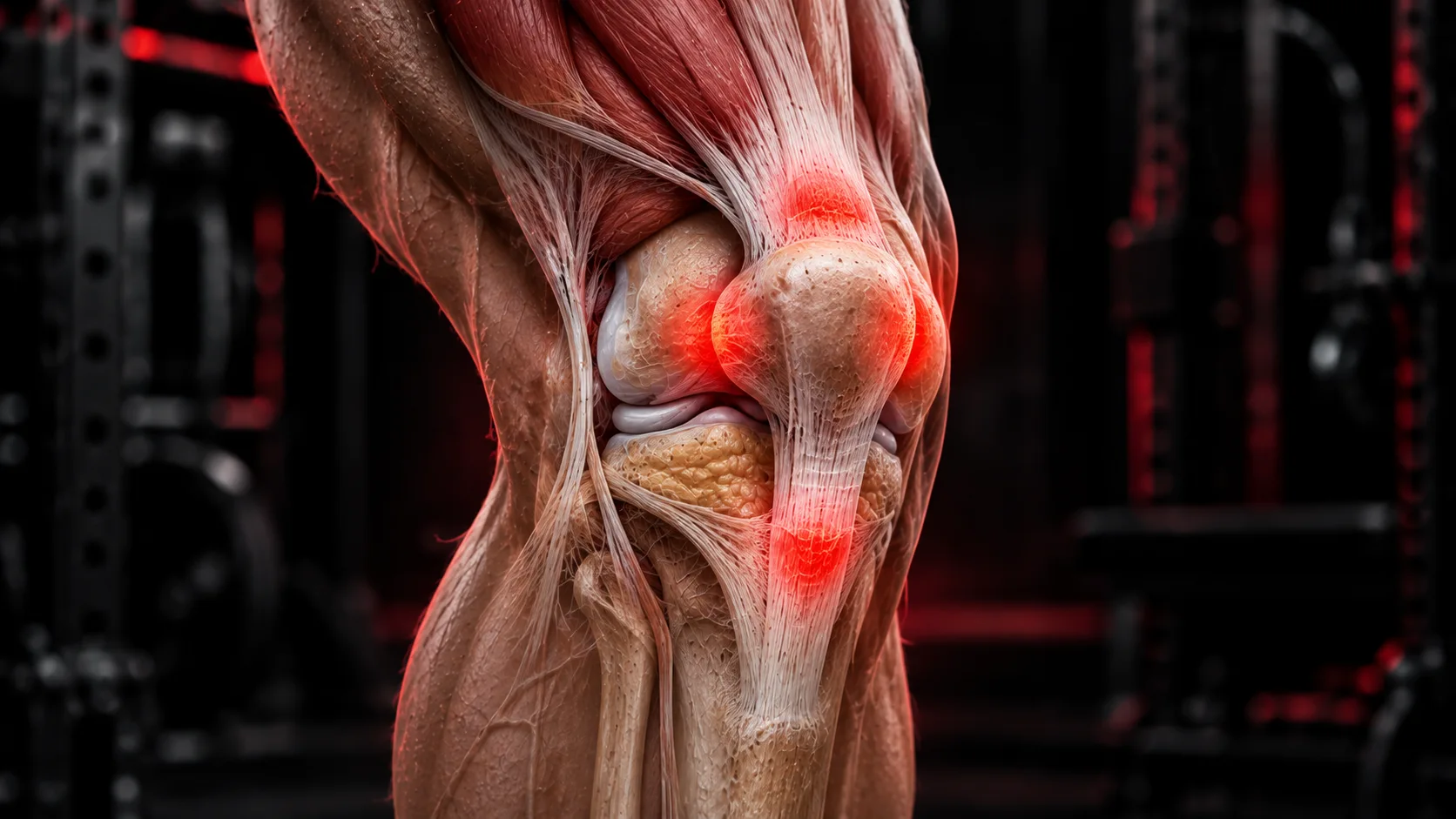
Above the kneecap. The quadriceps tendon attaches at the top of the patella and follows the same load logic as the patellar tendon below it; the differential for knee pain when squatting is position. Below the kneecap and deep in the joint. The infrapatellar fat pad is intracapsular, richly vascularised and innervated, carries substance P fibres and is implicated as a source of infrapatellar pain; inflammation and fibrosis in it follow trauma or surgery (PMID 22149697). A meniscus is the other deep candidate, and the section on scans explains why finding one on MRI often means nothing (PMID 18784100).
| Where and when | Usually | Read as |
|---|---|---|
| Diffuse, around or behind the kneecap; worse with depth, stairs, sitting | Patellofemoral pain; annual prevalence 22.7 percent (PMID 29324820); squatting listed first among aggravating activities (PMID 31475628) | Hip plus knee exercise has the evidence (PMID 26158920) |
| One fingertip at the lower tip of the kneecap; worse with energy-storing load | Patellar tendinopathy, diagnosed clinically (PMID 26390269) | Tendon loading, see the cornerstone |
| Above the kneecap, same pattern | Quadriceps tendon | Same logic, different position |
| Below the kneecap, pinch at full flexion, puffy fat pad | Infrapatellar fat pad irritation (PMID 22149697) | Assessment; avoid provoking end range for now |
| Deep, with catching, locking or swelling | Meniscus or cartilage; a tear on MRI is common and often silent (PMID 18784100) | Clinician decides, not the scan alone |
| Sudden pop, giving way, cannot extend, hot swollen joint | Ligament, fracture, infection, inflammatory arthritis | Physician now |
What the squat does to the knee: forces by depth
The reason knees hurt when squatting and not when walking is mechanical and measurable. In the biomechanical review of the dynamic squat, patellofemoral compressive forces and tibiofemoral compressive and shear forces increased progressively as the knees flexed and decreased as they extended, peaking near maximum knee flexion; posterior shear, restrained by the posterior cruciate ligament, was low to moderate throughout, and anterior shear, restrained by the anterior cruciate ligament, was low and confined to 0 to 60 degrees. Knee forces were minimal between 0 and 50 degrees, which is why that range suits many rehabilitation patients, and the parallel squat was shown not to be injurious to the healthy knee (PMID 11194098).

Depth is where the gym argument lives, and the larger review settles most of it. Across 164 papers, the highest retropatellar compressive forces and stresses occur at 90 degrees; with further flexion the wrapping effect improves load distribution and force transfer, the contact area on the back of the kneecap enlarges and shifts, and retropatellar stress falls. Menisci, cartilage, ligaments and bone adapt to mechanical load, concerns about degenerative change in deep squats were judged unfounded, and half and quarter squats with comparatively supramaximal loads were judged more likely to favour degenerative change in the long term (PMID 23821469).
The 2001 review, written before that evidence, recommended the parallel squat over the deep squat for healthy athletes on the grounds that meniscal and ligament injury potential might increase with depth (PMID 11194098); the two reviews disagree on that point and the later one has the larger evidence base.
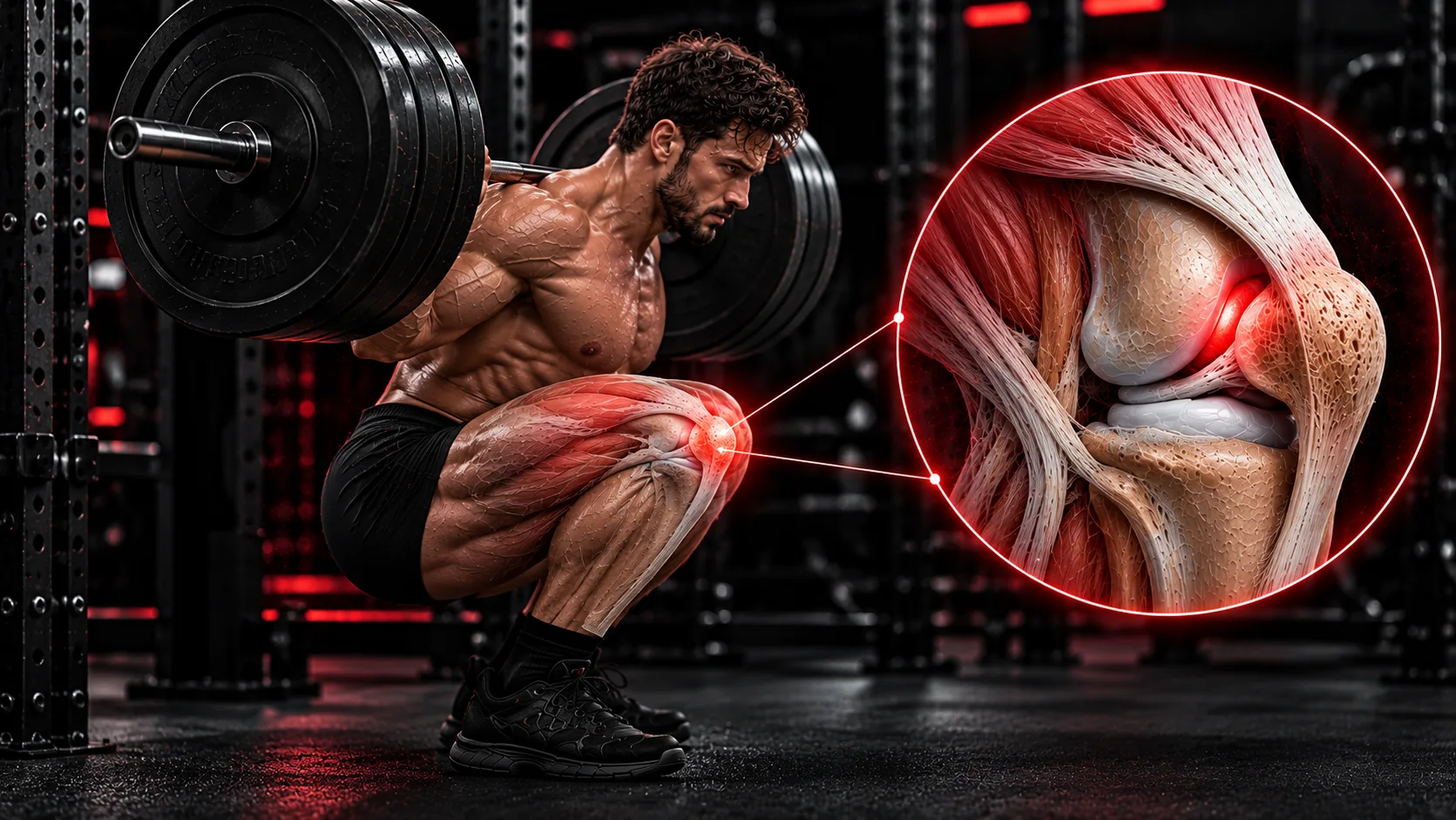
Depth also decides which muscle is working hardest, which matters for a painful knee. In ten strength-trained women squatting at 50 to 90 percent of one-repetition maximum, knee extensor relative effort rose with squat depth but not with barbell load, ankle plantar flexor effort rose with load but not depth, and hip extensor effort rose with both (PMID 22797000). A lifter whose knee pain when squatting is quadriceps-tendon or kneecap pain is loading the complaining structure hardest at the bottom, regardless of how light the bar is; one whose problem is the hip is not.
Direction of load matters as much as depth. On a single-leg decline squat, tilting the board 15 degrees or more raised the knee moment 40 percent while the hip and ankle moments fell, a 10 kg backpack at 25 degrees raised the knee moment a further 23 percent, and above 60 degrees of flexion the patellofemoral force rose faster than the patellar tendon force (PMID 17224441).
A 25 degree decline also increased patellar tendon strain and knee extensor activation compared with a flat surface (PMID 16675081). Forward knee travel, elevated heels and a more upright torso move load toward the knee by the same mechanics, and they are the first things to check when a knee hurts when squatting one way and not another; a hip-dominant squat moves it away.
Pain behind the kneecap: what the patellofemoral trials measured
Why do my knees hurt when I squat, with a diffuse ache around the kneecap that also shows up on stairs and after sitting? That is patellofemoral pain, and it is the best-studied answer to knee pain when squatting. The international research retreat has produced consensus statements on its terminology, examination and natural history (PMID 27343241) and on a pathomechanical model for it (PMID 29109118), and the 2019 clinical practice guideline reviewed about 4,500 studies published between 1960 and 2018 (PMID 31475628).
Diagnosis is clinical and imperfect. A systematic review of 25 clinical tests found only two with any diagnostic trend: patellar tilt, with a positive likelihood ratio of 5.4 and negative of 0.6, and the squat itself, with a positive likelihood ratio of 1.8 and negative of 0.2, neither reaching the thresholds of 10 and 0.1 that define clear diagnostic value (PMID 23232069). Reproducing knee pain when squatting in the clinic is suggestive; its absence is more informative than its presence.

Treatment evidence points away from the knee. The Cochrane review pooled 31 trials with 1,690 participants: exercise beat control for pain during activity by 1.46 points on a 10-point scale, for usual pain by 1.44, and for function by 12.21 points in the short term, with a trend to better long-term recovery; hip plus knee exercise beat knee exercise alone for pain during activity by 2.20 points and for usual pain by 1.77, on very low quality but consistent evidence (PMID 26158920).
The systematic review of proximal rehabilitation found strong evidence that hip combined with quadriceps work reduced pain and improved function in the short term, moderate evidence that it beat quadriceps work alone in the medium term, and limited evidence that the combination held a greater pain reduction at one year (PMID 26175019).
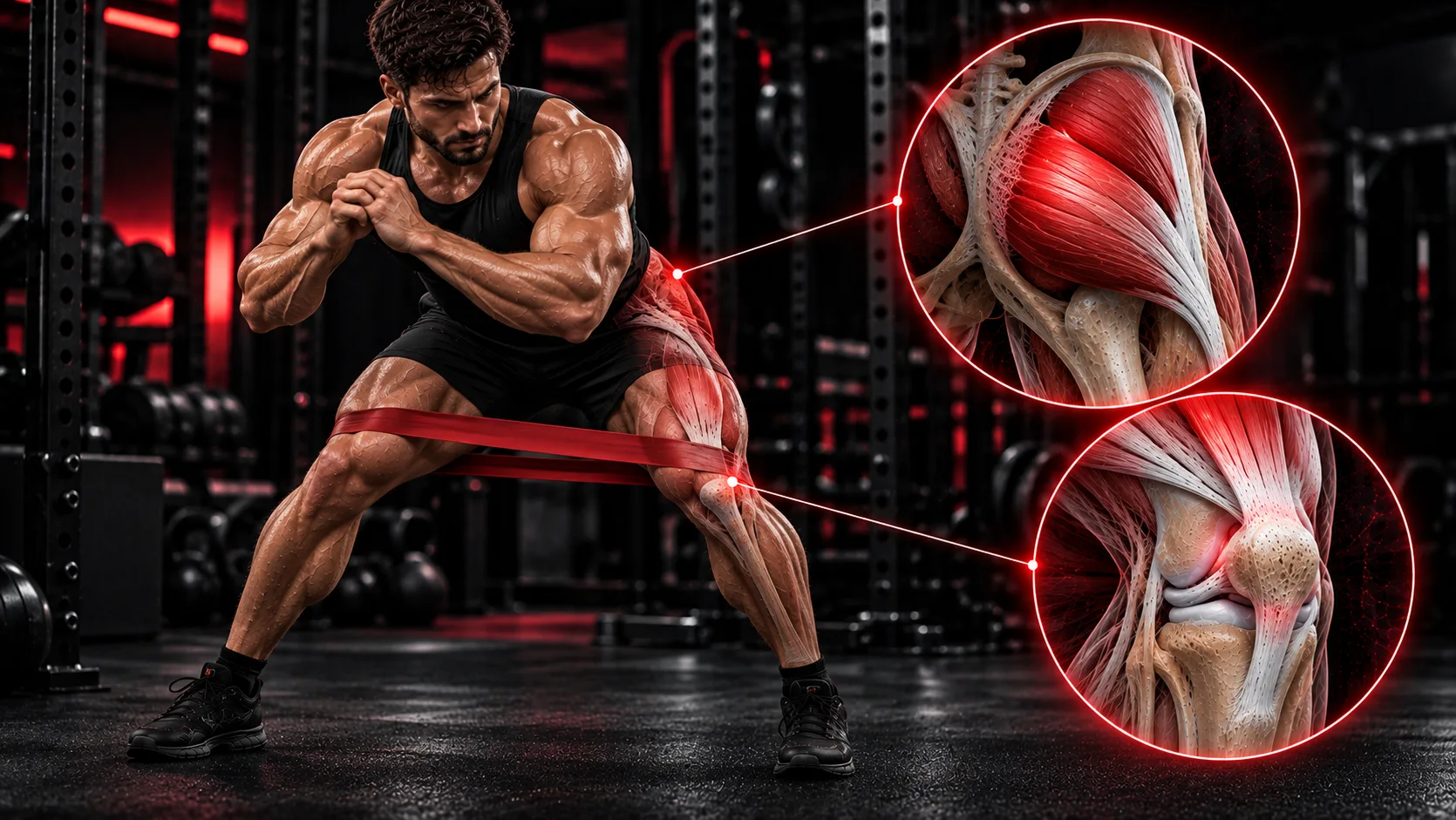
The 2018 consensus statement, voted on by 41 patellofemoral experts, recommends exercise therapy and especially the combination of hip-focused and knee-focused exercise, combined interventions and foot orthoses; it does not recommend patellofemoral, knee or lumbar mobilisations in isolation or electrophysical agents, and it lists taping and bracing, acupuncture and dry needling, manual soft tissue techniques, blood flow restriction training and gait retraining as uncertain (PMID 29925502). For a lifter whose knees hurt when squatting this reads simply: the squat is where the pain shows, the hip is where part of the fix was measured, and the knee sleeve and the massage gun are in the uncertain column. Adolescents may behave differently from adults with the same diagnosis (PMID 26178330).
Pain at the tip of the kneecap: the patellar tendon
When knees hurt when squatting at one precise point at the bottom of the kneecap, the structure is the patellar tendon, and the rules change. The two hallmark features are pain localised to the inferior pole of the patella and load-related pain that increases with the demand on the knee extensors, notably in activities that store and release energy in the tendon; management focuses on progressively developing the load tolerance of the tendon, the musculotendinous unit and the kinetic chain, and the authors warn that rehabilitation can be slow and sometimes frustrating (PMID 26390269).
The squat is both the provocation and, done differently, the treatment. The decline single-leg squat used in the tendon trials raised patellar tendon force 40 percent and knee moment by shifting load from hip and ankle to knee (PMID 17224441) and increased tendon strain and quadriceps activation (PMID 16675081); that is the mechanism behind its clinical use, and the same mechanism, uncontrolled, is why knees hurt when squatting after a quad-dominant heavy week.
In the loading trials, slow heavy resistance and eccentric decline squats improved patellar tendinopathy and held the result at six months while a corticosteroid injection did not (PMID 19793213), and a single bout of isometric knee extension holds reduced patellar tendon pain from 7.0 to 0.17 out of 10 for at least 45 minutes (PMID 25979840). Those trials, the continuum model and how long it takes are on tendonitis vs tendinosis; this page only places the tendon on the map.
Prevalence tells you how often this is the answer to knee pain when squatting. Jumper knee affected 8.5 percent of 891 non-elite athletes across seven sports, 14.4 percent in volleyball and 2.5 percent in soccer, with symptoms lasting 18.9 months on average and the affected athletes younger, taller and heavier (PMID 25091500). No equivalent survey exists for lifters; the lifter data that exists is in the section below.
Why the scan rarely settles knee pain when squatting
The lifter with knee pain when squatting usually wants an MRI, and the MRI usually finds something. In 991 adults aged 50 to 90, a meniscal tear or meniscal destruction was present in 19 percent of women aged 50 to 59 and 56 percent of men aged 70 to 90; among people with radiographic osteoarthritis the tear was present in 63 percent of those with frequent knee pain and 60 percent of those without, and among people without arthritis in 32 percent with pain and 23 percent without. Sixty-one percent of everyone with a tear had no pain, aching or stiffness in the previous month (PMID 18784100).
The same is true of the tendon and the kneecap. Asymptomatic tendon pathology on imaging can exist in people whose pain comes from another anterior knee source, which is why the diagnosis of patellar tendinopathy is clinical (PMID 26390269), and the clinical tests for patellofemoral pain do not reach diagnostic thresholds either (PMID 23232069). The fat pad is a source of infrapatellar pain in its own right that imaging describes but does not grade for pain (PMID 22149697). A scan rules out the things on the red flag list; it does not tell a lifter why the knee hurts when squatting.
Stance, depth and bar position: what the measurements say to change
Knee pain when squatting is sensitive to geometry, and three measured variables move the load. The first is stance width and foot angle. In a motion-analysis study of squat variations, both stance width and foot placement angle changed the hip and knee moments in the frontal and sagittal planes; a wider foot angle increased the difference between knee and hip displacement, a wider stance decreased it, novices showed larger values than experienced lifters, added weight reduced them, and the largest knee and hip moments appeared at the extremes, a narrow stance with feet turned out 42 degrees and a wide stance with feet straight at 0 degrees (PMID 30026952).
The second is depth, and for knee pain when squatting the finding cuts both ways. Retropatellar stress peaks around 90 degrees and falls below it (PMID 23821469), so the lifter who shortens the squat to protect a sore kneecap may be parking every rep at the worst angle; the lifter who goes deep is loading the knee extensors hardest at the bottom regardless of load (PMID 22797000), which is the stimulus for a healthy tendon and the provocation for a reactive one.
The third is how far forward the knee travels relative to the hip: the decline board raised knee moment 40 percent and tendon force with it (PMID 17224441), and forward knee travel, heel elevation and an upright torso move load the same way, so they are where to look first when knee pain after squats follows a change of style.
| Variable | What was measured | Read as |
|---|---|---|
| Stopping at 90 degrees | The angle of peak retropatellar stress across 164 papers (PMID 23821469) | Worst angle for kneecap pain |
| 0 to 50 degrees | Knee forces minimal; the range used in rehabilitation (PMID 11194098) | Where a reactive knee can keep training |
| Full depth | Retropatellar stress lower than at 90 through the wrapping effect (PMID 23821469); knee extensor effort highest (PMID 22797000) | Good for the kneecap, demanding for the tendon |
| Forward knee travel, heel wedge, upright torso | Decline of 15 degrees or more: knee moment and patellar tendon force plus 40 percent, hip and ankle moments down (PMID 17224441) | More tendon and kneecap load |
| Hip-dominant squat, more forward lean | The reverse of the decline geometry; hip extensor effort rises with load and depth (PMID 22797000) | Shifts load away from the knee |
| Extreme stance: narrow with 42 degree toe-out, or wide with 0 degrees | Largest knee and hip joint moments observed (PMID 30026952) | Avoid the extremes |
| Experience and load | Novices showed larger knee-hip displacement differences; added weight reduced them (PMID 30026952) | Technique variability is a novice problem |
How common knee pain when squatting is in lifters, and what men describe
Weight training produces fewer injuries than contact sport, and knee pain when squatting has a known base rate: the knee is reliably among the top three injury sites. Across nine studies of weightlifters and powerlifters, the spine, shoulder and knee were the most common injury locations in both sports, with 2.4 to 3.3 injuries per 1,000 training hours in weightlifting and 1.0 to 4.4 in powerlifting, and only one retrospective study had looked at risk factors (PMID 27707741).
Across 20 studies of all weight-training sports, bodybuilding had the lowest rates at 0.12 to 0.7 injuries per lifter per year, strains, tendinitis and sprains were the most common types, and the knee sat with the shoulder, lower back, elbow and wrist among the usual sites (PMID 27328853).

The survey that best describes the lifter whose knees hurt when squatting is Swedish. Of 104 subelite powerlifters, 70 percent were currently injured and 87 percent had been injured in the previous 12 months; the lumbopelvic region, shoulder and hip led, injuries occurred in training, and only 16 percent of those currently injured had completely stopped training. Training frequency, a higher deadlift best, onset during bench or deadlift training, the use of straps, alcohol and dietary issues were associated with current injury, and the authors suspect training load management and technique in the three lifts (PMID 29785405).
In 245 competitive powerlifters, 43.3 percent reported problems during routine workouts, the knee was among the three most injured regions, and the injury rate was 0.3 per lifter per year (PMID 21590644).
What men describe. On forums, lifters describe knee pain when squatting that is worst in the first warm-up sets and eases once the knee is warm, then returns the next morning on stairs; a sharp point at the bottom of the kneecap after a block of high-bar or front squats; a dull ache behind the kneecap after leg press and lunges; knee pain after squats that peaks the day after a volume jump; relief from a knee sleeve, heat or a longer warm-up; and years of rotating between squat variations to work around it. Men on anabolic steroids describe squats climbing faster than their knees and tendons adapt (forum posts).
What is measured. Knee pain when squatting that eases with warming and returns the next day is the reactive and dysrepair tendon presentation (PMID 26390269). Knee pain after squats that follows a volume jump is consistent with knee extensor effort rising with depth regardless of load (PMID 22797000) and with the load-management suspicion in the powerlifting survey (PMID 29785405). Knee sleeves and taping sit in the uncertain column of the 2018 consensus (PMID 29925502). No trial on this page measured knee injury in men using anabolic steroids, so the described mismatch between strength and tendon is unquantified; the pharmacology is on what are anabolic steroids. Lifters also describe dry knees on Winstrol and quiet knees on Deca-Durabolin, reports covered on those pages rather than trial results (forum posts); knees that ache together with every other joint and a dead libido on a cycle fit the low-estradiol picture on low estrogen on cycle rather than anything in the squat; and the peptides lifters mention for a sore knee rest on rodent data, reviewed on BPC-157.
What the measurements imply for the next session
Nothing here is a protocol or a diagnosis; it is what the biomechanics and the trials measured, read as principles for a lifter deciding what to do with knee pain when squatting this week, and for the morning-after version, knee pain after squats.
Locate it first. Diffuse around the kneecap, one fingertip at its lower tip, above it, or deep with catching or swelling are four different kinds of knee pain when squatting with four different evidence bases (PMID 31475628, PMID 26390269, PMID 22149697, PMID 18784100). Anything on the red flag list below is a clinician, not a cue.
Do not retreat to the half squat for knee pain when squatting behind the kneecap. Retropatellar stress peaks around 90 degrees and is lower both above 50 degrees of flexion and at full depth (PMID 11194098, PMID 23821469). The reduced range that feels protective is the most loaded range for the kneecap.
Move load off the knee with geometry, not with less training. Less forward knee travel, no heel wedge, a more hip-dominant pattern and a stance away from the extremes all reduced knee moment in the measurements (PMID 17224441, PMID 30026952); the hip and ankle take what the knee gives up. Dumbbell and single-leg patterns that keep the quads working while the barbell squat is adjusted are laid out on the full body dumbbell workout.
For kneecap pain, train the hip as well as the knee. Hip plus knee exercise beat knee exercise alone by 2.20 points on pain during activity (PMID 26158920), and the combination is what the 2018 consensus recommends (PMID 29925502).
For tendon pain, follow the tendon rules. Load it heavily and slowly rather than resting it, use isometric holds for the session, and judge the result at 12 weeks, the length of the loading programmes (PMID 25979840, PMID 19793213, PMID 26390269); the full picture is on tendonitis vs tendinosis.
Count the volume jump before blaming the exercise for knee pain after squats. Knee extensor effort rises with depth regardless of load (PMID 22797000), so a week with more deep sets is a bigger knee week even at the same weight; the powerlifting survey suspects training load management first (PMID 29785405). How weekly sets are counted is on training volume explained.
When knee pain when squatting needs a clinician, not a cue
This page describes load-related knee pain when squatting in otherwise healthy adults, which is what the trials and surveys recruited. Several other problems feel like knee pain when squatting and are not, and no stance change sorts them out. See a physician or physiotherapist promptly for any of the following.
A sudden pop or tearing sensation with immediate swelling, giving way or inability to continue. That is the picture of a ligament or meniscal injury, not a loading problem; the squat generates shear forces on the cruciate ligaments throughout the movement even when low (PMID 11194098).
A locked knee that will not fully straighten or bend, or catching that stops the movement. Mechanical symptoms point to a displaced meniscal fragment or loose body, which is a different question from the silent tears common on MRI (PMID 18784100).
A hot, red, swollen joint, fever, or pain that is severe at rest and at night. Infection, gout and inflammatory arthritis present this way and are excluded first. Numbness, tingling or weakness below the knee points to a nerve rather than a joint. Pain after a fall or direct impact with deformity or inability to bear weight needs imaging for fracture.
Knee pain when squatting that has not changed after 12 weeks of a structured programme, the point at which the tendon trials had measured their effect and the patellofemoral trials had reported, is a reason for assessment rather than another variation (PMID 26390269). Adolescents with kneecap pain are a different population from adults and should be assessed as such (PMID 26178330).
Five knee pain when squatting mistakes the measurements expose
Each comes from treating the location of knee pain when squatting as the location of the fix.
1. Squatting shallower to spare the kneecap. Retropatellar stress peaks around 90 degrees (PMID 23821469); the half squat lives there.
2. Fixing kneecap pain only at the knee. Hip plus knee exercise beat knee exercise alone by 2.20 points (PMID 26158920); proximal plus quadriceps work held a greater pain reduction at one year (PMID 26175019).
3. Letting the scan decide. Sixty-one percent of meniscal tears were painless (PMID 18784100); tendon pathology on imaging can be asymptomatic (PMID 26390269).
4. Resting a tendon until the knee stops hurting when squatting. The tendon trials treated the patellar tendon with load, not rest, and the decline squat that loads it 40 percent more is the treatment, not the enemy (PMID 17224441, PMID 26390269).
5. Changing the exercise instead of the load when knees hurt when squatting. Seventy percent of subelite powerlifters were injured and 16 percent had stopped training; the authors point to training load management and technique, not to exercise selection (PMID 29785405).
Verdict: knee pain when squatting is a location, a depth and a load, not a verdict on the squat
Read from the biomechanics papers, the consensus statements and the surveys, knee pain when squatting works like this. Four structures at the front of the knee produce four patterns, and the most common by far is pain around the kneecap that one adult in five reports in a year (PMID 29324820, PMID 31475628). The squat loads all of them more as the knee bends (PMID 11194098), but the kneecap is stressed most around 90 degrees and less at full depth (PMID 23821469), the knee extensors work hardest at the bottom regardless of load (PMID 22797000), and forward knee travel shifts load to the tendon by 40 percent (PMID 17224441).
What was measured to help was exercise, and for the kneecap specifically hip plus knee exercise, worth 2.20 points more than knee exercise alone (PMID 26158920, PMID 29925502); for the tendon it was heavy slow load rather than rest (PMID 26390269). Scans found tears in 61 percent of painless knees (PMID 18784100). Lifters carry these problems at a rate of 70 percent and only 16 percent stop training (PMID 29785405), which is exactly why the knees hurt when squatting question deserves a plan rather than a shrug.
For readers here the practical reading is that knee pain when squatting has four usual answers and the squat itself is rarely one of them: find the spot, stop parking at 90 degrees, move load with stance and knee travel rather than with rest, train the hip for the kneecap and load the tendon for the tendon, and see a clinician for anything on the red flag list. The tendon model is on tendonitis vs tendinosis, the loading side on progressive overload explained, the dose side on training volume explained; the hub is training hub.
Knee pain when squatting: frequently asked questions
Why do my knees hurt when I squat?
Because the squat loads four structures at the front of the knee more as the knee bends, and one of them is the source of the knee pain when squatting. Patellofemoral compressive forces rise progressively with knee flexion and peak near maximum flexion (PMID 11194098). The most common source is patellofemoral pain, diffuse pain around or behind the kneecap worsened by squatting, stairs and sitting, with an annual prevalence of 22.7 percent (PMID 29324820, PMID 31475628); the others are the patellar tendon at the lower tip of the kneecap (PMID 26390269), the quadriceps tendon above it, and the fat pad or meniscus below and behind it (PMID 22149697).
Is deep squatting bad for your knees?
Not according to the largest review. Across 164 papers, retropatellar compressive stress peaked at 90 degrees of knee flexion and fell with deeper flexion as the wrapping effect spread the load over a larger contact area; concerns about degenerative change in deep squats were judged unfounded, and half and quarter squats with supramaximal loads were judged more likely to favour degenerative change over time (PMID 23821469). The earlier 2001 review recommended the parallel squat over the deep squat for healthy athletes on the grounds that meniscal and ligament injury potential might rise with depth (PMID 11194098); the two disagree on that point and the later review has the larger evidence base.
Should I stop squatting if my knee hurts?
Usually change the geometry and the load rather than stopping, unless a red flag is present. Knee forces are minimal from 0 to 50 degrees of flexion (PMID 11194098), forward knee travel raised knee moment and tendon force 40 percent (PMID 17224441), and extreme stances produced the largest knee moments (PMID 30026952), so when knees hurt when squatting there is a lot to change before resting. Of 104 subelite powerlifters, 70 percent were injured and only 16 percent had stopped training (PMID 29785405). A pop with swelling or giving way, a locked knee, a hot swollen joint, numbness or pain unchanged after 12 weeks are reasons to see a clinician.
Why does knee pain after squats come the next day?
Knee pain after squats has two measured reasons. Knee extensor effort rises with squat depth regardless of barbell load (PMID 22797000), so a session with more deep sets is a larger knee session even at the same weight, and the load-related pain of a tendon typically follows the session rather than interrupting it (PMID 26390269). The pattern of a tendon that warms up during the session and is loud the next morning is the reactive and dysrepair presentation described on the tendon page. Pain that peaks the day after a volume jump fits the training load management the powerlifting survey suspects (PMID 29785405).
Does knee pain when squatting mean I have a meniscus tear?
A scan may find one, and that is not the same thing. In 991 adults, a meniscal tear on MRI was present in 19 to 56 percent depending on age and sex, 61 percent of people with a tear had no pain, aching or stiffness in the previous month, and the tear was almost as common in painless knees as in painful ones (PMID 18784100). Mechanical symptoms, a knee that locks or catches or gives way, change that calculation and need a clinician. Without them, the tear on the report is frequently a bystander.
Do knee sleeves, wraps or taping help knee pain when squatting?
Not established. The 2018 international consensus on patellofemoral pain recommends exercise therapy, especially combined hip and knee exercise, and foot orthoses; it lists patellar taping and bracing, acupuncture and dry needling, manual soft tissue techniques, blood flow restriction training and gait retraining as uncertain, and does not recommend isolated mobilisations or electrophysical agents (PMID 29925502). Lifters describe relief from sleeves and warmth (forum posts); that is a description, and the trials have not measured it.
What is the difference between patellar tendonitis and patellofemoral pain?
Location and behaviour. Patellar tendinopathy is pain at one point, the inferior pole of the patella, that rises with the demand on the knee extensors and with energy-storing load, and is diagnosed clinically (PMID 26390269). Patellofemoral pain is poorly defined pain around or behind the kneecap worsened by squatting, sitting, stairs, jumping and running (PMID 31475628). The treatments differ: the tendon responded to heavy slow loading and isometric holds (PMID 19793213, PMID 25979840), the kneecap to combined hip and knee exercise (PMID 26158920). The tendon side is on the tendonitis vs tendinosis page.
How long does knee pain from squatting last?
Knee pain after squats lasts as long as the structure behind it takes to settle, and the trials give the scale. Patellofemoral pain can recur and persist for years and its long-term prognosis is described as poor (PMID 31475628, PMID 29324820); exercise improved pain and function within the short term in the Cochrane trials, with a trend to better long-term recovery (PMID 26158920). Patellar tendinopathy rehabilitation is described as slow and sometimes frustrating (PMID 26390269), with the main result of the 12-week loading programmes holding at six months (PMID 19793213). Jumper knee symptoms in non-elite athletes lasted 18.9 months on average (PMID 25091500).
Sources and further reading
Every figure on this page about knee pain when squatting comes from one of the 25 papers below, each checked against its PubMed abstract in September 2026. Where two reviews disagree, both are cited and the disagreement is stated. Forum descriptions are reported as descriptions and carry no reference number. Reference links are dofollow to support open science.
Keep reading
Four pages from the training series: the tendon model this page rests on, how load is progressed, a squat programme to apply it to, and the muscle side of recovery.
Final Educational Note
This article is educational and is not medical, physiotherapy or coaching advice. It reports what biomechanical studies, systematic reviews, consensus statements and injury surveys say about knee pain when squatting, and it reports how some lifters describe their own knees as a description of experience, not as guidance. Exercises and loading appear only as the studies used them; the page gives no protocol, does not diagnose, and does not recommend any treatment. More guides sit on the training hub.
A pop with swelling or giving way, a locked knee, a hot or red joint, fever, numbness or weakness, pain after a fall with deformity, pain at night or at rest, or knee pain unchanged after 12 weeks of a structured programme are reasons to consult a physician or physiotherapist. Individual knees vary widely. Read more about how this site works on the about page and in the full disclaimer.