Tesamorelin
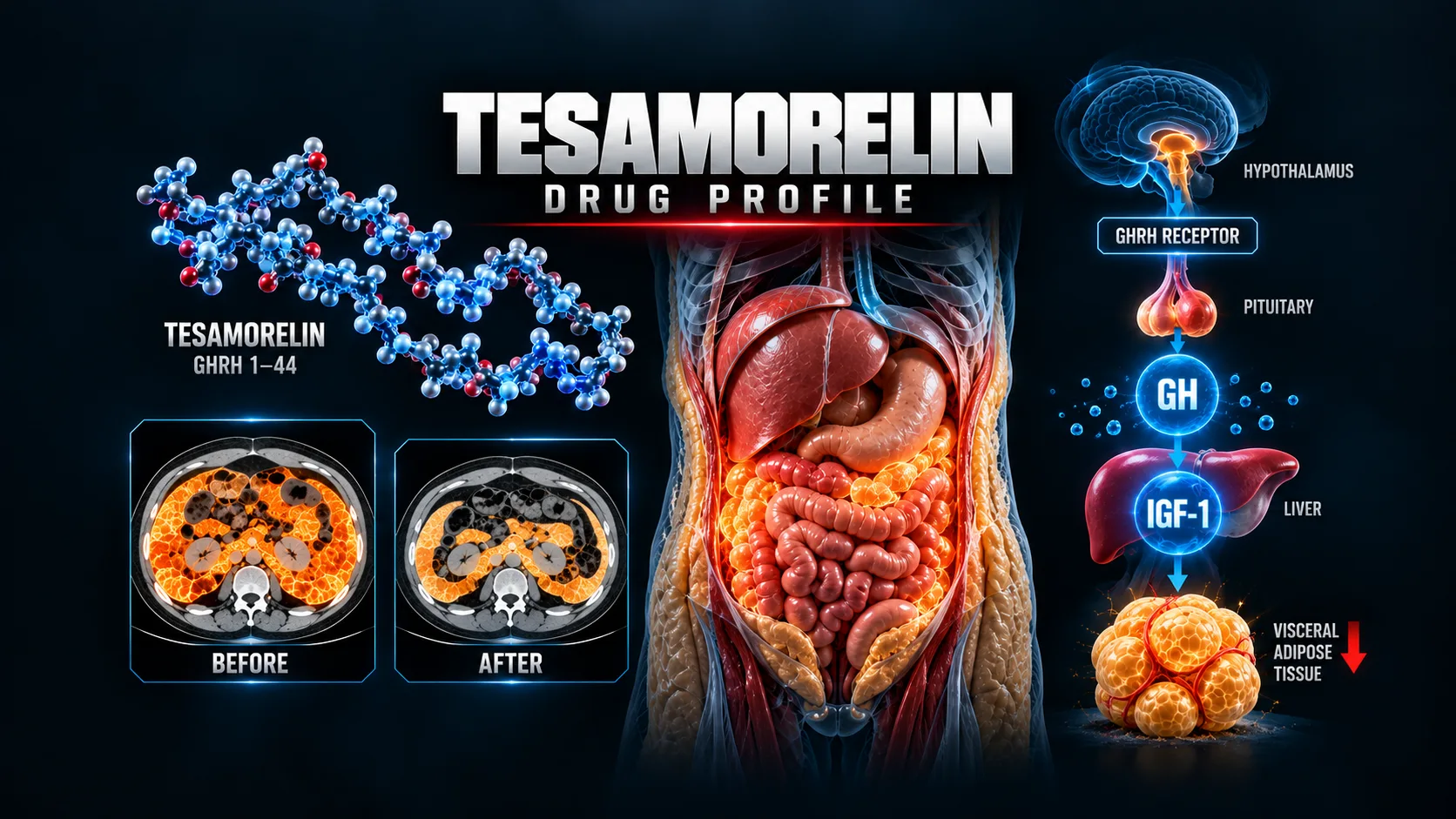
TESAMORELIN (EGRIFTA): 7 PROVEN FACTS, DOSAGE, SIDE EFFECTS
Tesamorelin is the only growth hormone releasing hormone analogue with an FDA label. Approved in 2010 as EGRIFTA for the reduction of excess abdominal fat in HIV-infected adults with lipodystrophy, it is a stabilised copy of the full 44-amino-acid hormone that tells the pituitary to release growth hormone in pulses (EGRIFTA prescribing information). In the two phase 3 trials that earned the approval, 2 mg injected daily for 26 weeks cut visceral fat 15.2 percent while placebo added 5.0 percent, raised IGF-1 by 81 percent, lowered triglycerides by 50 mg per decilitre and left glucose unchanged (PMID 18057338). Stop the injections and the fat comes back (PMID 18690162).
That label is why the tesamorelin peptide is sold online as the legal cousin of CJC-1295 and why gym users describe running it for stubborn belly fat. This page reads the record in full: the molecule, the label with its doses, contraindications and warnings, the five randomised trials in HIV, the trials in people without HIV, the cognition studies, how users describe using it as a description and not a protocol, the tesamorelin side effects the label quantifies, and how it compares with sermorelin and CJC-1295. Doses appear only as the label or a trial abstract states them. The class is on growth hormone peptides.
Tesamorelin in brief
Three numbers frame the drug: what it did to visceral fat against placebo, what it did to IGF-1, and how long a single injection actually lasts.
In 412 patients with HIV and abdominal fat accumulation, visceral fat fell 15.2 percent on tesamorelin and rose 5.0 percent on placebo; triglycerides fell 50 mg per decilitre against a 9 mg rise; the total to HDL cholesterol ratio improved; glycemic measures did not differ (PMID 18057338). The second phase 3 trial of 404 patients found 10.9 percent against 0.6 percent at six months and about 18 percent at twelve (PMID 20101189).
IGF-1 is the readout of a working growth hormone axis and the number the label tells prescribers to monitor: 47 percent of treated patients had an IGF-1 above 2 standard deviations at 26 weeks and 36 percent above 3, and the label says to consider stopping when the elevation persists above 3 SDS, particularly if the fat response is not robust (EGRIFTA prescribing information).
The peptide is gone in minutes; what it leaves behind is a pulse of the body's own growth hormone. In 13 healthy men, two weeks of 2 mg daily raised mean overnight growth hormone, pulse area and basal secretion, raised IGF-1 by 181 micrograms per litre, and did not change fasting glucose or insulin-stimulated glucose uptake on a clamp (PMID 20943777). The daily injection works by repeating that pulse.
Every figure on this page is taken from a PubMed abstract or from the EGRIFTA prescribing information, all listed at the end. Tesamorelin doses are quoted only where the label or a trial abstract states them; how gym users describe the tesamorelin peptide is reported as their description, not as a protocol.
What this tesamorelin guide covers
What tesamorelin is: the stabilised GHRH 1-44 molecule, the three EGRIFTA formulations, and why an 11-minute half-life produces a day-long effect.
The label: indication, the three doses across formulations, contraindications, the seven warnings, the adverse reaction table against placebo, and the limitations of use.
The trials: the dose-ranging study, both phase 3 trials with their extensions, the liver fat trials, and the 2026 meta-analysis.
Tesamorelin without HIV: abdominal obesity, type 2 diabetes, healthy men, and the cognition trials in older adults.
How gym users describe the tesamorelin peptide, separately from what is measured, plus tesamorelin side effects and the comparison with sermorelin, CJC-1295 and ipamorelin.
Not coveredA dose, schedule or cycle for fat loss, bodybuilding or anti-ageing. The label states that EGRIFTA is not indicated for weight loss and that its effect on weight is neutral; this page gives no protocol outside the label.
HIV lipodystrophy as a condition and antiretroviral therapy. The trials in those patients are cited for what they measured; management belongs to HIV physicians.
The rest of the peptide field. That sits on what are peptides and the peptides hub.
What is tesamorelin? A stabilised GHRH with a label
Growth hormone releasing hormone, GHRH, is a 44-amino-acid peptide from the hypothalamus that binds receptors on the pituitary somatotrophs and drives the synthesis and pulsatile release of growth hormone. Tesamorelin is that full sequence with a trans-3-hexenoic acid group on the N-terminus that protects it from the enzyme dipeptidyl peptidase IV, which otherwise inactivates GHRH within minutes. The label describes it as binding and stimulating human growth hormone releasing factor receptors with a potency similar to the endogenous hormone, and stimulating the synthesis and pulsatile release of endogenous growth hormone (EGRIFTA prescribing information).
The design goal was different from CJC-1295. Where CJC-1295 was engineered to bind albumin and stay in the blood for a week, tesamorelin keeps the natural short life of the hormone, an elimination half-life of 11 minutes with a median time to peak of 0.15 hours and subcutaneous bioavailability below 4 percent, and relies on a daily injection to deliver one physiological pulse a day (EGRIFTA prescribing information). Two weeks of that pulse in 13 healthy men raised mean overnight growth hormone, pulse area and basal secretion, and raised IGF-1 by 181 micrograms per litre, while insulin-stimulated glucose uptake on a euglycemic clamp was preserved (PMID 20943777).
The three formulations matter because the trials, the forum posts and the vendor listings quote different milligram figures for what is meant to be the same daily exposure. The 2 mg dose is the one in every trial abstract on this page; the 1.4 mg and 1.28 mg doses are newer formulations of the same drug with higher bioavailability per milligram, designed to give the same effect with less powder (EGRIFTA prescribing information). A vial of research-grade tesamorelin bought online is labelled in milligrams of peptide and says nothing about which formulation it resembles. The naming of these compounds is on types of peptides.
The EGRIFTA label: dose, contraindications, warnings
Tesamorelin is the one peptide on this site where the dose question has an official answer, so the label is quoted in full rather than paraphrased. The indication is the reduction of excess abdominal fat in HIV-infected adult patients with lipodystrophy. The recommended dose is 2 mg subcutaneously once daily for the original EGRIFTA, 1.4 mg once daily for EGRIFTA SV, and 1.28 mg once daily into the abdomen for EGRIFTA WR, where one 11.6 mg vial reconstituted with 1.3 ml of bacteriostatic water provides seven daily doses of 0.16 ml (EGRIFTA prescribing information).
| Section | What the label states | Read as |
|---|---|---|
| Contraindications | Disruption of the hypothalamic-pituitary axis from hypophysectomy, hypopituitarism, pituitary tumour or surgery, or head irradiation; active malignancy; known hypersensitivity to tesamorelin or excipients; pregnancy (EGRIFTA prescribing information) | Four absolute contraindications |
| Neoplasms | Tesamorelin induces the release of endogenous growth hormone, a known growth factor; do not treat patients with active malignancy; any pre-existing malignancy must be inactive and treatment complete; discontinue if recurrence occurs (EGRIFTA prescribing information) | Growth factor warning |
| Elevated IGF-1 | 47 percent of treated patients had an IGF-1 above 2 SDS at 26 weeks and 36 percent above 3 SDS; monitor IGF-1 during therapy; consider discontinuing in patients with persistent elevations above 3 SDS, particularly if the efficacy response is not robust (EGRIFTA prescribing information) | The blood test that governs the drug |
| Fluid retention | May cause edema, arthralgia and carpal tunnel syndrome as manifestations of growth hormone excess (EGRIFTA prescribing information) | Class effect |
| Glucose intolerance | New glucose intolerance in 5 percent on EGRIFTA against 1 percent on placebo, hazard ratio 3.3; evaluate glucose before and during treatment (EGRIFTA prescribing information) | Label warning |
| Hypersensitivity | Reactions in 4 percent of patients; discontinue if suspected (EGRIFTA prescribing information) | Label warning |
| Injection site reactions | 25 percent against 14 percent on placebo in the first 26 weeks; rotate sites (EGRIFTA prescribing information) | Most common event |
| Critical illness | Consider discontinuation in critically ill patients (EGRIFTA prescribing information) | Growth hormone class |
| Limitations of use | Long-term cardiovascular safety not established; not indicated for weight loss management, weight-neutral effect; no evidence that it improves adherence to antiretroviral therapy (EGRIFTA prescribing information) | What the label rules out |
| Pharmacokinetics | Elimination half-life 11 minutes; median time to peak 0.15 hours; subcutaneous bioavailability below 4 percent (EGRIFTA prescribing information) | Why it is daily |
Two sentences on the label matter more than the rest for anyone who arrived here from a fat-loss search. The first: EGRIFTA is not indicated for weight loss management and has a weight-neutral effect (EGRIFTA prescribing information). The trials moved visceral fat on a CT scan, not the scale. The second: the long-term cardiovascular safety of the drug has not been established (EGRIFTA prescribing information), which is the caveat on every number in the next section.
The tesamorelin trials: what was measured in HIV lipodystrophy
The programme began with a dose-ranging study. Sixty-one HIV patients with increased waist circumference were randomised to placebo, 1 mg or 2 mg of the compound then called TH9507 once daily for 12 weeks; IGF-1 rose 48 percent on 1 mg and 65 percent on 2 mg, trunk fat fell 9.2 percent on 2 mg against a 0.8 percent rise on placebo, visceral fat fell 15.7 percent on 2 mg but not significantly against placebo in that small sample, subcutaneous fat was preserved, triglycerides and the cholesterol to HDL ratio improved, and glucose did not change (PMID 16052083). The 2 mg dose went forward to phase 3 (PMID 18057338).
The first phase 3 trial is the one on the label. Four hundred and twelve patients, 86 percent men, received 2 mg of tesamorelin or placebo daily for 26 weeks (PMID 18057338). Visceral fat on CT fell 15.2 percent against a 5.0 percent rise; triglycerides fell 50 mg per decilitre against a 9 mg rise; the total to HDL cholesterol ratio fell 0.31 against a 0.21 rise, all with p below 0.001; IGF-1 rose 81.0 percent against a 5.0 percent fall; adverse events did not differ but more patients on tesamorelin withdrew because of one; glycemic measures did not differ (PMID 18057338).

The extension answered the question every fat-loss reader asks. At week 26 the tesamorelin patients were re-randomised to continue or switch to placebo. Those who continued held a visceral fat reduction of 18 percent over 52 weeks and a triglyceride fall of 51 mg per decilitre, glucose changes were not clinically significant, adverse events in the extension matched the first phase, and in the patients who switched to placebo the visceral fat reaccumulated (PMID 18690162). The abstract closes with the sentence that defines the drug: the effects do not last beyond the duration of treatment.
The second phase 3 trial repeated the design in 404 patients. Visceral fat fell 10.9 percent, 21 square centimetres, against 0.6 percent on placebo at six months; trunk fat, waist circumference and waist to hip ratio improved with no change in limb or abdominal subcutaneous fat; patient distress about belly appearance improved; IGF-1 rose; glucose did not change; visceral fat was down about 18 percent in patients who continued for 12 months, and the gains were rapidly lost in those switched to placebo (PMID 20101189).
Liver fat became the second target. In a six-month trial of 50 patients, tesamorelin reduced visceral fat by 34 square centimetres against an 8 square centimetre rise, and cut the liver lipid to water fraction by 2.0 percent against a 0.9 percent rise; fasting glucose rose 7 mg per decilitre more than placebo at two weeks but the difference had gone by six months (PMID 25038357).
The 12-month multicentre trial in 61 people with HIV and fatty liver disease found a 37 percent relative reduction in hepatic fat fraction and no difference in glucose or HbA1c, with more injection-site complaints on drug (PMID 31611038). In the 38 participants of that trial who were on integrase inhibitors, the antiretrovirals now associated with weight gain, visceral fat fell 25 square centimetres against a 14 square centimetre rise and liver fat fell 4.2 percent against 0.5 percent, with a similar frequency of hyperglycemia in both groups (PMID 38905488).
A 2026 meta-analysis of five randomised trials pooled the results: visceral fat down 27.71 square centimetres, trunk fat down 1.18 kg, limb fat down 0.22 kg, hepatic fat down 4.28 percentage points, waist down 1.61 cm, lean mass up 1.42 kg, no significant change in subcutaneous fat or BMI, and adverse events of arthralgia, myalgia, paresthesia and injection-site erythema without serious events or glucose perturbation (PMID 41545261). A CT density analysis of 341 participants from the two phase 3 trials added that fat quality improved as well as quantity: visceral and subcutaneous fat density rose by 6.2 and 4.0 Hounsfield units on tesamorelin against 0.3 on placebo, independent of the area lost (PMID 33756511).
Tesamorelin without HIV: obesity, diabetes, healthy men and the ageing brain
The label stops at HIV, but the trials did not, and the studies in people without HIV are the ones most relevant to anyone reading this for their own waistline. The closest match is a 12-month randomised trial of 60 abdominally obese adults with reduced growth hormone secretion, chosen because obesity suppresses the axis. On 2 mg daily, visceral fat fell 16 square centimetres against a 19 square centimetre rise on placebo, carotid intima-media thickness fell 0.04 mm more than placebo, C-reactive protein and triglycerides improved, subcutaneous fat did not change, IGF-1 rose 86 micrograms per litre, fasting and two-hour glucose and HbA1c did not change, and there were no serious adverse events (PMID 23015655).
A substudy of 39 of those subjects linked the IGF-1 rise to faster phosphocreatine recovery in muscle after exercise, a marker of mitochondrial function (PMID 24178787).
The diabetes question was tested directly. Fifty-three patients with type 2 diabetes received placebo, 1 mg or 2 mg for 12 weeks: the insulin response to oral glucose, fasting glucose, HbA1c and overall diabetes control did not differ between groups, no patient left for loss of glycemic control, and total and non-HDL cholesterol fell on 2 mg (PMID 28617838). In healthy men, two weeks of 2 mg daily raised IGF-1 by 181 micrograms per litre with no change in fasting glucose or clamp-measured insulin sensitivity (PMID 20943777).
| Population | Result | Weight |
|---|---|---|
| 60 abdominally obese adults with reduced GH, 2 mg daily, 12 months (PMID 23015655) | Visceral fat minus 16 vs plus 19 square centimetres; carotid thickness, CRP and triglycerides improved; subcutaneous fat unchanged; glucose and HbA1c unchanged | Randomised |
| 53 patients with type 2 diabetes, 1 or 2 mg, 12 weeks (PMID 28617838) | No change in insulin response, fasting glucose or HbA1c; cholesterol fell on 2 mg | Randomised |
| 13 healthy men aged about 45, 2 mg daily, 2 weeks (PMID 20943777) | Overnight GH, pulse area and basal secretion up; IGF-1 up 181 micrograms per litre; clamp insulin sensitivity preserved | Uncontrolled, short |
| 152 adults aged 55 to 87, healthy or with mild cognitive impairment, 1 mg nightly, 20 weeks (PMID 22869065) | Favourable effect on cognition, p 0.03, executive function p 0.005; IGF-1 up 117 percent within the physiological range; body fat down 7.4 percent; fasting insulin up 35 percent in the impaired group | Randomised |
| 73 people with HIV, abdominal obesity and cognitive impairment, 2 mg daily, 6 months, open label (PMID 39813152) | Waist down 2.7 cm more than standard care; no significant cognitive difference between groups | No placebo, underpowered |
| Tesamorelin in athletes, bodybuilders or anyone with a normal growth hormone axis using it for fat loss | No study exists | Not measured |
The cognition trial is the one that travels furthest from the label and the one most often quoted out of context. One hundred and fifty-two adults aged 55 to 87, including 66 with mild cognitive impairment, self-injected 1 mg of tesamorelin or placebo 30 minutes before bed for 20 weeks; cognition improved on the composite score with p equal to 0.03, executive function with p equal to 0.005, IGF-1 rose 117 percent while staying in the physiological range, body fat fell 7.4 percent, and fasting insulin rose 35 percent within the normal range in the impaired group (PMID 22869065).
A later open-label trial in people with HIV found no clear cognitive benefit (PMID 39813152). Note the population in the positive trial: older adults whose growth hormone axis has declined with age, not young men whose axis is intact.
The tesamorelin peptide in the gym: how users describe it, and what is measured
This is the section the label cannot write, so the page reports two things separately: how users and the vendors who sell to them describe the tesamorelin peptide in practice, and the measured data that any of it could rest on. Nothing in the first half is evidence. It is a description of a pattern, and a pattern people describe is not a dose anyone should copy.
What users describe. On bodybuilding forums the tesamorelin peptide is sold as research-grade lyophilised powder in 5 mg or 10 mg vials, reconstituted with bacteriostatic water and drawn on an insulin syringe (forum posts). The dose users most often describe is 2 mg once a day, some going to 2.5 mg, with a minority describing 1 mg nightly on the grounds that the cognition trial used it; the timing they describe is a single injection as close to falling asleep as possible, at least an hour after the last meal, because they believe insulin blunts the growth hormone pulse (forum posts).
Runs are described as continuous for months rather than in cycles, on the argument that the HIV trials ran for a year without loss of effect, and the usual recommendation in the threads is to commit to six months before judging results (forum posts).
The stacks users describe are ipamorelin at 100 to 600 micrograms alongside, or CJC-1295 with GHRP-2, and the compound is usually described as running on top of testosterone replacement (forum posts). The reasons given are visceral fat, sleep and recomposition. The dissent in the same threads is about cost, since a month at the described dose consumes several vials, and about non-response: one user who ran 2.5 mg daily for over a month reported no result and an IGF-1 that had not risen (forum posts).
What the reasons rest on. The visceral fat idea is the best supported claim on this site: five randomised trials in HIV lipodystrophy, one in obese adults without HIV, and a meta-analysis all point the same way (PMID 41545261, PMID 23015655). Two qualifications travel with it. The effect is on visceral fat measured by CT, with subcutaneous fat unchanged and body weight neutral according to the label, which is not what a mirror or a scale shows (EGRIFTA prescribing information); and the fat returned within months of stopping in the extension study (PMID 18690162).
The sleep idea rests on growth hormone physiology and on the overnight secretion data in healthy men (PMID 20943777), which measured hormones, not sleep. The recomposition idea has one number behind it, 1.42 kg of lean mass in the meta-analysis of HIV patients (PMID 41545261).
What is measured that a lifter could use. First, IGF-1: it rose 81 percent in the pivotal trial and the label asks for it to be monitored, with discontinuation considered above 3 SDS (PMID 18057338, EGRIFTA prescribing information); anyone running the peptide who then has bloodwork drawn should expect that number to be high, and the blood tests before steroids page explains what it normally means.
Second, glucose: the label records new glucose intolerance in 5 percent against 1 percent with a hazard ratio of 3.3 (EGRIFTA prescribing information), even though the trials in diabetes and healthy men found no change (PMID 28617838, PMID 20943777).
The honest summary for a lifter is that tesamorelin is the one growth hormone secretagogue with real fat data, that the data are in people whose axis was suppressed, and that the label itself says it is not a weight-loss drug. How to read a research-chemical listing against a trial is on peptide research vs human use.
Tesamorelin side effects by the evidence
Tesamorelin side effects are unusually well documented for a peptide on this site, because the label carries an adverse reaction table against placebo and the trials ran for a year. The pattern is the pattern of growth hormone excess, mild in most patients, plus injection-site reactions and a hypersensitivity rate that is not trivial.
Adverse reactions on the EGRIFTA label, percent of patients, tesamorelin against placebo, first 26 weeks of the phase 3 trials (EGRIFTA prescribing information).
Bars scaled to 30 percent. Pain in extremity was 6 percent against 5 percent. The placebo arm also injected daily, which is why 14 percent of placebo patients had site reactions.
| Effect | Strongest evidence | Read as |
|---|---|---|
| Injection site reactions | 25 vs 14 percent; erythema 17 vs 6 percent (EGRIFTA prescribing information); more localised complaints on drug in the liver trial, none serious (PMID 31611038) | Most common |
| Joint and muscle pain, edema, paresthesia | Arthralgia 13 vs 11, myalgia 6 vs 2, peripheral edema 6 vs 2 percent (EGRIFTA prescribing information); arthralgia, myalgia and paresthesia in the meta-analysis (PMID 41545261); carpal tunnel listed under fluid retention | Growth hormone excess |
| Glucose intolerance | 5 vs 1 percent, hazard ratio 3.3 (EGRIFTA prescribing information); a 7 mg per decilitre excess rise in fasting glucose at two weeks that had gone by six months (PMID 25038357); no change in diabetics or healthy men (PMID 28617838, PMID 20943777) | Label warning, small in trials |
| Elevated IGF-1 | Up 81 percent; 47 percent of patients above 2 SDS and 36 percent above 3 SDS at 26 weeks (PMID 18057338, EGRIFTA prescribing information) | Monitored on the label |
| Hypersensitivity | 4 percent of patients; discontinue if suspected (EGRIFTA prescribing information) | Label warning |
| Cancer | Growth hormone is a growth factor; active malignancy is a contraindication and prior malignancy must be inactive (EGRIFTA prescribing information); no trial signal reported; no long-term study | Mechanism, precaution |
| Cardiovascular outcomes | Triglycerides, cholesterol ratio, CRP and carotid thickness improved (PMID 18057338, PMID 23015655); long-term cardiovascular safety not established (EGRIFTA prescribing information) | Surrogates only |
| Withdrawal | Visceral fat reaccumulated after stopping; effects do not last beyond treatment (PMID 18690162, PMID 20101189) | Reversible effect |
| Serious adverse events | Comparable between extension and initial phase (PMID 18690162); none in the obesity trial (PMID 23015655); no serious events in the meta-analysis (PMID 41545261); more withdrawals for adverse events on drug in the pivotal trial (PMID 18057338) | Trials to 52 weeks |
| Use beyond one year, or in a normal axis | No study | Not measured |
The honest summary of tesamorelin side effects is that they are the side effects of more growth hormone, that they were mostly mild over a year in the trials, that the label has enough placebo-controlled numbers to say so, and that the three things it cannot say are what happens after a year, what happens in a person whose axis was never low, and what happens to the heart, because the label states that cardiovascular safety has not been established. The general page on peptide side effects covers the injection-site and sterility problems shared by every reconstituted peptide.
Tesamorelin vs sermorelin, CJC-1295 and ipamorelin
Four names share the search results. Three act at the same GHRH receptor and one at the ghrelin receptor; only one has a label. The differences are evidence and duration, not mechanism.
| Compound | What is measured | Status |
|---|---|---|
| Tesamorelin | GHRH 1-44 stabilised; half-life 11 minutes; daily 2 mg cut visceral fat 15.2 percent vs plus 5.0 in 412 patients over 26 weeks, IGF-1 up 81 percent (PMID 18057338); 52-week extension held 18 percent (PMID 18690162); works in obese adults without HIV (PMID 23015655) | FDA approved 2010 for HIV lipodystrophy |
| Sermorelin (GHRH 1-29) | The unmodified fragment; cleared in minutes; a GHRH 1-29 analog at 10 micrograms per kilogram nightly for 16 weeks raised IGF-1 28 percent in healthy elderly people (PMID 9360512); no fat-loss trial | Formerly approved, withdrawn for commercial reasons |
| CJC-1295 with DAC | Albumin-bound GHRH 1-29 analog; half-life 5.8 to 8.1 days; one dose raised GH 2- to 10-fold for six days and IGF-1 1.5- to 3-fold for 9 to 11 days in healthy adults (PMID 16352683); development stopped after phase 1; FDA Category 2, not permitted for compounding | Phase 1 only |
| Ipamorelin | Ghrelin-receptor agonist; half-life 2 hours; one GH pulse per dose (PMID 10496658); negative phase 2 trial; FDA Category 2 | Phase 2, stopped |
| Tesamorelin ipamorelin blend | No human study of the combination | Not measured |
Tesamorelin
Daily injection, physiological pulse, 11-minute half-life. Five randomised trials in HIV, one in obesity, one in diabetes, two in cognition. Visceral fat down 15 to 18 percent, reversible on stopping. A label with contraindications, warnings and monitoring. Cardiovascular outcomes unknown.
CJC-1295 with DAC
Weekly or biweekly injection, continuous stimulation, 5.8 to 8.1 day half-life, trough GH up 7.5-fold. Two phase 1 studies in 2006 and nothing since. No fat outcome ever measured. No label, no monitoring guidance, barred from compounding since 2023.
Tesamorelin vs sermorelin. Sermorelin is the first 29 amino acids of the hormone tesamorelin copies in full. Both act at the same receptor and both clear in minutes; the difference is that tesamorelin finished a phase 3 programme and sermorelin's human data are limited to growth hormone and IGF-1 responses in children and the elderly (PMID 8329826, PMID 9360512). Search interest in sermorelin vs tesamorelin is large; the head-to-head trial does not exist.
Tesamorelin vs CJC-1295. Tesamorelin is what CJC-1295 was meant to become. Both were developed for the visceral fat of HIV lipodystrophy; tesamorelin was approved and CJC-1295 stopped after phase 1 (PMID 16352683). The full record of the other compound is on CJC-1295. The tesamorelin ipamorelin blend sold online combines an approved drug with a ghrelin mimetic whose only human efficacy trial was negative (PMID 25331030), and the combination has never been tested; the other half of that blend is on ipamorelin.
Five mistakes people make about tesamorelin
Each comes from reading the label as a fat-loss licence, or a trial in one population as a promise for another.
1. Calling it an approved fat-loss drug. The label says EGRIFTA is not indicated for weight loss management and has a weight-neutral effect (EGRIFTA prescribing information). It reduces visceral fat on a CT scan in HIV lipodystrophy; the scale did not move.
2. Expecting the result to stay. Visceral fat reaccumulated after stopping and the effects do not last beyond treatment (PMID 18690162, PMID 20101189). The forum consensus that it must be run for months is, for once, the same as the trial design.
3. Applying the numbers to a normal growth hormone axis. Every fat trial enrolled people with suppressed secretion, from HIV therapy, obesity or age (PMID 18057338, PMID 23015655, PMID 22869065). No trial has measured a young lifter with an intact axis.
4. Skipping the IGF-1 test. 47 percent of treated patients were above 2 SDS and 36 percent above 3 at 26 weeks, and the label tells prescribers to monitor and consider stopping (EGRIFTA prescribing information). A research vial comes with no such instruction.
5. Assuming the milligrams on a vial mean the label dose. The label dose is 2 mg, 1.4 mg or 1.28 mg depending on formulation because bioavailability differs between them (EGRIFTA prescribing information). A research-grade powder resembles none of them in any tested way.
Verdict: the one growth hormone peptide with real fat data, for a specific patient
Tesamorelin, after the label and the abstracts rather than the vendor pages, is the best-evidenced peptide in its class by a wide margin: five randomised trials in HIV lipodystrophy, a 12-month trial in obese adults without HIV, a diabetes safety trial, a cognition trial in older adults, a 2026 meta-analysis, and a label with placebo-controlled adverse reaction rates. Visceral fat fell 15 to 18 percent and liver fat 37 percent while glucose held, and the fat came back when the injections stopped (PMID 18057338, PMID 31611038, PMID 18690162).
For readers here the practical conclusion is that the tesamorelin peptide is a real drug whose numbers belong to real patients, that its side effects are quantified and mostly mild but include a hypersensitivity rate of 4 percent and a glucose warning, and that the IGF-1 monitoring on its label is the difference between a prescription and a vial. The class is on growth hormone peptides, the compound it is most often compared with is on CJC-1295, and the arithmetic for any vial is on the peptide calculator.
Tesamorelin: frequently asked questions
What does tesamorelin do?
It is a stabilised copy of growth hormone releasing hormone that makes the pituitary release the body's own growth hormone in pulses (EGRIFTA prescribing information). In 412 patients with HIV and abdominal fat, 2 mg daily for 26 weeks cut visceral fat 15.2 percent against a 5.0 percent rise on placebo, lowered triglycerides 50 mg per decilitre and raised IGF-1 81 percent without changing glucose (PMID 18057338). In obese adults without HIV it cut visceral fat 16 square centimetres against a 19 square centimetre rise over 12 months (PMID 23015655).
Is tesamorelin FDA approved?
Yes, since 2010, as EGRIFTA, for the reduction of excess abdominal fat in HIV-infected adult patients with lipodystrophy. It is the only GHRH analogue with an FDA label. The label states it is not indicated for weight loss management, has a weight-neutral effect, and that long-term cardiovascular safety has not been established (EGRIFTA prescribing information). It is not approved for people without HIV, for bodybuilding or for anti-ageing.
What is the tesamorelin dosage on the label?
2 mg subcutaneously once daily for the original EGRIFTA, 1.4 mg once daily for EGRIFTA SV, and 1.28 mg once daily into the abdomen for EGRIFTA WR, where one 11.6 mg vial reconstituted with 1.3 ml of bacteriostatic water provides seven daily doses (EGRIFTA prescribing information). Every trial abstract on this page used 2 mg daily (PMID 18057338, PMID 20101189, PMID 23015655); the cognition trial used 1 mg nightly (PMID 22869065). These are the label and trial doses in their populations, not a dose for fat loss in anyone else.
What are the side effects of tesamorelin?
On the label, against placebo in the first 26 weeks: injection site reactions 25 vs 14 percent, injection site erythema 17 vs 6, arthralgia 13 vs 11, peripheral edema 6 vs 2, myalgia 6 vs 2, new glucose intolerance 5 vs 1 with a hazard ratio of 3.3, and hypersensitivity in 4 percent (EGRIFTA prescribing information). IGF-1 rose 81 percent and the label asks for it to be monitored, with discontinuation considered above 3 SDS. Contraindications are a disrupted pituitary axis, active malignancy, hypersensitivity and pregnancy.
Does tesamorelin burn belly fat?
It reduces visceral fat, the fat around the organs, in people whose growth hormone secretion is reduced: 15.2 percent in 26 weeks and about 18 percent at a year in HIV lipodystrophy (PMID 18057338, PMID 18690162), and 16 square centimetres against a 19 square centimetre rise in obese adults without HIV (PMID 23015655). Subcutaneous fat did not change and body weight was neutral, and the visceral fat returned after stopping (PMID 18690162). No trial has tested it in people with a normal growth hormone axis.
Tesamorelin vs sermorelin: which is better?
They act at the same receptor; tesamorelin is the full 44-amino-acid hormone stabilised against enzymes, sermorelin is the first 29 amino acids unmodified. Tesamorelin has five randomised trials in HIV, one in obesity and a label (PMID 18057338, PMID 23015655); sermorelin's human data are growth hormone and IGF-1 responses in children and the elderly, with IGF-1 up 28 percent after 16 weeks of a GHRH 1-29 analog nightly (PMID 9360512). No head-to-head trial exists.
Tesamorelin vs CJC-1295: what is the difference?
Both were developed for the visceral fat of HIV lipodystrophy. Tesamorelin has an 11-minute half-life, is injected daily, finished phase 3 and was approved (EGRIFTA prescribing information, PMID 18057338). CJC-1295 with DAC binds albumin, has a half-life of 5.8 to 8.1 days, stopped after two phase 1 studies in 2006 and was barred from compounding by the FDA in 2023 (PMID 16352683). No fat outcome has ever been measured on CJC-1295.
How do bodybuilders use tesamorelin?
Forum posts describe 5 mg or 10 mg research vials reconstituted with bacteriostatic water, 2 mg injected once a night as close to sleep as possible and at least an hour after eating, run continuously for six months or more rather than in cycles, often with ipamorelin or on top of testosterone replacement, for visceral fat, sleep and recomposition; the same threads report the cost and at least one non-responder whose IGF-1 did not rise (forum posts). That is a description of practice, not evidence: no trial has tested the peptide in anyone with a normal growth hormone axis, and the label states it is not a weight-loss drug (EGRIFTA prescribing information).
Sources and further reading
Every figure on this page comes from one of the 22 sources below: 20 papers checked against their PubMed abstracts on 30 September 2026 and the two current EGRIFTA prescribing information documents on DailyMed. Forum descriptions of use are reported as descriptions and carry no reference number. Reference links are dofollow to support open science.
Keep reading
Four pages around tesamorelin: the compound it is always compared with, the class it belongs to, the arithmetic of a vial, and how to read peptide research without overreaching.
Final Educational Note
This article is educational and is not medical advice. It reports what randomised trials, a meta-analysis and the EGRIFTA prescribing information say about tesamorelin, a prescription medicine for HIV-associated lipodystrophy with real endocrine and metabolic risks, and it reports how some users describe the tesamorelin peptide as a description of practice, not as guidance. Doses appear only as the label or a trial states them; the page gives no schedule, cycle or protocol, does not recommend the drug for any use outside its approved indication, and is not an encouragement to use research chemicals or performance-enhancing drugs, which carry serious health and legal risks. More guides sit on the PED side effects hub.
Swelling of the hands or feet, joint pain, numbness or tingling, rising fasting glucose, hives or breathing difficulty after an injection, or a spreading reaction at an injection site are clinical findings that a physician should assess at once. Read more about how this site works on the about page and in the full disclaimer.