GHK-Cu
GHK-CU (COPPER PEPTIDE): 7 PROVEN FACTS, USES, SIDE EFFECTS
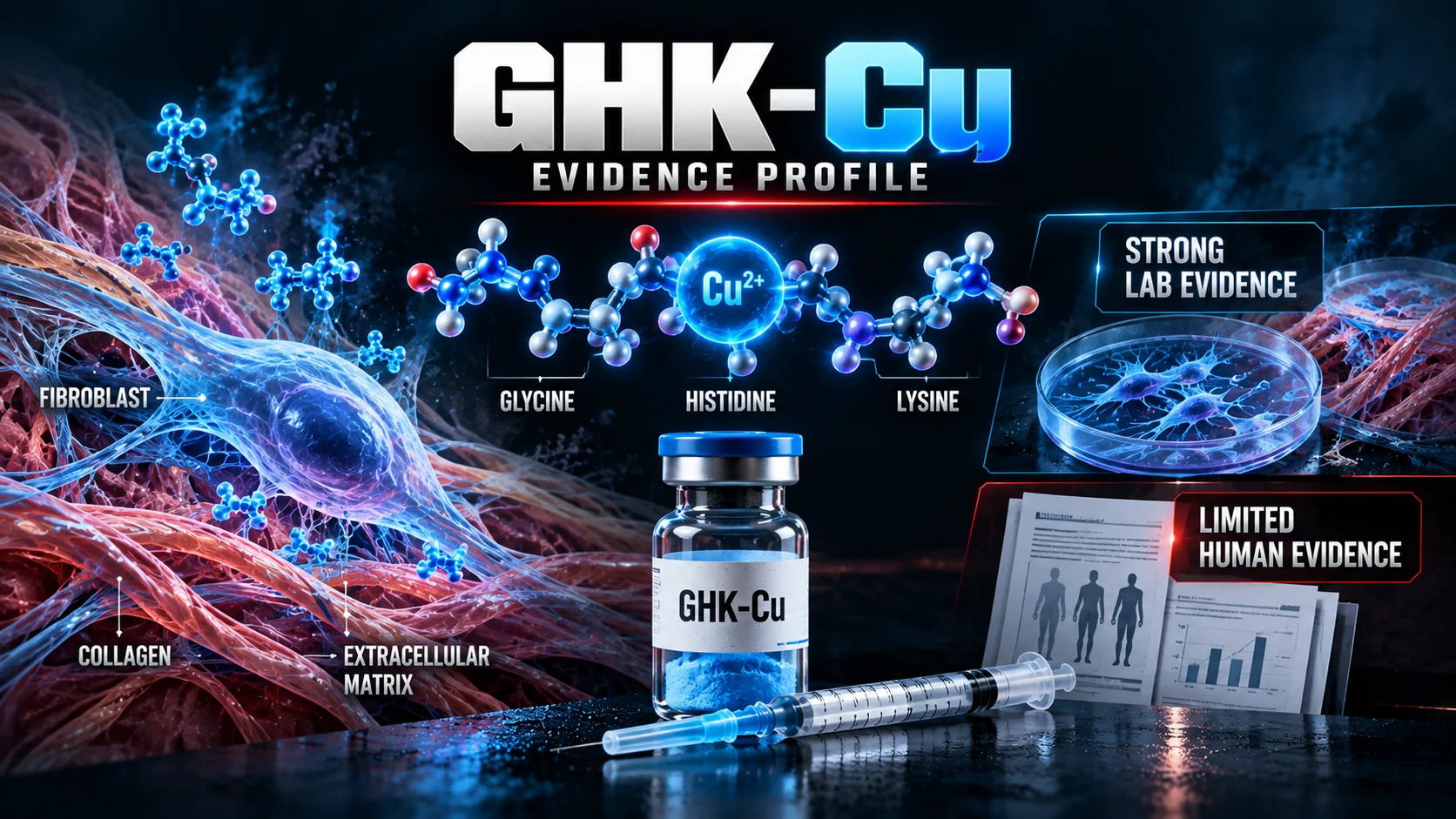
GHK-Cu is the copper complex of a three-amino-acid peptide, glycyl-L-histidyl-L-lysine, that circulates in human blood. It was found in 1973 as a factor in human serum that made old liver cells behave like young ones (PMID 4349963), identified in 1977 as Gly-His-Lys (PMID 858356), and shown in 1980 to co-isolate with copper and carry it into cells (PMID 7453802). In fibroblast cultures it raises collagen synthesis at concentrations of a billionth of a mole per litre (PMID 3169264). In the one multicentre randomised trial ever run on it, a GHK-Cu gel closed diabetic foot ulcers by a median 98.5 percent against 60.8 percent for the vehicle (PMID 17147644).
That is the whole human record, and it is why this page exists. It is sold in creams, serums and, on the research-chemical market, in vials for injection, and the vendor pages quote the laboratory data as if it had been measured in people. This page separates the two: what was measured in humans, what was measured in rats, mice, worms and dishes, how users describe injecting it, GHK-Cu side effects as far as anyone has recorded them, and where the FDA left the compound in 2026. The class of repair peptides is on healing peptides.
GHK-Cu in brief
Three numbers frame the compound: the one randomised trial result that holds up, the concentration at which it works in a dish, and the number of human trials behind the injections sold online.
In a multicentre, randomised, evaluator-blinded trial, daily GHK-Cu gel on top of debridement and offloading closed neuropathic foot ulcers three times faster than vehicle; in ulcers larger than 100 square millimetres the median closure was 89.2 percent against minus 10.3 percent, and infections fell from 34 to 7 percent (PMID 17147644). It remains the only multicentre RCT of the compound.
The effect on collagen synthesis begins between 10 to the minus 12 and 10 to the minus 11 molar and peaks at 10 to the minus 9, without any change in cell number (PMID 3169264). At the same nanomolar level it restores the doubling time of fibroblasts taken from irradiated patients and raises their output of bFGF and VEGF (PMID 15655171). Almost everything written about the peptide online comes from experiments at this scale.
Two systematic reviews published in 2026 found two randomised trials in total, both topical, against 18 preclinical studies (PMID 42619529), and described the human literature as thin and fragmented (PMID 42787770). A sports medicine review found no clinical data supporting GHK-Cu for any musculoskeletal condition (PMID 41476424). The injection data are from rats, mice and worms.
Every figure on this page is taken from a PubMed abstract or from an FDA regulatory notice, all listed at the end. No GHK-Cu dose is given for any human use because no trial has established one; how users describe injecting the GHK-Cu peptide is reported as their description, not as a protocol.
What this GHK-Cu guide covers
What it is: the tripeptide, its copper, where it comes from in the body, the 1973 discovery and why blood levels are said to fall with age.
The evidence map: every human study on PubMed, then the animal and cell work, sorted by what was actually measured.
Skin and wounds: the diabetic ulcer trial, the laser resurfacing trial, the cosmetic delivery problem, and how much copper crosses skin.
Hair: the three studies that quote a copper peptide, and why none of them isolates it.
GHK-Cu injections: what exists in animals, what does not exist in people, how users describe injecting the GHK-Cu peptide, GHK-Cu side effects as recorded, and the FDA compounding status after April 2026.
Not coveredA dose, cycle or reconstitution for injection. No human trial has tested injected GHK-Cu, so there is no measured dose to quote and this page invents none.
Product reviews of serums and creams. Cosmetic concentrations are reported where a study states them; brands are not compared.
The rest of the peptide field. That sits on what are peptides and the peptides hub.
What is GHK-Cu? A blood tripeptide that carries copper
GHK is glycyl-L-histidyl-L-lysine, three amino acids long, and it is a normal component of human plasma, saliva and urine (PMID 36905132). The story begins in 1973, when Loren Pickart reported a tripeptide in human serum that prolonged the survival of normal liver cells in culture and stimulated the growth of neoplastic liver cells (PMID 4349963); a synthetic version reproduced the effect the same year (PMID 4356974). In 1977 the growth-modulating serum tripeptide was identified as glycyl-histidyl-lysine (PMID 858356).
The copper came next. During isolation the peptide co-purified with roughly equimolar copper and about a fifth as much iron, its maximal effect on hepatoma cells needed both metals, and its sequence resembled the copper transport site of albumin, where the metal is held by a histidine next to a basic residue; Pickart proposed in 1980 that GHK acts as a copper transport factor, and showed that it forms complexes with copper(II) and enhances copper uptake into cells at nanomolar concentrations (PMID 7453802). GHK-Cu, the product sold today, is that complex: the tripeptide with a copper ion held between the histidine and the free amine, which gives its solutions the blue colour every vendor photograph shows.
The claim that plasma GHK declines with age runs through every review of the compound (PMID 26236730, PMID 25302294, PMID 28212278), and the one recent direct measurement fits it in a related way: patients with COPD had plasma GHK of 70 nanograms per millilitre against 133 in age-matched healthy controls, and the level correlated with pectoralis muscle area and inversely with TNF-alpha (PMID 36905132). Whether a falling level is a cause of anything, or a marker of it, has not been tested by giving the peptide back to people.
What the complex does in a dish is well described. It stimulates collagen synthesis in fibroblasts from picomolar concentrations with a peak at a nanomolar one (PMID 3169264), stimulates the expression of matrix metalloproteinase-2 in fibroblast cultures (PMID 11045606), modulates the expression and activation of metalloproteinases in rat wound chambers (PMID 10383745), and, in a gene-expression screen of emphysema lung tissue, reversed the signature of destruction and induced patterns consistent with TGF-beta activation in cultured fibroblasts (PMID 22937864). The reviews extrapolate this to thousands of genes reset to a healthier state (PMID 25302294). The naming of these compounds is on types of peptides.
The GHK-Cu evidence, sorted by what was measured
The table lists every study cited on this page by the system it was measured in. The pattern is the pattern of a compound that has been studied for fifty years without a drug programme behind it: abundant cell and animal data, a handful of small human studies, and none at all for the route most people now buy it for.
| Study | What was measured | Model |
|---|---|---|
| Mulder 1994 (PMID 17147644) | Diabetic neuropathic ulcers, multicentre, evaluator-blinded, GHK-Cu gel vs vehicle: median closure 98.5 vs 60.8 percent; closure three times faster; infections 7 vs 34 percent | RCT, topical |
| Miller 2006 (PMID 16847171) | 13 patients after CO2 laser resurfacing, GHK-Cu skin care vs none: no difference in erythema, wrinkles or objective skin quality; higher patient satisfaction, p 0.04 | RCT, topical |
| Lee 2016 (PMID 27489425) | 45 men with pattern hair loss, 5-ALA plus GHK complex vs placebo, 6 months: hair count up 52.6 and 71.5 vs 9.6; no change in length or thickness; no adverse events. GHK without copper, in a mixture | Controlled, mixed product |
| Kapoor 2018 (PMID 29482481) | 1000 patients, intradermal scalp injections of six growth factors plus copper tripeptide-1, open label, no control: hair pull reduced in 83 percent, total hair count up at one year, p 0.002 | Uncontrolled, cocktail |
| Bertin 2018 (PMID 29452017) | Four cases of pattern hair loss, fractional laser plus topical finasteride and growth factors with copper peptide 1 percent: improvement reported | Case series, cocktail |
| Byun 2016, Chae 2017 (PMID 27064823, PMID 28133891) | Jet-M skin resurfacing with a GHK-Cu, hyaluronic acid, rhodiola, tranexamic acid and beta-glucan solution: one man, crow's feet reduced, collagen raised on biopsy; small melasma group, pigment and erythema indices fell | Case report, small series |
| Hostynek 2010 (PMID 20703511) | Human skin ex vivo: permeability coefficient 2.43 by 10 to the minus 4 cm per hour; 136 micrograms of copper per square centimetre permeated in 48 hours, 82 retained as a depot | Human skin, ex vivo |
| Deng 2023 (PMID 36905132) | Plasma GHK 70 vs 133 ng per ml in COPD patients vs controls; GHK-Cu rescued smoke-induced muscle loss in mice at 0.2 and 2 mg per kg | Human plasma level; mouse treatment |
| Fu 2015 (PMID 25731775) | 72 rats after ACL reconstruction, weekly intra-articular GHK-Cu at 0.3 or 3 mg per ml: less knee laxity and stiffer graft at 6 weeks, no difference at 12 weeks; effect did not last after treatment stopped | Rat, injected |
| Canapp 2003 (PMID 14648529) | Ischemic open wounds in rats, topical GHK-Cu gel: wound area down 64.5 vs 28.2 percent untreated by day 13; TNF-alpha and MMP-2 and 9 lower | Rat, topical |
| Parker 2013 (PMID 23744835) | Irradiated skin flaps in rats, topical GHK-Cu gel: no difference in ischemic area, vessel count or VEGF | Rat, topical, negative |
| Siméon 1999 (PMID 10383745) | Rat wound chambers, serial injections of 2 mg GHK-Cu: pro-MMP-2 and active MMP-2 increased in the later stages of healing | Rat, injected |
| Maquart 1988, Pollard 2005 (PMID 3169264, PMID 15655171) | Collagen synthesis in fibroblasts from picomolar to nanomolar GHK-Cu; irradiated human fibroblasts regain normal doubling time and raise bFGF and VEGF at 1 nanomolar | Cell culture |
| Campbell 2012 (PMID 22937864) | GHK reverses the gene-expression signature of emphysema in the Connectivity Map and restores collagen contraction by COPD fibroblasts | Human tissue data, cell culture |
| Wen 2026 (PMID 42084774) | GHK-Cu extends lifespan and stress resistance in C. elegans via DAF-16 and SKN-1 | Worm |
| Any subcutaneous injection in humans | No study exists | Not measured |
Two systematic reviews from 2026 reach the same count from opposite directions. A review of GHK-Cu in aesthetic medicine found 20 eligible studies, 18 preclinical and 2 randomised trials, and concluded that the biological basis is reasonable but the clinical findings are constrained by methodological variability and a limited number of well-designed trials (PMID 42619529). A review of 64 records on microneedle delivery found that most randomised trials are small, conducted on facial cosmetic creams, and that microneedle delivery has never been tested in a registered human RCT (PMID 42787770). How to read that gap is on peptide research vs human use.
GHK-Cu for skin and wounds: the two trials and the delivery problem
The strongest human result on the GHK-Cu peptide is not cosmetic. In the 1990s a GHK-Cu gel called Iamin was tested in a multicentre, randomised, evaluator-blinded, placebo-controlled study of diabetic neuropathic foot ulcers, on top of an aggressive standard protocol of sharp debridement, offloading footwear and patient education. Daily gel raised the median percentage closure of plantar ulcers to 98.5 percent against 60.8 percent for vehicle, tripled the rate of closure, and in ulcers larger than 100 square millimetres, which did not respond to standard care alone, produced a median closure of 89.2 percent against minus 10.3 percent; the infection rate was 7 percent against 34 percent, and the benefit depended on starting immediately after debridement (PMID 17147644).

The trial has two limits worth stating. The abstract gives no patient count and the product never reached the market as a wound drug, so the result stands alone, unreplicated for thirty years. The rat data are mixed in the same way: the topical gel shrank ischemic open wounds by 64.5 percent against 28.2 percent untreated and lowered TNF-alpha and gelatinases in the tissue (PMID 14648529), but on irradiated skin flaps it made no difference to ischemia, vessel count or VEGF (PMID 23744835).
The cosmetic claim is a different matter. Reviews state that in cosmetic products the copper peptide tightens loose skin, improves elasticity, density and firmness, reduces fine lines, wrinkles, photodamage and hyperpigmentation (PMID 26236730), but the trials behind those sentences are company studies from the 2000s that were presented at meetings and are not indexed on PubMed, which is why the two 2026 systematic reviews could count only two randomised trials in total (PMID 42619529, PMID 42787770).
The one indexed cosmetic RCT is the laser resurfacing study above, and its objective measures were negative (PMID 16847171). The most-cited positive skin data are a case report of one 59-year-old man treated weekly for 12 weeks with a Jet-M spray of GHK-Cu mixed with hyaluronic acid, rhodiola, tranexamic acid and beta-glucan, whose crow's feet decreased and whose biopsies showed more collagen, fibrillin-1 and procollagen (PMID 27064823), and a small melasma series with the same cocktail (PMID 28133891). In both, the copper peptide is one of five ingredients pushed through resurfaced skin.
The delivery problem. The complex is hydrophilic and does not cross the stratum corneum easily, which is why liposomes, oligoarginine tags and microneedles keep appearing in the literature (PMID 39795193, PMID 31788907, PMID 42787770). On human skin ex vivo, copper applied as the tripeptide had a permeability coefficient of 2.43 by 10 to the minus 4 centimetres per hour, with 136 micrograms per square centimetre crossing dermatomed skin over 48 hours and 82 retained in the tissue as a depot (PMID 20703511); the authors framed this as potentially useful for inflammatory skin disease, not as proof that a serum reaches the dermis.
A 2025 review concluded that the transport of liposome-encapsulated GHK-Cu has received little attention and that methods to measure it still need to be developed (PMID 39795193). A cream can be legal, well tolerated and unmeasured all at once.
GHK-Cu for hair: three studies, none of them alone
Hair is the second reason people search for the GHK-Cu peptide, and the three human studies that mention a copper peptide share one problem: in none of them is the copper peptide given by itself.
The best designed is a placebo-controlled study of 45 men with pattern hair loss who applied a complex of 5-aminolevulinic acid and GHK peptide once a day for six months. The increase in total hair count was 52.6 in the high-dose group and 71.5 in the low-dose group against 9.6 on placebo, both p below 0.05, with no difference in hair length or thickness and no adverse events (PMID 27489425). The peptide in that product is GHK without copper, and it is paired with 5-ALA, so the trial cannot say which component acted.
The largest is an open-label, single-arm study of 1000 patients given intradermal scalp injections every three weeks for eight sessions of a formulation containing VEGF, bFGF, IGF, KGF, thymosin beta-4 and copper tripeptide-1. Hair fall on the pull test fell in 83 percent, vellus hairs decreased and terminal hairs increased on videomicroscopy, and total hair count was still significantly up at one year (PMID 29482481). Without a control arm and with six actives, it measures the cocktail, not the tripeptide. Four cases treated with fractional laser plus topical finasteride and growth factors including copper peptide at 1 percent belong to the same category (PMID 29452017).
The forum belief that the copper peptide blocks dihydrotestosterone has no measurement behind it: none of the three studies assayed DHT, and users who tracked their own hormones reported no change (forum posts). The mechanism the reviews propose is the same as for skin, more collagen and blood vessels around the follicle (PMID 26236730), which is plausible and untested in a trial of the peptide alone.
GHK-Cu injections: what exists in animals and what does not exist in people
The GHK-Cu peptide injection is the form now sold for skin, hair, recovery and anti-ageing, and it is the form with the least data. The search for a human trial of the subcutaneous form returns nothing: no pharmacokinetic study, no dose-ranging study, no controlled trial for any indication. The 2026 sports medicine reviews say so directly. One found that the compound showed promise in wound healing and anti-inflammatory effects in preclinical models but that no clinical data support its use for musculoskeletal conditions, and that indications, dosing, frequency and duration remain unknown (PMID 41476424); the other placed it among unapproved peptides for which rigorous human safety data are scarce (PMID 41966639).
Ligament, rats. Seventy-two rats that had undergone ACL reconstruction were randomised to weekly intra-articular injections of saline or GHK-Cu at 0.3 or 3 mg per millilitre for four weeks (PMID 25731775). At six weeks the treated knees had less side-to-side laxity and the low-dose grafts were stiffer; at twelve weeks there was no difference in laxity, ultimate load, gait or histology, and the authors wrote that the beneficial effects could not last as treatment was discontinued (PMID 25731775).
Muscle, mice. In mice exposed to cigarette smoke, the complex at 0.2 and 2 mg per kilogram reduced the loss of skeletal muscle mass and raised fibre cross-sectional area through a sirtuin 1-dependent pathway (PMID 36905132); the same paper measured plasma GHK in nine COPD patients and eleven controls and found it roughly halved in disease (PMID 36905132). The human part of that study is a blood level; the treatment part is a mouse.
Wounds, rats. Serial injections of 2 mg GHK-Cu into wound chambers under rat skin altered the timing of matrix metalloproteinase-2 activation in the later stages of healing (PMID 10383745). Lifespan, worms. In C. elegans, the complex extended lifespan, improved stress resistance and motility, and preserved mitochondrial function through DAF-16 and SKN-1 (PMID 42084774). None of these is a dose for a person, and the ligament study is a reminder that the one measured injection effect faded when the injections stopped.
The GHK-Cu peptide in the gym: how users describe it, and what is measured
There is no label to quote here, so the page reports two things separately: how users and the vendors who sell to them describe the GHK-Cu peptide in practice, and the measured data that any of it could rest on. Nothing in the first half is evidence. It is a description of a pattern, and a pattern people describe is not a dose anyone should copy.
What users describe. On forums the GHK-Cu peptide is sold as a blue lyophilised powder in vials, often 50 mg or 100 mg kits, reconstituted with bacteriostatic water; the threads recommend diluting a 100 mg kit with 3 to 6 millilitres of water and moving it into a larger sterile vial, because more dilute solutions sting less (forum posts).
The doses users describe range from 0.5 to 5 mg a day subcutaneously, most often 2 to 3 mg, with one user describing 5 mg daily for a hundred days; others describe 2 mg once a day for six weeks on and six weeks off, or 1 mg on waking and 1 mg at bedtime, or a ramp from 1 mg to 2 mg over a month followed by a month off (forum posts).
The stacks users describe are KPV, mentioned more than any other, BPC-157, and the blended vials sold as GLOW, KLOW, Wolverine and KPLOW, in which the copper peptide is combined with BPC-157 and TB-500 or KPV; the injection is often described alongside a 1 to 3 percent topical on the scalp or face with microneedling, and some users add zinc to balance the copper (forum posts). Runs are described as continuous or in eight-week cycles, and the consensus in the threads is that nothing is visible before two to four months, that people over forty see more than younger users, and that skin, nails and hair change before anything else (forum posts).
The dissent in the same threads is about stinging, which is the main complaint and is compared to being hit by an airsoft pellet, about bruises and knots at the injection site that last for days, about vendor purity, and about non-response: one user on 2 mg a day for two months reported no benefit so far, and a moderator on another board noted that claims of DHT blockade rest on no credible research (forum posts).
What the reasons rest on. The skin idea has the best support on this page, and it is topical: a randomised wound trial (PMID 17147644), a negative cosmetic RCT (PMID 16847171), and cell data at nanomolar concentrations (PMID 3169264). The hair idea rests on mixtures (PMID 27489425, PMID 29482481). The recovery and tendon idea rests on a rat ligament study whose effect disappeared by twelve weeks (PMID 25731775). The anti-ageing idea rests on the age-related decline of plasma GHK described in reviews (PMID 26236730) and on a worm (PMID 42084774).
What is measured that a user could use. Very little. Copper is the one component with known human pharmacology, and the ex vivo skin study quantified how much of it crosses skin from the tripeptide (PMID 20703511), but no study has measured plasma copper, ceruloplasmin, zinc or liver enzymes in anyone injecting it. Anyone who does and then has bloodwork drawn is generating the first data point. The arithmetic for any vial is on the peptide calculator; what a research-chemical listing can and cannot promise is on peptide research vs human use.
GHK-Cu side effects by the evidence
GHK-Cu side effects are, on paper, almost absent, and the reason is the paper. The topical trials reported no adverse events attributable to the gel (PMID 17147644, PMID 27489425), the reviews describe a long history of safe use in wound healing and skin care (PMID 22666519), and no injection trial exists to record anything. The table separates what was measured from what users report and from what is simply unknown.
| Effect | Strongest evidence | Read as |
|---|---|---|
| Topical tolerability | No adverse events in the diabetic ulcer trial or the hair complex study (PMID 17147644, PMID 27489425); no difference in post-laser erythema (PMID 16847171) | Well tolerated on skin |
| Wound infection | Lower on the gel: 7 vs 34 percent in diabetic ulcers (PMID 17147644) | Favourable, one trial |
| Injection site stinging and pain | The most common complaint in user threads, attributed to concentration and to copper; users describe diluting further to reduce it (forum posts) | Reported, not measured |
| Bruising, lumps, redness at the site | Described by users, including reactions lasting several days (forum posts); no trial data | Reported, not measured |
| Scalp irritation and shedding | Listed in user guides for topical use (forum posts); not seen in the 45-man hair study (PMID 27489425) | Reported, not measured |
| Copper load | GHK-Cu carries copper into cells (PMID 7453802) and delivers copper through skin as a depot (PMID 20703511); no study has measured serum copper, ceruloplasmin or zinc in people injecting it | Mechanism, not measured |
| Growth signalling and cancer | The 1973 discovery paper reported growth stimulation of neoplastic liver cells (PMID 4349963); reviews describe anti-cancer gene effects in vitro (PMID 25302294); no human data either way | Unresolved in vitro signal |
| Hormones, DHT, estradiol | Not measured in any study; users tracking labs report no change (forum posts) | Not measured |
| Systemic effects of injection | No human study; sports medicine reviews state that rigorous human safety data are scarce (PMID 41966639, PMID 41476424) | Not measured |
| Product purity and sterility | Research-chemical vials are not made under drug standards; users raise purity concerns (forum posts). Shared with every reconstituted peptide | Supply risk |
The honest summary of GHK-Cu side effects is that the topical form has a clean record in the few trials that looked, that injection-site stinging is the one consistent complaint from people injecting it, and that the systemic questions, copper, growth signalling, hormones, are not answered because nobody has run the study. The general page on peptide side effects covers the injection-site and sterility problems shared by every reconstituted peptide.
Is GHK-Cu legal? Cosmetics, compounding and the FDA in 2026
The compound lives under three different rules depending on its form. As an ingredient in a cream or serum it is a cosmetic, sold without approval and without a claim to treat anything. As a compounded drug it fell under the FDA rules for bulk substances used by 503A pharmacies: in September 2023 the agency placed it, with BPC-157, CJC-1295, ipamorelin and others, in Category 2, the list of substances that raise significant safety risks and may not be compounded (FDA Law Blog, April 2026). As a research chemical in a vial it is sold under a label that says not for human use, which is not a legal category at all.
Before April 2026
GHK-Cu on the 503A Category 2 list since September 2023. Compounding pharmacies could not prepare it; clinics prescribing it were doing so outside the rules. Cosmetic creams unaffected.
After 16 April 2026
FDA removed twelve peptides, GHK-Cu among them, from Category 2 within seven days of announcing Pharmacy Compounding Advisory Committee reviews. BPC-157, KPV, TB-500, MOTS-c, DSIP, Semax and Epitalon were reviewed on 23 and 24 July 2026; GHK-Cu is in the second group, due before the end of February 2027. Until then it sits in neither category (FDA Law Blog, April 2026; Newtropin, April 2026).
The removal from Category 2 is a procedural step toward a committee vote, not a finding of safety. What the committee will weigh is the same record this page describes: one wound trial, one negative cosmetic trial, mixed-product hair studies, and no injection data in people. Whichever way the vote goes, a compounded preparation prescribed by a physician and a research-chemical vial bought online remain different products under different law, and the FDA action changes nothing about the second. The wider regulatory picture for the class is on peptide side effects and BPC-157.
Five mistakes people make about GHK-Cu
Each comes from reading a cell culture result as a human result, or a mixture as a single ingredient.
1. Quoting the gene data as an effect in people. The claim that GHK resets thousands of genes comes from the Connectivity Map, a database of gene expression in cultured cell lines (PMID 22937864, PMID 25302294). It is a hypothesis generator, not a trial.
2. Treating the cosmetic claims as trial results. The reviews list tighter skin, fewer wrinkles and less photodamage (PMID 26236730), but the 2026 systematic reviews could find only two randomised trials, and the one cosmetic RCT on PubMed was objectively negative (PMID 42619529, PMID 16847171).
3. Crediting the copper peptide for the hair studies. The 45-man study used GHK without copper mixed with 5-ALA (PMID 27489425); the 1000-patient study injected six actives with no control (PMID 29482481). Neither isolates the peptide.
4. Assuming the injection has been tested. It has not, in any human, for any purpose (PMID 42619529, PMID 41476424). The ligament, muscle and lifespan data are from rats, mice and worms, and the ligament effect faded once injections stopped (PMID 25731775).
5. Reading the FDA action as approval. Removal from Category 2 in April 2026 was a step toward a committee review due by February 2027, not a decision that the compound is safe or effective (FDA Law Blog, April 2026).
Verdict: a real human peptide with one real trial, sold on the strength of dishes
GHK-Cu, after the abstracts rather than the vendor pages, is a genuine component of human blood with fifty years of consistent laboratory biology: it carries copper, it drives collagen synthesis at nanomolar concentrations, and it shifts gene expression toward repair in cultured cells (PMID 7453802, PMID 3169264, PMID 22937864). In people, one multicentre randomised trial of a topical gel closed diabetic foot ulcers far better than vehicle (PMID 17147644), one small cosmetic RCT found nothing objective (PMID 16847171), and the hair data belong to mixtures (PMID 27489425, PMID 29482481).
For readers here the practical conclusion is that a GHK-Cu cream is a low-risk cosmetic with unmeasured penetration, that the injection is an experiment without a control group in which the one consistent finding is that it stings, and that the numbers on the vendor page were measured in a dish. The compounds it is most often blended with are on BPC-157 and TB-500; the class is on healing peptides.
GHK-Cu: frequently asked questions
What does GHK-Cu do?
GHK-Cu is the copper complex of glycyl-L-histidyl-L-lysine, a tripeptide in human plasma. It carries copper into cells (PMID 7453802) and stimulates collagen synthesis in cultured fibroblasts at nanomolar concentrations (PMID 3169264). In people, a GHK-Cu gel closed diabetic foot ulcers by a median 98.5 percent against 60.8 percent on vehicle in a multicentre randomised trial (PMID 17147644), while GHK-Cu skin care after laser resurfacing gave no objective improvement in wrinkles or redness (PMID 16847171). No human trial has tested injected GHK-Cu.
Is GHK-Cu FDA approved?
No. GHK-Cu has never been approved as a drug for any use. In creams and serums it is a cosmetic ingredient. For compounding, the FDA placed it in the 503A Category 2 list in September 2023, removed it from that list on 16 April 2026 pending review, and scheduled a Pharmacy Compounding Advisory Committee review before the end of February 2027 (FDA Law Blog, April 2026). Research-chemical vials labelled not for human use are outside drug regulation entirely.
What is the GHK-Cu dosage?
There is no established human dose because no clinical trial has tested GHK-Cu by injection. The only injected doses ever measured are in animals: 0.3 and 3 mg per millilitre into rat knees (PMID 25731775), 0.2 and 2 mg per kilogram in smoke-exposed mice (PMID 36905132), and 2 mg into rat wound chambers (PMID 10383745). Forum posts describe 0.5 to 5 mg a day subcutaneously, most often 2 to 3 mg, as their own practice (forum posts); that is a description, not a dose anyone has validated.
What are the side effects of GHK-Cu?
On skin, the trials reported no adverse events from the gel or the hair complex (PMID 17147644, PMID 27489425) and no difference in post-laser redness (PMID 16847171). For injections, no human trial exists, so GHK-Cu side effects are known only from user reports: stinging at the injection site is the most common complaint, with bruising and lumps lasting days in some (forum posts). Serum copper, zinc, hormones and long-term effects have never been measured in anyone injecting it (PMID 41966639).
Does GHK-Cu regrow hair?
Not proven for GHK-Cu on its own. A placebo-controlled study of 45 men found hair counts up 52.6 and 71.5 against 9.6 on placebo after six months, but the product was GHK without copper combined with 5-aminolevulinic acid (PMID 27489425). An uncontrolled study of 1000 patients injected a six-factor scalp cocktail containing copper tripeptide-1 and reported less hair fall in 83 percent (PMID 29482481). Neither isolates the peptide, and no study has measured DHT.
GHK-Cu injection vs topical: which one has evidence?
Topical. Both randomised human trials of GHK-Cu used it on the skin: the diabetic ulcer trial, which was positive (PMID 17147644), and the laser resurfacing trial, which was objectively negative (PMID 16847171). Injected GHK-Cu has been studied in rats, where a ligament benefit faded after injections stopped (PMID 25731775), in mice (PMID 36905132) and in worms (PMID 42084774), and in no human being (PMID 42619529, PMID 41476424).
Does GHK-Cu really work for skin?
For chronic wounds, one multicentre RCT says yes: closure 98.5 versus 60.8 percent and infections 7 versus 34 percent (PMID 17147644). For cosmetic ageing, the one RCT on PubMed found no objective change in wrinkles or skin quality, only higher patient satisfaction (PMID 16847171); the wrinkle claims in reviews come from company studies not indexed on PubMed (PMID 26236730, PMID 42619529). Penetration through intact skin is limited and poorly measured (PMID 39795193, PMID 20703511).
How do bodybuilders use GHK-Cu?
Forum posts describe blue lyophilised powder in 50 mg or 100 mg kits reconstituted with bacteriostatic water, injected subcutaneously at 0.5 to 5 mg a day and most often 2 to 3 mg, continuously or in six to eight week cycles, frequently stacked with KPV or BPC-157 or bought as GLOW, KLOW or Wolverine blends, alongside a 1 to 3 percent topical with microneedling, for skin, nails, hair and recovery; the same threads report stinging as the main complaint and at least one user with no result after two months (forum posts). That is a description of practice, not evidence: no trial has tested injected GHK-Cu in anyone (PMID 42619529).
Sources and further reading
Every figure on this page comes from one of the 34 sources below: 32 papers checked against their PubMed abstracts on 30 September 2026 and two regulatory summaries of the April 2026 FDA action. Forum descriptions of use are reported as descriptions and carry no reference number. Reference links are dofollow to support open science.
Keep reading
Four pages around GHK-Cu: the two peptides it is blended with, the class it belongs to, and the side effects every reconstituted vial shares.
Final Educational Note
This article is educational and is not medical advice. It reports what published studies say about GHK-Cu, a compound that is a cosmetic ingredient in one form and an unapproved, untested injectable in another, and it reports how some users describe the GHK-Cu peptide as a description of practice, not as guidance. No dose is given because none has been established in people; the page gives no schedule, cycle or protocol, does not recommend the compound for any use, and is not an encouragement to use research chemicals or performance-enhancing drugs, which carry serious health and legal risks. More guides sit on the PED side effects hub.
A spreading, hot or persistently painful reaction at an injection site, fever after an injection, new lumps that do not resolve, or any symptom of copper excess such as abdominal pain, vomiting or jaundice are clinical findings that a physician should assess at once. Read more about how this site works on the about page and in the full disclaimer.