CJC-1295 Explained: Mechanism, DAC vs No-DAC, and Human Trial Evidence
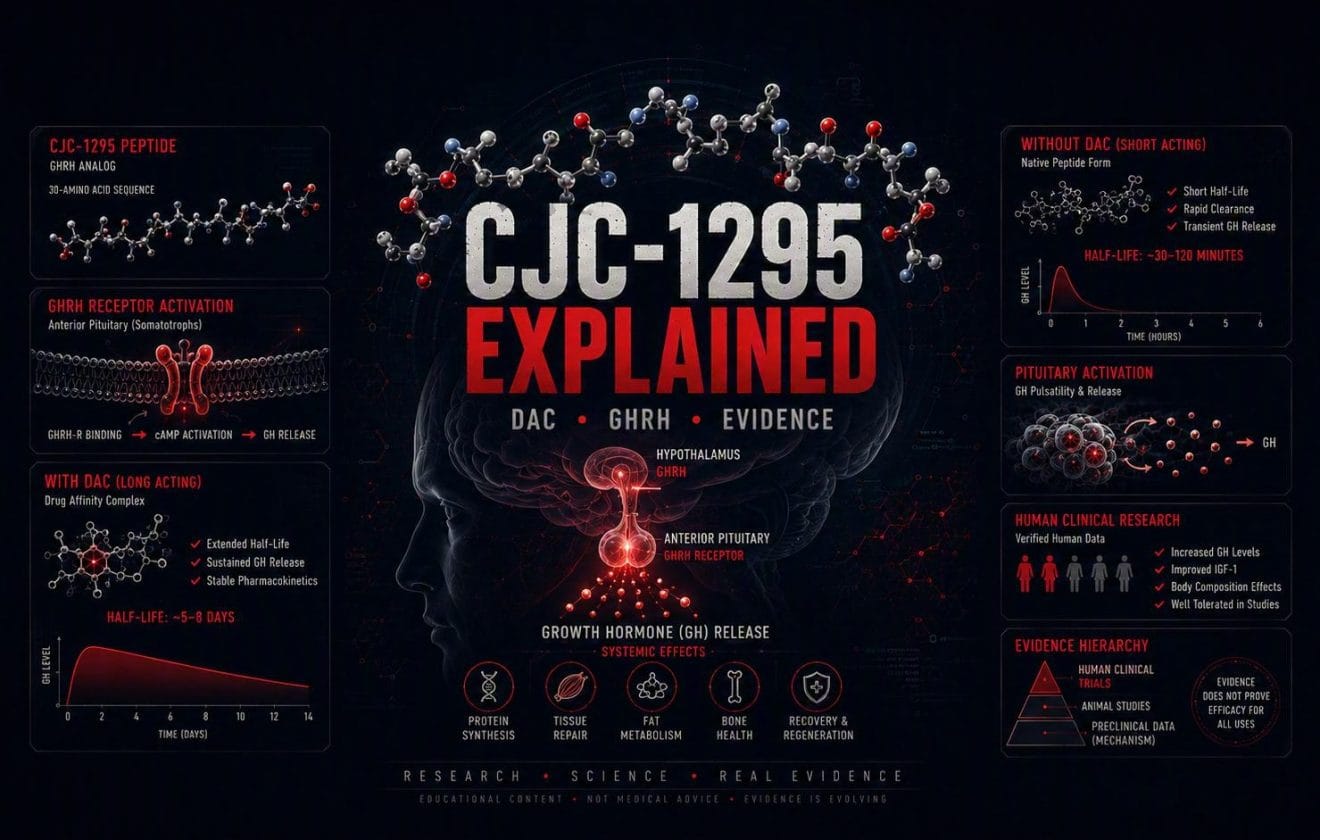
DAC vs no-DAC, and the human evidence
CJC-1295 is a synthetic analog of Growth Hormone Releasing Hormone - the hypothalamic peptide that signals the anterior pituitary to secrete GH. Two fundamentally different compounds are sold under this name: CJC-1295 without DAC and CJC-1295 with DAC. They have different half-lives, different GH release profiles, and different research bases. This guide separates them clearly, explains the mechanism, and covers the published human trial data that most sources fail to discuss.
CJC-1295: Three Things That Define This Compound
Two Compounds, One Name
CJC-1295 without DAC and CJC-1295 with DAC are pharmacologically distinct. Without DAC, half-life is approximately 30 minutes - producing pulsatile GH release. With DAC, half-life extends to 6-8 days via albumin binding - producing sustained GH elevation. Community discussions routinely conflate them, which makes any protocol comparison meaningless without specifying which form is being discussed.
Human Trial Data Exists
CJC-1295 with DAC was studied in a published Phase I/II human clinical trial (Teichman et al., 2006, J Clin Endocrinol Metab). Healthy adults received multiple doses and showed significant, dose-dependent increases in GH and IGF-1 lasting days per injection. This is concrete human pharmacological data - something few research peptides in community use can point to.
It Works Through the Hypothalamic Axis
CJC-1295 acts on the GHRH receptor in the pituitary - part of the body's native GH regulation system. It does not inject GH directly. It amplifies the natural signaling cascade that causes the pituitary to produce and secrete its own GH. This mechanism is fundamentally different from exogenous HGH administration and carries different pharmacological implications for GH pulse patterns and downstream IGF-1 production.
What This Guide Covers
Covered in This Guide
- CJC-1295 with DAC vs without DAC - the critical distinction
- Relationship to Sermorelin and native GHRH
- GHRH receptor mechanism and pituitary GH secretion
- Drug Affinity Complex (DAC) technology explained
- Published human trial data (Teichman 2006)
- Combination rationale with GHRPs (Ipamorelin)
- Common misinterpretations in community frameworks
Not Covered Here
- Specific dosing or injection frequency recommendations
- Sourcing or procurement guidance
- Legal status by jurisdiction
- Specific cycle or stack design
- Clinical endorsement of any use
Related guides: CJC-1295 is a GH secretagogue - for the broader category context, see Growth Hormone Peptides. For the healing peptide class covered in the same library, see BPC-157 and TB-500.
What CJC-1295 Actually Is: Separating Two Different Compounds
To understand CJC-1295, you first need to understand the compound it is derived from: Growth Hormone Releasing Hormone (GHRH). GHRH is a 44-amino acid peptide produced by the hypothalamus. It travels via the portal circulation to the anterior pituitary, where it binds to the GHRH receptor and triggers GH synthesis and secretion. This is the body's primary signal for GH release - a natural, pulsatile process tied to sleep, exercise, and metabolic state.
Sermorelin, the first synthetic GHRH analog used clinically, reproduces the first 29 amino acids of GHRH - the minimum active sequence required for receptor binding. This 29-amino acid fragment, GHRH(1-29), retains full biological activity but has a very short plasma half-life of approximately 10-20 minutes due to rapid enzymatic degradation. CJC-1295 is a modified version of this same GHRH(1-29) sequence, engineered for improved stability. Understanding CJC-1295 begins with understanding this shared origin.
CJC-1295 Without DAC (Modified GRF 1-29)
CJC-1295 without DAC - also sold and discussed under the names Mod GRF 1-29 and Modified GRF(1-29) - is GHRH(1-29) with four specific amino acid substitutions that improve resistance to enzymatic cleavage. These substitutions extend the plasma half-life from the ~10-20 minutes of natural GHRH to approximately 30 minutes. The compound still produces a pulsatile GH release pattern: administered, it triggers a GH pulse that rises and falls within a normal physiological time window. This more closely mirrors the body's natural GH secretion pattern than the sustained elevation produced by the DAC version.
The naming overlap between CJC-1295 without DAC and Mod GRF 1-29 creates consistent confusion in community discussions. These are the same compound described with different labels depending on the supplier or the forum. Any evaluation of a protocol that references "CJC-1295" without specifying DAC status is ambiguous - it may refer to either compound, and the pharmacological implications are substantially different.
CJC-1295 With DAC: The Albumin-Binding Version
CJC-1295 with DAC is the same modified GHRH(1-29) sequence - with the addition of a Drug Affinity Complex (DAC): a chemical linker attached to a lysine residue that covalently binds to albumin in the bloodstream. Albumin is the most abundant protein in human plasma, with a natural half-life of approximately 19 days. When CJC-1295 binds to albumin, it is effectively shielded from enzymatic degradation and renal clearance, dramatically extending its plasma half-life to 6-8 days.
The pharmacological consequence is fundamentally different from the no-DAC version. Rather than a single GH pulse following injection, CJC-1295 with DAC produces a prolonged, sustained elevation in GH and IGF-1 that lasts approximately one week per injection. This is the version studied in the Teichman et al. human clinical trial. It is also the version that community discussions most frequently reference when citing efficacy data - though the distinction is rarely made explicit in those discussions.
How CJC-1295 Works: The GHRH Receptor Pathway
CJC-1295 operates through the same receptor system used by the body's own GHRH - it does not bypass or override the pituitary, it amplifies a signal the pituitary already receives naturally. This makes its mechanism more nuanced than simply "increases GH" and has practical implications for how GH release occurs and how the hypothalamic-pituitary axis responds.
GHRH Receptor Binding
CJC-1295 binds to the GHRH receptor (GHRHr) - a G protein-coupled receptor located on somatotroph cells in the anterior pituitary. Somatotrophs are the specialized cells responsible for GH production and secretion. CJC-1295 occupies the same binding site as endogenous GHRH with equivalent or greater receptor affinity due to its engineered stability. The extended half-life means receptor occupancy is maintained for far longer than endogenous GHRH could achieve, particularly with the DAC version.
cAMP Cascade and GH Secretion
GHRHr activation stimulates adenylyl cyclase through the Gs alpha subunit → increases intracellular cyclic AMP (cAMP) → activates protein kinase A (PKA) → phosphorylates transcription factors including CREB → upregulates GH gene expression and triggers release of pre-formed GH from secretory granules. CJC-1295 drives this cascade at the receptor level. It does not alter the downstream signaling machinery - it simply provides a sustained upstream signal for pituitary GH output. The pituitary still regulates GH secretion through its own feedback mechanisms.
IGF-1 Production in the Liver
GH released by the pituitary travels via systemic circulation to the liver, where it binds GH receptors on hepatocytes → stimulates synthesis and secretion of Insulin-like Growth Factor 1 (IGF-1). IGF-1 is the primary mediator of most of GH's anabolic and tissue growth effects - muscle protein synthesis, bone growth, cell proliferation. In the Teichman human trial, both GH area-under-curve and IGF-1 levels increased significantly and durably with CJC-1295 with DAC, confirming that the full GHRH → GH → IGF-1 axis was activated in humans.
The pituitary also responds to somatostatin - an inhibitory hormone from the hypothalamus that opposes GHRH. CJC-1295 does not suppress somatostatin signaling. This means the full regulatory system remains active. GHRPs such as Ipamorelin work through a separate mechanism that partly suppresses somatostatin, which is the pharmacological basis for the synergistic effect when the two are combined - the combination removes both the inhibitory brake and amplifies the stimulatory signal simultaneously.
Human Trial Data: What the Teichman 2006 Study Actually Showed
CJC-1295 with DAC is one of the few research peptides commonly discussed in performance contexts that has published Phase I/II human clinical trial data. The Teichman et al. study, published in the Journal of Clinical Endocrinology and Metabolism in 2006, remains the primary human pharmacological reference for this compound. Understanding what it showed - and what it did not - is essential for evaluating any efficacy claim made about CJC-1295.
| Parameter | Detail |
|---|---|
| Study Design | Phase I/II, randomized, double-blind, placebo-controlled. Multiple ascending dose cohorts in healthy adults aged 21-61. Single and multiple dose arms. Total n=65 subjects across all cohorts. |
| Compound Used | CJC-1295 with DAC (pharmaceutical grade, injectable). Not CJC-1295 without DAC. Results cannot be assumed to apply to the no-DAC version. |
| GH Response | Mean GH area-under-curve increased 2-10 fold versus placebo across dose cohorts. Effect was dose-dependent and statistically significant. GH elevation persisted for multiple days following a single injection - consistent with the compound's 6-8 day half-life. |
| IGF-1 Response | IGF-1 levels increased 1.5-3 fold from baseline. Elevation was sustained and dose-dependent. After repeated dosing (multiple dose arm), IGF-1 remained elevated for up to 28 days following the last injection in some subjects. |
| Safety / Tolerability | No serious adverse events reported. Injection site reactions (redness, swelling) were the most common adverse events. One case of facial flushing and dizziness at the highest dose tested. No clinically significant changes in cortisol, prolactin, TSH, or LH. |
| Study Limitations | Subjects were healthy adults without GH deficiency - not athletic or bodybuilding populations. Primary endpoints were pharmacokinetic and safety, not performance or body composition outcomes. No long-term data. Compound was pharmaceutical grade - not research chemical from unverified suppliers. |
Source: Teichman SL et al. J Clin Endocrinol Metab. 2006. PMID 16882752.
The Teichman study confirms that CJC-1295 with DAC is pharmacologically active in humans and produces sustained, measurable increases in GH and IGF-1 via the expected GHRH receptor mechanism. It does not confirm performance enhancement, muscle gain, fat loss, or recovery improvement in healthy athletes or trained individuals. These applications were not studied. The human data establishes pharmacological activity - not the efficacy outcomes most community discussions imply.
CJC-1295 vs Sermorelin: Same Origin, Different Tools
Sermorelin and CJC-1295 are frequently discussed as alternatives, and both are based on GHRH(1-29) - the same 29-amino acid active sequence. The differences between them are pharmacological engineering choices with practical consequences. Understanding the distinction is essential for interpreting any comparison of the two in clinical or community contexts.
Native vs Modified GHRH(1-29)
Sermorelin is the unmodified native GHRH(1-29) sequence - identical to what the hypothalamus produces. CJC-1295 (both versions) contains four strategic amino acid substitutions at positions 2, 8, 15, and 27 that protect the molecule from enzymatic cleavage by dipeptidyl peptidase IV and other proteases. These substitutions preserve the receptor binding conformation while dramatically improving plasma stability. Sermorelin is the original; CJC-1295 is the engineered, more durable version.
Minutes vs Days
Sermorelin plasma half-life: approximately 10-20 minutes. CJC-1295 without DAC: approximately 30 minutes. CJC-1295 with DAC: 6-8 days. The engineering progression goes from native (shortest) to stabilized (moderate) to albumin-bound (extended). Each step extends half-life but shifts the GH release profile further from pulsatile toward sustained. Sermorelin requires frequent administration to maintain consistent GH stimulation; CJC-1295 with DAC requires only once-weekly or less frequent dosing.
FDA-Approved vs Research Chemical
Sermorelin was FDA-approved for treatment of idiopathic growth hormone deficiency in children (Geref, Serono) and was used clinically in adults as an alternative to exogenous HGH. It was withdrawn from the US market in 2008 for commercial reasons, not safety concerns, and has been compounded since. CJC-1295 has never been FDA-approved. The Teichman trial was a Phase I/II study that did not lead to regulatory approval. CJC-1295 remains a research chemical without approved clinical status in any major jurisdiction.
Pulsatile vs Sustained Elevation
Sermorelin and CJC-1295 without DAC both produce pulsatile GH release - a discrete pulse that rises and falls within 30-90 minutes, more closely matching the body's natural secretion pattern. CJC-1295 with DAC produces sustained GH elevation - sometimes described as a "GH bleed" - for days after injection. Whether pulsatile or sustained GH elevation is more appropriate for a given goal is debated. Natural GH secretion is pulsatile by design; sustained elevation represents a departure from physiological regulation.
CJC-1295 + Ipamorelin: Why the Two Are Frequently Combined
The pairing of CJC-1295 with Ipamorelin is one of the most consistently discussed peptide combinations in research contexts, and unlike many combination protocols in this space, the pharmacological rationale for it is mechanistically coherent. Understanding why requires understanding how the two compounds act on different points in the same GH regulatory system.
The anterior pituitary receives two opposing signals that regulate GH release. The first is GHRH - the stimulatory signal that drives GH production and secretion. The second is somatostatin - the inhibitory signal that suppresses GH release and counterbalances GHRH. Under normal physiology, GH is released in pulses that reflect the oscillating interplay between these two signals. CJC-1295 acts on the GHRH side: it binds the GHRH receptor and amplifies the stimulatory input. Ipamorelin acts through a different receptor entirely - the ghrelin receptor (GHSR-1a) - and its mechanism includes partial suppression of somatostatin release, effectively reducing the inhibitory brake on GH secretion.
Amplifies the Stimulatory Signal
By binding the GHRH receptor with extended half-life, CJC-1295 maintains a prolonged stimulatory signal to pituitary somatotrophs. This increases both the amplitude and duration of GH secretion in response to GHRH input. Without addressing somatostatin, however, the inhibitory brake remains active and partially limits how much GH the pituitary releases even with a strong stimulatory signal present.
Reduces the Inhibitory Brake
Ipamorelin, a selective GHRP, binds the ghrelin receptor on somatotrophs and hypothalamic neurons. Part of this receptor's downstream effect involves suppression of somatostatin release from the hypothalamus, reducing the inhibitory signal that limits GH output. By lowering somatostatin tone, Ipamorelin allows a given GHRH stimulus to produce a larger GH pulse than it would under normal somatostatin levels.
Gas and Brake Simultaneously
CJC-1295 provides sustained GHRH receptor stimulation - the gas pedal. Ipamorelin reduces somatostatin - the brake. Used together, the pituitary receives a strong stimulatory signal while the opposing inhibitory mechanism is partially suppressed. Animal studies of GHRH + GHRP combinations demonstrate GH responses significantly larger than either compound produces alone. This synergistic effect is the mechanistic basis for the combination framework - it is not based on clinical trial data in humans.
Mechanistic Logic, Not Clinical Proof
The pharmacological rationale for combining CJC-1295 and Ipamorelin is well-grounded in receptor biology. The human clinical data, however, applies only to the individual compounds separately - Teichman et al. studied CJC-1295 with DAC alone, not in combination. No peer-reviewed human study has evaluated the CJC-1295 + Ipamorelin combination specifically. The synergy is real in terms of mechanism; whether it translates to measurable performance or body composition outcomes in healthy adults has not been established under controlled conditions.
The Peptide Dosage Calculator covers the unit conversion framework used in GH peptide research protocols. It does not constitute a dosing recommendation for any specific compound or combination.
5 Things CJC-1295 Research Does Not Confirm
The existence of human pharmacokinetic data for CJC-1295 is frequently cited as evidence that the compound "works." The Teichman trial does confirm pharmacological activity in humans - but it does not confirm the outcomes most commonly discussed in performance contexts. The following five points define where the evidence boundary sits.
1. That GH and IGF-1 Increases Produce Muscle or Performance Gains
The Teichman study confirmed that CJC-1295 with DAC increases GH area-under-curve and IGF-1 levels significantly in healthy adults. It did not measure body composition, muscle protein synthesis, strength, recovery time, or any performance outcome. These were pharmacokinetic and safety endpoints, not efficacy endpoints for athletic applications. The assumption that higher IGF-1 = more muscle is not supported by the literature in healthy eugonadal adults with normal GH axis function. Exogenous GH and IGF-1 modulation in individuals with normal baseline function produces effects that are inconsistent, modest, and dose-dependent in ways not captured by the Teichman protocol.
2. That CJC-1295 With DAC and Without DAC Are Interchangeable
All human pharmacological data for CJC-1295 was generated with the DAC version - pharmaceutical-grade, intravenous, under controlled conditions. CJC-1295 without DAC has a half-life of approximately 30 minutes and produces a fundamentally different GH release profile. Its pharmacokinetics have not been studied under the same conditions. The two compounds share a base sequence but their clinical research profiles are entirely separate. Applying findings from the Teichman trial to CJC-1295 without DAC is a direct category error. Any community protocol that treats them as equivalent is extrapolating beyond what the data supports.
3. That Sustained GH Elevation Is Superior to Pulsatile Release
CJC-1295 with DAC produces prolonged GH elevation over days - a pattern that does not occur naturally. Endogenous GH secretion is pulsatile: high-amplitude pulses during deep sleep and after exercise, with near-undetectable levels in between. The pulsatile pattern is not incidental - it is required for normal GH receptor sensitivity and downstream IGF-1 signaling. Sustained GH elevation is associated with receptor desensitization in animal models. Whether the sustained elevation produced by CJC-1295 with DAC is more effective than pulsatile release for any specific goal, or whether it carries risks from chronic receptor downregulation, has not been studied in humans.
4. That Research Chemical Purity Matches the Clinical Trial Compound
The Teichman trial used pharmaceutical-grade CJC-1295 with DAC synthesized under controlled conditions, confirmed by mass spectrometry, and administered intravenously at precisely measured doses. Research chemical CJC-1295 available through unregulated suppliers is manufactured without regulatory oversight, without mandatory purity testing, and without sequence verification. Mass spectrometry analysis of commercial peptide products routinely identifies sequence errors, truncated fragments, oxidized variants, and low purity. The human safety and pharmacokinetic data from the Teichman trial cannot be assumed to apply to a product of unknown identity and purity from an unverified supplier.
5. That the GHRH + GHRP Combination Has Human Efficacy Data
The mechanistic rationale for combining CJC-1295 with Ipamorelin or another GHRP is pharmacologically coherent: amplified stimulatory signal combined with reduced inhibitory brake on the pituitary. The synergistic GH response has been demonstrated in animal models. No human clinical trial has studied this combination for any endpoint - pharmacokinetic, safety, or efficacy. Community frameworks that cite "synergistic GH release" as an established fact are accurately describing the mechanism but are not accurately describing the evidence status. Mechanistic plausibility and demonstrated human efficacy are not equivalent claims.
Common Mistakes in How CJC-1295 Is Discussed
- Mistake 01
Treating CJC-1295 With and Without DAC as the Same Compound
This is the single most pervasive error in CJC-1295 discussion. A protocol described as "CJC-1295" without specifying DAC status is pharmacologically ambiguous. The two versions have different half-lives (30 minutes vs 6-8 days), different GH release profiles (pulsatile vs sustained), and different research bases (the Teichman human trial used the DAC version only). Dosing frequencies, timing, and expected effects are not interchangeable. Any protocol evaluation or comparison that does not specify DAC status is describing two different possible interventions simultaneously, making the evaluation meaningless.
- Mistake 02
Equating CJC-1295 Without DAC with Sermorelin
CJC-1295 without DAC (Mod GRF 1-29) and Sermorelin are both based on GHRH(1-29) but are not identical. Sermorelin is the native, unmodified sequence. CJC-1295 without DAC has four amino acid substitutions for improved enzymatic stability. These modifications affect binding characteristics, degradation kinetics, and potentially receptor interaction properties - though both bind the same GHRHr. Sermorelin has a clinical history of FDA approval and compounding use. CJC-1295 without DAC has no regulatory history. Treating them as equivalent ignores the molecular differences that motivated the substitutions in the first place.
- Mistake 03
Citing the Teichman Trial as Evidence for Athletic Performance
The Teichman Phase I/II study measured GH and IGF-1 pharmacokinetics in healthy adults and confirmed safety over a short observation period. It did not measure lean mass, fat mass, strength, recovery, or any athletic outcome. The study population was healthy volunteers, not trained athletes or individuals with GH deficiency. Citing this study as evidence that CJC-1295 improves body composition or performance is a misrepresentation of what the study measured. Pharmacological activity and pharmacokinetic data are prerequisites for efficacy claims - they do not constitute those claims.
- Mistake 04
Assuming More GH Stimulation Is Uniformly Better
GH secretion in healthy adults is tightly regulated through feedback mechanisms for functional reasons. Pulsatile GH release drives intermittent IGF-1 production and receptor sensitivity; continuous GH receptor stimulation leads to downregulation. The body's somatostatin system exists to limit GH exposure between pulses - this is not a bug in physiology, it is a design feature. Community frameworks that treat maximal GH stimulation as a universal goal do not account for receptor biology, feedback dynamics, or the difference between correcting a deficiency and supraphysiologically overriding a healthy regulatory system.
- Mistake 05
Confusing GH Axis Stimulation with Exogenous HGH
CJC-1295 stimulates the pituitary to produce and release its own GH - it does not inject GH into the body. The distinction has pharmacological consequences. Endogenous GH released by the pituitary in response to CJC-1295 is identical to naturally secreted GH and is regulated by the same feedback loops. Exogenous HGH bypasses pituitary regulation entirely, suppresses endogenous GH production, and delivers pharmacological doses that are typically much higher than physiological pulses. The mechanisms, dose ranges, risk profiles, and downstream effects of GH axis stimulation and exogenous HGH are not equivalent. Treating CJC-1295 as a "gentler form of HGH" conflates two mechanistically distinct interventions.
Published Research Cited in This Guide
- Teichman SL, Neale A, Lawrence B, Gagnon C, Castaigne JP, Frohman LA. Prolonged stimulation of growth hormone (GH) and insulin-like growth factor I secretion by CJC-1295, a long-acting analog of growth hormone-releasing hormone, in healthy adults. Journal of Clinical Endocrinology & Metabolism. 2006. PMID: 16352683.
- Ionescu M, Frohman LA. Pulsatile secretion of growth hormone (GH) persists during continuous stimulation by CJC-1295, a long-acting GH-releasing hormone analog. Journal of Clinical Endocrinology & Metabolism. 2006. PMID: 17018654.
- Alba M, Fintini D, Sagazio A, Lawrence B, Castaigne JP, Frohman LA, et al. Once-daily administration of CJC-1295, a long-acting growth hormone-releasing hormone analog, normalizes growth in the GHRH knockout mouse. American Journal of Physiology-Endocrinology and Metabolism. 2006. PMID: 16822960.
CJC-1295 in Context: Human Data, Two Distinct Compounds, and What the Evidence Supports
CJC-1295 occupies a genuinely unusual position in the research peptide landscape. It is one of the few compounds commonly discussed in performance contexts that has published Phase I/II human pharmacokinetic data - the Teichman 2006 study confirmed that CJC-1295 with DAC produces significant, sustained increases in GH and IGF-1 in healthy adults, with an acceptable short-term safety profile. This is a meaningful data point that most research peptides lack entirely.
At the same time, several layers of complexity sit beneath the surface of any straightforward efficacy claim. The two compounds sold as "CJC-1295" are pharmacologically distinct - the naming overlap obscures a fundamental difference in half-life and GH release pattern that has real consequences for how each should be evaluated. The human trial data applies to the DAC version under pharmaceutical conditions, not to research chemicals of uncertain purity. And the pharmacokinetic endpoints in the trial - increased GH and IGF-1 - do not automatically translate to the performance and body composition outcomes most frequently associated with GH axis manipulation in community discussions.
CJC-1295 is best understood as a compound with a solid mechanistic basis, confirmed human pharmacological activity, and genuine uncertainty about efficacy for the applications most commonly associated with it. The combination with Ipamorelin has mechanistic logic but no human clinical trial validation. Understanding these distinctions is the foundation for evaluating any CJC-1295 framework honestly.
- Growth Hormone Peptides - category overview covering all GH secretagogues and their research context
- Peptides Hub - full index of the peptides section and all published guides
- What Are Peptides - foundational guide to peptide biochemistry and classification
- Types of Peptides - how healing, GH, and other peptide categories differ mechanistically
- Peptide Side Effects - documented and proposed adverse effects across peptide classes
- Peptide Research vs Human Use - why animal and pharmacokinetic data do not equal performance efficacy
- BPC-157 Explained - healing peptide with different mechanism covered in this library
- TB-500 Explained - Thymosin Beta-4: endogenous healing peptide with Phase II human trial data
- Peptide Dosage Calculator - unit conversion tool for understanding research dosing frameworks
- Start Here - full editorial overview of MuscleScience.org content
For Educational Purposes Only
This article discusses CJC-1295, Sermorelin, and GHRH analog pharmacology for educational and harm-reduction purposes. It does not constitute medical advice and is not a substitute for consultation with a qualified physician. The information provided reflects published research and is intended to support informed decision-making, not to encourage or facilitate the use of research chemicals or controlled substances.
MuscleScience.org does not sell any compounds, medications, or supplements. All author names are pseudonyms. Author photographs are stylized portraits, not images of real individuals. See our About page and Disclaimer for full disclosure on editorial policy and anonymity.