Ipamorelin Explained: Selective GH Secretagogue - Mechanism and Research Evidence
How this GH secretagogue actually works
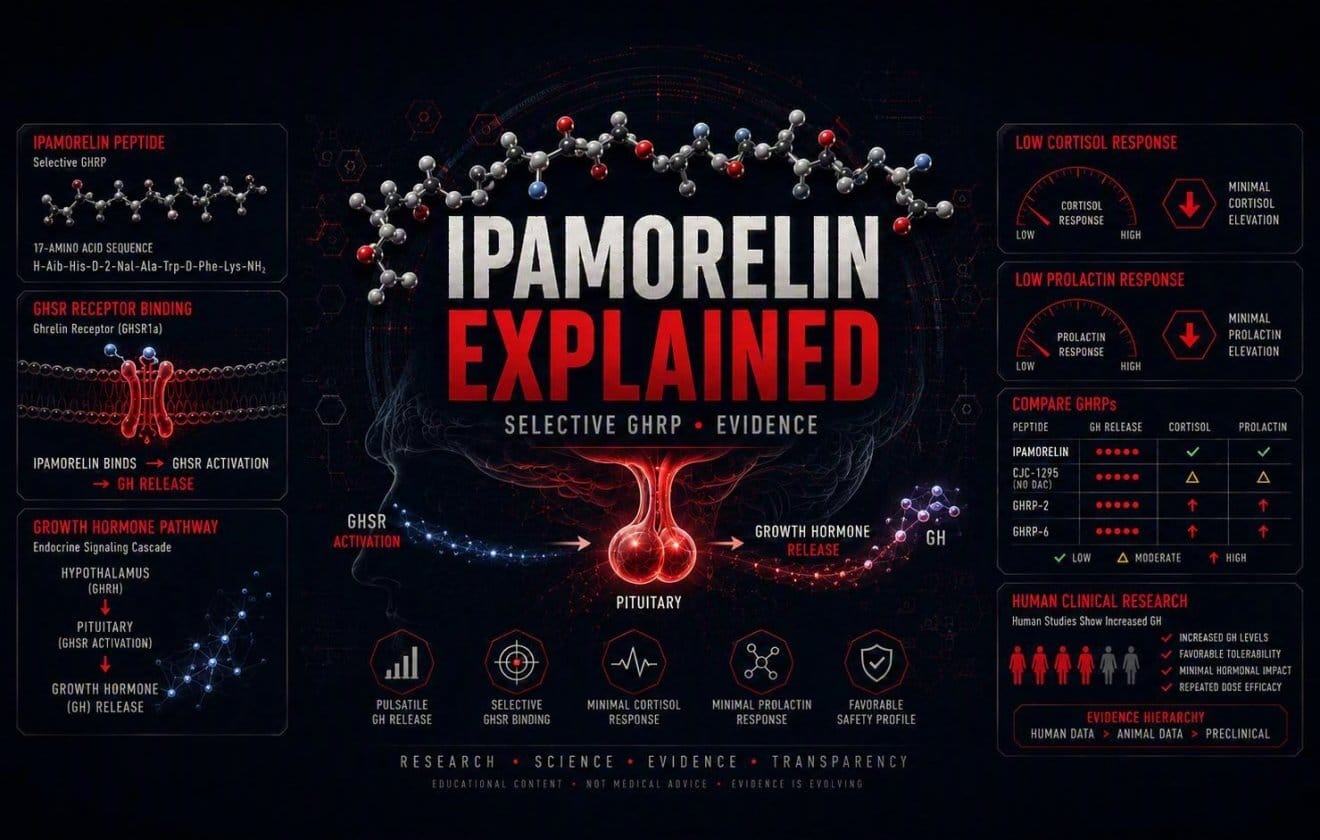
Ipamorelin is a synthetic pentapeptide that stimulates GH release through the ghrelin receptor - and is defined in the scientific literature as the first selective growth hormone secretagogue. What makes it selective: unlike GHRP-6 and GHRP-2, it stimulates GH release without significantly elevating cortisol, prolactin, or appetite. This selectivity profile is the compound's primary pharmacological distinction and the main reason it became the preferred GHRP in most combination frameworks.
Ipamorelin: Three Things That Define This Compound
The First Selective GHRP
Ipamorelin was characterized in published literature as the first selective growth hormone secretagogue - a designation earned because it produces robust GH release without the cortisol, prolactin, and appetite stimulation associated with other GHRPs. This selectivity was not a marketing claim; it emerged from head-to-head animal pharmacology studies comparing it directly to GHRP-6 and GHRP-2.
Ghrelin Receptor Mechanism
Ipamorelin works through the ghrelin receptor (GHSR-1a) on pituitary somatotrophs - the same receptor targeted by GHRP-6 and GHRP-2, and by the body's own ghrelin. However, its interaction with this receptor activates GH-stimulating pathways while producing far less downstream activation of appetite and cortisol-related signaling compared to other compounds in the same class.
Designed for Combination Use
The CJC-1295 + Ipamorelin pairing is the most widely discussed GHRH + GHRP combination, and its selectivity is the pharmacological reason it became the default GHRP in that framework. It provides the somatostatin-suppressing and GH-amplifying effect of GHRP class compounds without the appetite stimulation that makes GHRP-6 unsuitable for users not seeking increased hunger, and without the cortisol and prolactin elevation concerns of GHRP-2.
What This Guide Covers
Covered in This Guide
- What Ipamorelin is and how it was developed
- Ghrelin receptor mechanism and GH secretion pathway
- Selectivity profile: cortisol, prolactin, appetite comparison
- Comparison against GHRP-6 and GHRP-2
- Published animal and human research evidence
- Why this compound is the default GHRP in CJC-1295 combinations
- Evidence gaps and common misinterpretations
Not Covered Here
- Specific dosing or injection timing recommendations
- Sourcing or procurement guidance
- Legal status by jurisdiction
- Specific stack design or protocol structure
- Clinical endorsement of any use
Related guides: The CJC-1295 + Ipamorelin combination mechanism is explained in depth in the CJC-1295 guide. For broader GH secretagogue context, see Growth Hormone Peptides. For the GHRP class overview including GHRP-6 and GHRP-2 comparison, this guide is the primary reference.
What Is Ipamorelin: Structure, Origin, and the Selectivity Designation
Ipamorelin is a synthetic pentapeptide - a chain of five amino acids with the sequence Aib-His-D-2-Nal-D-Phe-Lys-NH2, where Aib denotes alpha-aminoisobutyric acid and D-2-Nal denotes D-2-naphthylalanine. Its molecular weight is approximately 711 daltons - smaller than GHRP-6 (~873 Da) and GHRP-2 (~818 Da). It is not naturally occurring; it was synthesized by researchers at Novo Nordisk in Denmark and first described in published literature in 1998.
The development of Ipamorelin arose from efforts to design a GHRP compound with a cleaner pharmacological profile than the earlier GHRPs. GHRP-6, the first widely studied GHRP, was shown to stimulate robust GH release but also significantly elevated cortisol, prolactin, and appetite - effects mediated through the same ghrelin receptor but via pathways not directly related to GH secretion. GHRP-2 was developed as an improvement, with somewhat lower cortisol and prolactin effects, but still produced meaningful elevations of both. This compound represented the next step: engineered to activate the GH-stimulating pathways of the ghrelin receptor while minimizing activation of the other downstream effects.
The term "selective growth hormone secretagogue" was applied to Ipamorelin in the original pharmacological characterization literature - specifically in contrast to GHRP-6 and GHRP-2. "Selective" in this context means selective for GH secretion relative to cortisol and prolactin - not selective in the sense of targeting a unique receptor unavailable to other GHRPs. All three compounds bind the same ghrelin receptor. The difference lies in which receptor-coupled signaling pathways are preferentially activated by each compound's specific binding conformation.
Ipamorelin Is Not Ghrelin
Ghrelin - the endogenous ligand for GHSR-1a - is a 28-amino acid peptide produced primarily in the stomach. It was discovered in 1999, after the compound covered in this guide had already been characterized. Both Ipamorelin and ghrelin act on the same receptor, but they are not the same molecule and do not produce identical pharmacological effects. Ghrelin strongly stimulates appetite (hence its role as the "hunger hormone") and elevates cortisol and prolactin. Its receptor interaction is structurally different enough to produce a significantly different downstream profile. This receptor-specific selectivity is the mechanistic basis for its pharmacological advantages over GHRP-6, which more closely mimics ghrelin's full effect profile.
How Ipamorelin Works: Ghrelin Receptor to GH Pulse
The mechanism begins at the ghrelin receptor and produces GH release through two parallel intracellular pathways. Understanding both pathways - and how they differ from what GHRP-6 activates - is essential to understanding why this compound has the selectivity profile it does.
Gq/PLC - Calcium Mobilization
Ipamorelin binds GHSR-1a and activates the Gq protein subunit → phospholipase C beta (PLCβ) → cleaves PIP2 into IP3 and DAG → IP3 triggers calcium release from the endoplasmic reticulum of somatotroph cells → intracellular calcium surge drives GH vesicle fusion and secretion. This is the primary fast-release pathway for GH secretion in response to both ghrelin and GHRPs. It activates this pathway with high efficiency, producing GH pulses comparable in magnitude to GHRP-6 in animal studies.
Gs/cAMP - Transcription and Somatostatin Suppression
GHSR-1a also couples to Gs protein → adenylyl cyclase → cAMP → PKA. This pathway contributes to GH gene transcription and, importantly, to partial suppression of somatostatin release from hypothalamic neurons. Somatostatin is the brake on GH secretion; by partially lowering somatostatin tone, this compound amplifies the response to any concurrent GHRH signal - which is the mechanistic basis for the synergistic effect when combined with CJC-1295. It activates this cAMP pathway without significantly stimulating the corticotroph cells that mediate cortisol release.
Why Cortisol and Prolactin Are Not Elevated
GHRP-6's cortisol and prolactin effects are mediated primarily through hypothalamic CRH and dopamine pathways - not directly through pituitary somatotrophs. Ipamorelin's binding conformation activates the pituitary somatotroph pathways (Gq/PLCβ and Gs/cAMP) with high efficiency while producing significantly less downstream activation of the hypothalamic neuroendocrine pathways responsible for ACTH-cortisol and prolactin release. This is a structural pharmacology difference, not a dose difference - at equivalent GH-stimulating doses, it produces minimal cortisol and prolactin elevation, while GHRP-6 produces significant elevations of both.
GH released by the pituitary following this stimulation travels to the liver and peripheral tissues, where it drives IGF-1 production via the standard GH receptor pathway - the same downstream cascade activated by CJC-1295 and exogenous HGH. The tissue-level effects of GH stimulation are downstream of the receptor and are identical regardless of which compound triggered the pituitary release.
Ipamorelin vs GHRP-6 vs GHRP-2: The Selectivity Comparison
The three GHRPs most commonly discussed in research contexts - Ipamorelin, GHRP-6, and GHRP-2 - all work through the same ghrelin receptor and all produce significant GH release. The differences between them are not about which receptor they use but about the specificity of their downstream effects. This comparison is the most pharmacologically significant context for understanding why the first became the default GHRP in most combination frameworks.
| Parameter | Ipamorelin | GHRP-2 | GHRP-6 |
|---|---|---|---|
| Structure | Pentapeptide, 5 AA, ~711 Da | Hexapeptide, 6 AA, ~818 Da | Hexapeptide, 6 AA, ~873 Da |
| GH Release | Strong - comparable to GHRP-6 at equivalent molar doses in animal studies | Strong - reported as slightly greater than GHRP-6 in some animal models | Strong - the original benchmark GHRP for GH release potency |
| Cortisol Elevation | Minimal - no significant cortisol elevation demonstrated in animal studies at GH-stimulating doses | Moderate - documented cortisol elevation in animal studies; less than GHRP-6 but present | Significant - documented cortisol and ACTH elevation in rats and humans at therapeutic doses |
| Prolactin Elevation | Minimal - no significant prolactin effect demonstrated at GH-stimulating doses | Moderate - prolactin elevation documented; clinically observed in some human studies | Moderate - prolactin elevation documented in human and animal pharmacology |
| Appetite Stimulation | Minimal - significantly lower appetite stimulation than GHRP-6 or native ghrelin | Low to moderate - lower than GHRP-6; ghrelin receptor activation still present | Strong - most closely mimics ghrelin's appetite-stimulating effect of the three; significant hunger increase documented in both animal and human studies |
| Human Trial Data | Phase II GI motility trials (postoperative ileus); short-term GH pharmacokinetic data | Limited published human data; primarily animal pharmacology | Human pharmacology data including cortisol/ACTH and appetite effects confirmed in clinical studies |
| Primary Use Rationale | GH stimulation without endocrine side effects - preferred GHRP for combinations | Maximum GH pulse potency - used when GH amplitude is the priority over selectivity | GH stimulation with appetite increase - used when caloric intake support is also desired |
Raun K et al. Eur J Endocrinol. 1998. Muccioli G et al. Eur J Pharmacol. 2001. Human GHRP-6 data: Loche S et al. J Clin Endocrinol Metab. 1995.
The comparison table above reflects the pharmacological basis for this compound's position as the preferred GHRP in CJC-1295 combination frameworks. When the goal is maximal GH stimulation with minimal additional hormonal perturbation, its selectivity profile represents the best available option within the GHRP class. GHRP-6 remains relevant specifically when appetite stimulation is a secondary objective - for example in individuals who want to increase caloric intake while also stimulating GH. GHRP-2 occupies a middle position with higher reported GH potency but greater endocrine side effects than the alternative.
What the Published Data Shows for Ipamorelin
The research profile here is more developed than many research peptides in community use - it advanced through animal pharmacology into human clinical testing for a GI indication - but the evidence base for the applications most commonly discussed in performance contexts remains limited.
GH Release and Selectivity Profile
Foundational studies by Raun et al. (1998) in rats demonstrated that Ipamorelin produced GH release comparable to GHRP-6 and hexarelin but with no significant elevation of cortisol or prolactin at equivalent doses. These studies established the selectivity profile and coined the "selective GH secretagogue" designation. Subsequent animal studies confirmed dose-dependent GH pulse amplification, additive effects with GHRH, and a favorable tolerability profile with repeat administration - without tachyphylaxis (receptor desensitization) at doses studied.
GH Axis Effects with Chronic Use
Rat studies with prolonged Ipamorelin administration showed sustained GH pulse amplification without progressive receptor desensitization over the study periods examined - a contrast to hexarelin, which rapidly desensitizes its receptor with repeated dosing. IGF-1 levels increased in line with elevated GH. Bone mineral density and lean mass gains were observed in aged rat models, consistent with expected GH/IGF-1 axis activity. These animal findings are often cited in community frameworks - but represent animal data in aged, often GH-deficient models, not healthy adult humans.
Postoperative Ileus Trials
Ipamorelin was developed clinically not for GH stimulation but for gastrointestinal motility - specifically postoperative ileus (delayed bowel function after abdominal surgery). The ghrelin receptor is present in GI smooth muscle and mediates prokinetic effects. Phase II trials tested its ability to accelerate return of GI function after surgery. Results showed improvement in GI motility endpoints with an acceptable safety profile. These trials provided human pharmacological data and confirmed short-term safety - but in a surgical context completely unrelated to GH stimulation or performance applications.
No Human GH Stimulation Trials
Unlike CJC-1295 with DAC, which has a published Phase I/II human pharmacokinetic study directly measuring GH and IGF-1 responses, this compound does not have equivalent published human data for its GH-stimulating effects. The GH selectivity profile was established in animal models. The assumption that the same selectivity translates identically in humans - with equivalent GH potency and equivalent absence of cortisol/prolactin effects - is pharmacologically reasonable but has not been confirmed under controlled human conditions for GH stimulation specifically.
CJC-1295 + Ipamorelin: Why This Is the Default Pairing
The combination of CJC-1295 with Ipamorelin is the most consistently discussed GHRH + GHRP pairing in research contexts, and its position as the default GHRP in this combination has a specific pharmacological basis. The full mechanistic rationale for the pairing - GHRH receptor stimulation plus ghrelin receptor activation producing synergistic GH release - is covered in the CJC-1295 guide. The focus here is why this compound specifically, rather than GHRP-6 or GHRP-2, became the standard GHRP choice for this combination.
Cortisol and Prolactin Profile
CJC-1295 stimulates the GHRH receptor - a pathway that does not elevate cortisol or prolactin. Pairing it with GHRP-6 would introduce significant cortisol and prolactin elevation from the GHRP component, partially offsetting the clean endocrine profile of CJC-1295. Ipamorelin contributes the synergistic somatostatin-suppressing effect of GHRP class compounds without adding cortisol or prolactin elevation, preserving the clean hormonal profile of the combination.
Appetite Profile
GHRP-6 produces strong appetite stimulation - a useful property when increased caloric intake is a goal, but disruptive when it is not. This compound produces minimal appetite stimulation. For users who are not specifically seeking appetite increase, GHRP-6's hunger-inducing effect represents an unwanted variable in dietary management. It eliminates this variable, making the GH stimulus-only effect of the combination more pharmacologically specific.
Equivalent GH Release Potency
Its GH-stimulating potency in animal models is comparable to GHRP-6 at equivalent molar doses. The selectivity advantage does not come at the cost of GH release efficacy. In combination with CJC-1295's GHRH receptor stimulation, it produces the same synergistic GH response as other GHRPs - but with the clean endocrine profile that makes it the preferred combination partner.
Combination Lacks Direct Human Trial Data
The pharmacological rationale for the CJC-1295 + Ipamorelin combination is grounded in established receptor biology. No published human clinical trial has studied this combination directly for any endpoint - GH pharmacokinetics, safety, or performance outcomes. The combination is extrapolated from separate studies of each compound individually. As with CJC-1295 alone, mechanistic plausibility and human efficacy data are not equivalent.
5 Things Ipamorelin Research Does Not Confirm
The pharmacological profile of this compound is well-characterized relative to most research peptides. The selectivity data, animal pharmacology, and human GI trial data collectively represent a meaningful evidence base. However, the gap between what the research shows and what is typically claimed in performance contexts is substantial. The five points below define where that boundary sits.
1. That Rat Selectivity Data Predicts Identical Human Cortisol Response
The cortisol and prolactin selectivity profile that defines Ipamorelin was established in rat pharmacology studies. Rats and humans share the ghrelin receptor and the general architecture of the hypothalamic-pituitary axis, but the specific downstream signaling proportions - how much each pathway is activated relative to the others at a given dose - are not identical across species. The human response at GH-stimulating doses has not been studied in a controlled human trial for this indication. The selectivity advantage is well-supported in animal data and is pharmacologically plausible in humans, but the claim that "Ipamorelin does not raise cortisol in humans" is extrapolating from rat data rather than reporting a confirmed human finding.
2. That GH Stimulation Produces Muscle or Performance Gains
No published study in any species has measured the effect of this compound on lean mass, body composition, strength, or recovery in healthy, trained individuals. The animal data showing GH/IGF-1 elevation and bone/lean mass gains comes from aged, often GH-deficient animal models - populations with impaired baseline GH axis function. In healthy adults with normal GH secretion, the incremental benefit of further GH stimulation on muscle mass or performance outcomes has not been established. The assumption that "more GH = more muscle" in eugonadal healthy adults with normal GH function is not supported by the available evidence.
3. That "Selective" Means "Side-Effect Free"
The selectivity designation refers specifically to reduced cortisol, prolactin, and appetite effects compared to other GHRPs - not to an absence of all side effects. The human GI trial data (postoperative ileus studies) identified adverse events including nausea, dizziness, and injection site reactions. The GI indication studies used doses and routes in clinical populations; whether the same adverse event profile applies to subcutaneous administration of research chemicals at community-discussed doses is unknown. "Selective" is a pharmacological term of art describing receptor pathway specificity - it is not a safety claim.
4. That This Compound Alone Is Equivalent to the CJC-1295 Combination
Used alone, this peptide produces GH pulses via the ghrelin receptor. The combination with CJC-1295 produces a synergistically larger GH response by simultaneously activating the GHRH receptor while suppressing somatostatin - two mechanisms not provided by the ghrelin receptor pathway alone. Many community frameworks discuss the combination as if it were interchangeable with either component alone in terms of effects. It is not. The combination activates two separate points in the GH regulatory axis simultaneously, which is pharmacologically distinct from activating either point in isolation. The efficacy claims associated with the combination cannot be attributed to standalone use.
5. That the Postoperative Ileus Data Supports GH Stimulation Applications
The human clinical data available comes entirely from GI motility trials - postoperative ileus studies where the endpoint was return of bowel function after abdominal surgery. The ghrelin receptor is present in GI smooth muscle and its activation accelerates gastric emptying and intestinal motility. This GI efficacy is pharmacologically separate from the pituitary GH-stimulating effect. The GI trial data confirms pharmacological activity in humans and an acceptable short-term safety profile in surgical patients - it does not confirm GH stimulation efficacy in healthy adults, body composition effects, or recovery acceleration in athletic contexts.
Common Mistakes in How Ipamorelin Is Discussed
- Mistake 01
Treating "Selective" as a Synonym for "Safe"
The selectivity profile - minimal cortisol, prolactin, and appetite effects compared to GHRP-6 - is frequently described in community contexts as evidence that Ipamorelin is "safe" or "side-effect free." Selectivity is a pharmacological descriptor of pathway specificity, not a safety determination. A compound that selectively stimulates one receptor pathway can still have adverse effects through that pathway, through off-target receptor interactions, or through the downstream consequences of the primary effect (elevated GH and IGF-1). This compound's human safety data is limited to short-term GI trial populations and cannot be extrapolated to sustained subcutaneous administration in healthy adults.
- Mistake 02
Citing GI Trial Data as Evidence for Athletic Application
The Camilleri and Hansen postoperative ileus studies are real, peer-reviewed human trials with clinical endpoints. They are sometimes cited in community frameworks to establish that "Ipamorelin has been tested in humans and works." What these studies show is that it accelerates GI motility recovery in surgical patients via the ghrelin receptor. They do not demonstrate GH stimulation efficacy in healthy adults, and GI motility is a mechanistically separate effect from the pituitary GH axis that community use is predicated on. These are different pharmacological endpoints - citing one to support the other misrepresents what the studies actually measured.
- Mistake 03
Using It as a Standalone When the Evidence Is for Combinations
The pharmacological rationale for Ipamorelin in most research contexts is as the GHRP component in a GHRH + GHRP combination - providing somatostatin suppression and ghrelin receptor GH stimulation that synergizes with GHRH receptor stimulation from CJC-1295 or a similar analog. Used alone, it produces GH pulses, but without the additive GHRH signal, those pulses are smaller than the combination produces. Community discussions sometimes present standalone use as equivalent in intent and effect to the combination protocol, which is pharmacologically incorrect.
- Mistake 04
Assuming Its Profile Is Identical to Ghrelin
Because Ipamorelin binds the ghrelin receptor (GHSR-1a) - the same receptor as the body's own ghrelin - it is sometimes described as "ghrelin-like" or discussed as if it replicates ghrelin's effects. Ghrelin strongly stimulates appetite, significantly elevates cortisol, and regulates multiple metabolic and GI functions through GHSR-1a and secondary receptor interactions. This compound specifically does not replicate ghrelin's appetite or cortisol effects. Two compounds binding the same receptor do not necessarily produce the same downstream profile - the binding conformation determines which coupled signaling pathways are preferentially activated. This distinction is the entire basis for its selective designation.
- Mistake 05
Ignoring the Research Chemical Purity Problem
Ipamorelin from research chemical suppliers is not the pharmaceutical-grade compound used in published studies. Research chemical products have no mandatory identity verification, purity testing, or sequence confirmation. Mass spectrometry analysis of commercial peptides routinely identifies truncated sequences, racemized amino acids, oxidized variants, and low-purity batches. Its five-amino-acid sequence means that any modification - including a single incorrect amino acid or racemized residue - produces a molecule that may not bind the ghrelin receptor correctly or may bind it differently than the studied compound. The selectivity profile established by Raun et al. for the pharmaceutical-grade version does not apply to a product of unknown identity.
Published Research Cited in This Guide
- Raun K, Hansen BS, Johansen NL, et al. Ipamorelin, the first selective growth hormone secretagogue. European Journal of Endocrinology. 1998. PMID: 9849822.
- Beck B, et al. Efficacy of ipamorelin, a novel ghrelin mimetic, in a rodent model of postoperative ileus. Journal of Pharmacology and Experimental Therapeutics. 2009. PMID: 19289567.
- Beck DE, Sweeney WB, McCarter MD, et al. Prospective, randomized, controlled, proof-of-concept study of the ghrelin mimetic ipamorelin for the management of postoperative ileus in bowel resection patients. International Journal of Colorectal Disease. 2014. PMID: 25331030.
Ipamorelin in Context: Selectivity Profile, Evidence Status, and What It Actually Means
This compound holds a well-defined position in the GHRP class: it is the most selective option available for GH stimulation within this receptor family, producing GH release without the cortisol, prolactin, and appetite effects associated with GHRP-6 and GHRP-2. This selectivity is grounded in peer-reviewed pharmacology data - specifically the original Raun et al. characterization - and provides a genuine pharmacological rationale for preferring it over other GHRPs when the goal is isolated GH axis stimulation.
The evidence base has real structure to it: the selectivity profile is established in animal pharmacology, the GH-stimulating mechanism is well-characterized, and human clinical exposure exists through the postoperative ileus trials. These are meaningful data points that most research peptides in community use lack. At the same time, the human evidence does not confirm GH stimulation efficacy in healthy adults or any performance-related outcome. The GI trial data and the GH stimulation application operate through different aspects of the same receptor - they are not the same endpoint, and one does not validate the other.
Ipamorelin's practical role in the research community is primarily as the preferred GHRP component in combination with CJC-1295 - providing somatostatin suppression and ghrelin receptor GH amplification without the appetite and cortisol variables that complicate use of the earlier GHRPs. Understanding this position - and the evidence gaps that surround it - is the foundation for evaluating any GHRP-containing framework honestly.
- Growth Hormone Peptides - category overview covering all GH secretagogues and their research context
- CJC-1295 Explained - GHRH analog that pairs with Ipamorelin; full combination mechanism covered here
- Peptides Hub - full index of the peptides section and all published guides
- What Are Peptides - foundational guide to peptide biochemistry and classification
- Types of Peptides - how GH secretagogues, healing peptides, and other classes differ
- Peptide Side Effects - documented and proposed adverse effects across peptide categories
- Peptide Research vs Human Use - why animal selectivity data does not equal confirmed human outcomes
- Peptide Dosage Calculator - unit conversion tool for understanding research dosing frameworks
- BPC-157 Explained - healing peptide with a mechanistically distinct tissue repair focus
- Start Here - full editorial overview of MuscleScience.org content
For Educational Purposes Only
This article discusses Ipamorelin and GHRP pharmacology for educational and harm-reduction purposes. It does not constitute medical advice and is not a substitute for consultation with a qualified physician. The information provided reflects published research and is intended to support informed decision-making, not to encourage or facilitate the use of research chemicals or controlled substances.
MuscleScience.org does not sell any compounds, medications, or supplements. All author names are pseudonyms. Author photographs are stylized portraits, not images of real individuals. See our About page and Disclaimer for full disclosure on editorial policy and anonymity.