Shoulder Pain on the Bench Press: What the Pain Pattern Means and What to Change

SHOULDER PAIN ON THE BENCH PRESS: WHAT THE PAIN PATTERN MEANS AND WHAT TO CHANGE
Shoulder pain bench press complaints are the most common upper-body problem in the weight room and one of the least specific: four different structures sit within a few centimetres of each other at the front and top of the shoulder, and each hurts in a different place, at a different point of the press and at a different time after the session. Up to 36 percent of documented resistance-training injuries involve the shoulder complex (PMID 20508476), and in men aged 20 to 40 with erosion of the end of the collarbone on MRI, 56 percent were benching more than 1.5 times body weight against 6 percent of men without it (PMID 27550324).
The bench itself is rarely the whole answer. In ten experienced strength athletes pressing through 21 technical variations, a grip narrower than 1.5 times shoulder width and a retracted shoulder blade both reduced the compressive and shear loads on the shoulder joint in a musculoskeletal model (PMID 38974522), and in the trials that matter most for the lifter whose shoulder hurts when bench pressing, surgery to decompress the shoulder performed no better than a placebo operation (PMID 29169668, PMID 30026230). What matters is which structure is complaining and what you change in response.
This guide reads bench press shoulder pain from the biomechanics papers, the rotator cuff and acromioclavicular joint literature, the surgical and exercise trials and the lifter injury surveys: where each of the four pain patterns sits, what grip width, elbow angle and shoulder blade position do to the joint, what the trials measured for the rotator cuff, what weightlifter shoulder is, why the scan rarely settles it, how often lifters get it, what men describe against what was measured, and the signs that need a clinician rather than a cue.
Every figure about shoulder pain bench press causes on this page comes from a PubMed abstract listed at the end. The tendon model behind this page is on tendonitis vs tendinosis; the series lives on the training hub.
Shoulder pain bench press facts in brief
Three numbers frame shoulder pain bench press complaints: how much of the injury burden in lifting lands on the shoulder, how strongly heavy benching is tied to the one condition named after it, and how often a scan finds something that is not the cause.
Across the epidemiological literature on resistance training, up to 36 percent of documented injuries and disorders involved the shoulder complex, with joint and muscle imbalances and inattention to technique the trends that raised the likelihood; most of the data were retrospective surveys (PMID 20508476). In 245 competitive powerlifters the shoulder led the injury list with the lower back and knee, and upper-limb injuries rose after age 40 (PMID 21590644).
Of 262 men aged 20 to 40 with distal clavicular osteolysis on MRI, 56 percent were high-intensity bench pressers, against 6 percent of 227 age-matched men without it; the odds ratio was 19, benching more than once a week and for more than five years were also risk factors, and low-intensity benching was not (PMID 27550324).
In 96 people with no shoulder symptoms, MRI found a rotator cuff tear in 34 percent, full thickness in 15 percent and partial in 20 percent, rising sharply with age: none of the 19 to 39 year olds had a full tear and 4 percent had a partial one, against 54 percent with some tear over 60 (PMID 7822341). A scan finding is not automatically the reason the bench press hurts shoulder tissue.
Every figure on this page about shoulder pain bench press causes is taken from a PubMed abstract listed at the end. Where a model is proposed rather than demonstrated, the page says so. Where lifters describe their own shoulders on forums, it is reported as a description, not as evidence. Nothing here diagnoses; the red flags that need a clinician are listed near the end.
What this shoulder pain bench press guide covers
The four patterns of shoulder pain bench press lifters describe: the front of the shoulder where the biceps and pec tendons attach, the top of the shoulder over the end of the collarbone, deep under the point of the shoulder, and the chest tendon itself, with what each usually means.
What the bench does to the shoulder: how grip width, elbow angle and shoulder blade position change the loads in a musculoskeletal model, why the lateral force on the bar matters, and what fatigue inside a set does to shoulder range of motion.
What was measured to help: the rotator cuff exercise trials, the placebo-controlled surgery trials, the cortisone meta-analysis, the weightlifter shoulder cohort, why scans mislead, how often lifters get shoulder pain from bench press training, and the principles for the next session.
Not coveredThe tendon model in depth. Why rest does not fix a degenerative tendon, isometrics, heavy slow resistance and the timeline are on tendonitis vs tendinosis, the cornerstone of this series.
Dislocation and fracture. A shoulder that has come out of joint, a broken collarbone or a fall is a clinical problem from day one and is not a load-management question.
Programmes. The page reports what trials did and measured; it does not prescribe sets, loads or exercises. Weekly dose is on training volume explained, loading progression on progressive overload explained, and the pulling work that balances a press is on upper back workouts.
Where the shoulder hurts when bench pressing, and what each place usually means
Shoulder pain bench press complaints are a location before they are a diagnosis. The front and top of the shoulder hold four structures that each respond to pressing load in their own way, so bench press shoulder pain is sorted by place and timing: the first useful question is not what is wrong but where exactly the shoulder hurts when bench pressing and at which point of the rep.

The front of the shoulder. An ache a fingertip can find at the front of the joint, sharpest at the bottom of the press when the bar is on the chest and the elbow is behind the body, that warms up during the session and is loud the next morning, is the load-related presentation of a tendon, the most common shoulder pain bench press lifters describe. The long head of the biceps and the upper pec attach there and the front of the rotator cuff passes underneath.
The hallmark of a tendon problem is pain that rises with the demand on the tissue and settles with rest without going away, which is the pattern the continuum model describes for every tendon in the body.
The whole model is on tendonitis vs tendinosis.
The top of the shoulder. Pain over the bony bump where the collarbone meets the shoulder, worse on dips, flyes and the bottom of a close-grip press, point tender to pressure, is the picture of the acromioclavicular joint, the second shoulder pain bench press pattern. In lifters the specific diagnosis is distal clavicular osteolysis, coined weightlifter shoulder, in which repetitive microtrauma produces painful erosion and resorption of the end of the collarbone (PMID 37294199). Bench pressing was the most common activity-based risk factor in the cohorts, named in 49.1 percent of 483 patients, and 69.9 percent reported pain at the AC joint (PMID 42656558).
Deep under the point of the shoulder. Pain and weakness experienced most during external rotation and when lifting the arm, hard to localise with one finger, is the hallmark of rotator cuff tendinopathy.
Assessment of that pattern is complicated by nonspecific clinical tests and the poor correlation between structural failure and symptoms, so the diagnosis is best reached by exclusion (PMID 26390274); when the shoulder hurts when bench pressing in this way, the exclusion is of the three other patterns. The chest near the armpit. A sudden snap during a heavy rep with bruising and a change in the shape of the chest is the pec major, which is a different problem from everything above and is covered in its own section (PMID 21831661).
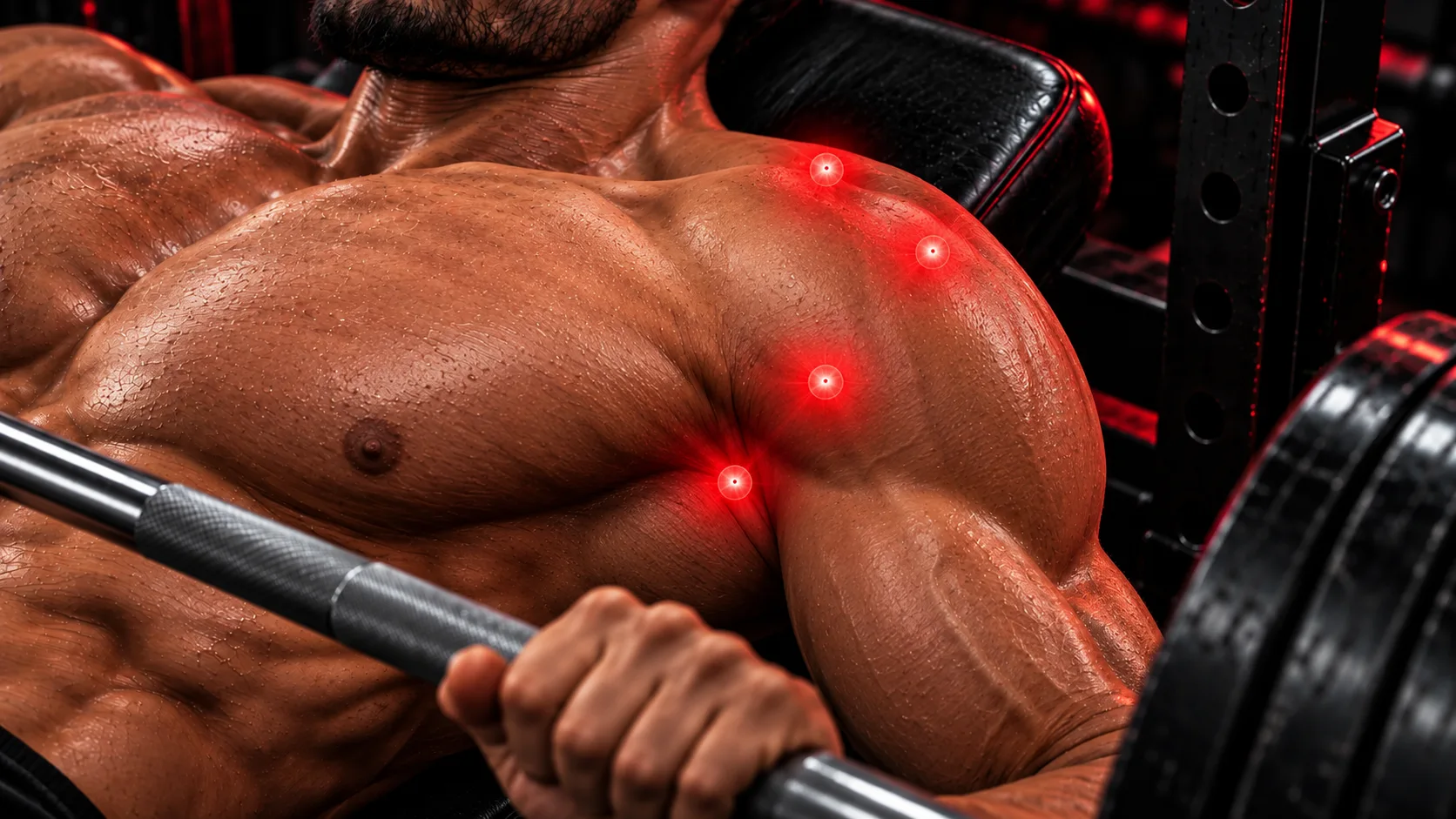
| Where and when | Usually | Read as |
|---|---|---|
| Front of the shoulder; worst at the bottom of the press; warms up, loud next morning | Biceps or pec tendon, front of the cuff: load-related tendon pain | Tendon rules, see the cornerstone |
| Top of the shoulder over the end of the collarbone; dips, flyes, close grip; point tender | AC joint, distal clavicular osteolysis; heavy benching is the risk factor, OR 19 (PMID 27550324) | Assessment; load and grip change |
| Deep, when lifting or rotating the arm; weakness on external rotation | Rotator cuff tendinopathy or subacromial pain; tests do not settle it (PMID 22773322) | Exercise has the evidence (PMID 22607807) |
| Front, with a sense the ball is slipping forward; worse in the high-five position | Anterior instability or hyperlaxity, more common in lifters (PMID 22836608) | Assessment; drop behind-the-neck work |
| Sudden snap or pop with bruising, a gap in the chest, weakness pressing | Pec major tear (PMID 21831661) | Physician now |
| Night pain, hot swollen joint, numbness down the arm, shoulder out of joint | Infection, inflammatory arthritis, nerve, dislocation | Physician now |
What the bench press does to the shoulder: loads by grip, elbow and shoulder blade
The reason the bench press hurts shoulder tissue, and why shoulder pain when bench pressing differs from push-up to barbell, are mechanical and now measured. Ten experienced strength athletes performed 21 variations of the barbell bench press, with grip widths of 1, 1.5 and 2 times the distance between the shoulder tips, shoulder abduction angles of 45, 70 and 90 degrees, and the shoulder blade neutral, retracted or released, while an instrumented bar and motion capture fed a musculoskeletal shoulder model. A grip narrower than 1.5 shoulder widths decreased compression at the acromioclavicular joint and decreased the posterior shear force and rotator cuff activity at the ball-and-socket joint; scapular retraction decreased posterior shear and cuff activity as well (PMID 38974522).

The same study found that the force lifters exert sideways along the bar varied considerably between athletes and largely affected the shoulder reaction forces, which is the part of bench press shoulder pain no cue about grip covers (PMID 38974522). In 18 recreational lifters with an instrumented bar, the lateral force was always outward, followed the shape of the vertical force, and peaked at 26.3 percent of the vertical force during a maximal lift and 23.7 percent at 80 percent of maximum; the authors concluded that pushing outward is a by-product of the muscles generating vertical force rather than a technique choice (PMID 21804421).
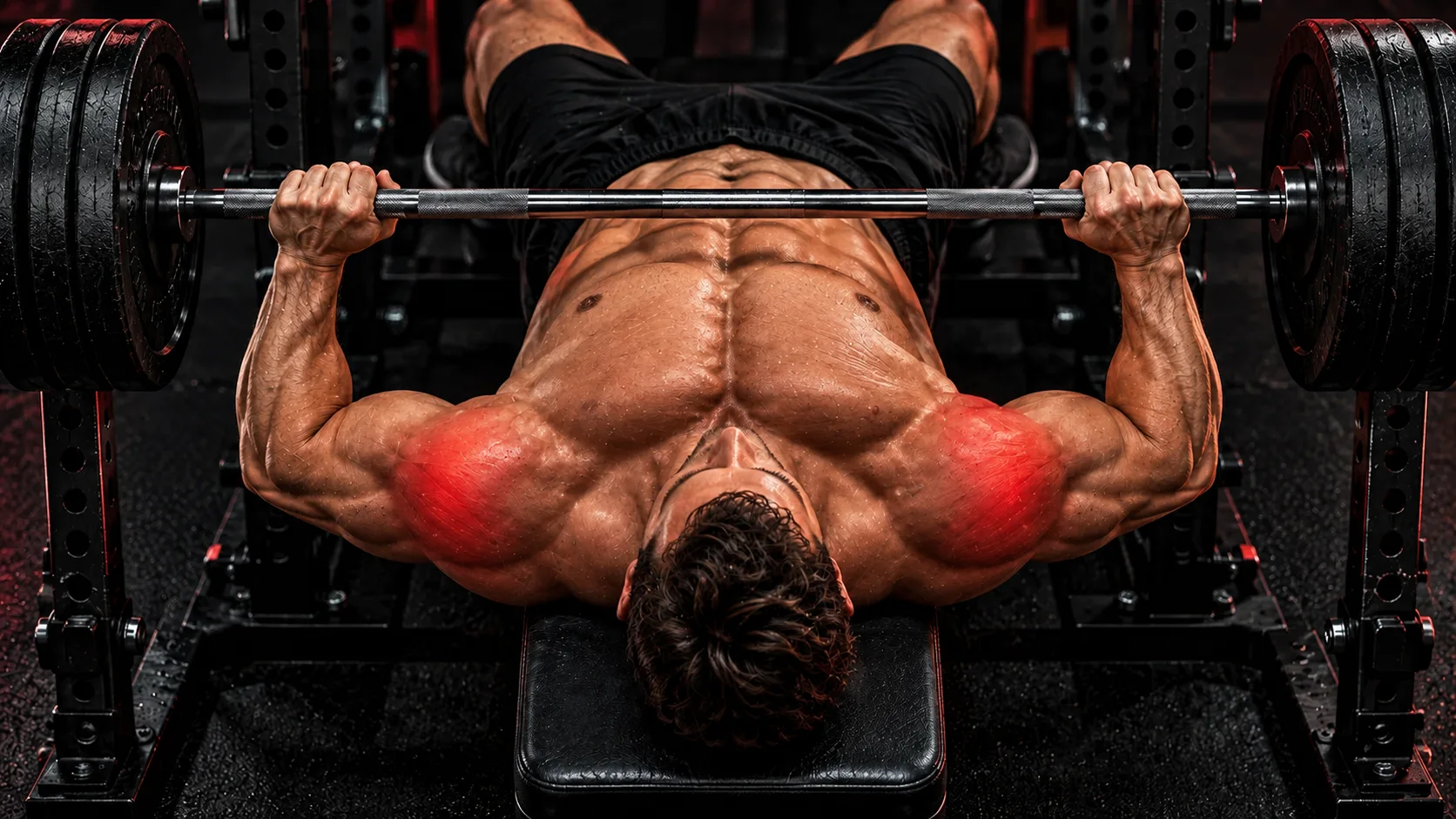
Grip width also decides which joint does the work. In 35 strength-trained adults performing 6 to 8 repetition maximum sets, a narrower grip produced larger elbow moments and more activity in the lateral triceps, front deltoid and upper pec, and a wider grip produced larger shoulder moments, normalised shoulder effort and more activity in the lower pec (PMID 33555823). In 28 men, a narrow grip lowered the 6-repetition maximum load, biceps activity rose with grip width and a wide grip lowered triceps activity (PMID 34198674); in an isometric study of 12 men, moving from wide to narrow raised triceps activity and lowered the sternal pec (PMID 16095407).
The wide grip that lets a lifter move the most weight is the one that puts the most moment through the shoulder, which is one reason shoulder pain after bench press sessions tracks the competition grip and not the close one.
Fatigue changes the joint inside a set, which matters for shoulder pain after bench press volume work. In 19 competitive powerlifters pressing three sets of eight at 73.9 percent of their maximum, glenohumeral range of motion increased significantly from the first repetition to the second-to-last in every axis, plane of elevation, elevation and rotation, with larger increases in the women (PMID 42748970).
In 24 powerlifters measured by ultrasound, women had a higher supraspinatus occupation ratio and a smaller acromiohumeral distance in the bench press position than men (PMID 41804856). A narrative review of the same question argues that velocity-based, reps-in-reserve and autoregulated programming should be preferred over repetitions to failure to limit the overexertion that drives shoulder injury in the bench press (PMID 39808810).
Rotator cuff pain on the bench: what the trials measured
Why does my shoulder hurt when I bench press, deep in the joint, with weakness when I rotate or raise the arm? That is the rotator cuff picture, and it is the best-studied answer to shoulder pain bench press lifters report. The cuff tendons run under the bony roof of the shoulder; pain there has been called impingement, subacromial pain and rotator cuff tendinopathy by different authors describing the same patients, and the consensus of the clinical review is that the diagnosis is reached by excluding other sources, because the clinical tests are nonspecific and structure on a scan correlates poorly with symptoms (PMID 26390274).
The tests confirm that for shoulder pain when bench pressing deep in the joint. In the updated systematic review of shoulder examination, the Neer test had a pooled sensitivity of 72 percent and specificity of 60 percent for impingement, Hawkins-Kennedy 79 and 59 percent, and the painful arc 53 and 76 percent, none of them decisive on their own (PMID 22773322).
Lifters do present with these signs more often than non-lifters: in 77 men, those who trained with weights at least twice a week were more likely to have a positive painful arc and Hawkins-Kennedy together, a cluster with a positive likelihood ratio of 5.0, and the signs were associated with lateral raises and upright rows above 90 degrees and inversely with external rotator strengthening (PMID 24077379).

Treatment evidence for this bench press shoulder pain points to loading the cuff, not cutting the roof. In 102 patients with subacromial impingement lasting over six months, a specific programme of eccentric rotator cuff exercises and concentric and eccentric scapular stabiliser exercises for 12 weeks improved the Constant-Murley score by 24 points against 9 for unspecific neck and shoulder movement exercises, a 15-point difference, and more patients in the specific group reported success and fewer chose surgery (PMID 22349588).
Across 16 randomised trials with 1,162 participants there was strong evidence that exercise reduces pain and improves function in the short term in subacromial pain (PMID 22607807), and a single self-managed loaded exercise matched usual physiotherapy at three, six and twelve months in 86 patients with rotator cuff tendinopathy (PMID 26160149).
The surgical trials are the part most lifters with shoulder pain from bench press training have not heard. CSAW randomised 313 patients with at least three months of subacromial pain, an intact cuff and a failed non-operative programme to arthroscopic decompression, arthroscopy alone as a placebo, or no treatment: at six months the Oxford Shoulder Score was 32.7 after decompression and 34.2 after placebo surgery, both slightly above no treatment at 29.4, and the authors judged none of the differences clinically important (PMID 29169668).
FIMPACT randomised 210 patients to decompression, diagnostic arthroscopy or exercise therapy and found no clinically relevant difference between decompression and placebo surgery at 24 months, and differences against exercise below the 15-point threshold the trial set (PMID 30026230). In 180 shoulders over 55 with non-traumatic supraspinatus tears, physiotherapy alone matched acromioplasty and matched tendon repair on the Constant score at one year (PMID 24395315).
Injections do not change the picture for shoulder pain after bench press sessions. Across 11 randomised trials with 726 patients, a corticosteroid injection did not reduce rotator cuff tendinosis pain more than a placebo injection at three months; there was a small transient effect between four and eight weeks, with at least five patients injected for one to get transient relief to no more than mild pain, and repeat injections were no better than one (PMID 27469590). What the lifter with shoulder pain after bench press sessions is left with is the same thing the knee and the tendon pages found: structured, graduated loading of the complaining tissue, with the symptoms rather than the scan as the guide (PMID 26390274).
Weightlifter shoulder: the AC joint and heavy benching
One cause of shoulder pain from bench press training has the bench in its risk profile by name. Distal clavicular osteolysis, called weightlifter shoulder, is painful erosion and resorption of the end of the collarbone caused by repetitive microtrauma, and its diagnosis, treatment and prevention are described as challenging; activity modification and rehabilitation are the mainstays of initial treatment, with injections or surgery reserved for refractory cases, and early recognition matters to prevent progression to AC joint pathology or instability (PMID 37294199).
The dose-response is the clearest in the whole shoulder pain bench press subject. From a retrospective review of shoulder MRI reports in men aged 20 to 40, 262 with osteolysis and 227 age-matched men without it completed a bench press questionnaire: 56 percent of the osteolysis group were high-intensity bench pressers, with a one-repetition maximum above 1.5 times body weight, against 6 percent of the controls, an odds ratio of 19. Benching more than once a week and for more than five years were also risk factors, low-intensity benching below 1.5 times body weight was not, and the mean maximum in the affected benchers was 283 pounds against 209 in those unaffected (PMID 27550324).
The scoping review of eight cohort studies with 483 patients confirms the pattern and adds the course. Bench pressing was the most common activity-based risk factor at 49.1 percent, followed by general weight training at 24.4 percent; frequency and intensity of loading were noted as risk factors; the most common symptom was pain at the distal clavicle or AC joint in 69.9 percent; MRI showed marrow oedema and subchondral fracture of the distal clavicle; most patients recovered with conservative care and 16 percent needed surgery after it failed, with largely favourable outcomes from resection (PMID 42656558).
The clinical signs were not distinguishable from other shoulder pathologies, which is why the loading history, not the examination, is what points to it (PMID 42656558).
The mechanics of bench press shoulder pain fit. The same model that measured grip width found that a grip narrower than 1.5 shoulder widths decreased acromioclavicular compression, and the authors wrote that this may decrease the risk of distal clavicular osteolysis (PMID 38974522). For the lifter whose shoulder hurts when bench pressing at the top of the joint rather than the front or deep inside, the two variables the evidence names are how heavy and how wide.
The pec tear: the one bench press shoulder pain that is an emergency
A snap during a heavy rep with immediate weakness, bruising spreading down the arm and chest and a visible change in the contour of the pec is not shoulder pain from bench press loading; it is a pectoralis major tear, and it needs a physician within days. In a systematic review of 365 published cases between 1822 and 2010, 75 percent had occurred in the last 20 years, 83 percent resulted from indirect trauma and 48 percent happened during weight-training activities (PMID 21831661).
The injury reviews describe a substantial rise in prevalence in the past 20 years, largely related to the popularity of weight lifting, increased satisfaction among patients treated operatively, and a return to activity between 6 and 24 months after surgery (PMID 35102069).
The upper-extremity injury review for resistance-training athletes lists pec major tendon ruptures alongside distal biceps ruptures, muscle strains, ligament sprains and chronic shoulder pain with capsulolabral injury, and notes that the chronic problems generally resolve with workout modification, recovery and physical therapy, while surgery is often successful where conservative treatment fails (PMID 29657436). The practical reading is the one in the red flag list: pain that builds over weeks is a loading problem to work on; a pop with bruising and a gap is a tear to be seen, and the time to see it is not after another block of training.
Why the scan rarely settles shoulder pain bench press causes
The lifter with shoulder pain bench press sessions provoke usually wants an MRI, and the MRI usually finds something. In 96 people with no shoulder symptoms at all, MRI found a rotator cuff tear in 34 percent, full thickness in 15 percent and partial thickness in 20 percent; the frequency rose with age, 54 percent over 60 had a tear, and among the 19 to 39 year olds none had a full-thickness tear and one in 25 had a partial one. The authors warned against using the scan alone to decide on surgery (PMID 7822341).
In 411 volunteers with asymptomatic shoulders examined by ultrasound, 23 percent had a cuff tear, 13 percent in their fifties rising to 51 percent over 80, and the authors concluded that cuff tears must to some extent be regarded as normal degenerative attrition that does not necessarily cause pain (PMID 10471998).
The same is true of the structures the bench loads most, and of shoulder pain when bench pressing in general. The clinical review of rotator cuff tendinopathy describes the poor correlation between structural failure and symptoms as one of the two reasons assessment is hard (PMID 26390274), and in the osteolysis cohorts the marrow oedema on MRI was read in the context of the loading history rather than on its own (PMID 42656558).
A scan rules out the things on the red flag list, a tear, a fracture, a dislocation; it does not tell a lifter why the shoulder hurts at the bottom of a press. For a young lifter the scan finding that explains bench press shoulder pain usually explains a painless shoulder just as well.
Grip, elbows, arch and shoulder blades: what the measurements say to change
Shoulder pain bench press lifters report is sensitive to geometry, and three measured variables move the load. The first is grip width: below 1.5 times the distance between the shoulder tips, acromioclavicular compression and posterior shear on the shoulder joint fell (PMID 38974522), and shoulder moments and lower pec activity fell with elbow moments and triceps activity rising in their place (PMID 33555823). The second is the shoulder blade: retracted into the bench, it lowered posterior shear and rotator cuff activity; released, it loaded both (PMID 38974522). The third is the lateral force on the bar, which varied between athletes and changed shoulder reaction forces as much as the other two (PMID 38974522, PMID 21804421).
Two more shoulder pain bench press variables come from the lifter studies rather than the bench model. Lateral raises and upright rows above 90 degrees were associated with impingement signs and external rotator strengthening was inversely associated with them (PMID 24077379); behind-the-neck pulldowns and presses, the high-five position, were associated with anterior instability signs in 123 lifters and external rotator work again inversely (PMID 22836608). Lifters with impingement signs had less internal and external rotation range and weaker external rotators and lower trapezius than lifters without them (PMID 27390859).
On a reverse-fly machine a neutral hand position produced more posterior deltoid and infraspinatus activity than a pronated one (PMID 23302754), which is the kind of detail a pulling day can use; the rest of that day is on upper back workouts.
| Variable | What was measured | Read as |
|---|---|---|
| Grip wider than 1.5 shoulder widths | Higher AC compression and posterior shear in the model (PMID 38974522); higher shoulder moments and lower pec activity (PMID 33555823) | More AC joint and cuff load |
| Grip narrower than 1.5 shoulder widths | Lower AC compression, posterior shear and cuff activity (PMID 38974522); more elbow moment, triceps and front deltoid (PMID 33555823); lower 6RM (PMID 34198674) | Shifts load to the elbow and triceps |
| Shoulder blades retracted into the bench | Lower posterior shear and rotator cuff activity than neutral or released (PMID 38974522) | Cheapest change on the list |
| Pushing outward on the bar | Lateral force 26 percent of vertical at maximum, outward in every lift, varying by athlete (PMID 21804421, PMID 38974522) | Unmeasured by the lifter, large effect on the joint |
| Sets to failure | Glenohumeral range rose from the first to the second-to-last rep of each set (PMID 42748970); review favours RIR and velocity over failure (PMID 39808810) | Form changes inside the set |
| Lateral raises and upright rows above 90 degrees | Associated with impingement signs in lifters (PMID 24077379) | Stop at shoulder height for a sore shoulder |
| Behind-the-neck pulldowns and presses | Associated with anterior instability signs (PMID 22836608) | Drop the high-five position |
| External rotator and lower trapezius work | Inversely associated with impingement and instability signs (PMID 24077379, PMID 22836608); weaker in lifters with impingement (PMID 27390859) | The muscles the trials loaded |
How common shoulder pain bench press training causes is in lifters, and what men describe
Weight training produces fewer injuries than contact sport, and the shoulder is reliably at the top of the list. The review of resistance-training injuries found that up to 36 percent of documented injuries and disorders occurred at the shoulder complex, with intrinsic risk factors of joint and muscle imbalance and the extrinsic factor of improper attention to technique; most of the research was retrospective and little of it predictive (PMID 20508476). In 245 competitive powerlifters, 43.3 percent reported problems during routine workouts, the shoulder, lower back and knee were the most injured regions, and upper-limb injuries rose after age 40 (PMID 21590644).

The case-control work on lifters describes what shoulder pain from bench press training looks like. Of 55 men training at least twice a week, the 24 with impingement signs had less internal and external rotation range, weaker external rotators and lower trapezius adjusted for body weight, and strength ratios implying agonist-antagonist imbalance, compared with the 31 without (PMID 27390859). In 159 men, the 123 who trained with weights had more anterior hyperlaxity on the load-and-shift test and more positive apprehension and relocation tests than the 36 controls, with the high-five exercises associated and external rotator work inversely associated (PMID 22836608).
Of 104 subelite powerlifters, 70 percent were currently injured, the shoulder was among the three leading regions, and only 16 percent of those injured had completely stopped training (PMID 29785405).
What men describe. On forums, lifters describe a front-of-shoulder ache that sharpens at the bottom of the bench and eases once warm; a sharp point on top of the shoulder on dips and close-grip work that makes them stop flyes first; a deep catch when the arm goes overhead the day after a heavy bench day; shoulder pain after bench press sessions that is worst with a wide competition grip and tolerable with a closer one; relief from face pulls and band work; years of rotating between barbell, dumbbell and floor press to work around it (forum posts).
Among men on cycles, lifters describe dry aching shoulders on Winstrol and quiet ones on Deca-Durabolin (forum posts). Men on anabolic steroids also describe bench numbers climbing faster than their shoulders and chest tendons can follow, and pec tears clustering at the top of a cycle (forum posts).
What is measured. Shoulder pain bench press sessions bring on at the bottom of the press, easing with warming and returning the next day, is the reactive and dysrepair tendon presentation described on the cornerstone. The top-of-shoulder point on dips and close grip fits the osteolysis cohorts, where bench pressing was the leading risk factor and AC joint pain the leading symptom (PMID 42656558). Relief with a closer grip fits the lower AC compression and shear in the model (PMID 38974522). Face pulls and band work fit the inverse association between external rotator strengthening and impingement and instability signs (PMID 24077379, PMID 22836608).
No trial on this page measured shoulder injury or pec tears in men using anabolic steroids, so the described clustering is unquantified; the pharmacology is on what are anabolic steroids, and the joint reports on Winstrol and Deca-Durabolin are covered on those pages as reports rather than trial outcomes. Peptides lifters mention for a sore shoulder rest on rodent data, reviewed on BPC-157.
What the measurements imply for the next session
Nothing here is a protocol or a diagnosis; it is what the biomechanics and the trials measured, read as principles for a lifter deciding what to do with shoulder pain bench press sessions have brought on this week.
Locate it first. Shoulder pain bench press training has caused at the front of the shoulder, at the top over the collarbone, deep under the point, or in the chest with a snap and a bruise is four different problems with four different evidence bases (PMID 26390274, PMID 37294199, PMID 22773322, PMID 21831661). Anything on the red flag list below is a clinician, not a cue.
Bring the grip in and the shoulder blades back when the shoulder hurts when bench pressing. Below 1.5 shoulder widths, acromioclavicular compression and posterior shear fell; retraction lowered shear and cuff activity (PMID 38974522). The elbow and triceps take what the shoulder gives up (PMID 33555823), and the 6RM drops a little with it (PMID 34198674).
Stop the set before form changes, especially with shoulder pain after bench press volume. Glenohumeral range rose inside every set from the first rep to the second-to-last (PMID 42748970); the review of bench press shoulder injury favours reps in reserve, velocity and autoregulation over training to failure (PMID 39808810). How weekly sets are counted is on training volume explained, and how load is progressed without failure on progressive overload explained.
Train the muscles that steady the joint when the bench press hurts shoulder tissue. External rotator and lower trapezius work was inversely associated with impingement and instability signs in lifters (PMID 24077379, PMID 22836608) and weaker in lifters with impingement (PMID 27390859); specific eccentric cuff and scapular exercise beat unspecific exercise by 15 Constant points (PMID 22349588). Lateral raises and upright rows above 90 degrees and behind-the-neck pressing and pulling were the exercises associated with the signs (PMID 24077379, PMID 22836608).
For AC joint shoulder pain from bench press training, the variable is the bar weight. Benching more than 1.5 times body weight, more than once a week and for more than five years were the measured risk factors for weightlifter shoulder, and lighter benching was not (PMID 27550324); activity modification and rehabilitation are the first-line management (PMID 37294199).
For tendon pain at the front, follow the tendon rules. Load it rather than resting it, and judge the result at 12 weeks, the length of the programmes in the trials; the model and the loading trials are on tendonitis vs tendinosis, and the same location-first logic for the knee is on knee pain when squatting.
When shoulder pain bench press training causes needs a clinician, not a cue
This page describes load-related shoulder pain bench press sessions provoke in otherwise healthy adults, which is what the trials and surveys recruited. Several other problems feel like shoulder pain bench press loading causes and are not, and no grip change sorts them out. See a physician or physiotherapist promptly for any of the following.
A snap or pop during a rep with bruising, a gap or dent in the chest, and weakness pressing. That is the picture of a pec major tear, 48 percent of which happen in weight training; surgical repair is the usual treatment and the return to activity takes 6 to 24 months (PMID 21831661, PMID 35102069).
The shoulder coming out of joint, or a sense of the ball slipping forward with apprehension in the high-five position. Instability is more common in lifters and is an assessment question, not a loading one (PMID 22836608).
A hot, red, swollen joint, fever, or pain that is severe at rest and at night. Infection, gout and inflammatory arthritis present this way and are excluded first. Numbness, tingling or weakness down the arm points to a nerve rather than a tendon. Pain after a fall or impact with deformity over the collarbone needs imaging for fracture or AC separation.
Shoulder pain bench press training provokes that has not changed after 12 weeks of a structured programme, the point at which the exercise trials had measured their effect (PMID 22349588), is a reason for assessment rather than another variation; osteolysis that failed conservative care needed surgery in 16 percent of cases (PMID 42656558).
Five shoulder pain bench press mistakes the measurements expose
Each comes from treating the location of shoulder pain bench press training has caused as the location of the fix.
1. Widening the grip to move more weight through shoulder pain bench press sessions already provoke. Wider than 1.5 shoulder widths raised acromioclavicular compression and posterior shear (PMID 38974522) and shoulder moments (PMID 33555823); heavy benching is the measured risk factor for weightlifter shoulder (PMID 27550324).
2. Fixing bench press shoulder pain with more pressing. The muscles weaker in lifters with impingement signs were the external rotators and lower trapezius (PMID 27390859); the exercises associated with the signs were lateral raises and upright rows above 90 degrees and behind-the-neck work (PMID 24077379, PMID 22836608).
3. Letting the scan decide why the shoulder hurts when bench pressing. Thirty-four percent of asymptomatic shoulders had a cuff tear on MRI and 23 percent on ultrasound (PMID 7822341, PMID 10471998).
4. Asking for the injection or the operation first for shoulder pain after bench press training. Cortisone matched placebo at three months with a number needed to treat of five for transient relief (PMID 27469590); decompression matched placebo surgery in two trials (PMID 29169668, PMID 30026230).
5. Training the last rep of every set. Shoulder range of motion drifted inside every set in competitive powerlifters (PMID 42748970), and the injury review favours reps in reserve and velocity over failure (PMID 39808810).
Verdict: shoulder pain bench press causes are a location, a grip and a load, not a verdict on the bench
Read from the biomechanics papers, the surgical and exercise trials and the lifter surveys, shoulder pain bench press training causes works like this. Four structures at the front and top of the shoulder produce four shoulder pain bench press patterns, and up to 36 percent of lifting injuries land there (PMID 20508476). The bench loads them through grip width, shoulder blade position and the outward push on the bar: a grip narrower than 1.5 shoulder widths and a retracted scapula lowered joint loads in the model (PMID 38974522), a wider grip raised shoulder moments (PMID 33555823), and the lateral force was 26 percent of the vertical force (PMID 21804421).
What was measured to help was exercise for the rotator cuff and scapula, 24 points against 9 (PMID 22349588), while surgery matched placebo (PMID 29169668, PMID 30026230) and cortisone matched placebo at three months (PMID 27469590). The one pattern with the bar weight as its measured exposure is weightlifter shoulder, odds ratio 19 above 1.5 times body weight (PMID 27550324).
Scans found tears in 34 percent of painless shoulders (PMID 7822341), which is why shoulder pain when bench pressing is read from the history, not the image. Lifters carry these problems at a rate of 70 percent and only 16 percent stop training (PMID 29785405), which is exactly why the bench press shoulder pain question deserves a plan rather than a shrug.
For readers here the practical reading is that shoulder pain bench press training brings on has four usual answers and the bench itself is rarely one of them: find the spot, narrow the grip and set the shoulder blades, stop sets before form drifts, train the external rotators and lower traps, treat the bar weight as the variable for the AC joint, and see a clinician for anything on the red flag list. The tendon model is on tendonitis vs tendinosis, the knee version of the same logic on knee pain when squatting, the recovery side on recovery and fatigue; the hub is training hub.
Shoulder pain bench press questions, answered from the trials
Why does my shoulder hurt when I bench press?
Because the bench press hurts shoulder structures in four places at the front and top of the joint, and one of them is the source of the shoulder pain bench press sessions bring on. In a musculoskeletal model of 21 variations, grip width, shoulder blade position and the outward push on the bar all changed the compressive and shear loads on the shoulder (PMID 38974522). The usual sources are a tendon at the front, the AC joint in heavy benchers (PMID 27550324), and the rotator cuff deep under the point of the shoulder (PMID 26390274). A snap with bruising is the pec major and is an emergency (PMID 21831661).
Is front shoulder pain on the bench press the rotator cuff?
Not necessarily, and front shoulder pain bench press lifters describe is the most common pattern. The front of the shoulder holds the long head of the biceps, the upper pec tendon and the front of the rotator cuff, and the clinical tests do not separate them well: the Neer test had a pooled sensitivity of 72 percent and specificity of 60 percent, Hawkins-Kennedy 79 and 59 percent (PMID 22773322). Rotator cuff tendinopathy is pain and weakness most during external rotation and lifting the arm, diagnosed by exclusion (PMID 26390274). Pain that is sharpest at the bottom of the press, warms up and returns the next morning is the load-related tendon pattern whatever the exact tendon.
Does grip width matter for shoulder pain when bench pressing?
Yes, and it was measured. A grip narrower than 1.5 times the distance between the shoulder tips decreased acromioclavicular compression and decreased posterior shear and rotator cuff activity at the shoulder joint, and retracting the shoulder blades did the same for shear and cuff activity (PMID 38974522). A wider grip produced larger shoulder moments and more lower pec activity, a narrower grip larger elbow moments with more triceps and front deltoid activity (PMID 33555823), and a narrow grip lowered the 6-repetition maximum (PMID 34198674). The outward push on the bar, 26 percent of the vertical force, varied by athlete and also changed the joint loads (PMID 21804421, PMID 38974522).
Should I stop benching if my shoulder hurts?
Usually change the geometry of the press and the load rather than stopping when the shoulder hurts when bench pressing, unless a red flag is present. Bringing the grip under 1.5 shoulder widths and pulling the shoulder blades back lowered joint loads (PMID 38974522), stopping sets before form drifts avoids the range creep measured inside sets (PMID 42748970), and external rotator and lower trapezius work was inversely associated with impingement and instability signs in lifters (PMID 24077379, PMID 22836608). Of 104 subelite powerlifters, 70 percent were injured and 16 percent had stopped training (PMID 29785405). A snap with bruising, a dislocation, a hot swollen joint, numbness or pain unchanged after 12 weeks are reasons to see a clinician.
What is weightlifter shoulder?
The shoulder pain bench press training is named for: distal clavicular osteolysis, painful erosion and resorption of the end of the collarbone at the AC joint from repetitive microtrauma, treated first with activity modification and rehabilitation (PMID 37294199). In men aged 20 to 40 with it on MRI, 56 percent benched more than 1.5 times body weight against 6 percent of men without it, an odds ratio of 19; benching more than once a week and for more than five years were also risk factors and lighter benching was not (PMID 27550324). Across 483 patients bench pressing was the leading risk factor, 49.1 percent, and 16 percent needed surgery (PMID 42656558).
Do I need an MRI for shoulder pain after bench press?
A scan may find something, and that is not the same as finding the cause of shoulder pain after bench press training. In 96 asymptomatic people MRI found a rotator cuff tear in 34 percent, 15 percent full thickness, rising with age; none of the 19 to 39 year olds had a full tear (PMID 7822341). In 411 asymptomatic volunteers ultrasound found tears in 23 percent, 13 percent in their fifties and 51 percent over 80 (PMID 10471998). Structure and symptoms correlate poorly in rotator cuff tendinopathy (PMID 26390274). A scan rules out a tear, a fracture or a dislocation after a red flag; without one, a finding of tendinopathy or fraying is the normal picture.
Does surgery fix bench press shoulder pain?
For bench press shoulder pain of the subacromial kind with an intact cuff, two placebo-controlled trials say no better than a sham operation. CSAW randomised 313 patients to decompression, arthroscopy alone or no treatment: Oxford Shoulder Score 32.7 after decompression against 34.2 after placebo surgery at six months, differences judged not clinically important (PMID 29169668). FIMPACT found no clinically relevant difference between decompression and diagnostic arthroscopy at 24 months in 210 patients (PMID 30026230). For non-traumatic supraspinatus tears over 55, physiotherapy matched acromioplasty and repair at one year (PMID 24395315). A pec major tear is the exception, with surgical repair the usual treatment (PMID 35102069).
How long does shoulder pain from bench press last?
Shoulder pain from bench press training lasts as long as the structure behind it takes to settle, and the trials give the scale. The specific rotator cuff and scapular exercise programme that beat unspecific exercise by 15 Constant points ran 12 weeks (PMID 22349588); a self-managed loaded exercise matched physiotherapy at three, six and twelve months (PMID 26160149); corticosteroid relief was transient at four to eight weeks and gone by three months (PMID 27469590). Weightlifter shoulder mostly recovered with conservative care, with 16 percent needing surgery (PMID 42656558). A pec tear repair takes 6 to 24 months to return to activity (PMID 35102069). Shoulder pain unchanged after 12 weeks of a structured programme is a reason for assessment.
Sources and further reading
Every figure on this page about shoulder pain bench press causes comes from one of the 32 papers below, each checked against its PubMed abstract in September 2026. Where two sources disagree, both are cited. Forum descriptions are reported as descriptions and carry no reference number. Reference links are dofollow to support open science.
Keep reading
Four pages from the training series: the tendon model this page rests on, the same logic applied to the knee, the pulling work that balances a press, and a split to place it in.
Final Educational Note
This article is educational and is not medical, physiotherapy or coaching advice. It reports what biomechanical studies, randomised trials, systematic reviews and injury surveys say about shoulder pain bench press training can cause, and it reports how some lifters describe their own shoulders as a description of experience, not as guidance. Exercises and loading appear only as the studies used them; the page gives no protocol, does not diagnose, and does not recommend any treatment. More guides sit on the training hub.
A snap with bruising or a gap in the chest, a shoulder out of joint, a hot or red joint, fever, numbness or weakness down the arm, pain after a fall with deformity, pain at night or at rest, or shoulder pain unchanged after 12 weeks of a structured programme are reasons to consult a physician or physiotherapist. Individual shoulders vary widely. Read more about how this site works on the about page and in the full disclaimer.