How Hormonal Recovery Works After Steroids
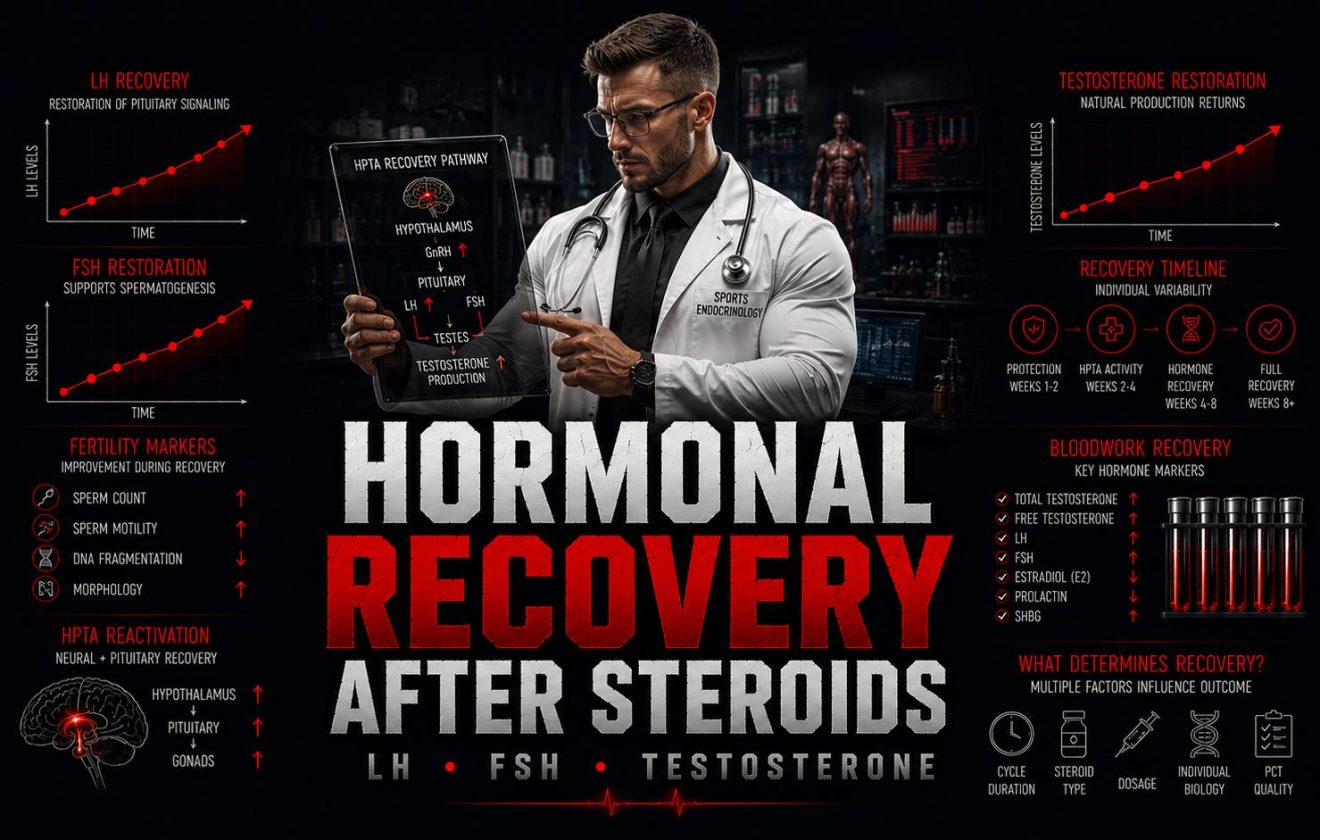
How your hormones switch back on
Hormonal recovery after anabolic steroids is the process by which the HPTA gradually resumes autonomous function following cessation of exogenous androgen use. LH and FSH are the first markers to respond, followed by rising endogenous testosterone as Leydig cell activity resumes. This process is not automatic on any fixed schedule, not fully predictable, and varies considerably between individuals — but the biological sequence is consistent and measurable through bloodwork.
This article explains what happens in the body during the hormonal recovery process — the sequence of events, which blood markers change and when, and what factors determine how long the process takes. The goal is to provide a biological framework for understanding recovery before evaluating any approach to post-cycle therapy.
This article does not recommend or evaluate specific PCT protocols or medications. For protocol context, see What Is PCT? This content is educational only. Nothing here constitutes medical advice.
Hormonal Recovery: The Core Points
Recovery Follows a Fixed Sequence
Hormonal recovery is not simultaneous across all markers. LH and FSH recover before endogenous testosterone. Spermatogenesis lags significantly behind gonadotropin normalization.
Timeline Is Highly Variable
Hormonal recovery may complete in weeks after a short cycle or take many months after prolonged heavy use. Age, dose, compound half-life, and cycle history all influence the duration.
Bloodwork Confirms HPTA Status
Subjective wellbeing does not reliably indicate whether the HPTA has resumed function. LH, FSH, and testosterone panels are required to assess restoration objectively.
What This Article Covers
This guide covers the biology of the hormonal recovery process — the physiological sequence, the blood markers involved, and the variables that shape how long the process takes. It does not evaluate specific recovery approaches or make clinical recommendations.
Covered
- What hormonal recovery means biologically
- The sequence: GnRH → LH/FSH → testosterone
- Which blood markers reflect HPTA restoration progress
- Factors that accelerate or delay the process
- Testosterone recovery versus fertility recovery
- Common misunderstandings about the post-cycle period
Not Covered Here
- Specific PCT compounds or protocols
- Medical treatment for ASIH
- Drug interactions or contraindications
- Individual compound suppression profiles
Prerequisite: Why Steroids Cause Testosterone Suppression — Bloodwork & Health Hub
What Hormonal Recovery Actually Means
Before examining the sequence, it helps to be precise about what is being recovered. During anabolic steroid use, the HPTA was suppressed — not destroyed. The hypothalamus reduced GnRH pulsatility in response to elevated androgen load. The pituitary stopped releasing LH and FSH in meaningful quantities. The Leydig cells, receiving no LH signal, ceased producing testosterone. The structural machinery remained largely intact throughout.
Hormonal recovery is therefore not the repair of damaged tissue. It is the re-establishment of hormonal signaling in a system that was deliberately suppressed. When the suppressive stimulus — exogenous androgens — is removed, the system does not restart immediately. There is a lag period reflecting the time required for the hypothalamus to detect the changed environment and begin resuming normal GnRH pulsatility.
Why the Process Does Not Begin at the Last Dose
The onset of hormonal recovery depends first on how long exogenous androgens remain in circulation. Long-ester compounds — testosterone enanthate, testosterone cypionate, testosterone undecanoate — have half-lives measured in days to weeks. Until circulating androgen levels fall below the suppressive threshold, the hypothalamus continues to detect high androgen load and maintains suppressed GnRH output. The window for HPTA restoration cannot open while significant exogenous androgen is still present.
Short-ester compounds and oral androgens clear faster, so the window opens sooner after cessation. This pharmacokinetic difference — not the compound’s potency or suppressive depth — is what determines when the HPTA first has an opportunity to respond. Understanding why testosterone suppression occurs is the essential physiological context for understanding why the timeline unfolds as it does.
What Full Hormonal Recovery Means
Hormonal recovery is considered complete when endogenous testosterone production is restored to pre-cycle baseline and LH and FSH are operating within normal physiological ranges — consistently, not transiently. This is distinct from subjective improvement, which can occur before the HPTA is fully functional. It is also distinct from fertility recovery, which requires FSH-driven spermatogenesis to normalize — a process that consistently lags behind testosterone normalization on its own separate timeline.
The Hormonal Recovery Sequence: LH and FSH Come First
Hormonal recovery follows a consistent biological sequence driven by the structure of the signal chain. Each step depends on the one before it. Understanding the order in which markers change explains why bloodwork interpretation requires multiple data points and why some aspects of the process take considerably longer than others.
Step 1: GnRH Pulsatility Resumes
The first event is the gradual return of GnRH pulsatility from the hypothalamus. As circulating exogenous androgens clear and androgen receptor input decreases, the hypothalamus begins increasing GnRH pulse frequency and amplitude. This step is not visible in standard blood panels — GnRH is not routinely measured clinically — but it is the prerequisite for every downstream event. Without resumed GnRH signaling, nothing else in the axis can follow.
Step 2: LH and FSH Begin to Rise
As GnRH signaling returns, the anterior pituitary resumes secreting LH and FSH. In most cases, LH begins to rise before FSH, though both should trend upward during successful HPTA restoration. Gonadotropin values in the low-to-normal range are typically the first laboratory confirmation that the axis is actively responding. A rising LH — even below the reference range — indicates the hypothalamic-pituitary axis is reactivating. A persistently undetectable LH weeks after compound clearance signals that the process has not yet meaningfully begun.
These gonadotropin values are the most informative early markers to track. Comprehensive bloodwork context is available in the Bloodwork & Health Hub.
Step 3: Endogenous Testosterone Production Resumes
Once LH stimulation reaches the testes, the Leydig cells begin responding and endogenous testosterone production gradually resumes. This phase of hormonal recovery typically lags behind LH by days to weeks, depending on the depth of prior suppression and current Leydig cell responsiveness. During this transition, total testosterone values will be low before beginning a gradual rise.
Understanding the distinction between total and free testosterone is particularly relevant here, as SHBG may be altered during the early post-cycle period, affecting how much testosterone is biologically active even as total concentrations begin climbing.
Step 4: Spermatogenesis Recovery (Slowest)
FSH acts on Sertoli cells to support sperm production. Even when LH and testosterone have returned to functional levels, spermatogenesis may remain significantly impaired. Fertility-relevant restoration typically requires more time than testosterone normalization alone — sometimes considerably more. Research on fertility and steroid suppression indicates that sperm parameters can lag many months behind gonadotropin normalization, particularly after extended or repeated cycles.
What Blood Markers Show During Hormonal Recovery
Tracking the post-cycle process through bloodwork requires understanding what each marker reflects at different stages — during active suppression, during the clearance window, and during active HPTA restoration. Single-point testing can be misleading; trends across multiple tests over time are far more meaningful. For pre-cycle baseline context, see key blood tests before steroids.
| Marker | Active Suppression | Clearance Window | Hormonal Recovery |
|---|---|---|---|
| LH | Near zero or undetectable | Beginning to rise as androgen clears | Trending toward low-normal, then into normal range |
| FSH | Near zero or undetectable | May lag slightly behind LH | Rising toward normal; sustained FSH needed for spermatogenesis |
| Total Testosterone | Elevated (exogenous) | Dropping as compound clears | Initially low, then rising as endogenous production resumes |
| Free Testosterone | Elevated | Dropping with total T | Rising with total T; SHBG may transiently affect the ratio |
| Estradiol | Elevated (aromatizing compounds) | Falling with exogenous T | Normalizing as endogenous testosterone stabilizes |
| SHBG | Often suppressed | Beginning to normalize | Returning toward baseline; affects free T calculation |
| Sperm Count | Reduced or absent | Still suppressed | Slowly improving; can take months to years for full restoration |
Testing timing matters: Testing too early after a long-ester cycle gives misleading results — exogenous testosterone may still be measurable while LH remains suppressed. LH and FSH are the most reliable early indicators that the axis is responding. Full context: TRT Bloodwork.
What Affects the Timeline of Hormonal Recovery
The duration of the post-cycle HPTA restoration process is shaped by multiple overlapping factors. No two users will have identical timelines. These are the variables most consistently identified across research and clinical observation.
- Factor 01
Cycle Length
Longer cycles produce deeper and more entrenched suppression of the HPTA. A six-week cycle and a twenty-four week cycle may produce similar LH and FSH suppression levels at the end, but the longer cycle represents far more sustained inactivity of the hypothalamic-pituitary axis. The post-cycle restoration period after extended cycles consistently takes longer than after shorter ones of comparable dose.
- Factor 02
Compound Half-Life
Long-ester compounds remain in circulation for weeks after the last injection. The HPTA restoration process cannot meaningfully begin while suppressive androgen levels persist. Short-ester compounds and oral androgens allow the window to open sooner after cessation. The difference in onset between a testosterone enanthate cycle and a testosterone propionate cycle of the same duration and dose can be several weeks.
- Factor 03
Dose and Androgenic Load
Higher doses produce deeper suppression of GnRH and gonadotropins. Higher androgenic loads are associated with more sustained post-cessation suppression, though the relationship is not strictly linear. The post-cycle window after high-dose cycles tends to be longer than after moderate doses for equivalent cycle lengths — both because suppression was deeper and because clearance of high-dose compounds takes more time.
- Factor 04
Age
Older age is associated with a slower return to baseline after AAS cessation. Baseline LH and FSH output declines with age, and the HPTA’s capacity to rapidly resume function after prolonged suppression appears to diminish over time. Users over 35 to 40 with extended cycle histories may face significantly longer post-cycle timelines compared to younger users with equivalent cycle parameters.
- Factor 05
History of Prior Cycles
Repeated cycles without full inter-cycle restoration may cumulatively affect HPTA responsiveness. Clinical observation suggests that users with multiple prior cycles and short inter-cycle intervals show slower recovery than first-cycle users. Each successive cycle begun before complete restoration from the previous one may compound the suppressive burden over time.
- Factor 06
Individual Hormonal Baseline
Pre-existing hormonal conditions — subclinical hypogonadism, elevated SHBG, prior TRT use, or other endocrine disruptions — can affect how readily the axis resumes function. Users whose pre-cycle testosterone was already at the lower end of normal may face more difficulty with HPTA restoration than those who started the cycle with robust baseline function.
6 Key Facts About Hormonal Recovery After Steroids
These points address the aspects of the post-cycle process that are most consistently misunderstood among people reading about HPTA restoration for the first time.
- Fact 01
LH and FSH Recover Before Testosterone Does
The sequence of hormonal recovery is fixed by HPTA physiology. LH and FSH must rise before testosterone can follow — because LH is the signal that drives Leydig cell testosterone production. Bloodwork showing rising LH before rising testosterone is not a sign that the process is stalling. It is the expected order. Misinterpreting this sequence leads to premature conclusions about HPTA status.
- Fact 02
The HPTA Can Restore Without Pharmacological Intervention
Spontaneous post-cycle hormonal recovery — without PCT medications — is documented in research for most users following cycles of typical duration. However, the timeline without intervention is often considerably longer, and return to pre-cycle baseline is not guaranteed within any predictable window. Whether intervention meaningfully accelerates the process compared to medical supervision and watchful waiting is a separate, more complex question beyond the scope of this article.
- Fact 03
Testosterone Normalization and Fertility Restoration Are Not the Same Event
A user may have completed testosterone-level hormonal recovery — with LH, FSH, and total testosterone all in normal ranges — while remaining significantly subfertile. FSH-driven spermatogenesis operates on a separate, slower timeline. Sperm maturation cycles take approximately 74 days, and sperm count normalization consistently lags behind gonadotropin recovery. Anyone for whom fertility matters should assess sperm parameters through semen analysis, not assume it follows automatically from normalized testosterone.
- Fact 04
Feeling Better Does Not Confirm HPTA Restoration
Subjective improvements in energy, libido, and mood can precede laboratory confirmation of hormonal recovery. Conversely, users can feel poorly while LH and FSH are rising appropriately. Symptom-based assessment of HPTA function is unreliable as a standalone tool. Bloodwork is the only objective method for confirming that endogenous production is returning to pre-cycle baseline.
- Fact 05
Some Cases Involve Prolonged or Incomplete Hormonal Recovery
A minority of users — particularly those with extended or repeated heavy cycles, older age, or pre-existing hormonal vulnerabilities — experience suppression that does not spontaneously resolve within a typical post-cycle window. This is referred to clinically as anabolic steroid-induced hypogonadism (ASIH). In these cases, the process may require medical evaluation and active management rather than observation alone. This outcome is distinct from ordinary inter-individual variability in timeline.
- Fact 06
Estradiol Behavior in the Post-Cycle Period Is Often Overlooked
As exogenous testosterone clears and endogenous production remains temporarily low, estradiol — which aromatizes from testosterone — also drops in the early post-cycle weeks. This transient low-estradiol phase can produce symptoms including joint discomfort, mood changes, and reduced libido that are sometimes attributed to other causes. As estradiol normalizes alongside rising endogenous testosterone during hormonal recovery, these symptoms typically resolve without specific intervention in most cases.
Common Mistakes When Assessing Post-Cycle HPTA Status
These are the recurring errors in how people interpret the post-steroid HPTA restoration process.
- Mistake
Testing Too Soon After a Long-Ester Cycle
Testing LH, FSH, and testosterone one or two weeks after the last injection of a long-ester compound will not accurately reflect the state of hormonal recovery. Exogenous testosterone may still be measurable in blood, suppressing LH and giving a false picture of total testosterone. Meaningful bloodwork requires waiting for compound clearance — a minimum of four to six weeks after the last injection of most long esters, and longer for testosterone undecanoate.
- Mistake
Treating Total Testosterone as Proof of Complete Hormonal Recovery
A total testosterone result in the normal range does not confirm that the HPTA has fully restored. LH and FSH must also be assessed. It is possible to have near-normal total testosterone while LH remains suppressed — particularly during the transition period when exogenous compound is still partially present. Full restoration requires LH, FSH, and testosterone all trending normally on repeat testing.
- Mistake
Assuming Testosterone Normalization Means Fertility Is Restored
Testosterone normalization and spermatogenesis restoration are separate processes on different timelines. Users who have completed testosterone-level hormonal recovery may still have significantly impaired sperm parameters weeks or months later. Anyone evaluating fertility status during the post-cycle period should conduct a semen analysis in addition to standard hormone panels — not assume that fertility follows automatically from normalized testosterone, LH, and FSH.
- Mistake
Using Symptoms Alone to Judge Whether the HPTA Has Restored
Post-cycle symptom patterns — fatigue, reduced libido, mood disruption, body composition changes — can persist or fluctuate in ways that do not accurately reflect HPTA laboratory status. Some users feel well while LH is still below normal. Others feel poorly while hormonal recovery is proceeding correctly. Symptoms guide clinical attention; bloodwork confirms or contradicts the symptom picture. Relying solely on subjective state is not a valid monitoring approach.
Scientific References
The following references were verified directly on PubMed. Topics selected to represent spermatogenesis suppression and recovery, gonadotropin dynamics after exogenous androgens, and post-cessation hormonal outcomes.
- Desai A, Yassin M, Cayetano A, Tharakan T, Jayasena CN, Minhas S. Understanding and managing the suppression of spermatogenesis caused by testosterone replacement therapy (TRT) and anabolic-androgenic steroids (AAS). Ther Adv Urol. 2022 Jun 26;14:17562872221105017. PMID 35783920
- Naelitz BD, Momtazi-Mar L, Vallabhaneni S, Cannarella R, Vij SC, Parekh NV, Bole R, Lundy SD. Testosterone replacement therapy and spermatogenesis in reproductive age men. Nat Rev Urol. 2025 Oct;22(10):703-719. PMID 40346275
- Fusco F, Verze P, Capece M, Napolitano L. Suppression of Spermatogenesis by Exogenous Testosterone. Curr Pharm Des. 2021;27(24):2750-2753. PMID 33292112
- Christin-Maitre S, Young J. Androgens and spermatogenesis. Ann Endocrinol (Paris). 2022 Jun;83(3):155-158. PMID 35489414
- Solanki P, Eu B, Smith J, Allan C, Lee K. Physical, psychological and biochemical recovery from anabolic steroid-induced hypogonadism: a scoping review. Endocr Connect. 2023 Oct;12(12):e230358. PMID 37855241
Hormonal Recovery as a Biological Process
Hormonal recovery after anabolic steroids follows a predictable sequence — GnRH resumes, LH and FSH rise, endogenous testosterone production restores — but the timeline for each step is shaped by cycle history, compound pharmacokinetics, age, and individual physiology. Full restoration is achievable for most users, but it is not instantaneous, not reliably symptom-confirmed, and not equivalent to fertility recovery.
The most important practical point: bloodwork is the only objective tool for tracking HPTA status. LH and FSH are the first indicators the axis is responding. Total and free testosterone confirm that endogenous production is rebuilding. Semen parameters confirm that fertility-relevant restoration has occurred. No single marker is sufficient, and repeat testing over time is far more meaningful than any single-point result.
Related guides:
This article describes the biology of the post-steroid HPTA restoration process. It does not constitute medical advice, endorse the use of anabolic steroids, or recommend any specific clinical intervention. Individual outcomes vary in ways that cannot be addressed in a general educational format.
If you are experiencing symptoms consistent with hormonal disruption, or if post-cycle bloodwork shows persistently suppressed LH, FSH, or testosterone, consult a qualified endocrinologist or urologist. A licensed physician should evaluate your complete bloodwork and clinical history before any treatment decision is made.
This article was written for educational and harm-reduction purposes only. See our full site disclaimer for details on our editorial scope and limitations.
Author: Daniel Cross — Hormones & PED Education Editor. This contributor writes under a pseudonym. The photograph above is a stylized portrait, not a real image of the writer. See our About page for details on our editorial team and anonymity policy.