Is TRT a Steroid? TRT vs Steroid Cycles: 7 Real Differences
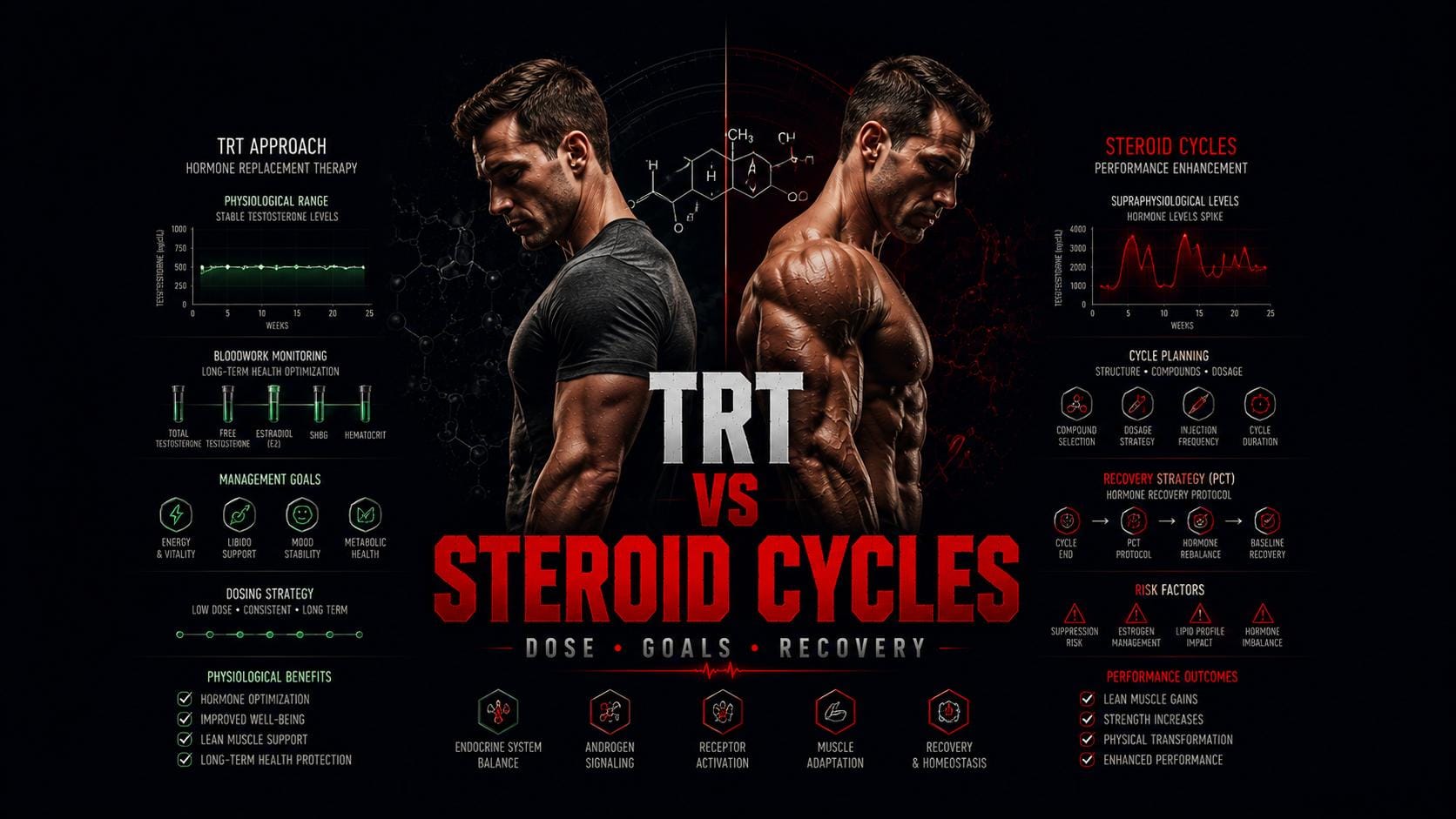
IS TRT A STEROID? YES. IS IT A CYCLE? NO.
Is TRT a steroid? Yes, by chemistry and by law. Testosterone is the original anabolic steroid, and TRT is testosterone. But TRT is not a steroid cycle. The dose, the target blood level, the length and the exit plan are all different.
This guide answers is TRT steroids in plain numbers: guideline doses, trial results, risks and bloodwork, side by side. Background on replacement is in what is TRT.
TRT vs steroids in three numbers
Is TRT a steroid or a cycle? Three figures from guidelines and trials draw the line better than any label.
Top TRT dose
Endocrine Society guideline: 75 to 100 mg (PMID 29562364).
Classic cycle trial
10 weeks in healthy men (PMID 8637535).
Former users
Below the reference limit years after stopping (PMID 27532478).
Study figures come from PubMed papers. What users do in practice is not studied; where we describe it, we say so.
What this guide covers
Is TRT a steroid in chemistry, in law and in practice.
Seven differences between TRT and a steroid cycle: goal, dose, blood level, length, suppression, recovery and monitoring.
Risks and bloodwork for each, with the trial numbers.
Not covered
Cycle protocols. We describe what studies and users report; we do not prescribe.
A diagnosis. Whether you need TRT is a decision for a doctor and your blood tests.
Is TRT a steroid? The short answer
Yes, chemically. Testosterone is a steroid hormone. A pharmacology review lists testosterone esters among the anabolic steroids used in medicine (PMID 18500378).
Yes, legally. Anabolic steroids are controlled substances in the United States, the United Kingdom, Canada and Australia (PMID 18500378). Prescribed testosterone is still that drug.
No, in purpose and dose. TRT treats a diagnosed deficiency. The guideline dose is 75 to 100 mg of injectable testosterone a week, aimed at a normal blood level (PMID 29562364).
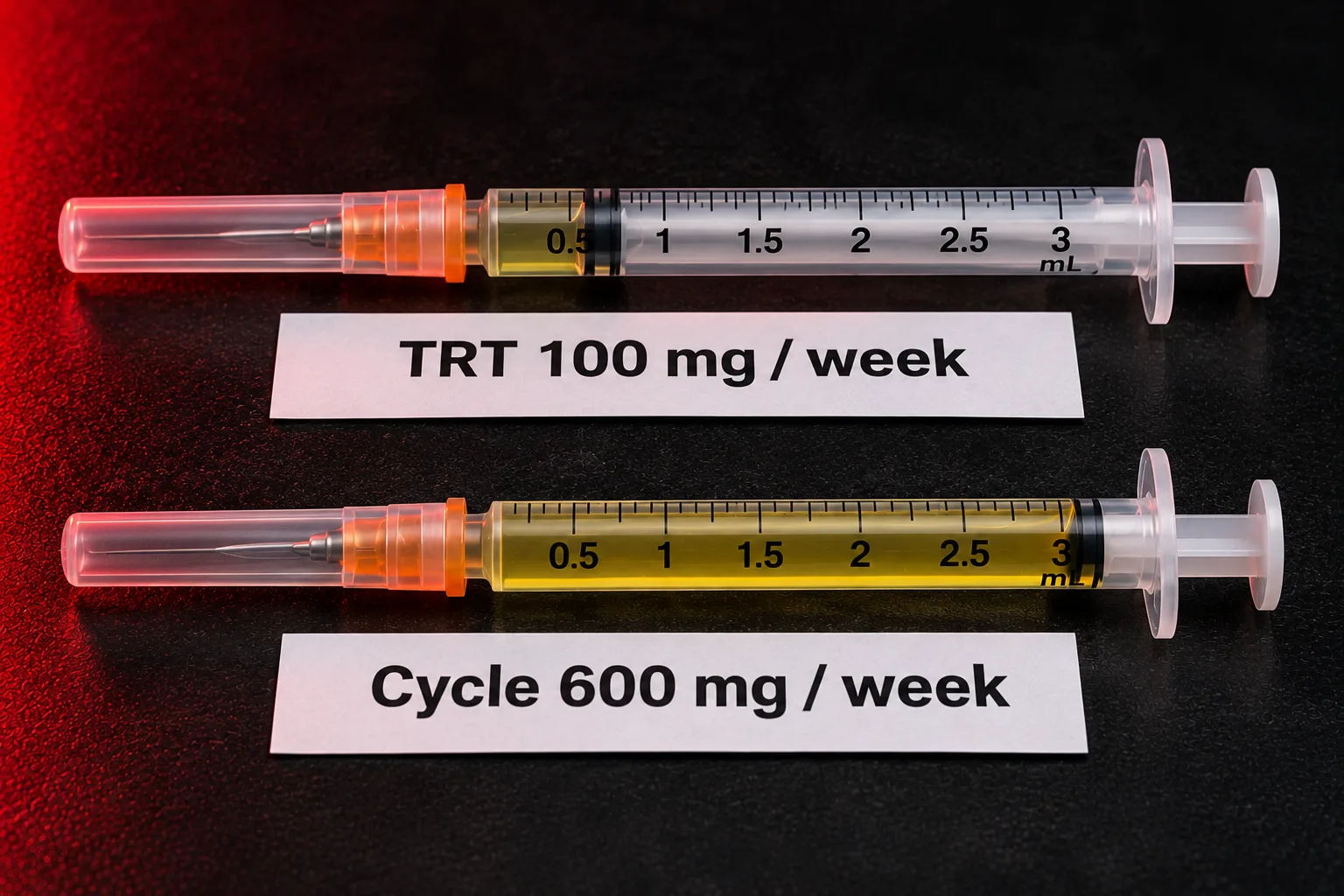
A cycle uses the same molecule to go far above normal. The classic trial used 600 mg a week, six times the top TRT dose (PMID 8637535).
Is testosterone a steroid?
Yes. Testosterone is built on the steroid ring structure, like estradiol and cortisol. It is the natural template for every anabolic steroid (PMID 18500378).
It acts on the androgen receptor directly. The body also turns it into DHT through 5 alpha reductase, and into estradiol through aromatase (PMID 18500378).
Synthetic steroids such as nandrolone or oxandrolone are tweaks of that template. Testosterone esters for injection are the same hormone with a tail that slows its release (PMID 18500378).
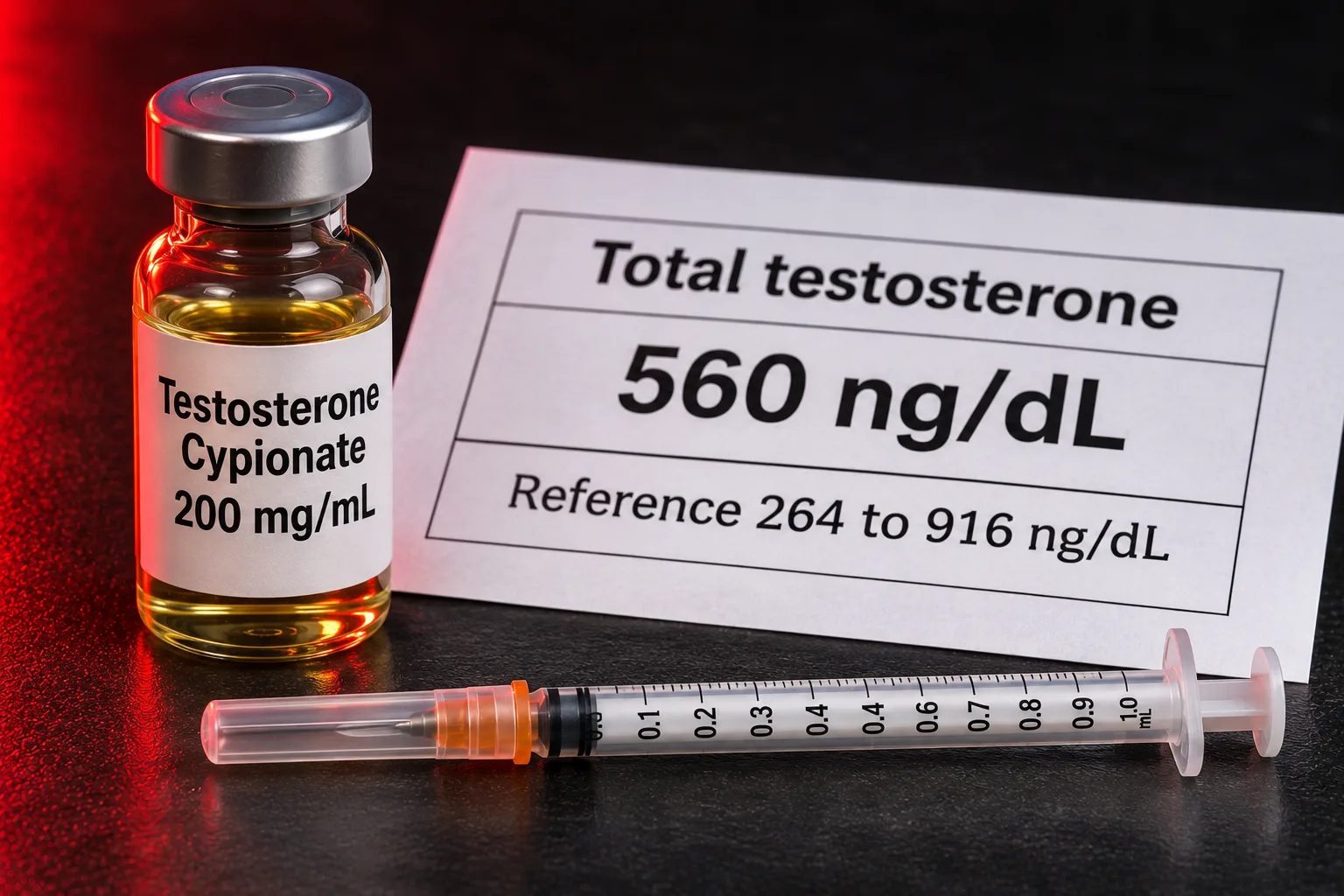
TRT vs steroids: dose and blood level
Who gets TRT. Men with symptoms plus two low morning tests. The cutoff is 264 ng/dL in the Endocrine Society guideline and 300 ng/dL for the AUA (PMID 29562364, 29601923).
The dose. 75 to 100 mg of enanthate or cypionate a week, or 150 to 200 mg every two weeks (PMID 29562364).
The target. The middle of the normal range. The harmonized range in healthy young men is 264 to 916 ng/dL (PMID 28324103). The AUA aims for 450 to 600 ng/dL (PMID 29601923).
A cycle. The goal is to go above 916, often far above. Users report weekly doses of 300 to 1,000 mg or more, often with other compounds. That is practice, not a studied protocol.
Steroid users often take very high doses and combine several drugs, an Endocrine Society statement notes (PMID 24423981).
TRT vs steroids: what a cycle dose does
In the 1996 trial, 43 healthy men got 600 mg of testosterone enanthate or placebo a week for 10 weeks (PMID 8637535).
Without any training, the testosterone group added 424 square mm to the triceps and 607 to the quadriceps. Bench press rose 9 kg and squat 16 kg (PMID 8637535).
With training, fat free mass rose 6.1 kg. Bench press rose 22 kg and squat 38 kg (PMID 8637535).
TRT does not produce that, by design. It restores normal levels; it does not exceed them (PMID 29562364).
TRT vs steroids: 7 differences from a cycle
Each row of this TRT vs steroids table changes what the protocol is, not just what it is called.
| Point | TRT | Steroid cycle |
|---|---|---|
| 1. Goal | Treat a diagnosed deficiency (PMID 29562364) | Go beyond normal for muscle or strength |
| 2. Weekly dose | 75 to 100 mg (PMID 29562364) | 600 mg in the classic trial (PMID 8637535); users report 300 to 1,000 mg |
| 3. Blood level | Mid normal, 450 to 600 ng/dL (PMID 29601923) | Above 916 ng/dL, the top of normal (PMID 28324103) |
| 4. Length | Ongoing, reviewed yearly (PMID 29562364) | Fixed weeks, then off |
| 5. Own production | Suppressed, but it was already low | Suppressed in a man whose axis worked |
| 6. After stopping | Back to low baseline | Recovery needed; 27.2% still low years later (PMID 27532478) |
| 7. Monitoring | Testosterone, hematocrit, PSA on a schedule (PMID 29562364) | No medical schedule; users self test |
The first three rows decide everything else. A doctor who targets 1,200 ng/dL is prescribing outside both guidelines (PMID 29562364, 29601923).
TRT vs steroids risks: where they overlap
The same hormone acts on the same organs. What changes is how hard it pushes.
Thick blood
Erythrocytosis is the main lab problem on TRT, highest with short acting injections (PMID 28526632). Cycle doses push it harder.
Heart on TRT
In TRAVERSE, 5,246 men: heart events 7.0% on testosterone gel vs 7.3% on placebo (PMID 37326322).
Heart on cycles
Long term users had ejection fraction of 52% vs 63% in non users, and more coronary plaque (PMID 28533317).
Sperm
On prescribed testosterone, 88.4% of infertile men had no sperm; 65% recovered within 6 months of stopping (PMID 24094422).
TRAVERSE also saw more atrial fibrillation, acute kidney injury and pulmonary embolism on testosterone (PMID 37326322).
Steroid use is linked to a higher risk of death. The Endocrine Society statement also lists heart, mental health, liver and kidney problems (PMID 24423981).
TRT vs steroids: suppression and recovery
Any outside testosterone shuts down LH and FSH, on TRT or on a cycle. The difference is what was there before.
A man on TRT had low production already. A man on a cycle switches off a system that worked and needs it back later.
It does not always come back. About 2.5 years after stopping, 27.2% of former users had testosterone below the reference limit, vs none of the controls (PMID 27532478).
In another series, 5 untreated former users had testosterone below 200 ng/dL 3 to 26 months after stopping. 29% had major depression during withdrawal (PMID 25598171).
Some of these men end up on TRT for a deficiency the cycles caused (PMID 25598171).
Is blast and cruise the same as TRT?
Blast and cruise is user practice. No trial has tested it. The figures below are what users report.
Users replace the off weeks with a lower testosterone dose, often 150 to 250 mg a week, then blast again. Some call the low phase TRT.
That dose is above the guideline range of 75 to 100 mg a week (PMID 29562364). It follows no diagnosis, and it never ends.
TRT vs steroids bloodwork: same tests, new calendar
| Marker | On TRT | Guide |
|---|---|---|
| Total testosterone | Mid normal at a timed draw (PMID 29562364) | TRT bloodwork |
| Hematocrit | Act above 54% (PMID 29562364) | Hematocrit and hemoglobin |
| PSA | Checked on a schedule (PMID 29562364) | TRT bloodwork |
| LH, FSH | Suppressed on both (PMID 27532478) | Suppression |
| Lipids, blood pressure | Worse at high doses (PMID 24423981) | Cholesterol on steroids |
Guidelines check TRT at 3 to 12 months, then yearly (PMID 29562364). On a cycle, users test before, mid cycle and after; that schedule is practice.
Is TRT a steroid: 7 facts to remember
1. Yes, testosterone is a steroid. Testosterone esters are anabolic steroids (PMID 18500378).
2. TRT dose is low. 75 to 100 mg a week (PMID 29562364).
3. A cycle is six times more. 600 mg in the classic trial (PMID 8637535).
4. TRT stays in the normal range. 264 to 916 ng/dL (PMID 28324103).
5. TRT heart data are reassuring. 7.0% vs 7.3% events (PMID 37326322).
6. Cycles can leave low testosterone. 27.2% years later (PMID 27532478).
7. A cruise is not TRT. Above guideline dose, no diagnosis (PMID 29562364).
TRT vs steroids: frequently asked questions
Is TRT a steroid?
Yes. TRT is testosterone, and testosterone esters are anabolic steroids (PMID 18500378). It is a steroid at a medical dose aimed at a normal level, not a cycle (PMID 29562364).
Is TRT steroids or not?
Both answers are half right. Same molecule as a cycle, but 75 to 100 mg a week vs 600 mg in the classic performance trial (PMID 29562364, 8637535).
Is TRT a strong steroid?
Not at guideline doses. It is meant to keep testosterone in the 264 to 916 ng/dL normal range (PMID 28324103). Higher levels mean the dose is above TRT.
Is testosterone a steroid?
Yes. It is the natural steroid hormone that synthetic anabolic steroids copy (PMID 18500378).
Do you stay on TRT for life?
Usually yes, because the deficiency does not go away. Guidelines review it at 3 to 12 months and then yearly (PMID 29562364).
Is being on TRT bad for your heart?
In TRAVERSE, heart events were 7.0% on testosterone vs 7.3% on placebo. Atrial fibrillation and pulmonary embolism were more common (PMID 37326322).
Does TRT shut down natural testosterone like steroids?
Yes. Any outside testosterone suppresses LH and FSH. On a cycle the axis worked before; 27.2% of former users stayed low years later (PMID 27532478).
Is blast and cruise the same as TRT?
No. Users report cruises of 150 to 250 mg a week. That is above the 75 to 100 mg guideline dose, with no diagnosis behind it (PMID 29562364).
Sources and further reading
Every study figure on this page comes from one of the 12 papers below, checked against PubMed on 3 November 2026. Practice figures are marked as practice. Reference links are dofollow to support open science.
Verified
Verified
Verified
Verified
Verified
Verified
Verified
Verified
Verified
Verified
Verified
Verified
More from cycle design
Four guides that sit closest to this one.
Final Educational Note
This article is educational and is not medical advice. MuscleScience does not prescribe, sell or supply testosterone or any other compound, and does not give cycle protocols. Non medical steroid use is illegal in many countries.
Chest pain, shortness of breath or sudden mood changes on any hormone need a doctor. More guides sit on the cycle design hub. Read more on the about page and in the full disclaimer.