TB-500 Explained: Mechanism, Research Evidence, and Use Context
TB-500 EXPLAINED: MECHANISM, RESEARCH EVIDENCE, AND USE CONTEXT
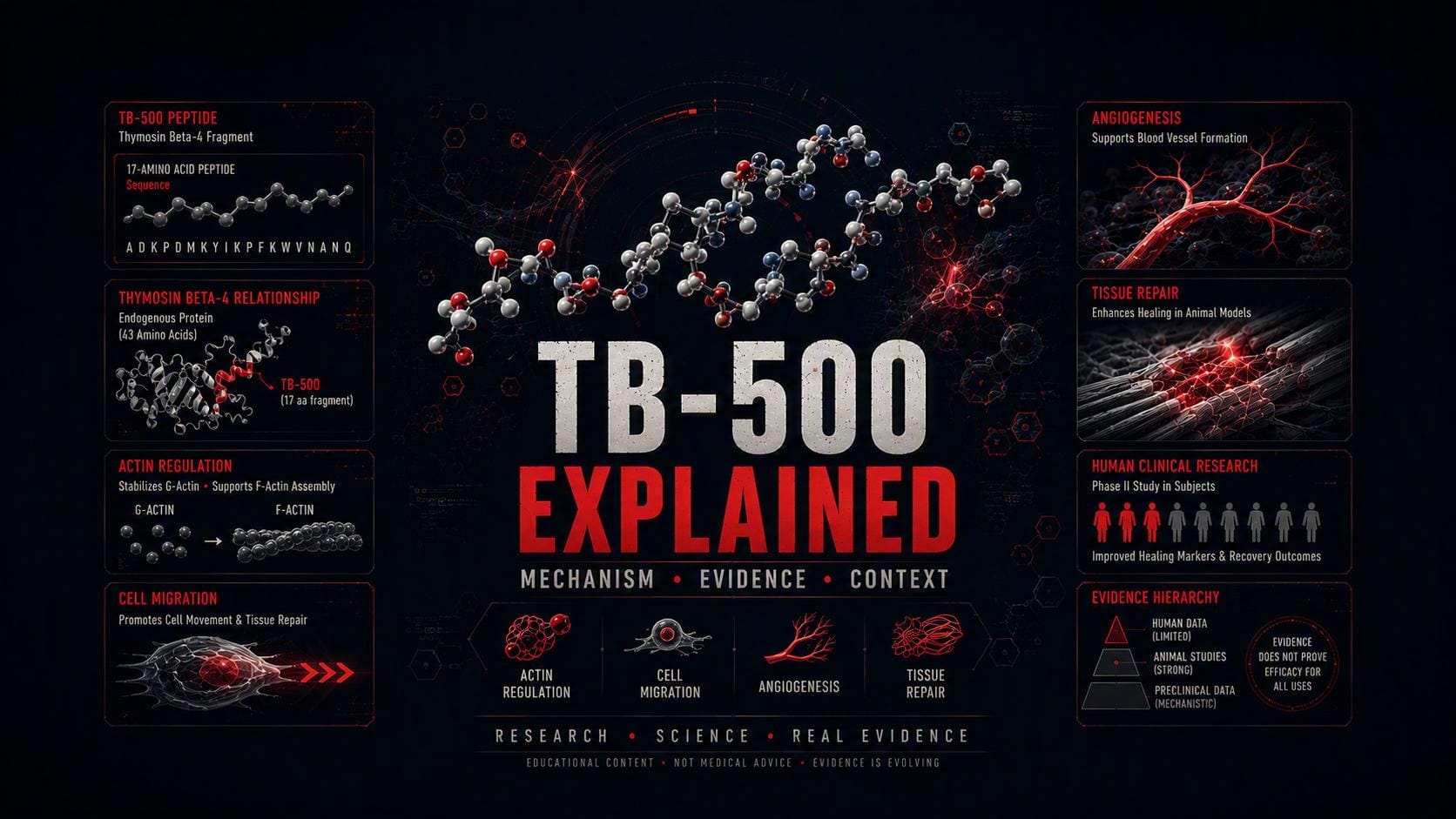
TB-500 is a short lab made copy of one piece of thymosin beta 4, a protein your own body makes in almost every cell. The piece is seven building blocks long, out of 43, and it carries the part that grabs actin, the scaffolding inside cells (PMID 23084823). It started life as a veterinary product for racehorses. The full protein has real human trials behind it, for dry eye, skin ulcers and heart attack safety. The seven building block fragment sold as TB-500 has none. Zero human studies. That gap is what this page is about.
This page explains it the way a coach would: plain words, every number from a PubMed abstract. You get what TB-500 is and how it differs from thymosin beta 4, what has been measured in people and in animals, the TB-500 dosage that was actually tested against the vendor figures, the TB-500 side effects on record, and what the BPC-157 and TB-500 stack has behind it. Syringe arithmetic for your own vial is on the peptide calculator.
TB-500 in brief
Three numbers tell most of the story. How much of the protein TB-500 copies, how many people have taken TB-500 in a study, and what the one animal tendon study used.
How much of thymosin beta 4 the TB-500 fragment actually contains
Thymosin beta 4 is a 43 building block protein. TB-500 is the piece at positions 17 to 23, seven building blocks, with an acetyl cap on the front. That piece is the actin binding site (PMID 23084823). It is not the whole protein, and the human trials used the whole protein.
Published studies of the TB-500 fragment in people, for any purpose
Every human trial in this field used full length thymosin beta 4. Eye drops for dry eye, gel for leg ulcers, infusions in healthy volunteers (PMID 20536472, PMID 20536470, PMID 26056426). The fragment sold as TB-500 has been given to horses and rats. Never to a person in a published study.
The only published TB-500 dose with a healing result, in rats with a cut Achilles tendon
In 2026, rats got 60 micrograms per kilogram a day into the belly cavity for four weeks after tendon surgery. The TB-500 group had a stronger tendon and better collagen alignment than controls (PMID 42542926). Eight rats per group. On paper that scales to about 0.8 mg a day for an 80 kg person. Nobody has tested it.
Every figure on this page about TB-500 and thymosin beta 4 comes from a PubMed abstract listed at the end. Doses appear only where a study states them. What gym users do is reported as vendor guides and forum posts, never as a recommendation.
What this TB-500 guide covers
What TB-500 is and why it is not the same thing as thymosin beta 4, with what the labs found in the vials.
What has been measured: the human trials of the full protein, the animal studies of the fragment, and the one rat tendon study.
TB-500 dosage: what was tested in people and animals, and where the 2 to 5 mg a week figures online come from.
TB-500 side effects by the evidence, the BPC-157 and TB-500 stack, and the anti doping and supply chain record.
Not covered
A dose, schedule or cycle for you. No regulator has approved TB-500 or thymosin beta 4 for anything. This page gives no protocol.
Where to buy it. This site does not sell or source peptides and does not link to sellers.
The rest of the peptide field. The healing group is on healing peptides. The whole field sits on the peptides hub.
What is TB-500, in plain words
Start with the protein it comes from. Thymosin beta 4 is a small protein, 43 building blocks long, found in almost every cell in your body and packed into platelets. Its day job is to hold on to single actin molecules, the raw material of the cell's internal scaffolding. It releases them where the cell needs to move or rebuild (PMID 22074294). When tissue is injured, platelets and immune cells release it at the wound. That is why researchers have studied it for healing since the 1990s.
TB-500 is not that protein. It is a copy of one short piece of it. The piece is the seven building blocks at positions 17 to 23, written LKKTETQ. A small chemical cap, an acetyl group, is added to the front end. That stretch is the part of thymosin beta 4 that grabs actin (PMID 23084823). The product first appeared as a veterinary preparation for racehorses. The first scientific paper about it was a doping test from a Hong Kong racing laboratory in 2012. You will see the name written TB-500, TB500 and TB 500. It is the same product.
Why does the difference matter? Because every human study in this field used the whole 43 building block protein, made by a company called RegeneRx. The whole protein has other active regions besides the actin site. A body also handles a 43 building block protein differently from a seven building block fragment. Nobody has shown that the fragment does in a living person what the whole protein does. It might. It has not been tested.
There is a second twist. Some research vendors sell the full 43 building block protein and call it TB-500. Others sell the seven building block fragment. A 2023 analysis of TB500 and TB1000 products bought online found that the contents were not consistently what the labels and descriptions said (PMID 36482504). So when someone says TB-500 worked for them, you do not know which molecule they took, or whether they took either.
What has been measured on TB-500, and in whom
The record splits cleanly in two. The whole protein, thymosin beta 4, has a real if small human programme: a safety study in healthy volunteers, wound trials, eye drop trials. The fragment, TB-500, has one rat tendon study, a horse doping paper, and a product analysis. The table keeps the two apart.
| What was found | Molecule | Who or what | Type of evidence |
|---|---|---|---|
| Single and daily intravenous doses of 42 to 1260 mg for 14 days: adverse events infrequent and mild, no dose limiting toxicity (PMID 20536472) | Full thymosin beta 4 | 40 healthy volunteers | Randomised phase 1 |
| Topical gel on venous leg ulcers for 84 days: safety like placebo; the 0.03 percent dose may speed healing, about 25 percent fully healed in 3 months (PMID 20536470) | Full thymosin beta 4 | 73 ulcer patients | Randomised phase 2 |
| 0.1 percent eye drops for severe dry eye: ocular discomfort down 35.1 percent and corneal staining down 59.1 percent vs vehicle at day 56 (PMID 25826322) | Full thymosin beta 4 | 9 patients, 18 eyes | Randomised phase 2, tiny |
| 0.1 percent eye drops for moderate to severe dry eye, 28 days: both primary endpoints missed; some secondary measures improved (PMID 26056426) | Full thymosin beta 4 | 72 patients | Randomised phase 2, primary endpoints missed |
| 0.1 percent eye drops for neurotrophic keratopathy, 4 weeks: complete healing in 6 of 10 vs 1 of 8 on placebo, p = 0.0656, no significant adverse effects (PMID 36613994) | Full thymosin beta 4 | 18 patients | Randomised phase 3, tiny |
| Phase 2 trials in pressure ulcers, stasis ulcers and epidermolysis bullosa wounds: faster repair reported, safe and well tolerated (PMID 27450738) | Full thymosin beta 4 | Wound patients | Review of phase 2 data |
| 60 µg/kg a day into the belly cavity for 4 weeks after Achilles tendon surgery: higher load to failure and better tendon structure than controls (PMID 42542926) | TB-500 fragment | Rats, 8 per group | Animal, the only TB-500 healing study |
| Single 10 mg dose: the fragment and its breakdown products detected in blood and urine (PMID 23084823) | TB-500 fragment | Racehorses | Doping control |
| 1 µg in fibrin glue placed in a cut knee ligament: better fibre alignment and mechanical strength at 4 weeks (PMID 23523891) | Full thymosin beta 4 | Rats | Animal |
| Topical or injected: skin wounds re-covered 42 percent faster at day 4 and up to 61 percent at day 7 (PMID 10469335) | Full thymosin beta 4 | Rats | Animal |
| After a tied off coronary artery: better early heart cell survival and heart function (PMID 15565145) | Full thymosin beta 4 | Mice | Animal |
| 150 µg twice a week for 6 months in muscular dystrophy mice: more regenerating fibres, but no improvement in grip strength, heart function or fibrosis (PMID 20126456) | Full thymosin beta 4 | Mice | Animal, negative on function |
| Online TB500 and TB1000 products did not consistently contain what their descriptions claimed (PMID 36482504) | Sold as TB-500 | Seized products | Product quality |
| Thymosin beta 4 and its fragment are banned by horse racing bodies and WADA; a synthesis impurity can expose use in horses (PMID 39314109) | Both | Racehorses | Anti doping |
| Of six popular peptides including TB-500, 67 percent of papers were animal studies; human studies were few and mostly uncontrolled (PMID 42578445) | Both | Scoping review | Review |
| TB-500 in athletes or anyone injecting it for a tendon, muscle or joint; any human study of the fragment at all | TB-500 fragment | No study exists | Not measured |
Read the molecule column first. Every human row says full thymosin beta 4. Every TB-500 row says rats, horses or seized products. There is no row where a person received TB-500. That is the single most important fact on this page.
The thymosin beta 4 human trials, in plain words
These trials matter because they are the only human data anyone can point to. They also show what the molecule was being developed for. None of it was muscle or tendon.
Safety in healthy volunteers. In 2010, forty healthy people were split into four groups of ten. Each group got a single intravenous dose of thymosin beta 4 or placebo, at 42, 140, 420 or 1260 milligrams. After a safety review, they got the same dose every day for 14 days. Side effects were infrequent and mild or moderate. There were no serious adverse events and no dose limiting toxicity. The half-life got longer as the dose went up (PMID 20536472). The company was aiming at heart attack patients, and this was the first step.
Leg ulcers. Seventy three patients with venous ulcers at eight European sites took part. They got a thymosin beta 4 gel or placebo on the ulcer for 84 days, at rising doses. Safety was the same as placebo. The 0.03 percent dose looked like it might speed healing. About a quarter of patients fully healed in three months, mostly those with smaller ulcers (PMID 20536470). The authors called it a suggestion, not a proof.
Dry eye. Two phase 2 trials of 0.1 percent eye drops. The tiny one had nine patients and 18 eyes. It found discomfort down 35.1 percent and corneal staining down 59.1 percent against vehicle at day 56 (PMID 25826322). The larger one, 72 patients for 28 days, missed both of its primary endpoints. Some secondary measures improved, discomfort by 27 percent in a dry chamber test (PMID 26056426). A later phase 3 enrolled 18 patients with a nerve related corneal defect. Complete healing came in 6 of 10 on the drops against 1 of 8 on placebo, p = 0.0656, just short of significance (PMID 36613994).
Skin wounds. A 2016 review from the developers covers phase 2 trials in pressure ulcers, stasis ulcers and epidermolysis bullosa wounds. It reports faster repair and says the protein was safe and well tolerated (PMID 27450738). The protein was first shown to speed skin healing in rats in 1999. Wounds re-covered 42 percent faster at day 4 and up to 61 percent faster at day 7 (PMID 10469335).
What was never tested in people. Tendons, ligaments, muscle, joints, recovery from training. The heart programme produced the safety study and then stalled. A 2013 review called the heart story a possible missed beat. Two mouse studies disagreed on whether the protein makes new heart muscle at all (PMID 22628110). In mice with muscular dystrophy, six months of thymosin beta 4 produced more regenerating fibres. It gave no gain in grip strength, heart function or scarring (PMID 20126456).
TB-500 dosage: what was tested, and what people use
Here is the honest answer to the dosage question. There is no human dose of TB-500, because no human has taken TB-500 in a study. There is one animal dose with a healing result, from 2026. Everything else is either the whole protein in a trial that had nothing to do with tendons, or a vendor guide.
| Source | Molecule | Who or what | Dose and route | What happened |
|---|---|---|---|---|
| Biçer 2026 (PMID 42542926) | TB-500 fragment | Rats, cut Achilles | 60 µg/kg a day into the belly cavity, 4 weeks | Stronger tendon, better collagen alignment than controls |
| Ho 2012 (PMID 23084823) | TB-500 fragment | Racehorses | 10 mg, single dose | Detected in blood and urine; no healing measured |
| Ruff 2010 (PMID 20536472) | Full thymosin beta 4 | 40 healthy volunteers | 42 to 1260 mg into a vein, daily for 14 days | Well tolerated, no dose limiting toxicity |
| Guarnera 2010 (PMID 20536470) | Full thymosin beta 4 | 73 ulcer patients | Gel on the ulcer, up to 0.03 percent, 84 days | May speed healing; about 25 percent fully healed |
| Sosne 2015 (PMID 26056426) | Full thymosin beta 4 | 72 dry eye patients | 0.1 percent eye drops, 28 days | Primary endpoints missed, some secondary gains |
| Xu 2013 (PMID 23523891) | Full thymosin beta 4 | Rats, cut knee ligament | 1 µg in fibrin glue, once, into the gap | Better fibre alignment and strength at 4 weeks |
| Vendor guides, forum posts | Sold as TB-500 | Gym users | 2 to 2.5 mg under the skin twice a week for 4 to 6 weeks, then 2 mg once or twice a month | Never measured for anything |
The one TB-500 dose that did something. In the 2026 rat study, 32 rats had their Achilles tendon cut and repaired. Eight got BPC-157 at 10 micrograms per kilogram a day. Eight got TB-500 at 60 micrograms per kilogram a day. Eight got both, and eight got nothing. All injections went into the belly cavity for four weeks. At the end, the TB-500 tendons took more force to break than controls, and that difference reached significance. Their tissue scores were better too (PMID 42542926).
What that converts to on paper. The FDA method for turning a rat dose into a human starting dose divides the milligram per kilogram figure by 6.2. So 60 micrograms per kilogram in a rat becomes about 9.7 micrograms per kilogram in a person. For someone who weighs 80 kg that is roughly 775 micrograms a day. Over a week that is about 5.4 mg. It is arithmetic on one rat study with eight animals per group, not a dose anyone has tested in a person.
Where the online figures come from. Vendor guides and forum posts describe a loading phase of 2 to 2.5 mg under the skin twice a week for four to six weeks. Then 2 mg once or twice a month to maintain (vendor guides, forum posts). That is 4 to 5 mg a week in the loading phase, which happens to sit near the paper conversion above. The resemblance is a coincidence. The forum pattern is years older than the rat study. It came from the veterinary product, where a single horse dose was 10 mg (PMID 23084823).
What the whole protein doses tell you. Not much that transfers. Healthy volunteers tolerated 42 to 1260 mg a day into a vein for two weeks (PMID 20536472). That is a different molecule by a different route, and the point of that study was safety, not healing. The wound and eye trials used gels and drops on the surface of the body, where the dose means something else entirely.
Whatever is in your vial, the syringe arithmetic has a right answer. A 5 mg vial mixed with 1 ml of bacteriostatic water gives 5 mg per ml. Each unit on a U-100 insulin syringe then holds 50 micrograms, so 2 mg is 40 units. The peptide calculator does this for any vial and any volume. It does not tell you how much to take, because that has not been measured.
TB-500 side effects, by the evidence
TB-500 side effects come from three places: what the molecule does, what is in the vial, and the rules around it. For the molecule, the only human safety data belongs to the whole protein, and it is reassuring. For the fragment there is nothing. The vial and the rules carry the concrete risks.
| Effect | Strongest evidence | Read it as |
|---|---|---|
| Tolerability of the whole protein | Intravenous thymosin beta 4 at 42 to 1260 mg a day for 14 days: infrequent, mild adverse events, no serious events (PMID 20536472). Gel and eye drops: safety like placebo (PMID 20536470, PMID 36613994) | Reassuring, for a different molecule |
| Tolerability of the fragment | No human study. Rats on 60 µg/kg a day for 4 weeks: no toxicity reported, but the study was not designed to look (PMID 42542926) | Not measured |
| Blood vessel growth in the wrong place | The protein grows new vessels and recruits progenitor cells by design (PMID 22074294). A 2026 review lists pathological angiogenesis and carcinogenesis among the theoretical risks of unregulated peptides including TB-500 (PMID 42757290) | Plausible, not shown, not ruled out |
| Headache, fatigue, flushing, nausea | Common forum reports after injection (forum posts). Not recorded in any trial of the fragment | Anecdote |
| Injection site reactions | Shared by every injected peptide; the venous ulcer trial recorded nothing beyond placebo for the gel (PMID 20536470) | Expected |
| Long term use | No human study of the fragment at all; longest human exposure to the protein was 84 days of gel (PMID 20536470) | Not measured |
| What is in the vial | Online TB500 and TB1000 products did not consistently match their descriptions (PMID 36482504). Contamination, impurities and inaccurate dosing are the first three hazards of unregulated peptides (PMID 42757290) | Product identity |
| Anti doping | Thymosin beta 4 and TB-500 are banned in sport by WADA and in horse racing by the IFHA and FEI; detectable in blood and urine (PMID 39314109, PMID 23084823). Both remain banned substances in sports (PMID 41476424) | Tested athletes |
| Regulatory status | No approval anywhere for TB-500 or thymosin beta 4 for any use; RGN-259 eye drops still await FDA approval (PMID 36613994). Sold as a research chemical | Unapproved |
The safety story people quote is the 2010 volunteer study, and it is a good study. Forty healthy people took up to 1260 mg a day of thymosin beta 4 into a vein for two weeks. Side effects were mild (PMID 20536472). But that was pharmaceutical grade whole protein, made under supervision, in a trial. The fragment in a research vial is a different molecule from an unregulated source. The 2023 analysis of TB500 products found the contents did not consistently match the descriptions (PMID 36482504). You cannot borrow a safety result from a molecule you may not even be taking.
The theoretical worry is the one the protein's own biology raises. Thymosin beta 4 heals by growing new blood vessels, recruiting progenitor cells and moving cells into a wound (PMID 22074294). A 2026 review of unregulated injectable peptides lists pathological angiogenesis and carcinogenesis among the mechanisms of concern for compounds including TB-500 (PMID 42757290). Nobody has shown that happens. Nobody has run the study that would rule it out either. The general page on peptide side effects covers the sterility and injection problems shared by every mixed vial.
BPC-157 and TB-500: what the stack has behind it
The BPC-157 and TB-500 pairing, sold as a blend and nicknamed the Wolverine stack online, is the form most people actually buy. The logic is that the two work differently: BPC-157 acts on growth factor and nitric oxide signalling, TB-500 on actin and cell movement. Two paths, one wound. The evidence for the pair is one study, and it cuts the other way from what you might expect.
In the 2026 rat Achilles study, the rats that got both peptides did not do better than the rats that got TB-500 alone. TB-500 on its own gave the significant gain in tendon strength. The combination group beat controls on one of two tissue scores. It did not beat TB-500 alone on strength (PMID 42542926). Eight rats per group, so read it as a hint, not a verdict. The hint is that stacking added nothing in that model.
In people, the pair has one data point and it is weaker still. A chart review followed 16 patients who got BPC-157 injected into a painful knee. Four of them also got TB-500, and those four reported slightly less relief than the twelve on BPC-157 alone. No controls, no dose reported, phone follow up. The full BPC-157 story, including that study, is on BPC-157 dosage explained, and its stack section is at BPC-157 and TB-500.
TB-500 in the gym: what users report, and what is measured
The trials cannot write this section, so it reports two things separately. First, how users describe TB-500. Second, the measured data that any of it could rest on. Nothing in the first part is evidence. It is a description of a habit.
What users describe. Vendor guides and forum logs describe TB-500 as the peptide for a nagging tendon, a shoulder that will not settle, or a pulled muscle. The pattern is a loading phase of 2 to 2.5 mg twice a week for four to six weeks, then 2 mg once or twice a month. Users inject it under the skin anywhere rather than near the injury, because they believe it acts through the whole body. Most pair it with BPC-157. Runs are described as short, tied to the injury, and repeated when something else hurts (vendor guides, forum posts). The reasons given are faster recovery, less inflammation and more range of motion. The complaints are headache and fatigue after a shot and a wave of tiredness on injection day. A common verdict is that it is hard to tell what the peptide did and what time did (forum posts).
What the reasons rest on. The whole body idea comes from the protein's biology. Thymosin beta 4 is released by platelets at a wound and travels. In rats it sped skin healing whether applied on the wound or injected into the belly (PMID 10469335). The tendon idea rests on the rat Achilles study (PMID 42542926) and the rat knee ligament study. There, 1 microgram of the whole protein in fibrin glue improved the ligament at four weeks (PMID 23523891). The recovery and inflammation ideas rest on the protein's general properties in reviews (PMID 22074294). None of this was measured in a person with a sore shoulder.
What is measured that a lifter could use. One thing, and it is indirect. TB-500 at 60 micrograms per kilogram a day for four weeks made a surgically cut rat tendon stronger (PMID 42542926). A cut and sutured tendon in a rat is not an overuse tendon in a person. Four weeks of daily belly injections is not two shots a week. But it is the first controlled result for the fragment in any animal, and it points the right way. How to read a result like that without overreaching is on peptide research vs human use.
Five mistakes people make about TB-500
1. Calling it thymosin beta 4
TB-500 is a seven building block fragment of a 43 building block protein (PMID 23084823). Every human trial used the whole protein. The fragment has no human study.
2. Quoting the volunteer safety study for the vial
That study gave pharmaceutical grade thymosin beta 4 into a vein under supervision (PMID 20536472). The vial is a different molecule from an unregulated source, and a lab found the contents did not match the labels (PMID 36482504).
3. Treating the eye and ulcer trials as healing proof
The largest dry eye trial missed its primary endpoints (PMID 26056426). The ulcer trial called its result a suggestion (PMID 20536470). The phase 3 eye trial had 18 patients and p = 0.0656 (PMID 36613994). Real, small, and nothing to do with tendons.
4. Calling the Wolverine stack proven synergy
In the one controlled test, rats on both peptides did not beat rats on TB-500 alone (PMID 42542926). The four humans who got both in a knee chart review reported slightly less relief than those on BPC-157 alone.
5. Assuming it is legal to compete on
Thymosin beta 4 and TB-500 are banned by WADA and by horse racing authorities. Both the fragment and a synthesis impurity can be detected (PMID 39314109, PMID 23084823).
Verdict: a real protein, a borrowed story, and one rat study
Judged by the papers rather than the vendor pages, thymosin beta 4 is a serious molecule with a thin but real human record. It is safe at very high intravenous doses for two weeks. It may speed the healing of skin ulcers and eye defects. It has not yet earned an approval anywhere (PMID 20536472, PMID 20536470, PMID 36613994). TB-500 is a piece of that protein. It was first sold for horses, first studied by a doping lab, and tested for healing exactly once, in 32 rats, in 2026 (PMID 23084823, PMID 42542926). The one study went its way.
For readers here, the practical conclusion is simple. The dosage online is a horse protocol scaled by habit. The safety record belongs to a different molecule. The vial may not contain what it says. The stack with BPC-157 showed no advantage in the only test. The other half of that stack is on BPC-157. The whole group is on healing peptides. The syringe arithmetic for any vial is on the peptide calculator.
TB-500: frequently asked questions
What is TB-500 and what does it do?
TB-500 is a lab made copy of seven building blocks of thymosin beta 4, a 43 building block protein found in almost every cell. The seven are the part that binds actin, the cell's internal scaffolding (PMID 23084823). The whole protein helps cells move into a wound and grows new blood vessels (PMID 22074294). In the only healing study of the fragment, rats got 60 micrograms per kilogram a day for four weeks. Their repaired Achilles tendons were stronger than controls (PMID 42542926). No human has taken the fragment in a published study.
Is TB-500 the same as thymosin beta 4?
No. Thymosin beta 4 is the full 43 building block protein, and it is what every human trial used. Intravenous infusions in volunteers, gel on leg ulcers, eye drops for dry eye (PMID 20536472, PMID 20536470, PMID 26056426). TB-500 is the seven building block fragment at positions 17 to 23 with an acetyl cap (PMID 23084823). Some vendors sell the whole protein under the TB-500 name. A 2023 analysis found online TB500 products did not consistently match their descriptions (PMID 36482504).
What is the TB-500 dosage used in studies?
In rats, 60 micrograms per kilogram a day into the belly cavity for four weeks (PMID 42542926). In racehorses, a single 10 mg dose, measured only to build a doping test (PMID 23084823). No human dose exists. For the whole protein, healthy volunteers got 42 to 1260 mg a day into a vein for 14 days in a safety study (PMID 20536472). The 2 to 2.5 mg twice a week loading schedule online comes from vendor guides and forum posts and has never been measured.
What are the side effects of TB-500?
Nothing has been measured for the fragment in people. For the whole protein, intravenous doses up to 1260 mg a day for 14 days caused only infrequent, mild side effects in healthy volunteers (PMID 20536472). Gels and eye drops were as safe as placebo (PMID 20536470, PMID 36613994). Users report headache, fatigue and flushing after shots (forum posts). The theoretical concern is unwanted blood vessel growth, listed as a risk of unregulated peptides including TB-500 but not shown (PMID 42757290). The concrete risk is the vial: online products did not consistently match their descriptions (PMID 36482504).
Can you take BPC-157 and TB-500 together?
People do, and vendors sell blends. The only controlled test is a 2026 rat Achilles study. Rats on both peptides did not beat rats on TB-500 alone for tendon strength (PMID 42542926). In people, four patients in a knee pain chart review got both. They reported slightly less relief than the twelve on BPC-157 alone, with no controls. Stacking does not make either peptide better studied.
Is TB-500 legal and is it approved?
It is not approved for any use anywhere, and neither is thymosin beta 4; the RGN-259 eye drops still await FDA approval (PMID 36613994). It is sold as a research chemical. In sport it is banned by WADA, and in horse racing by the IFHA and FEI. Laboratories can detect the fragment, its breakdown products, and a synthesis impurity that gives away a synthetic source (PMID 23084823, PMID 39314109).
Does TB-500 heal tendons?
In one study, in rats. Eight rats got 60 micrograms per kilogram a day for four weeks after Achilles surgery. Their tendons took more force to break than controls, with better collagen alignment (PMID 42542926). The whole protein also improved a cut knee ligament in rats when placed in the gap in fibrin glue (PMID 23523891). No human tendon study exists for either molecule. A 2026 scoping review found 67 percent of papers on these peptides were animal studies. The human ones were few and mostly uncontrolled (PMID 42578445).
How long does TB-500 stay in your system?
For the fragment in people, nobody has measured it. In racehorses, the fragment and its breakdown products were detectable in blood and urine after a single 10 mg dose. That is how the doping test works (PMID 23084823). For the whole protein in healthy volunteers, the half-life got longer as the intravenous dose rose from 42 to 1260 mg (PMID 20536472). The once or twice a month maintenance schedule online rests on the belief that effects outlast the molecule; no study has tested that.
Sources and further reading
Every figure on this page about TB-500 and thymosin beta 4 comes from one of the 22 papers below, each checked against its PubMed abstract on 25 October 2026. How users describe the peptide is labelled as vendor guides and forum posts in the text and carries no reference number. Animal studies are cited as animal studies, never as human results. Reference links are dofollow to support open science.
Verified
Verified
Verified
Verified
Verified
Verified
Verified
Verified
Verified
Verified
Verified
Verified
Verified
Verified
Verified
Verified
Verified
Verified
Verified
Verified
Verified
Verified
Keep reading
Four pages around TB-500: the other half of the usual stack, the whole healing group, the syringe arithmetic for any vial, and how to read peptide research without overreaching.
Final Educational Note
This article is educational and is not medical advice. It reports what the human trials of thymosin beta 4, the animal studies of TB-500 and the doping and review literature say. It reports how some users describe TB-500 as a description of a habit, not as guidance. Doses appear only as a study states them. The page gives no schedule, cycle or protocol, and does not recommend TB-500 for any use. It is not an encouragement to use research chemicals or performance enhancing drugs, which carry serious health and legal risks. More guides sit on the peptides hub.
Some signs need a doctor at once. A lump that grows, a reaction that spreads from an injection site, unexplained bleeding, or lasting fatigue. Anyone with a history of cancer should talk to a physician before any compound that grows blood vessels. Read more about how this site works on the about page and in the full disclaimer.