Do Steroids Raise Blood Pressure? 6 Facts & How to Lower It
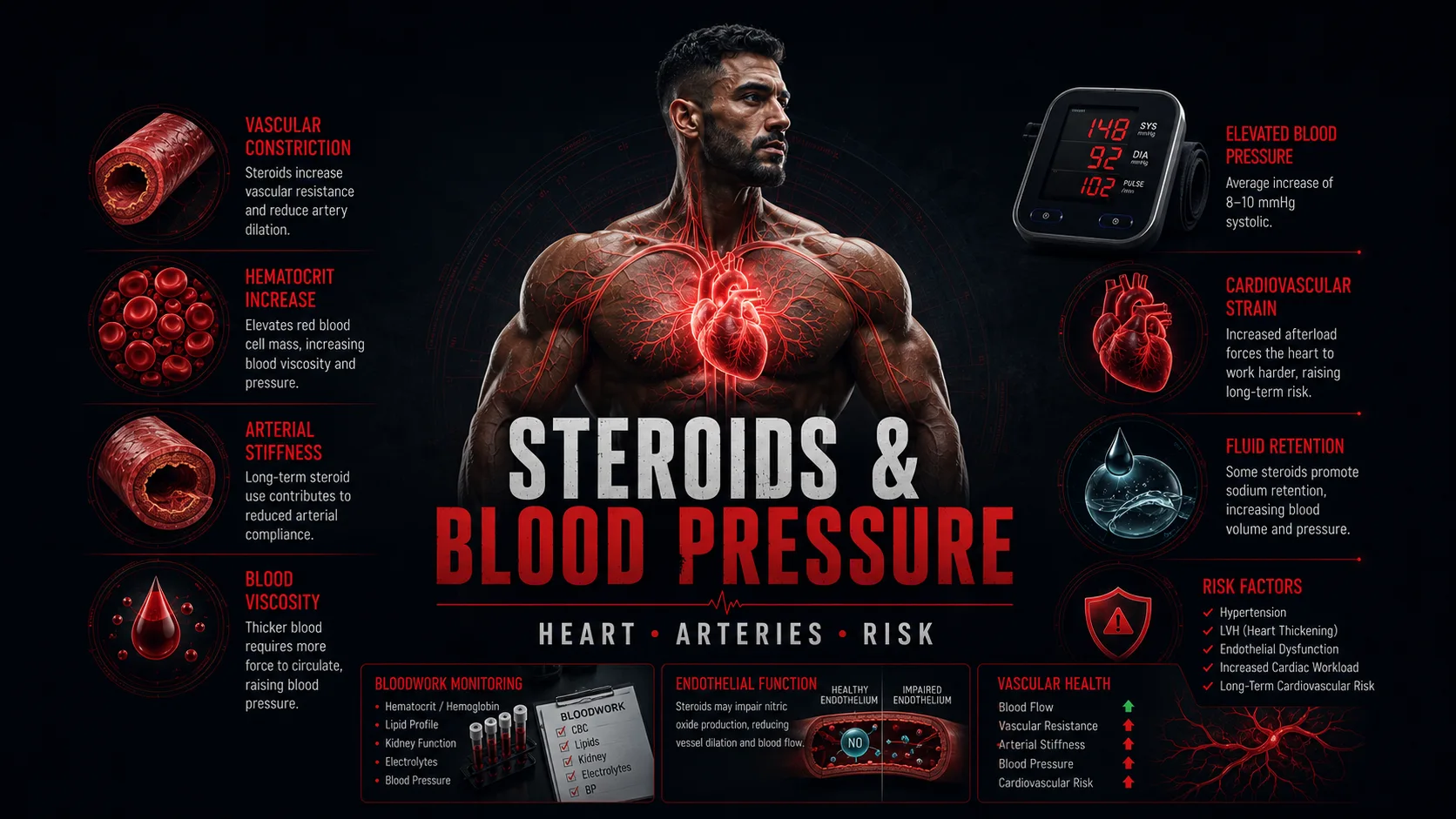
DO STEROIDS RAISE BLOOD PRESSURE? 6 FACTS, 16 STUDIES
Do steroids raise blood pressure? The short answer is yes, and this page is about anabolic androgenic steroids, not prednisone. Corticosteroids raise pressure by a different route. They come from a doctor rather than a gym, so they sit outside this bloodwork and health hub page.
This guide uses 16 PubMed papers. Six facts cover the measured rise, the routes behind it, how to read your own number, and whether it comes back down. Two more sections cover what lowered pressure in trials and how to measure at home.
Steroids and blood pressure in three numbers
Three measured figures frame the question. One comes from a cohort on cycle, one from 24 hour monitoring, one from trials on what a few mmHg are worth.
Systolic rise on cycle
Systolic pressure rose 6.87 mmHg during a cycle in 100 men followed prospectively (PMID 35014715).
Users vs 124 in controls
24 hour systolic pressure averaged 132 mmHg in current users against 124 mmHg in controls (PMID 28863033).
Per 10 mmHg lower
A 10 mmHg lower systolic pressure cut major cardiovascular events by 20 percent across 123 trials (PMID 26724178).
Study figures come from the 16 PubMed papers in the sources list. Where a point is practice rather than a trial, the text says so. This page is about anabolic steroids, not prednisone.
What this guide covers
How much pressure rises, from prospective and cross-sectional measurements in users (PMID 35014715, PMID 28863033).
The routes with measurements behind them: peptides, vessel stiffness, red cells and the post-exercise response (PMID 28863033, PMID 16796605, PMID 38088425, PMID 28743567).
How to read your own number, what lowers pressure in trials, and when to see a doctor (PMID 29133356, PMID 23558162, PMID 23525435).
Not covered
Prednisone and corticosteroids: a different drug class with a different route, and a prescription decision.
Ranking compounds by how much they raise pressure, because no head to head trial exists to rank them.
Fact 1. Do Steroids Raise Blood Pressure? The Measured Rise
The cleanest figure comes from a prospective cohort of 100 men followed through a cycle (PMID 35014715). Blood pressure rose 6.87 mmHg systolic and 3.17 mmHg diastolic from baseline during use (PMID 35014715). Hematocrit rose 0.03 L/L in the same men over the same period (PMID 35014715). All three returned to baseline within a year, which the later sections come back to.
Ambulatory monitoring tests whether steroids raise blood pressure across a full day and night. Current users averaged 132 mmHg over 24 hours against 124 mmHg in controls (PMID 28863033). Systolic hypertension was present in 51 percent of users against 17 percent of controls (PMID 28863033). A clinic reading can miss that pattern, because pressure moves through the day.
Replacement therapy shows that even prescribed steroids raise blood pressure, just less of it. Office systolic pressure rose 6.2 mmHg on testosterone against a fall of 7.0 mmHg on placebo in a randomized trial (PMID 38088425). A different oral preparation moved 24 hour systolic pressure by 1.7 mmHg at 120 days (PMID 34114726). Small as that is, it shows steroids raise blood pressure even at replacement levels.
Not every study finds a rise, and the negative ones were short. Echocardiographic studies of up to 16 weeks found no significant pressure change in strength athletes (PMID 12868045). A short window is a weak test for an effect that builds over months. So do steroids cause high blood pressure in everyone? No, and the negative studies belong in the evidence too.
So steroids raise blood pressure by a few mmHg on average, and the average is not the whole story. The same cohort had people who saw no change and people who crossed into hypertension. Will steroids raise your blood pressure by more than that average? Sometimes, and the tail of the distribution is the part that matters. Do steroids raise blood pressure in your own case? Only your own baseline can answer that.
Fact 2. Why Do Steroids Raise Blood Pressure?
The first route is a lost brake on sodium and water. Current users had lower plasma MR-proANP alongside higher aldosterone and noradrenaline (PMID 28863033). Lower peptide levels were independently associated with higher systolic pressure and stiffer aortas (PMID 28863033). The kidney is the organ doing that sodium work, and do steroids affect your kidneys covers it separately.
The second route is the vessel wall itself. Aortic distensibility was 21 percent lower in current and former users than in controls (PMID 28863033). Stiffness is one reason steroids raise blood pressure beyond the fluid they add.
The third route is how the vessel lining responds. Bodybuilders using steroids showed impaired vasoreactivity compared with non users (PMID 16796605). Twenty eight bodybuilders took part, and the group on steroids sat well below the rest (PMID 16796605). The impairment improved after they stopped, so the drug is doing the work.
The fourth route is red cell mass and blood thickness. Office systolic pressure tracked hematocrit, with each 10 mmHg linked to a 0.3 percentage point rise in hematocrit (PMID 38088425). Hemoglobin also moved with testosterone concentration in 61 healthy men studied over 20 weeks (PMID 11701431). That is one concrete way steroids raise blood pressure through the blood itself. That link is why hematocrit and hemoglobin belong next to any pressure reading.
The fifth route appears after training. Exercise normally lowers systolic pressure for an hour. In users that fall was blunted, at 2.5 mmHg against 13.9 mmHg in controls at 40 minutes (PMID 28743567). Training then stops doing part of its own job, and steroids raise blood pressure by removing that daily brake.
The sixth route is water, and it is the one you notice in the mirror. In people with hypertension, cutting salt lowered systolic pressure 5.39 mmHg across 34 trials (PMID 23558162). That is the fluid route in action, and steroid water retention covers where the fluid sits. This is also why steroids raise blood pressure fastest in a man who eats a lot of salt.
Fact 3. What Is Measured and What Is Assumed
Some parts of this question are measured and some are assumed. Ambulatory pressure, office pressure, aortic stiffness, vasoreactivity and the post-exercise response all have data in users (PMID 28863033, PMID 16796605, PMID 28743567). Those are measurements taken from men on cycle, not projections from theory.
What does not exist is a head to head trial of compounds. No study randomizes users to different drugs and compares pressure, so no ranking is honest. A table putting one compound above another would be invention, and this page will not print one. Endpoints differ across studies too, with some reporting office pressure and others a full 24 hour average (PMID 38088425, PMID 28863033). So whether steroids raise blood pressure more on one compound than another is unknown, not settled.
Prescribed testosterone has the best controlled data, because it can be studied properly. Randomized trials exist for replacement therapy with office and ambulatory endpoints (PMID 38088425, PMID 34114726). The route of administration also changes how far hematocrit moves (PMID 40126900), which is covered under TRT side effects.
Whether steroids raise blood pressure most with injections or tablets is still unanswered in users. Do steroids increase blood pressure differently in men who train hard? Nobody has separated that out either. The replacement data hint that route matters, and they do not settle it for cycle doses.
Fact 4. How to Read Your Own Number
A home average of 130/80 mmHg is the threshold current guidelines treat as hypertension (PMID 29133356). Stage 2 starts at 140/90 mmHg in the same guideline (PMID 29133356). A reading in a gym or straight after coffee is not your average.
Read your number against your own baseline, not against a chart. A rise of about 7 mmHg systolic is what the average user saw on cycle (PMID 35014715). A personal move of that size is the signal, not one alarming morning.
home devices read a few mmHg away from clinic devices, so do not mix the two in one log.
Blood pressure on steroids builds slowly, so one reading proves very little. This is where most people go wrong, because the change hides inside normal day to day swings. Record a baseline before anything starts with blood pressure before steroids, then track the weekly average.
Do steroids raise blood pressure differently at home than in a clinic? Sometimes, and that is why an average beats a single office value.
Fact 5. Does It Come Back Down?
In the prospective cohort it did come down. Pressure was back to baseline three months after the cycle and still at baseline one year after the start (PMID 35014715). Both checkpoints were clean, so the recovery was not a fluke in one visit. That is the best evidence on recovery, and it covers one year.
The vessels may lag behind the number. Former users still showed 21 percent lower aortic distensibility than controls (PMID 28863033). Vasoreactivity improved after stopping in a smaller study (PMID 16796605).
So the rise is reversible on the scale and possibly not on the artery wall. Steroids and blood pressure recover on different clocks, and that is the useful finding here. That gap is why follow-up after a cycle matters, and why bloodwork on a cycle should not stop when the drugs do.
Fact 6. Why a Few mmHg Matter
A few mmHg is not a rounding error at population scale. Every 10 mmHg lower systolic pressure cut major cardiovascular events by 20 percent in a meta-analysis of 123 trials (PMID 26724178). Heart failure risk fell 28 percent and all cause mortality fell 13 percent (PMID 26724178).
The long term data are starker. Each 20 mmHg higher usual systolic pressure was linked to more than double the stroke death rate at ages 40 to 69 (PMID 12493255).
The population shift matters more than the personal average. Systolic hypertension was present in 51 percent of users against 17 percent of controls (PMID 28863033). So steroids raise blood pressure enough to move half of a group over a clinical line, not just an unlucky few. Can steroids cause high blood pressure at that level without anyone noticing? That is exactly why the number gets measured.
Pressure rarely travels alone in this group either. The same cohort saw HDL cholesterol fall 0.40 mmol/L during use (PMID 35014715), so the lipid panel belongs in the same review. Guidelines also set a treatment threshold below the level many users reach while on cycle (PMID 29133356). That is the practical reason the reading deserves attention even when it looks mild.
What Lowers It in Trials, by Method
Salt has the cleanest trial evidence. A modest reduction equal to 4.4 g of salt a day lowered systolic pressure 4.18 mmHg and diastolic 2.06 mmHg across 34 trials (PMID 23558162). In people with hypertension the fall was 5.39 and 2.82 mmHg (PMID 23558162).
Endurance training comes next. It lowered systolic pressure 3.5 mmHg and diastolic 2.5 mmHg across 93 trials (PMID 23525435). Dynamic resistance training lowered systolic 1.8 mmHg and diastolic 3.2 mmHg (PMID 23525435).
Isometric training looks strongest per session. It lowered systolic pressure 10.9 mmHg and diastolic 6.2 mmHg in a small set of trials (PMID 23525435). Combined training lowered only diastolic pressure, by 2.2 mmHg (PMID 23525435).
None of these trials were run in steroid users, and that gap is worth naming. Steroids and high blood pressure are rarely studied together in one randomized trial. They are the best evidence for the levers, not proof of the exact size in this group. Combining salt reduction with training is not tested as a package, so treat the numbers as separate tools. Steroids raise blood pressure through sodium, vessel tone and the training response, and each of those levers has trial support.
Do steroids raise blood pressure past the point where these methods stop working? For some men yes, and that is a conversation with a doctor rather than a forum.
How to Measure at Home, in Five Steps
Whether steroids raise blood pressure is a question you answer with a log rather than a memory.
these steps describe everyday home technique rather than a study protocol.
- Sit quietly for five minutes with your back supported and both feet flat on the floor.
- Wrap the cuff over bare skin at heart height, never over a sleeve.
- Take two readings a minute apart and write down both numbers.
- Repeat at the same times each day, morning and evening, for a full week.
- Record a baseline with blood tests before steroids so later readings have something to beat.

Four Signs That Need a Doctor
Steroids raise blood pressure quietly, so these four findings are the ones to take to a clinician rather than a forum.
Pressure that stays high: A home average at or above 130/80 mmHg is the threshold that current guidelines treat (PMID 29133356).
Hematocrit climbing: Systolic pressure tracked hematocrit at 0.3 percentage points per 10 mmHg during therapy (PMID 38088425).
Breathlessness on stairs: Users had a lower ejection fraction, at 52 percent against 63 percent in non users (PMID 28533317).
Chest tightness on exertion: Users carried more coronary plaque than non users (PMID 28533317).
Six Facts on Steroids and Blood Pressure
1. Blood pressure rose 6.87 mmHg systolic during a cycle in 100 men (PMID 35014715).
2. 24 hour systolic pressure averaged 132 mmHg in users against 124 mmHg in controls (PMID 28863033).
3. Aortic distensibility was 21 percent lower in current and former users (PMID 28863033).
4. Every 10 mmHg lower systolic pressure cut major cardiovascular events by 20 percent (PMID 26724178).
5. A salt reduction of 4.4 g a day lowered systolic pressure 4.18 mmHg (PMID 23558162).
6. Endurance training lowered systolic pressure 3.5 mmHg across 93 trials (PMID 23525435).
Frequently Asked Questions
Do steroids raise blood pressure?
Yes, by several mmHg on average. Systolic pressure rose 6.87 mmHg during a cycle in a prospective cohort (PMID 35014715).
Can steroids raise blood pressure without symptoms?
Yes. Users had higher 24 hour pressure with systolic hypertension in 51 percent against 17 percent of controls (PMID 28863033).
Which steroids cause high blood pressure?
No head to head trial compares compounds, so no honest ranking exists. Any page that ranks them is not working from data.
How long does it take for pressure to go down after steroids?
It was back to baseline by three months after the cycle (PMID 35014715).
Do oral steroids raise blood pressure?
No study compares oral and injected steroids in users. Oral testosterone moved 24 hour systolic pressure by 1.7 mmHg (PMID 34114726).
What are common side effects of steroids?
Hypertension is listed among them (PMID 36644692), along with a fall in HDL cholesterol (PMID 35014715).
How to control high blood pressure on steroids?
Salt reduction lowered systolic pressure 4.18 mmHg in trials (PMID 23558162). Endurance training lowered it 3.5 mmHg (PMID 23525435).
Is a small rise worth acting on?
Yes, because every 10 mmHg lower systolic pressure cut major events by 20 percent (PMID 26724178).
Sources and further reading
Every study figure on this page comes from one of the 16 papers below, checked against PubMed on 7 November 2026. Practice notes are marked as practice. Reference links are dofollow to support open science.
Verified
Verified
Verified
Verified
Verified
Verified
Verified
Verified
Verified
Verified
Verified
Verified
Verified
Verified
Verified
Verified
Keep reading
Four pages that finish the job: the baseline reading, the red cell markers, the kidney question, and water retention.
Final Educational Note
This article is educational and is not medical advice. MuscleScience does not prescribe, sell or supply steroids and does not give cycle protocols. Non medical steroid use is illegal in many countries.
This page sits inside the bloodwork and health hub, where every marker has its own guide. More guides sit on the bloodwork and health hub. Read more on the about page and in the full disclaimer.