Libido on Steroids: 6 Reasons Your Drive Crashes
LIBIDO ON STEROIDS: 6 REASONS YOUR DRIVE CRASHES
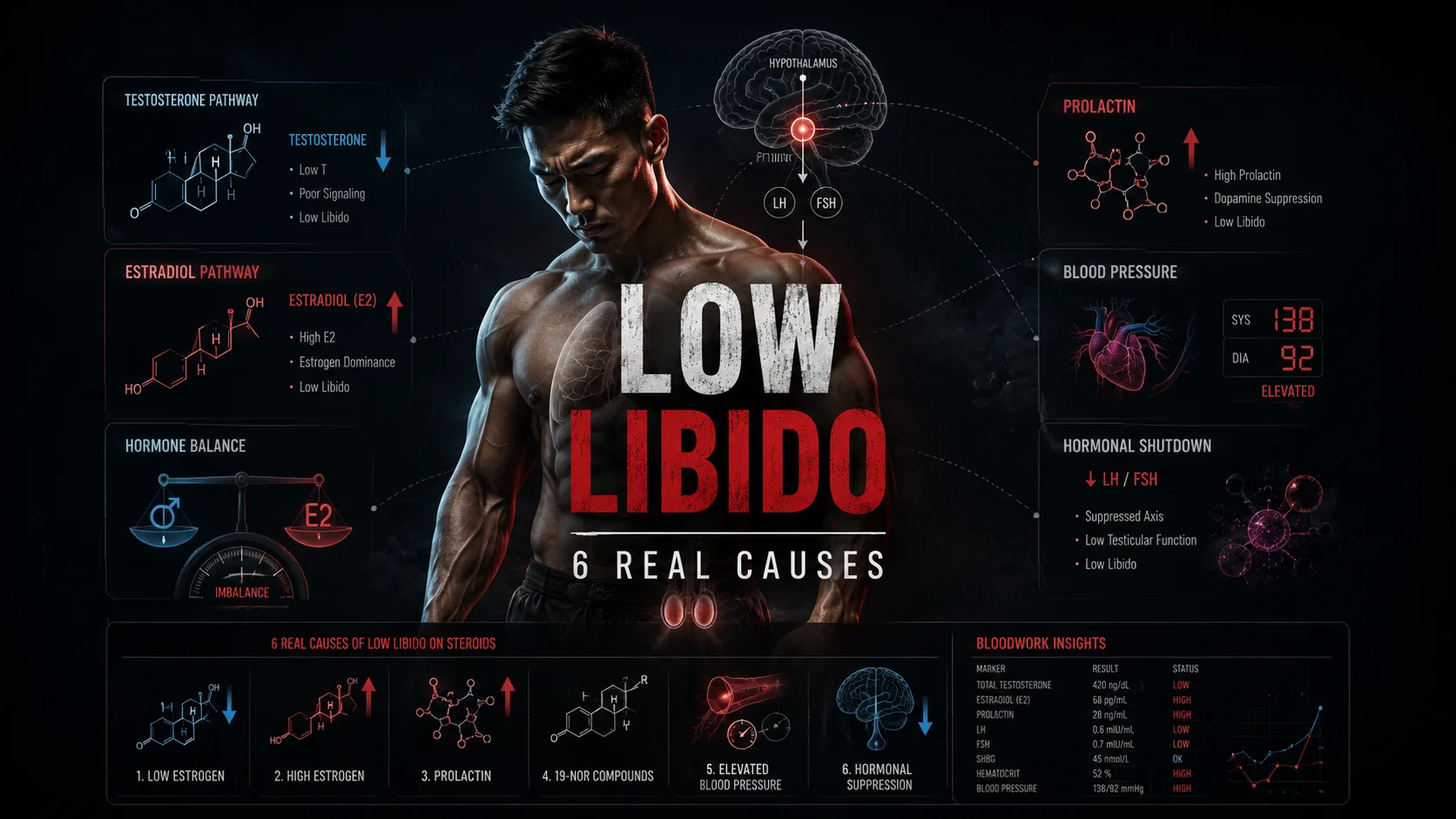
Libido on steroids rises first and falls later, and the fall is the common part. In the HAARLEM study, which followed 100 men through a cycle and for a year afterwards, decreased libido after the cycle was the single most frequent negative effect, reported by 58 percent (PMID 33038020). Years after stopping, 40 percent of former users still reported reduced desire and 27 percent erectile dysfunction (PMID 27532478). Do steroids increase libido? Briefly, yes. What happens next depends on estradiol, prolactin, blood pressure and how fast the axis restarts, and this guide goes through each with the measured numbers, including the crashed estrogen case that an aromatase inhibitor creates.
Data in brief
Three numbers describe libido on steroids better than any forum thread: how often it drops after a cycle, how often it is still down years later, and how much lower sexual desire scores are in men who stopped.
In 100 men followed through an anabolic steroid cycle and for a year afterwards, decreased libido after the cycle was reported by 58 percent, the most common negative effect in the study. Dose and cycle length did not predict whose libido on steroids fell (PMID 33038020).
Among 33 former users a mean 2.5 years after their last cycle, 40.1 percent reported decreased libido and 27.3 percent erectile dysfunction, against 30 healthy lifters who had never used (PMID 27532478). Steroids and libido stay linked long after the compounds are gone.
Nineteen untreated former long-term users scored 2.4 points lower on the IIEF sexual desire subscale than 36 non-using weightlifters, with testosterone 131 ng/dL lower and smaller testes 3 to 26 months after stopping (PMID 25598171).
Every figure is taken from the abstracts of the twelve papers at the end. This page describes causes and measured outcomes; it recommends no compound, dose or drug.
What this guide covers
Why libido on steroids goes up and then down, with the hormone data behind both directions.
The six measured causes: crashed estradiol, high estradiol, prolactin, 19-nor compounds, blood pressure and post-cycle shutdown.
How long libido on steroids takes to recover, from the one-year HAARLEM follow-up and the studies of former users years later.
Which bloodwork separates the causes of low libido on steroids, because the symptom is the same whichever one is driving it.
Not coveredLow libido on prescription testosterone. A replacement dose is a different situation and has its own page: low libido on TRT.
Fertility and sperm recovery. That is fertility and suppression on steroids.
Any protocol. No aromatase inhibitor, dopamine agonist, PDE5 or PCT instructions. Drug names appear only where a study used them.
Why does libido on steroids crash when testosterone is high?
Because sexual desire in men is not run by testosterone alone. In 400 healthy men whose own production was switched off and who then received graded testosterone, 198 without and 202 with an aromatase inhibitor, both androgen deficiency and estrogen deficiency contributed to the decline in sexual function (PMID 24024838). A cycle can push testosterone far above normal while estradiol, prolactin or blood pressure moves in the wrong direction, and libido on steroids follows the weakest link, not the highest number.
Estradiol is made from testosterone, and the conversion is dose dependent: across five weekly doses of testosterone enanthate in 103 men, total and free estradiol rose with the dose, and the maximum conversion rate was 40 percent higher in older men (PMID 20534765). Estrogen receptors and aromatase sit in the brain regions linked to arousal and throughout the corpus cavernosum, and low testosterone and elevated estrogen each raise the odds of erectile dysfunction independently (PMID 26908066).
So do steroids increase libido? At the start of exposure, usually yes: more testosterone and proportionately more estradiol. The problem for libido on steroids is what people do next. The two most common responses to a strong cycle, adding an aromatase inhibitor and stacking a 19-nor, each remove one of the hormones desire depends on, and the third response, doing nothing about blood pressure, quietly removes blood flow.
Libido on steroids by phase: what the data show at each point
The same man moves through four hormone states in one cycle and its aftermath, and libido on steroids changes in each. The table follows libido on steroids through each, with the study that measured it.
| Phase | Hormone state | What was measured | Libido |
|---|---|---|---|
| First weeks | Testosterone and estradiol both rising with the dose | Sexual desire tracks testosterone dose when estradiol is allowed to follow (PMID 24024838); conversion rises with dose (PMID 20534765) | Rising |
| Mid cycle, aromatase inhibitor added | Testosterone high, estradiol driven low | Twelve weeks of anastrozole in 37 men cut estradiol from 26 to 17 pg/mL and raised testosterone 67 percent; sexual function scores did not improve (PMID 15001605) | Flat or falling |
| Mid cycle, 19-nor stacked | Progestogenic activity, prolactin may rise | Elevated prolactin has a stepwise negative effect on male sexual desire; normalising it restores desire but only partly restores erections (PMID 37340146) | Depends on prolactin |
| Weeks 0 to 12 after the cycle | Exogenous androgen gone, own production suppressed | Decreased libido reported by 58 percent of 100 men after the cycle, the most common negative effect (PMID 33038020); testosterone normalised within 3 months in most (PMID 33550376) | Falls in most |
| One year on | Axis recovered in most, not all | Prevalence of side effects back to baseline at one year, but 11 percent still had testosterone below normal (PMID 33038020, PMID 33550376) | Recovered in most |
| Years later, long-term users | Persistent hypogonadism in a minority | 40.1 percent decreased libido and 27.3 percent erectile dysfunction 2.5 years out (PMID 27532478); IIEF desire 2.4 points lower, 8 percent not recovered even on replacement (PMID 25598171) | Low in a large minority |
Two rows carry the practical lesson. The post-cycle row is where most men meet low libido on steroids, and it is expected: the compound is gone, and the testes have not restarted. The last row is the one to take seriously, because it shows that steroids and libido do not always separate cleanly once use stops.
The 6 reasons libido on steroids crashes
Six mechanisms behind low libido on steroids, each with a measurement behind it. Most men who lose their drive on cycle have two or three of them at once, which is why guessing at one and treating it rarely works.
Crashed estradiol from an aromatase inhibitor
Estradiol modulates libido and erectile function in men, with receptors in the arousal centres of the brain and in the penis (PMID 26908066). Driving it down with an inhibitor removed the estrogen half of sexual desire in the Finkelstein trial (PMID 24024838), and in older men twelve weeks of anastrozole bought a 67 percent testosterone rise with no gain in sexual function (PMID 15001605). This is the most common self-inflicted cause of low libido on steroids, and the clearest measured answer on steroids and libido: suppressing estrogen did not restore it.
Estradiol too high for too long
Estradiol rises in step with the testosterone dose (PMID 20534765), and elevated estrogen raises the incidence of erectile dysfunction independently of testosterone (PMID 26908066). For libido on steroids, the signs of high estradiol overlap with the crashed state, which is why the two are told apart by a blood test, not by feel; the full picture is on the high estrogen symptoms page below.
Prolactin creeping up
Prolactin suppresses the pulsatile release of GnRH, LH and testosterone, and in men presents as impaired libido, erectile dysfunction and reduced ejaculate volume (PMID 12668871), a pattern that reads as low libido on steroids when a 19-nor is in the stack. A 2024 meta-analysis found a stepwise negative influence of prolactin on sexual desire and that normalising it restores libido, while its effect on erections is limited (PMID 37340146).
19-nor compounds and the deca dick label
Nandrolone and trenbolone carry progestogenic activity and are the compounds users blame most for lost drive. No controlled trial has measured libido on a nandrolone cycle in users, and in the HAARLEM cohort neither dose nor cycle length predicted who got side effects (PMID 33038020). What is measured is the prolactin route in cause 3 and the estradiol route in cause 1, both of which a 19-nor stack tends to disturb at the same time.
Blood pressure and blood flow
Erection is a vascular event. In 104 hypertensive men, 68.3 percent had erectile dysfunction and in 45.2 percent it was severe, more than in an age-matched general population (PMID 10992363). In the same HAARLEM cohort, systolic pressure rose 6.87 mmHg and LDL 0.45 mmol/L during the cycle while HDL fell 0.40 mmol/L (PMID 35014715), so low libido on steroids can be a circulation problem with a hormonal label.
Post-cycle shutdown
Once the exogenous androgen clears, own production has to restart from suppressed. Decreased libido after the cycle was reported by 58 percent of 100 men (PMID 33038020). Testosterone was back to baseline within three months in most, but 11 percent were still below normal at one year (PMID 33550376), and in long-term users the hypogonadism was still present 3 to 26 months after stopping (PMID 25598171).
Causes 1, 2 and 3 are read off a single blood draw of sensitive estradiol, prolactin, total testosterone and LH, the same panel described on blood tests before steroids. Cause 5 needs a cuff, and cause 6 needs time and a repeat draw.
Deca dick, prolactin and the 19-nor question
Deca dick is the forum name for lost erections and lost libido on steroids of the nandrolone class, and it deserves a careful sentence rather than a myth or a dismissal. No trial has measured sexual function in men running nandrolone at cycle doses, so the label rests on user reports. What has been measured is the mechanism users point to: prolactin.
Hyperprolactinaemia in men inhibits GnRH pulsatility and with it LH and testosterone, and presents as impaired libido, erectile dysfunction and diminished ejaculate volume; it was found in 16 percent of men with erectile dysfunction in one clinical series (PMID 12668871). The 2024 meta-analysis of 25 studies confirmed a stepwise negative effect of prolactin on desire and that normalising it restores libido, while erections only partly recover (PMID 37340146). That pattern, desire gone first and erections unreliable, is exactly what deca dick describes.
The honest reading is that a 19-nor does not switch libido off by itself. It changes prolactin and estradiol at the same time as the base testosterone changes them, and the combination is what the HAARLEM men reported as decreased libido in 58 percent (PMID 33038020). The compound profile is on the Deca Durabolin page; the hormone that gets blamed is measured with one prolactin draw.
How long does libido on steroids take to come back?
The one-year answer on steroids and libido comes from the HAARLEM cohort. Three months after the end of the cycle, total and free testosterone were no different from baseline in the group as a whole, and by one year the prevalence of side effects, decreased libido included, had returned to baseline (PMID 33038020, PMID 33550376). For most men, the axis restarts and libido on steroids returns within a season.
A different dataset from the chart above: what long-term use left behind in 19 untreated former users, 3 to 26 months after stopping, against 36 lifters who never used. Kanayama 2015, PMID 25598171.
The authors called steroid-withdrawal hypogonadism common, frequently prolonged and associated with substantial morbidity. The 8 percent row is the one that no timeline chart can promise away.
The longer answer on libido on steroids is less comfortable. In 33 former users a mean 2.5 years after stopping, 27.2 percent had total testosterone below the reference limit and 40.1 percent reported decreased libido, against none and far fewer in 30 matched controls (PMID 27532478). Sperm count recovers more slowly than testosterone: a year after starting the cycle, 34 percent of the HAARLEM men still had a total sperm count below 40 million (PMID 33550376). Libido on steroids is therefore two questions: how long until it comes back, and whether the axis was already damaged by years of use before this cycle.
What that recovery looks like on paper, and which markers move first, is on hormonal recovery after steroids; the fertility side is on fertility and suppression on steroids.
What actually fixes libido on steroids, by cause
The fix for low libido on steroids is whichever measurement is out of place, and the literature is clear about which interventions restored desire and which did not. This is a description of what studies found, not a protocol.
| Cause | What identifies it | What the data show | Status |
|---|---|---|---|
| Crashed estradiol | Sensitive estradiol assay low, symptoms of low estrogen | Restoring estrogen action restores the estrogen half of desire (PMID 24024838); blocking it further did not improve sexual function (PMID 15001605) | Stop lowering it |
| High estradiol | Sensitive estradiol high next to testosterone | Elevated estrogen raises erectile dysfunction risk independently (PMID 26908066); the estradiol rise is dose dependent, so the dose is the lever (PMID 20534765) | Dose, then reassess |
| Prolactin | Serum prolactin above range | Normalising prolactin restores libido; erectile effect limited (PMID 37340146); cabergoline effective in men with prolactinomas (PMID 12668871) | Clinician-managed, measured to work |
| Blood pressure | Cuff reading, not a hormone panel | Hypertensive men: 68.3 percent erectile dysfunction, 45.2 percent severe (PMID 10992363); systolic pressure rose 6.87 mmHg during the cycle and returned to baseline three months after it (PMID 35014715) | Treat the pressure |
| Post-cycle shutdown | Low testosterone with low LH after the cycle | Recovered within 3 months in most, 11 percent still low at one year (PMID 33550376); prolonged in long-term users (PMID 25598171) | Time, repeat draw, clinician if it persists |
| 19-nor stack | Prolactin and estradiol together | No compound-specific trial; dose and duration did not predict side effects (PMID 33038020). The measured levers are the two rows above | Measure both |
Every row starts with a number from a blood draw or a cuff. That is the whole method: libido on steroids is diagnosed, not guessed. The two estradiol states are described in detail on high estrogen symptoms on steroids and low estrogen symptoms on cycle, and the pressure side on do steroids raise blood pressure.
Five mistakes that keep libido on steroids low
These are the patterns that turn a two-week dip in libido on steroids into a six-month problem.
1. Adding an aromatase inhibitor because testosterone is high. Testosterone is supposed to be high on cycle, and steroids and libido part ways when estradiol is removed. The inhibitor removes estradiol, and estradiol is half of libido on steroids (PMID 24024838). In the anastrozole trial, testosterone rose 67 percent and sexual function did not move (PMID 15001605).
2. Reading symptoms instead of a sensitive assay. High and low estradiol produce overlapping complaints. Only the number separates them, and routine immunoassays are not reliable at male concentrations, which is why the baseline draw matters before anything is taken (see the estradiol before steroids page).
3. Never drawing prolactin. The one hormone that a 19-nor is blamed for is the one most men never test. Normalising it is the intervention with the clearest measured effect on desire (PMID 37340146).
4. Ignoring blood pressure. A hormonal explanation for low libido on steroids is satisfying; a cuff is faster. Severe erectile dysfunction was found in 45.2 percent of hypertensive men (PMID 10992363).
5. Chasing the drive with another cycle. Do steroids increase libido? At the start, yes, which is why this trap works. Each cycle adds to the exposure that predicts prolonged hypogonadism, the state in which steroids and libido stay linked for years in former users, where 40.1 percent still reported decreased libido 2.5 years later (PMID 27532478).
The alternative to all five is the same panel taken before the cycle and repeated: sensitive estradiol, prolactin, testosterone with LH, and a pressure reading, as laid out on estradiol before steroids.
Verdict: a balance problem, not a testosterone problem
Libido on steroids follows a predictable arc. It rises with the dose while estradiol is allowed to rise with it, falls when an inhibitor, a 19-nor, rising pressure or the end of the cycle removes one of the inputs, and comes back within about three months in most men once the axis restarts. Do steroids increase libido? Yes, and then they take it away, in that order (PMID 33550376). The 58 percent who report decreased libido after a cycle are the rule, not the exception (PMID 33038020).
The minority story on libido on steroids is the one worth planning around. Long-term use leaves a measurable share of men with prolonged hypogonadism and a sexual desire score that replacement therapy does not always restore (PMID 25598171). Steroids and libido are not linked by a single hormone, and the fix is never a single guess: it is the sensitive estradiol, the prolactin, the testosterone with LH, and the cuff, read together by someone qualified to read them.
The wider set of effects is on the PED side effects hub. If the question is about a replacement dose rather than a cycle, low libido on TRT covers that situation separately.
Libido on steroids: frequently asked questions
Why is my libido on steroids low when my testosterone is so high?
Because desire depends on estradiol, prolactin and blood flow as well as testosterone. In 400 men given suppression and graded testosterone, 202 of them with anastrozole, both androgen deficiency and estrogen deficiency contributed to the fall in sexual function (PMID 24024838). A cycle with an aromatase inhibitor keeps testosterone high and removes the estrogen half, which is the most common reason libido on steroids collapses mid cycle.
Do steroids increase libido?
At first, usually yes. Sexual desire tracked the testosterone dose when estradiol was allowed to rise with it (PMID 24024838), and estradiol rises in proportion to the dose (PMID 20534765). The drop comes later: decreased libido after the cycle was reported by 58 percent of 100 men in the HAARLEM study, the most common negative effect recorded (PMID 33038020).
Can steroids cause erectile dysfunction?
Yes, through more than one route. Elevated estrogen raises erectile dysfunction risk independently of testosterone (PMID 26908066), elevated prolactin impairs erections as well as desire (PMID 12668871), and blood pressure matters: 68.3 percent of hypertensive men had erectile dysfunction, 45.2 percent severe (PMID 10992363). Among former users 2.5 years after stopping, 27.3 percent reported erectile dysfunction (PMID 27532478).
What is deca dick?
The user term for lost desire and unreliable erections on nandrolone. No trial has measured sexual function on a nandrolone cycle, so the label rests on reports. The mechanism blamed, prolactin, is well measured: it has a stepwise negative effect on male sexual desire and normalising it restores libido, while erections recover only partly (PMID 37340146). In the HAARLEM cohort, neither dose nor cycle length predicted who got side effects (PMID 33038020).
How long does libido take to come back after a cycle?
For most men, within about three months. In 100 men followed for a year, total and free testosterone were back to baseline three months after the cycle and the prevalence of decreased libido had returned to baseline by one year, but 11 percent still had testosterone below normal at that point (PMID 33038020, PMID 33550376). In long-term users the hypogonadism can last months to years (PMID 25598171).
Will an aromatase inhibitor fix low libido on steroids?
Not if estradiol is already normal or low. In 37 men, twelve weeks of anastrozole cut estradiol from 26 to 17 pg/mL and raised testosterone 67 percent, and sexual function scores did not improve (PMID 15001605). Estradiol supports libido and erections in men in its own right (PMID 26908066), so the inhibitor is only a lever when a sensitive assay shows estradiol is high.
Is low libido on steroids permanent?
Usually not, but not always. A year after the cycle most of the HAARLEM men had recovered (PMID 33038020). Among 33 former users a mean 2.5 years out, 40.1 percent still reported decreased libido and 27.2 percent had testosterone below the reference limit (PMID 27532478), and 2 of 24 long-term users had not regained libido or erectile function even on replacement testosterone (PMID 25598171). Prolonged cases are a clinician's problem, not a forum's.
Which blood tests explain low libido on cycle?
Sensitive estradiol, prolactin, total testosterone with LH, and a blood pressure reading. Those four separate the six causes on this page: crashed or high estradiol (PMID 24024838), prolactin (PMID 37340146), blood flow (PMID 10992363) and post-cycle shutdown (PMID 33550376). Steroids and libido cannot be sorted out from symptoms alone because the high and low estradiol states feel the same.
Sources and further reading
Every figure on this page comes from one of the twelve papers below, each checked against its PubMed record on 27 September 2026. Reference links are dofollow to support open science.
Keep reading
Four pages that carry libido on steroids further: the two estradiol states behind most of it, the baseline panel that separates the causes, and what recovery looks like once the cycle ends.
Final Educational Note
This article is educational and is not medical advice. It reports what cohort studies and controlled trials measured about libido on steroids and erectile function in men who use anabolic steroids, during use and after it. It does not recommend any compound, dose, inhibitor, dopamine agonist or recovery drug, and it is not an encouragement to use anabolic steroids, which carry serious health and legal risks. More guides sit on the PED side effects hub.
Persistent loss of libido or erectile function, during a cycle or after it, is a clinical question for a physician, who can order the right panel and read it against the rest of the picture. Read more about how this site works on the about page and in the full disclaimer.