Masteron (Drostanolone): 7 Critical Facts and Risks
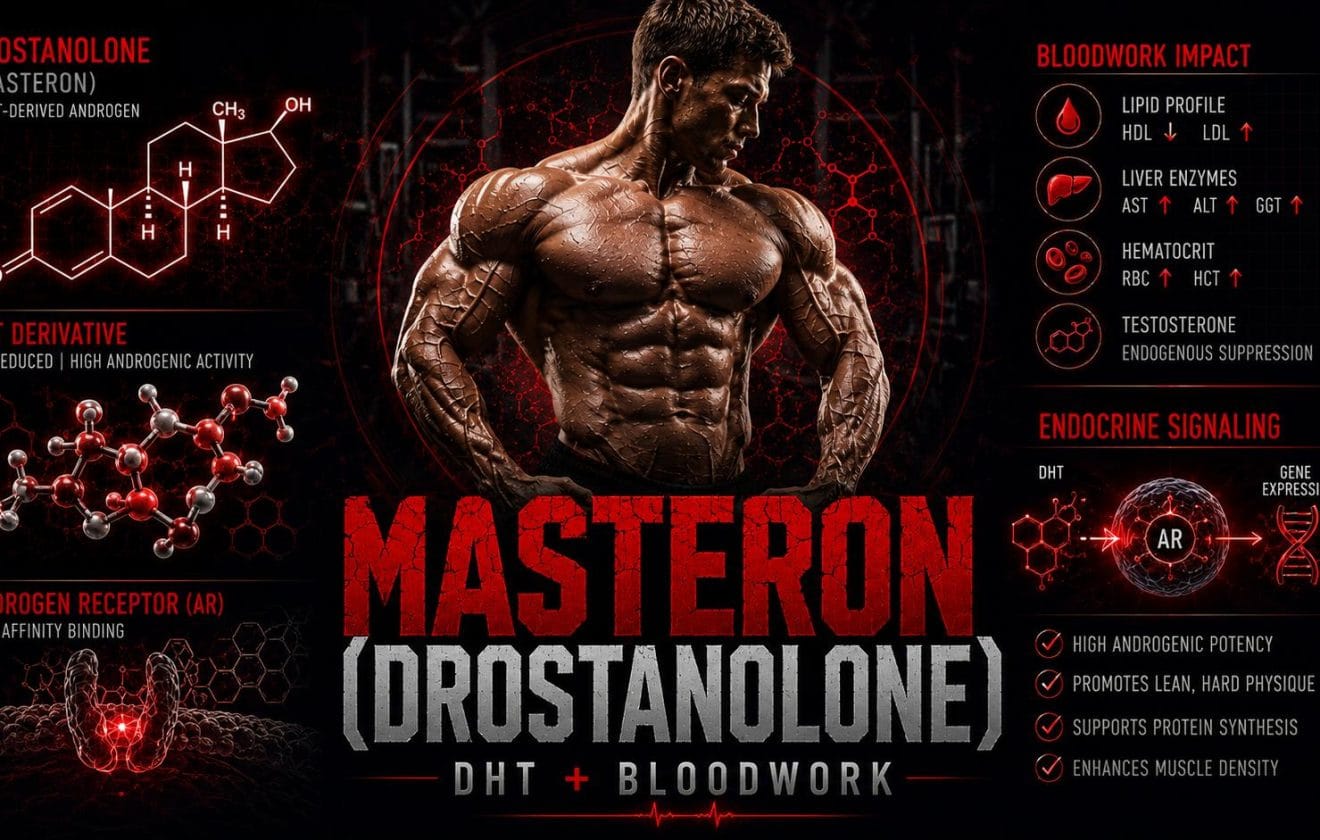
Masteron (Drostanolone): 7 Critical Facts and Risks
Masteron is the old trade name for drostanolone, an injectable androgen built by adding a 2-alpha-methyl group to dihydrotestosterone, and that one structural fact explains most of what the compound does and does not do. It cannot be converted to estrogen, it delivers a dihydrotestosterone-level androgenic signal to scalp and prostate tissue, and its widely quoted anabolic rating comes from rodent assays rather than from human trials. This profile is pharmacology and risk only, and it sits alongside the wider DHT-derived steroid category.
Masteron: The Data in Brief
Drostanolone propionate is formally named 2-alpha-methyl-4,5-alpha-dihydrotestosterone 17-beta-propionate and is described in the chemical literature as a synthetic anabolic-androgenic steroid derived from dihydrotestosterone (Borodi G et al, Molecules, 2020, PMID 32245263). The 2-alpha-methyl group is the only addition to the dihydrotestosterone skeleton.
Aromatase converts androstenedione, testosterone and 16-alpha-hydroxytestosterone into estrogens, and narrow androgenic substrate specificity is the hallmark of the enzyme (Ghosh D et al, Nature, 2009, PMID 19129847). A 5-alpha-reduced steroid such as drostanolone lacks the A-ring the enzyme aromatizes, so no estrogenic metabolites are produced.
The anabolic to androgenic ratio of drostanolone is quoted almost everywhere as 62:25 against testosterone at 100:100. Those figures come from rodent myotrophic and androgenic bioassays, a methodology that Kicman describes as a weak predictor of effects in humans (Br J Pharmacol, 2008, PMID 18500378).
Every headline claim on this page carries the PubMed identifier of the study it rests on, so the statement and its source can be checked together rather than taken on trust.
What This Compound Profile Covers
Structure. Why the 2-alpha-methyl group was added to dihydrotestosterone, and what it changes about receptor activity and metabolism.
Estrogen pathway. Why drostanolone is not a substrate for aromatase, what that means for estrogenic metabolites, and which popular claims about estrogen control go beyond the published evidence.
Potency figures. The anabolic to androgenic ratio, where the numbers come from, and how far they can be trusted.
Risk. Androgenic effects on scalp, skin and prostate, lipid changes typical of non-aromatizing androgens, suppression of endogenous testosterone, and the historical oncology use of the drug.
No protocols. No doses, no cycle design, no stacking, no injection schedules and no sourcing guidance appear anywhere on this page.
Category mechanism. How 5-alpha reduction shapes the whole androgen class lives on DHT-derived steroids.
Follicle biology. The mechanism of androgenic alopecia is covered in depth on hair loss and DHT on steroids.
Route and esters in general. How esters, depots and first-pass metabolism differ across the class belongs to injectable versus oral steroids, and the testosterone baseline itself to testosterone-based steroids.
Drostanolone Is a Dihydrotestosterone Derivative
The first fact worth stating plainly, because it is the one most often searched for with a citation attached, is this. Drostanolone is a derivative of dihydrotestosterone. The chemical literature names drostanolone propionate as 2-alpha-methyl-4,5-alpha-dihydrotestosterone 17-beta-propionate and calls it a synthetic anabolic-androgenic steroid derived from dihydrotestosterone (Borodi G et al, Molecules, 2020;25(6), PMID 32245263). That paper exists to describe the crystal polymorphs of the drug, but its opening sentence is the cleanest published statement of what the molecule actually is.
Two modifications separate it from testosterone. The first is 5-alpha reduction: the double bond between carbons 4 and 5 of the A-ring is saturated, which is exactly what defines dihydrotestosterone. The second is a methyl group at the 2-alpha position. That methyl group is not decoration. Unmodified dihydrotestosterone is cleared so quickly by 3-alpha-hydroxysteroid dehydrogenase that it is close to useless as an injected drug, and a substituent next to the 3-keto group slows that inactivation. The 2-alpha-methyl group is the reason masteron survives long enough in tissue to do anything at all.
The 17-beta propionate or enanthate ester is a third and trivial modification. Esters are cleaved after injection and govern only how quickly the parent steroid appears in circulation. Once the ester is gone, the molecule acting at the receptor is drostanolone in both masteron preparations.
The structure creates no new mechanism. Masteron works through the androgen receptor, as every anabolic-androgenic steroid does, and receptor binding across this class is uneven: 19-nortestosterone and methenolone bound more strongly than testosterone in skeletal muscle and prostate, while stanozolol, methandienone and oxymetholone bound so weakly that affinity was hard to measure (Saartok T et al, Endocrinology, 1984;114(6):2100-6, PMID 6539197). Structural family alone predicts little about potency.
Drostanolone Is Not a Substrate for Aromatase
The second claim people come looking for a source on is that drostanolone is not a substrate for aromatase and therefore produces no estrogenic metabolites. The reason is structural, and the reference is the crystal structure of the human enzyme itself.
Aromatase is the only enzyme in vertebrates that makes estrogens from androgens. It performs three oxidation steps, converting androstenedione, testosterone and 16-alpha-hydroxytestosterone into estrone, estradiol and estriol respectively. The first two steps hydroxylate the C19 methyl group, and the third aromatizes the steroid A-ring, a reaction unique to this enzyme. Most cytochrome P450 enzymes are promiscuous about substrates; aromatase is not, and that androgenic specificity is described as its hallmark (Ghosh D et al, Nature, 2009;457(7226):219-23, PMID 19129847).
Every one of those accepted substrates carries a 3-keto group with a double bond between carbons 4 and 5. That unsaturated A-ring is the thing the enzyme rebuilds into an aromatic ring. Drostanolone is 5-alpha reduced, so that double bond has already been removed before the molecule ever reaches an aromatase-expressing tissue. There is nothing left for the enzyme to work on, which is why masteron produces no estradiol, no estrone and no estrogenic metabolites at any dose or duration. The same logic applies to every 5-alpha-reduced androgen, which is why the entire dihydrotestosterone family behaves this way.
One widely repeated claim deserves a flag rather than a citation. Masteron is often said to actively inhibit aromatase and block estrogen at the receptor, and therefore to control estradiol on a cycle that includes aromatizing compounds. A PubMed search for drostanolone and aromatase inhibition returns nothing: no human trial and no enzyme kinetics paper. Not being a substrate and being an inhibitor are different claims, and only the first is supported, so estradiol still has to be measured. That marker is covered on estradiol before steroids.
The Masteron Anabolic to Androgenic Ratio
The third fact people search for with a source attached is the ratio. The anabolic to androgenic ratio of drostanolone is conventionally given as 62:25, against testosterone set at 100:100. That pairing is quoted in essentially every compound reference, and it is worth understanding exactly what kind of number it is before leaning on it.
Those values come from the Hershberger-type rodent bioassay. Castrated immature rats receive the steroid and two tissues are weighed: the levator ani muscle as the anabolic readout, and the prostate and seminal vesicles as the androgenic readout. The ratio of the two responses, normalised against testosterone, becomes the published rating. Kicman reviews that methodology and notes that the dissociation seen in rodents has never translated into a genuinely tissue-selective androgen in humans (Br J Pharmacol, 2008;154(3):502-21, PMID 18500378).
Three limits follow. The rodent levator ani is not a representative skeletal muscle. The assays used different routes and schedules across compounds, so the comparisons were never like for like. And the human androgen receptor is the same protein in muscle, scalp and prostate, so a number claiming four times more anabolic than androgenic activity cannot describe receptor selectivity. The practical reading of the masteron ratio is narrow: among injectable androgens it is not a strong mass-builder, and an androgenic rating below testosterone does not make it gentle on androgen-sensitive tissue.
Propionate and Enanthate: What the Ester Changes
Masteron is encountered in two ester forms. Drostanolone propionate was the original pharmaceutical preparation; drostanolone enanthate has no pharmaceutical precedent and exists only as an underground version of the same active molecule with a longer chain attached. Neither is a different drug. The ester governs release rate and clearance and nothing else, a framework set out on injectable versus oral steroids.
| Property | Propionate | Enanthate | Status |
|---|---|---|---|
| Active molecule after cleavage | Drostanolone | Drostanolone | ● Identical |
| Ester chain length | 3 carbons | 7 carbons | ● Differs |
| Approximate half-life | Around 2 to 3 days | Around 7 to 10 days | ● Differs |
| Time to near-complete clearance | Days | Several weeks | ● Differs |
| Aromatization | None | None | ● Identical |
| Androgen receptor activity | Drostanolone | Drostanolone | ● Identical |
| Detection window in anti-doping testing | Governed by long-term urinary metabolites, not by the ester. Sulfated and glucuronidated metabolites of the parent steroid were mapped by gas chromatography mass spectrometry to extend that window (Albertsdóttir AD et al, Drug Test Anal, 2020, PMID 32386339). | ● Context | |
| Hepatic route | Not 17-alpha alkylated | Not 17-alpha alkylated | ● Identical |
The one practical consequence is blood level stability. A short ester gives sharp peaks and troughs, a long ester gives steadier levels but responds slowly and takes weeks to clear. Neither property alters the androgenic load, the lipid effect or the suppression that masteron produces.
How DHT-Derived Compounds Differ From One Another
Being a dihydrotestosterone derivative is not one single profile. The family shares a saturated A-ring and therefore the inability to aromatize, but it splits on the 17-alpha position, which decides whether a member is orally active and hepatotoxic. For real-world risk that split matters more than the anabolic ratings do.
| Compound | Aromatization | Androgenic load on scalp and prostate | Hepatic route | Status |
|---|---|---|---|---|
| Drostanolone (62:25) | None, not a substrate | Full dihydrotestosterone-type signal, no 5-alpha reductase step to block | Injectable, not 17-alpha alkylated | ● Moderate |
| Methenolone (88:44) | None | Dihydrotestosterone-type, moderate | Injectable ester and 17-alpha acetate oral form | ● Moderate |
| Stanozolol (30:20) | None | Dihydrotestosterone-type | 17-alpha alkylated, hepatotoxic by either route | ● Higher |
| Oxymetholone | None directly | Dihydrotestosterone-type | 17-alpha alkylated, marked hepatic burden | ● Higher |
| Mesterolone | None | Dihydrotestosterone-type, weak anabolic effect | 1-methyl oral, low hepatic burden | ● Lower |
| Testosterone (100:100), for reference | Yes, aromatase substrate | Partly mediated by local conversion to dihydrotestosterone | Injectable esters | ● Baseline |
Read across the table and the position of masteron is clear. It is not the most dangerous member of its family, because it is not 17-alpha alkylated and carries no hepatic burden. It is not the mildest either, because the androgenic signal it sends to hair follicles and prostate tissue cannot be reduced by any available drug. The class overview is on DHT-derived steroids.
Rodent Ratings Next to a Real Lipid Trial
The chart plots published rodent bioassay ratings for five androgens with masteron marked. Seen side by side, the methodological problem is obvious: the highest anabolic rating does not belong to the strongest receptor binder, and the lowest rating belongs to one of the most damaging compounds in practice.

The animation below shows different data: measured human lipids rather than rodent tissue weights. Eleven male weight lifters took oral stanozolol or intramuscular testosterone enanthate for six weeks in a crossover design. Stanozolol cut HDL cholesterol by 33 percent and the HDL2 subfraction by 71 percent, dropped apolipoprotein A-I by 40 percent and raised LDL cholesterol by 29 percent, while testosterone lowered HDL by only 9 percent and LDL by 16 percent (Thompson PD et al, JAMA, 1989;261(8):1165-8, PMID 2915439).
Lipid change after six weeks, oral stanozolol versus injected testosterone enanthate (Thompson 1989)
Stanozolol is a dihydrotestosterone derivative like masteron, which is why the trial is relevant here, but it is also 17-alpha alkylated and oral, and that drives the extreme numbers. The inference is not that masteron does this. It is that route and structure, not the anabolic rating, decide what happens to lipids, and that non-aromatizing injectables sit between the two arms of this study rather than at either end.
Does Masteron Cause Hair Loss, Acne and Prostate Effects
The fourth claim worth pinning to a citation concerns androgenic effects. Masteron carries a dihydrotestosterone-level androgenic signal to scalp, skin and prostate tissue, and its hair loss risk cannot be reduced by a 5-alpha reductase inhibitor. This is where the reassuring androgenic rating of 25 becomes actively misleading.
Androgenetic alopecia is driven by dihydrotestosterone acting on genetically susceptible follicles, and the logic of finasteride and dutasteride is to block 5-alpha reductase so that less testosterone is converted inside scalp tissue (Kaufman KD, Mol Cell Endocrinol, 2002;198(1-2):89-95, PMID 12573818). That strategy has a target only when the offending androgen is made locally from testosterone.
Masteron is already 5-alpha reduced, so it is not a substrate for 5-alpha reductase either: the reaction that enzyme performs was done during manufacture. Injecting it delivers a finished dihydrotestosterone-type androgen straight to the follicle, and no reductase inhibitor can lower that concentration. For a man with a family history of male pattern baldness this is the most important practical fact here, because the usual mitigation does not apply. The follicle mechanism is on hair loss and DHT on steroids.
The same reasoning covers skin and prostate. Masteron reaches sebaceous glands the same way, and acne was among the most common adverse effects in the prospective HAARLEM cohort of amateur androgen users (Smit DL et al, Curr Opin Endocrinol Diabetes Obes, 2022;29(6):560-565, PMID 35938779). Prostate tissue is the classic androgen-responsive organ, and the rodent assay behind the androgenic half of the masteron rating measured prostate weight for that reason. Anyone with an elevated prostate specific antigen or diagnosed benign prostatic hyperplasia has most to lose.
Lipid Effects of a Non-Aromatizing Androgen
Androgens lower HDL cholesterol through a reasonably well described mechanism. Hepatic triglyceride lipase activity rises first and the fall in HDL2 cholesterol follows it, a sequence shown directly during anabolic steroid therapy (Applebaum-Bowden D et al, Metabolism, 1987;36(10):949-52, PMID 3657514). The enzyme is induced by androgen exposure at the liver, which is why oral 17-alpha alkylated compounds do the most damage.
Two features of masteron matter here. It is injectable and not 17-alpha alkylated, which places it in the milder arm of that comparison. But it also produces no estradiol, and estradiol is the main reason testosterone users keep some HDL support. An androgen that suppresses endogenous testosterone while contributing no aromatizable substrate removes that counterweight, so the expectation for masteron is a real HDL decline without the extreme oral figures.
The endpoint behind these markers is not theoretical: long-term androgen users showed reduced left ventricular systolic function and more extensive coronary atherosclerosis than non-using weightlifters, with the burden tracking lifetime exposure (Baggish AL et al, Circulation, 2017;135(21):1991-2002, PMID 28533317). Ranges for the panel itself are on the lipid panel guide.
Suppression of Endogenous Testosterone
Every androgen that reaches the hypothalamus and pituitary in supraphysiological amounts shuts down the signal driving the testes, and masteron is no exception. Gonadotropin-releasing hormone pulses slow, luteinising hormone and follicle-stimulating hormone fall, and endogenous testosterone production stops. The review literature documents this suppression as a consistent finding across the drug class (Hartgens F, Kuipers H, Sports Med, 2004;34(8):513-54, PMID 15248788).
One nuance is specific to non-aromatizing compounds. With testosterone, feedback comes partly from the androgen and partly from the estradiol made from it. With masteron there is no estrogenic arm, so feedback is purely androgenic. That does not make suppression milder. It means masteron used alone can present with suppressed gonadotropins, suppressed testosterone and low estradiol at once, a combination that produces joint discomfort, flat mood and poor libido rather than the classic high-estrogen picture.
The HAARLEM data cut both ways: gonadal function was disrupted during use but resumed normally in the majority of athletes afterwards, and acute life-threatening toxicity was rare (Smit DL et al, PMID 35938779). Recovery is the usual outcome, not a guaranteed one, and what decides it is covered on hormonal recovery after steroids and testosterone suppression on steroids.
The Breast Cancer Origin of the Drug
Masteron was not developed for physique use. Like several androgens of its era it was introduced as a hormonal treatment for advanced breast cancer, on the principle that androgen therapy could oppose estrogen-driven tumour growth before selective estrogen receptor modulators and aromatase inhibitors existed.
A randomised study from that period compared testosterone decanoate, drostanolone and testolactone in disseminated breast cancer and reported that single-agent hormone therapy with the three drugs produced similar rates of objective response. Adding cyclophosphamide raised objective responses from 22 to 25 percent up to 46 to 55 percent, and in that combined setting testosterone decanoate and testolactone outperformed drostanolone over the 10 to 16 week observation period (Rieche K et al, Arch Geschwulstforsch, 1975;45(5):485-8, PMID 1243528).
Two things follow. Masteron has genuine clinical provenance, which is more than several drugs in the same market can claim. And it was superseded for that indication decades ago, so the modern evidence base for masteron in healthy people is close to empty. What exists is chemistry, anti-doping analytical work and inference from the wider androgen literature, which is why so much of what circulates about this steroid is assertion rather than data.
Six Risks That Belong to This Compound Specifically
Hair loss that nothing blocks
Because masteron is already 5-alpha reduced, finasteride and dutasteride have no enzyme left to inhibit. A genetically susceptible man gets the full follicular androgen signal with no countermeasure, unlike with testosterone, where blocking local conversion offers partial protection (Kaufman KD, PMID 12573818).
Skin and sebaceous response
Acne was among the most frequently reported adverse effects in the prospective HAARLEM cohort (Smit DL et al, PMID 35938779). A dihydrotestosterone-type androgen such as masteron acts directly on sebaceous glands, and no reductase inhibitor changes that signal.
Prostate tissue exposure
The androgenic half of the rodent rating was measured as prostate and seminal vesicle weight, which says plainly that masteron acts on prostate tissue. Benign prostatic hyperplasia, urinary symptoms or a rising prostate specific antigen belong in the contraindication column, not the monitoring column.
HDL decline with no estrogenic buffer
Androgen exposure raises hepatic triglyceride lipase and HDL2 cholesterol falls behind it (Applebaum-Bowden D et al, PMID 3657514). Masteron contributes no estradiol and suppresses the testosterone that would have produced some, so the usual partial protection of HDL is absent.
Suppression with a low estradiol picture
Gonadotropins and endogenous testosterone fall as with any androgen (Hartgens F, Kuipers H, PMID 15248788), but without an aromatizable substrate estradiol falls too. Joint pain, low mood and absent libido on masteron are routinely misread as something other than what they are.
An evidence vacuum around the product itself
There is no modern clinical literature on masteron in healthy people. It circulates almost entirely as unlicensed product, so identity, concentration and sterility are unverified, and the confident numbers repeated about it are inherited from rodent assays run more than fifty years ago.
Five Mistakes People Make Reading This Compound
1. Treating no aromatization as no estrogen problem. The absence of an estrogenic metabolite removes one direction of risk and creates another. Suppressed testosterone plus masteron means estradiol has nowhere to come from, and sub-physiological estradiol in men has its own symptom profile and its own effect on bone and lipids.
2. Believing masteron is an aromatase inhibitor. This is the most repeated claim about the drug and the one with the least support. Being unable to act as a substrate is a structural fact with a crystal structure behind it (Ghosh D et al, PMID 19129847). Inhibiting the enzyme in a person is a different claim, and no published human study has established it.
3. Reading an androgenic rating of 25 as low androgenic risk. The rating compares tissue responses in castrated rats. It does not describe what reaches a hair follicle, and it cannot account for a 5-alpha reduced androgen bypassing the step that inhibitor drugs target. On masteron, a low rating and high practical androgenic exposure coexist.
4. Assuming the ester changes the drug. Both masteron esters release the same molecule at different speeds. Expecting a different side effect profile from the long ester is expecting something the chemistry does not provide, and slower clearance only means a longer wait before levels fall if something goes wrong.
5. Trusting compound ratings as clinical data. The masteron ratio, the half-life values and the potency comparisons in every reference table descend from mid-twentieth-century animal work and pharmacological convention, not modern trials. They orient and they do not predict. A baseline panel, described on blood tests before steroids, tells you more than any rating table.
Masteron Questions, Answered With Sources
Is drostanolone a derivative of dihydrotestosterone?
Yes. Masteron is the trade name for drostanolone, and drostanolone propionate is chemically 2-alpha-methyl-4,5-alpha-dihydrotestosterone 17-beta-propionate, and the published chemical literature describes it as a synthetic anabolic-androgenic steroid derived from dihydrotestosterone (Borodi G et al, Molecules, 2020;25(6), PMID 32245263). The only addition to the dihydrotestosterone skeleton is a methyl group at the 2-alpha position, which slows inactivation by 3-alpha-hydroxysteroid dehydrogenase and makes the molecule usable as an injected drug.
Is drostanolone a substrate for aromatase?
No. Aromatase accepts androstenedione, testosterone and 16-alpha-hydroxytestosterone, and its narrow androgenic substrate specificity is described as the hallmark of the enzyme (Ghosh D et al, Nature, 2009;457(7226):219-23, PMID 19129847). Each of those substrates carries a 3-keto group with a double bond between carbons 4 and 5, and that is the bond the enzyme aromatizes. Masteron is 5-alpha reduced, so the bond is absent and no estrogenic metabolites of the drug can be formed.
What is the masteron anabolic to androgenic ratio?
It is conventionally given as 62:25, against testosterone at 100:100. The figures come from Hershberger-type rodent bioassays that weigh the levator ani muscle against the prostate and seminal vesicles after dosing castrated rats. Kicman reviews that methodology and notes that the dissociation seen in rodents has never produced a genuinely tissue-selective androgen in humans (Br J Pharmacol, 2008;154(3):502-21, PMID 18500378), so the masteron ratio is a comparative label rather than a measured human parameter.
Does masteron cause hair loss?
In genetically susceptible men, yes, and the usual protective drug does not work. Androgenetic alopecia is driven by dihydrotestosterone acting on the follicle, and finasteride helps by blocking the 5-alpha reductase step that creates it locally (Kaufman KD, Mol Cell Endocrinol, 2002;198(1-2):89-95, PMID 12573818). Masteron is already 5-alpha reduced, so there is no conversion step left to inhibit and a reductase inhibitor cannot lower the androgen concentration reaching the scalp.
Does masteron convert to estrogen?
No, and it cannot at any dose or duration, because conversion requires the aromatase enzyme and the molecule is not a substrate for it. The separate and much repeated claim that the drug actively inhibits aromatase and can be used to control estradiol on a cycle is not supported by any published human study. Estradiol should still be measured, because suppressed endogenous testosterone plus a non-aromatizing androgen commonly produces a low estradiol level rather than a high one.
What is the difference between drostanolone propionate and enanthate?
Only release rate. Both masteron esters are cleaved after injection and both deliver identical drostanolone to the androgen receptor. The propionate form has a half-life of roughly two to three days and clears within days, while the enanthate form runs to roughly seven to ten days and takes several weeks to clear. Aromatization, androgenic load, lipid impact and suppression are the same for both.
Does this compound suppress endogenous testosterone?
Yes. On masteron, suppression of gonadotropins and of endogenous testosterone production follows the pattern that is a consistent finding across anabolic-androgenic steroids (Hartgens F, Kuipers H, Sports Med, 2004;34(8):513-54, PMID 15248788). Because this androgen does not aromatize, feedback is purely androgenic and estradiol falls alongside testosterone. In the prospective HAARLEM cohort gonadal function was disrupted during use but resumed in the majority of athletes after discontinuation (Smit DL et al, PMID 35938779).
Is masteron hepatotoxic?
Masteron is not 17-alpha alkylated and is given by injection, so it does not carry the hepatic burden that defines the oral members of the dihydrotestosterone family such as stanozolol and oxymetholone. That is a genuine difference in risk, not a claim of safety. Cardiovascular and endocrine effects are unaffected by the route, and long-term androgen users show reduced left ventricular function and more extensive coronary atherosclerosis than non-using weightlifters (Baggish AL et al, PMID 28533317).
References and Further Reading
All citations below are peer-reviewed publications verified through PubMed, and reference links are dofollow to support open science. The structural, pharmacological and lipid figures quoted in this profile come directly from the primary publications listed here, which is why each claim in the text carries its PubMed identifier next to the sentence it supports.
Keep Reading
All guides are evidence-based, PMID-verified, and written for people who want the pharmacology of a compound rather than a protocol.
Final Educational Note
This profile of masteron exists for education and harm reduction. It is not medical advice, it is not a substitute for a qualified physician, and it deliberately contains no doses, cycle structures or sourcing information. Drostanolone is a controlled anabolic-androgenic steroid in most countries and has no current licensed use in healthy people.
MuscleScience.org sells no compounds, medications or supplements. All author names are pseudonyms and author portraits are stylised illustrations rather than photographs of real people. Full editorial policy is set out on our About page and our Disclaimer, and the wider compound library is indexed on the steroids hub.