Healing Peptides: BPC-157, TB-500 and What Tissue Repair Research Actually Shows
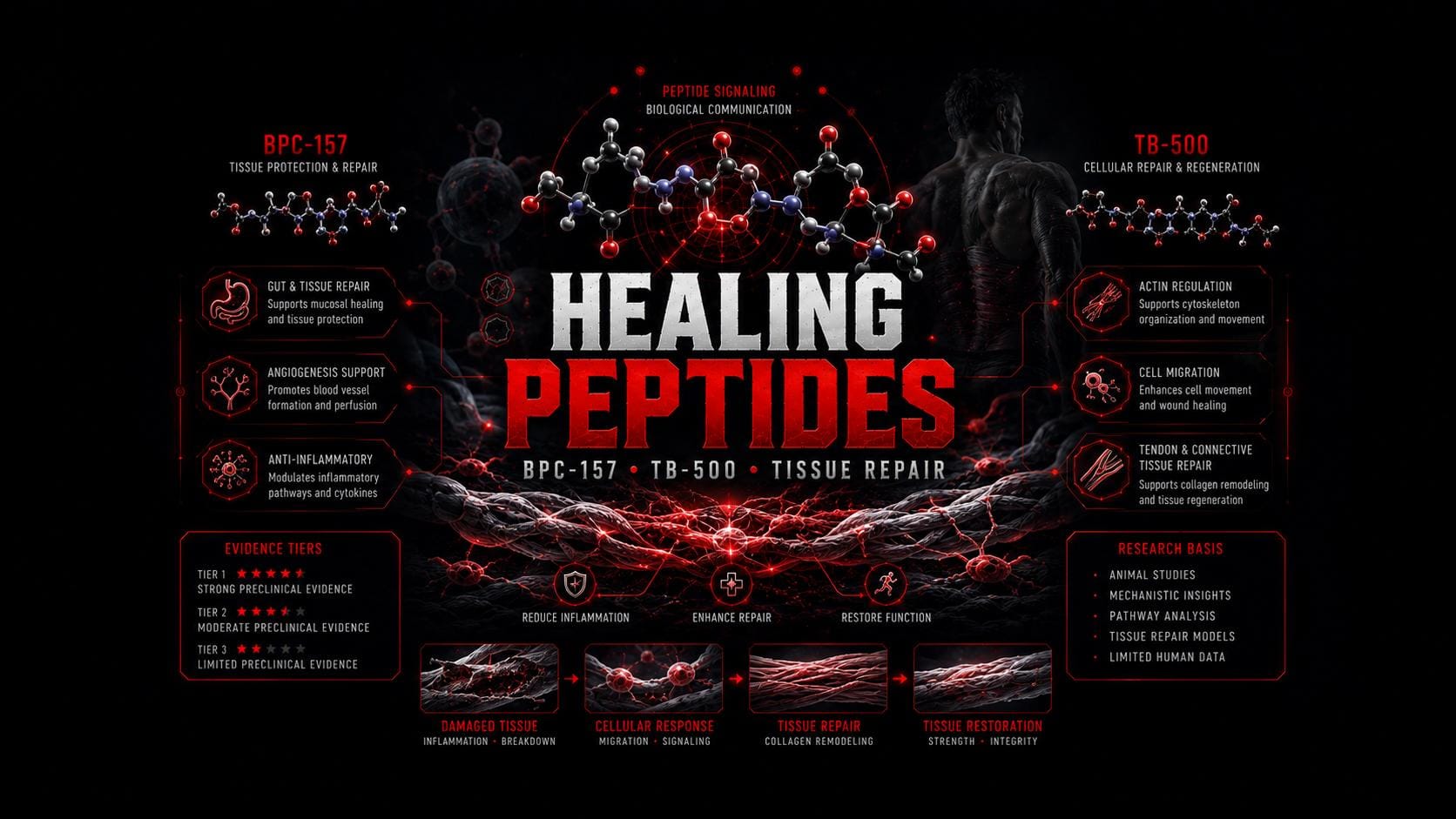
HEALING PEPTIDES: BPC-157, TB-500 AND WHAT TISSUE REPAIR RESEARCH ACTUALLY SHOWS
Healing peptides are sold for the injuries every lifter knows: a tendon that will not settle, a cranky knee, a pulled muscle, a slow recovery after surgery. The two big names are BPC-157 and TB-500, and in rats they really do speed healing. In people, BPC-157 has 30 patients in three uncontrolled studies (PMID 42885452), and TB-500 has none. The surprise is that the peptide with the best human evidence for tendons and joints is not an injectable at all. It is collagen powder, with randomised trials in tendons, muscle and knees (PMID 30609761, PMID 39060741, PMID 29018060).
This page explains it the way a coach would: plain words, every number from a PubMed abstract or a regulator page. You get how tissue heals, which peptide has been tested in which tissue, the peptides for joint pain and tendons people ask about, the risks, and what actually speeds a tendon back. The deep pages on BPC-157 and TB-500 go line by line.
Healing peptides in brief
Three numbers tell most of the story. How many people have taken BPC-157 in a study, how many have taken TB-500, and how many collagen trials sit behind tendons and joints.
Every human ever studied on BPC-157, across three small studies with no control group
A 2026 systematic review found three human studies of BPC-157 with 30 patients in total. All were rated poor quality and the certainty of evidence very low (PMID 42885452). The rat record runs to dozens of studies.
Humans who have received the TB-500 fragment in a published study
TB-500 is a 7 amino acid piece of thymosin beta 4 (PMID 23084823). Its one healing result is a 2026 rat Achilles study (PMID 42542926). The human trials people quote used the full protein, for leg ulcers and dry eye.
Randomised collagen peptide trials in a 2024 meta analysis of muscle, tendon and recovery
Nineteen trials and 768 adults found collagen peptides plus training improved tendon structure, fat free mass and strength a little more than training alone. Certainty was low to very low for tendons (PMID 39060741). Small, real, and far more than the injectables have.
Every figure on this page comes from a PubMed abstract or a regulator document listed at the end. No dose, schedule or protocol appears for any unapproved compound. Nothing here is a recommendation to use any peptide.
What this guide covers
How tissue heals in plain words, and where a healing peptide is supposed to act.
Which peptide has been tested in which tissue, tendon, ligament, muscle, knee and skin, split into animal and human results.
BPC-157, TB-500, thymosin beta 4, collagen peptides, GHK-Cu and KPV, one section each, plus the peptides for joint pain and tendon questions people ask.
The risks, and what the evidence says actually speeds a tendon back.
Not covered
Doses or protocols for injectables. None of the injectable healing peptides is approved. This page gives no protocol.
Where to buy anything. This site does not sell or source peptides and does not link to sellers.
The rest of the field. The basics are on what are peptides. The full map is on types of peptides.
How tissue heals, and where healing peptides are meant to act
Every injury heals in three overlapping stages. First comes inflammation, the first few days, when blood and immune cells flood in and clear the damage. Then comes rebuilding, roughly days to weeks, when new blood vessels grow and cells lay down fresh collagen. Last comes remodelling, weeks to months, when that new collagen is lined up and strengthened by load. Tendons and ligaments are slow at every stage because they have a poor blood supply.
Healing peptides are sold as a way to speed the second stage. BPC-157 is said to grow new blood vessels and help tendon cells survive and move into the gap. Thymosin beta 4, the protein TB-500 is cut from, holds actin, the cell's internal scaffolding, and helps cells migrate into a wound (PMID 22074294). In rats, both effects show up. Wounds re-covered 42 percent faster at day 4 on thymosin beta 4 (PMID 10469335). Cut Achilles tendons healed stronger on BPC-157 (PMID 14554208).
Collagen peptides work at the third stage from a different angle. They supply the raw building blocks of collagen. In one study, men took 15 g of vitamin C enriched gelatin an hour before exercise. A blood marker of new collagen doubled (PMID 27852613). Load tells the tendon where to put the collagen. The peptide just makes sure there is enough to build with.
Which healing peptide has been tested in which tissue
Here is the whole field in one grid. Each cell shows the best evidence for that peptide in that tissue. Read across the rows to compare peptides, down the columns to see where each one has been tested.
The pattern is hard to miss. BPC-157 is a column of grey with one dark red cell, a chart review of 16 knee patients (PMID 34324435). TB-500 is a column of black with one grey cell, the rat tendon study (PMID 42542926). Thymosin beta 4 has one red cell, for leg ulcers (PMID 20536470). Collagen peptides have four red cells, one each for tendon, muscle, knee and skin (PMID 30609761, PMID 39060741, PMID 29018060, PMID 37432180).
Peptides for healing, tissue by tissue
The grid gives the shape. This table gives the numbers behind each cell, so you can check any claim against it.
| Tissue | Best animal result | Best human result | Read it as |
|---|---|---|---|
| Tendon | BPC-157 healed cut rat Achilles tendons with better strength at 10 µg/kg, 10 ng/kg and 10 pg/kg a day (PMID 14554208). TB-500 at 60 µg/kg a day made repaired rat Achilles tendons stronger (PMID 42542926) | Collagen peptides plus calf exercises improved Achilles tendinopathy scores faster than exercise alone in 20 patients (PMID 30609761). 10 g a day for 16 weeks raised Achilles stiffness in 50 healthy men (PMID 40623147) | Collagen: small human trials. Injectables: rats only |
| Ligament | BPC-157 improved a cut rat knee ligament by injection, in drinking water and as a cream (PMID 20225319). Thymosin beta 4 in fibrin glue improved a cut rat knee ligament at 4 weeks (PMID 23523891) | Gelatin with vitamin C doubled a blood marker of collagen synthesis in 8 men and made lab grown ligaments stronger (PMID 27852613) | Animal and lab data; no human ligament trial |
| Muscle | BPC-157 sped healing of crushed rat calf muscle even on a steroid (PMID 20190676). Thymosin beta 4 raised regenerating fibres in dystrophy mice, without strength gain (PMID 20126456) | Collagen peptides plus training: fat free mass, muscle architecture and strength up a little more than training alone across 19 trials and 768 adults (PMID 39060741) | Collagen: meta analysis, low to moderate certainty |
| Knee joint | Not the focus of the main animal work | Collagen hydrolysate gave large short term pain relief in a meta analysis of osteoarthritis supplements (PMID 29018060). BPC-157 injected into the knee: 14 of 16 reported relief by phone, no control group, dose not reported (PMID 34324435) | Collagen: meta analysis. BPC-157: chart review |
| Skin and ulcers | Thymosin beta 4 re-covered rat wounds 42 percent faster at day 4 (PMID 10469335). BPC-157 sped several wound types in rats (PMID 34267654) | Thymosin beta 4 gel at 0.03 percent may speed venous leg ulcer healing, phase 2 in 73 patients (PMID 20536470). Oral collagen improved skin hydration and elasticity across 26 trials (PMID 37432180) | Two real human signals, neither for TB-500 |
Two things stand out. Every injectable healing result in tendon, ligament and muscle is a rat or mouse result. And the human results that do exist for tendons, muscle and knees come from a cheap oral supplement. It was used alongside training, with modest effects and low certainty. That is not the story the vial labels tell.
Each healing peptide, in one paragraph
BPC-157
A 15 amino acid piece of a stomach protein. In rats it healed tendon, ligament, muscle and gut injuries across dozens of studies (PMID 14554208, PMID 20225319, PMID 20190676). In people, three uncontrolled studies with 30 patients, all poor quality (PMID 42885452). Placed in FDA Category 2 for compounding in 2023 and banned in tested sport. Full story on BPC-157 dosage explained.
TB-500
A 7 amino acid fragment of thymosin beta 4, first sold for racehorses and first studied by a doping lab (PMID 23084823). One healing study, in rats: 60 micrograms per kilogram a day for four weeks made repaired Achilles tendons stronger (PMID 42542926). No human study of the fragment. Lab tests of online TB500 products found they did not match their descriptions (PMID 36482504). Full story on TB-500 explained.
Thymosin beta 4
The full 43 amino acid protein. It has real human trials. It was safe at up to 1260 mg a day into a vein for 14 days in healthy volunteers (PMID 20536472). A phase 2 trial suggested faster leg ulcer healing (PMID 20536470), and eye drop trials gave mixed results (PMID 26056426). No trial in tendons, joints or muscle, and no approval anywhere.
Collagen peptides
Collagen broken into small fragments you swallow. The only healing peptide with randomised trials in tendons, muscle and knees. Across 19 trials and 768 adults, collagen with training improved tendon structure and strength a little more than training alone (PMID 39060741). In Achilles tendinopathy, collagen plus calf exercises improved scores faster than exercises alone (PMID 30609761). A food supplement, cheap, no side effects reported in the trials.
GHK-Cu
A three amino acid copper peptide. In lab and gene studies it raises collagen and elastin production and supports wound repair (PMID 29986520). Controlled human trials are thin and mostly cosmetic. Now also sold as an injectable, with no human injection trial behind it.
KPV
A three amino acid tail of a natural anti inflammatory hormone, alpha MSH. In skin cells in a dish it cut inflammation and cell death from fine dust (PMID 40073467). It is sold for gut and joint inflammation. No human trial has been published.
Peptides for joint pain, tendons and the questions people ask
Peptides for joint pain. The best human data is collagen hydrolysate. A 2018 meta analysis of 20 supplements for osteoarthritis found collagen hydrolysate among seven with large short term pain relief. No supplement held up at long term follow up (PMID 29018060). The only injectable with knee data is BPC-157. In a chart review of 16 patients, 14 reported relief by phone, with no controls, no scales and no dose reported (PMID 34324435).
Peptides for healing tendons. Collagen peptides plus a calf strengthening programme improved Achilles tendinopathy scores faster than the programme alone in a 20 patient crossover trial (PMID 30609761). Ten grams a day for 16 weeks made healthy Achilles tendons stiffer without changing their size (PMID 40623147). BPC-157 and TB-500 have rat tendon results only (PMID 14554208, PMID 42542926).
Can peptides heal a torn meniscus? No study has tested any peptide on a meniscus tear in people. The knee chart review lumped meniscus tears with arthritis and tendon problems and did not image anyone (PMID 34324435). A torn meniscus needs a diagnosis, not a vial.
What are the big 3 peptides? In healing forums it usually means BPC-157, TB-500 and GHK-Cu, sometimes sold as one blend. None of the three has a human trial in tendons or joints. The one controlled test of BPC-157 with TB-500, in rats, found the pair did not beat TB-500 alone (PMID 42542926).
Peptides for recovery after training. Collagen peptides with training improved 48 hour recovery of reactive strength after muscle damage, with low certainty (PMID 39060741). No injectable healing peptide has a human recovery trial.
Peptides for bone healing and after surgery. No published human study tests any of the injectable healing peptides on bone or post surgical recovery. A 2026 review of peptides in orthopaedics called the preclinical work promising and noted the lack of clinical trials (PMID 41490200).
Are healing peptides safe?
For the injectables, nobody knows, because nobody has run the study that would tell us. People quote a reassuring line: no adverse events in the BPC-157 human studies. That comes from 30 people followed up by phone with no control group (PMID 42885452). That is an absence of reports, not evidence of safety.
| Risk | Strongest evidence | Read it as |
|---|---|---|
| Unknown effects of the molecule | BPC-157: no adverse events in 30 people, with no controls and short follow up (PMID 42885452). TB-500: no human data at all | Not measured |
| Blood vessel growth in the wrong place | Both peptides heal partly by growing new vessels; a 2026 review lists pathological angiogenesis and carcinogenesis among theoretical risks of BPC-157 and TB-500 (PMID 42757290) | Plausible, not shown, not ruled out |
| Wrong molecule in the vial | Online TB500 products did not consistently match their descriptions (PMID 36482504); contamination, impurities and inaccurate dosing lead the hazard list (PMID 42757290) | The concrete risk |
| Missing a real injury | Pain relief reported by phone in an uncontrolled knee series (PMID 34324435) is not a diagnosis; tears and fractures need imaging | Practical risk |
| Regulatory | BPC-157 placed in FDA Category 2 for compounding in September 2023; no approval for any healing peptide injection (PMID 41966639) | Unapproved |
| Anti doping | BPC-157, TB-500 and thymosin beta 4 are banned in tested sport (PMID 41476424) | Tested athletes |
| Collagen peptides | No side effects reported across the tendon, muscle and skin trials (PMID 30609761, PMID 23949208) | Low risk food supplement |
The theoretical worry comes from the mechanism itself. Both BPC-157 and thymosin beta 4 heal partly by growing new blood vessels. A compound that grows vessels in a healing tendon could, in principle, do the same where you do not want it. A 2026 review of unregulated injectable peptides lists pathological angiogenesis and carcinogenesis among the concerns for exactly these compounds (PMID 42757290). Nobody has shown it happens. Nobody has run the study that would rule it out. The general page on peptide side effects covers the sterility and injection problems shared by every mixed vial.
What the evidence says actually helps a tendon heal
If the goal is a tendon or joint that works again, the strongest evidence is not a peptide. It is load. Progressive strengthening is the treatment that tendon research keeps coming back to. The one positive collagen tendinopathy trial paired its supplement with exactly that: twice daily calf strengthening and a return to running programme (PMID 30609761). The difference between an irritated tendon and a degenerated one, and how to load each, is on tendonitis vs tendinosis.
Collagen sits on top of load, not instead of it. In the meta analysis, the gains came from collagen combined with training over weeks (PMID 39060741). In the gelatin study, the extra collagen synthesis came from taking it an hour before a short bout of exercise (PMID 27852613). The supplement supplies the material. The loading tells the tendon where to lay it down.
Five mistakes people make about healing peptides
1. Reading rat healing as human healing
BPC-157 and TB-500 have strong rat tendon results (PMID 14554208, PMID 42542926). Neither has a controlled human tendon study. Rats heal fast and are injected daily into the belly cavity.
2. Quoting thymosin beta 4 trials for TB-500
The leg ulcer and eye trials used the full 43 amino acid protein (PMID 20536470). TB-500 is a 7 amino acid fragment that has never been in a human study (PMID 23084823).
3. Ignoring the supplement with the data
Collagen peptides have randomised trials in tendons, muscle and knees (PMID 30609761, PMID 39060741, PMID 29018060). They are the healing peptide with human evidence, and the cheapest one.
4. Using a peptide instead of load
The positive collagen tendon trial paired the supplement with twice daily calf strengthening (PMID 30609761). No study supports a peptide replacing rehabilitation.
5. Trusting the label on the vial
Lab tests of online TB500 products found the contents did not consistently match their descriptions (PMID 36482504). The peptide you read about may not be the one you inject.
Verdict: strong in rats, empty in people, and the jar beats the vial
Judged by the papers rather than the ads, the injectable healing peptides are rat compounds. BPC-157 has dozens of positive animal studies and 30 humans in three uncontrolled reports (PMID 42885452). TB-500 has one rat tendon study and no human study (PMID 42542926). Thymosin beta 4 has human trials, but for leg ulcers and eyes, not tendons. The peptide with randomised human trials in tendons, muscle and knees is collagen, taken with training, with modest gains and low certainty (PMID 39060741).
For readers here, the practical conclusion is simple. Load the injury, give it time, and if you want a peptide, the one with human data comes in a jar. The deep pages are on BPC-157 and TB-500. The rest of the field is on types of peptides and growth hormone peptides. The syringe arithmetic for any vial is on the peptide calculator.
Healing peptides: frequently asked questions
What is the best peptide for healing?
By human evidence, collagen peptides. They have randomised trials showing small gains in tendon structure, muscle and strength when taken with training (PMID 39060741). They sped improvement in Achilles tendinopathy with calf exercises (PMID 30609761), and gave short term pain relief in knee osteoarthritis (PMID 29018060). BPC-157 has the most rat studies but only 30 humans in uncontrolled reports (PMID 42885452). TB-500 has no human study.
Do peptides really work for healing?
In rats, BPC-157 and TB-500 clearly speed tendon, ligament and muscle healing (PMID 14554208, PMID 42542926). In people, the injectables have not been tested in a controlled trial. Thymosin beta 4 may speed leg ulcer healing in a phase 2 trial (PMID 20536470). Collagen peptides show modest real effects with training (PMID 39060741). So: some do, a little, in people; the famous ones are unproven.
What are the best peptides for joint pain?
Collagen hydrolysate gave large short term pain relief in a meta analysis of 20 osteoarthritis supplements, though no supplement held up long term (PMID 29018060). The only injectable with knee data is BPC-157. In a chart review, 14 of 16 patients reported relief by phone, with no control group and no dose reported (PMID 34324435).
Are there peptides for healing tendons?
Collagen peptides plus calf strengthening improved Achilles tendinopathy faster than strengthening alone in 20 patients (PMID 30609761). Ten grams a day for 16 weeks raised Achilles stiffness in healthy men (PMID 40623147). BPC-157 and TB-500 healed rat tendons (PMID 14554208, PMID 42542926) but have no human tendon study.
What are the big 3 peptides?
In healing forums it usually means BPC-157, TB-500 and GHK-Cu, often sold as one blend. None has a human trial in tendons or joints. In the one controlled test of BPC-157 with TB-500, in rats, the pair did not beat TB-500 alone (PMID 42542926). GHK-Cu has mostly lab and gene data (PMID 29986520).
Can peptides heal a torn meniscus?
No study has tested any peptide on a meniscus tear in people. The one BPC-157 knee report mixed meniscus tears with arthritis and tendon pain, used no imaging and no control group (PMID 34324435). A meniscus tear needs a diagnosis and a plan from a clinician.
Are healing peptides safe?
For the injectables, unknown. BPC-157 reported no adverse events in 30 people with no controls (PMID 42885452); TB-500 has no human data. A 2026 review lists unwanted blood vessel growth and cancer among theoretical risks, plus contamination and inaccurate dosing (PMID 42757290). Online TB500 products did not match their descriptions (PMID 36482504). Collagen peptides reported no side effects in their trials (PMID 30609761).
Do peptides help with recovery after training?
Collagen peptides with long term training improved 48 hour recovery of reactive strength after muscle damage. That was in the 2024 meta analysis, with low certainty (PMID 39060741). No injectable healing peptide has a human recovery trial. The growth hormone peptides sold for recovery are covered on the growth hormone peptides page.
Sources and further reading
Every figure on this page comes from one of the 30 sources below. 29 are papers checked against their PubMed abstracts on 25 October 2026, and one is the FDA compounding list. Every cell in the tissue grid matches a row of the tissue table and its source. Animal studies are cited as animal studies, never as human results. Reference links are dofollow to support open science.
Verified
Verified
Verified
Verified
Verified
Verified
Verified
Verified
Verified
Verified
Verified
Verified
Verified
Verified
Verified
Verified
Verified
Verified
Verified
Verified
Verified
Verified
Verified
Verified
Verified
Verified
Verified
Verified
Verified
Regulator
Keep reading
Four pages that go deeper: the two big healing peptides line by line, tendon loading, and the full map of peptide types.
Final Educational Note
This article is educational and is not medical advice. It reports what animal studies, human trials, reviews and regulators say about the peptides sold for healing. It gives no dose, schedule or protocol for any injectable and does not recommend any research chemical for any use. Research peptides are not approved for human use anywhere and carry serious health and legal risks. More guides sit on the peptides hub.
Some signs need a clinician before anything else. A joint that locks, gives way or swells, a tendon that snapped or pops, or pain that wakes you at night. Anyone with a history of cancer should talk to a physician before any compound that grows blood vessels. Read more about how this site works on the about page and in the full disclaimer.