Bulking vs Cutting: The Complete Nutrition Guide for Muscle Gain and Fat Loss
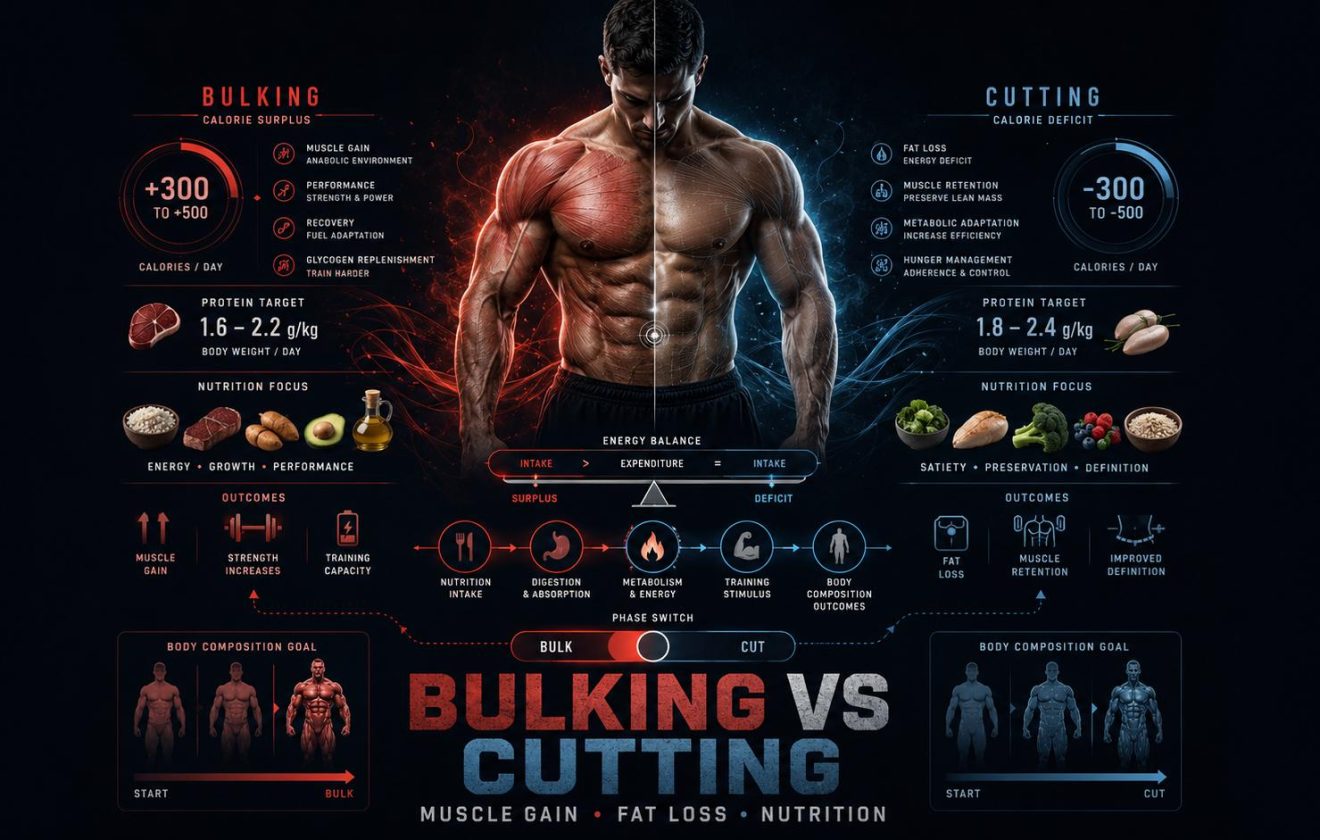
How to eat for each phase
Bulking vs cutting is the most fundamental decision in physique nutrition. The bulking vs cutting choice determines your calorie target, protein requirements, macronutrient distribution, and how aggressively you pursue either muscle gain or fat loss at any given time. Choosing between a calorie surplus and a calorie deficit sets the entire metabolic environment for training adaptation - and getting the surplus or deficit size right, and knowing when to transition between phases, determines how much of each training year produces real physique progress versus wasted effort in the wrong direction.
Bulking vs Cutting: Three Principles That Define Each Phase
Three bulking vs cutting principles that explain what separates an effective phase from one that produces excess fat gain, unnecessary muscle loss, or no meaningful progress in either direction.
Bulking vs Cutting: Surplus Size Determines Fat Gain Rate
In the bulking vs cutting decision, the size of the calorie surplus in the gaining phase is the variable most directly under your control. Muscle can be gained at a maximum rate of approximately 0.25-0.5 kg per month for intermediate trainees - a rate that requires only a modest surplus of 200-350 kcal above maintenance. A larger surplus does not accelerate muscle gain beyond this ceiling; it only accelerates fat accumulation alongside it. Lean bulking - a controlled surplus matched to the physiological rate of muscle gain - produces the same muscle accrual as aggressive overfeeding with substantially less fat to remove in the subsequent deficit.
Bulking vs Cutting: Deficit Rate Determines Muscle Retention
On the cutting side of the bulking vs cutting equation, how fast you lose body weight determines how much of that weight is fat versus lean mass. Research on natural bodybuilders supports a fat loss rate of 0.5-1% of bodyweight per week as the range that maximises fat loss while retaining lean mass - achieved through a moderate calorie deficit of 300-600 kcal below maintenance. Faster rates - above 1% of bodyweight per week - produce greater lean mass loss relative to fat loss, compounding with metabolic adaptation to slow progress and compromise the muscle built in the previous gaining phase.
Bulking vs Cutting: Protein Requirements Differ Between Phases
Protein intake needs are not identical in a surplus and a deficit, and treating them as the same is one of the most common bulking vs cutting nutrition errors. During a calorie surplus, protein requirements for muscle gain are met at approximately 1.6-2.2 g/kg of bodyweight per day. During a calorie deficit, protein requirements increase to 2.0-3.1 g/kg of lean body mass to offset the increased oxidation of amino acids for energy and the catabolic hormonal environment created by energy restriction. A trainee who does not increase protein during a cut relative to their bulking phase intake is measurably more likely to lose lean mass.
What This Bulking vs Cutting Guide Covers
Covered in This Guide
- The physiological mechanisms of bulking vs cutting - surplus anabolism, deficit catabolism, metabolic adaptation
- How to set calorie surplus and deficit size by goal and training history
- Protein requirements in a bulking vs cutting context and why they differ by phase
- Body recomposition - when simultaneous muscle gain and fat loss is realistic outside the bulking vs cutting cycle
- How long each phase should run and how to structure the transition
- 5 common bulking vs cutting nutrition mistakes that limit long-term progress
Not Covered Here
- How to calculate your TDEE - covered in the Calories and Energy Balance guide
- Carbohydrate and fat amounts by phase - covered in the Carbs for Training and Dietary Fats guides
- Training programme differences between phases - covered in the Cutting vs Bulking Training guide
- Contest prep and peak week nutrition - covered in the Peak Week guide
- Steroid or PED use in a bulk or cut - covered in the Steroids hub
Where bulking vs cutting fits in the nutrition sequence. Bulking vs cutting decisions are built on top of accurate TDEE estimation. Read the Calories and Energy Balance guide first to establish your maintenance intake, then apply the surplus or deficit targets from this guide. For the full macronutrient allocation within each phase, pair this with the Protein Intake guide and the Carbs for Training guide.
Six topics covering the bulking vs cutting physiology of both phases, calorie and protein targets, body recomposition, phase duration, and the most costly mistakes in each direction.
Bulking vs Cutting: What Each Phase Actually Does
Bulking vs cutting are not simply different calorie targets - they create fundamentally different metabolic and hormonal environments that determine what the body does with training stimulus. Understanding the physiology of each bulking vs cutting phase explains why the same training programme produces different outcomes in a surplus versus a deficit, and why the transition between phases requires deliberate nutritional adjustment rather than just changing a calorie number.
In a calorie surplus, the gaining phase of bulking vs cutting creates an anabolic hormonal environment. Elevated insulin - stimulated by the higher calorie and carbohydrate intake of a bulk - activates the mTOR signalling pathway that drives muscle protein synthesis and suppresses protein breakdown. Circulating IGF-1 rises with calorie availability, further amplifying the anabolic signal from resistance training. Growth hormone secretion patterns shift to favour tissue growth and nutrient partitioning. The net result is a state where protein synthesis consistently exceeds protein breakdown - the fundamental requirement for net muscle gain. This anabolic environment does not eliminate the need for adequate protein or progressive training stimulus; it amplifies the response to those inputs.
In a calorie deficit, the cutting phase of bulking vs cutting generates competing physiological pressures. Cortisol rises as the body responds to energy scarcity, promoting amino acid oxidation for gluconeogenesis and increasing protein breakdown in muscle. IGF-1 falls with reduced energy availability. The mTOR signal from resistance training is partially blunted by low energy status. Simultaneously, metabolic adaptation - the reduction in total daily energy expenditure beyond what is predicted by weight loss alone - progressively shrinks the effective deficit over time. Research by Trexler et al. documents this adaptive thermogenesis as a measurable reduction in resting metabolic rate, non-exercise activity thermogenesis, and the thermic effect of food, all of which work to slow fat loss and are more pronounced in leaner individuals and longer deficits.
Bulking vs Cutting: Surplus Anabolic Environment
A calorie surplus in the bulking vs cutting gaining phase elevates insulin, IGF-1, and mTOR signalling, creating conditions where muscle protein synthesis consistently exceeds breakdown with adequate training stimulus and protein intake. The rate of muscle gain is physiologically limited regardless of surplus size - intermediate trainees gain approximately 1-2 kg of lean mass per month at best, and only in the first several months of a structured gaining phase. Surplus calories beyond what is needed to support this rate of gain are stored as fat. The surplus is not the driver of muscle gain; training and protein are. The surplus creates the permissive metabolic environment in which those inputs produce their maximum effect.
Bulking vs Cutting: Deficit Catabolic Pressure
A calorie deficit in the bulking vs cutting cutting phase creates a catabolic metabolic environment in which both fat and lean mass are mobilised for energy. The degree of lean mass loss relative to fat loss is determined by three variables: deficit size, protein intake, and training stimulus. A deficit that is too large depletes glycogen rapidly, elevates cortisol excessively, and outpaces the muscle-sparing capacity of dietary protein and resistance training. Metabolic adaptation compounds the challenge by reducing TDEE as the deficit proceeds, requiring either further calorie reduction or increased activity to maintain the same rate of fat loss over time. The cutting phase goal is to create a deficit large enough to lose fat at a meaningful rate while keeping all three protective factors in place.
Bulking vs Cutting: Switching Between Phases
The bulking vs cutting transition - from a gaining to a cutting phase or vice versa - is not simply a calorie adjustment. Switching from bulk to cut requires raising protein to its deficit-phase target, reducing carbohydrate to create the deficit preferentially, and managing the initial water and glycogen loss that accompanies caloric reduction. Switching from a cut to a bulk requires a gradual calorie increase to avoid rapid fat regain from the metabolic rebound that follows a prolonged deficit. A maintenance period of 2-4 weeks between bulking vs cutting phases allows metabolic adaptation to partially reverse, restores glycogen and hormonal baselines, and reduces the risk of a large weight overshoot when the surplus is introduced.
Bulking vs cutting in the context of training programming. The physiological environment of each phase requires different training emphases. A surplus supports higher volume and more aggressive progressive overload. A deficit requires protecting intensity while managing fatigue accumulation that is harder to recover from under caloric restriction. See the Cutting vs Bulking Training guide for how to adapt your programme to the bulking vs cutting phase you are in.
Setting Calories for Bulking vs Cutting
The calorie targets for bulking vs cutting are set as a percentage above or below estimated total daily energy expenditure. The fundamental bulking vs cutting principle is that the surplus or deficit should be sized to the physiological rate of the outcome being pursued - muscle gain in a surplus, fat loss in a deficit - rather than to the psychological desire to accelerate the process beyond its biological ceiling. A surplus larger than needed to support the maximum rate of muscle gain only adds fat. A deficit larger than needed to lose fat at the lean-mass-protective rate only increases muscle loss and metabolic adaptation.
The lean bulk approach to the gaining side of bulking vs cutting targets a daily surplus of 200-350 kcal above maintenance - approximately 5-10% above TDEE for most trainees. This modest surplus is sufficient to support the 0.25-0.5 kg per month of lean mass gain that intermediate trainees can realistically achieve, produces minimal fat co-accumulation, and is easier to maintain over a 12-20 week gaining phase than an aggressive overfeed. The aggressive bulk - 500-750 kcal daily surplus - produces faster total weight gain but most of the additional weight above the lean bulk rate is fat, which must then be removed in a longer subsequent deficit. Over a full annual bulking vs cutting cycle, lean bulking with a shorter clean-up deficit typically produces the same or better net muscle gain with less time spent in a depleting caloric restriction.
| Bulking vs Cutting Phase | Calorie Adjustment | % of TDEE | Expected Rate | Muscle Retention Risk |
|---|---|---|---|---|
| Lean bulk | +200-350 kcal/day | +5-10% | 0.25-0.5 kg LBM/month | Not applicable - gaining phase |
| Aggressive bulk | +500-750 kcal/day | +12-18% | 0.5-1 kg total weight/month | Not applicable - higher fat co-accumulation |
| Conservative cut | −300-500 kcal/day | −8-12% | ~0.5% bodyweight/week | Low - optimal muscle-sparing rate |
| Moderate cut | −500-750 kcal/day | −12-18% | ~0.75% bodyweight/week | Low to moderate - acceptable with high protein |
| Aggressive cut | −750-1100 kcal/day | −18-25% | >1% bodyweight/week | High - elevated lean mass loss and metabolic adaptation |
All bulking vs cutting targets are relative to accurately estimated TDEE. Use the TDEE Calculator to establish your maintenance before applying these adjustments. Reassess every 2-3 weeks by tracking bodyweight trend - if rate of change does not match expected, adjust by 100-150 kcal in the appropriate direction.
Starting Body Fat - Choosing Bulking vs Cutting First
Body fat percentage at the point of deciding between phases is a practical starting criterion for the bulking vs cutting choice. Trainees above 18-20% body fat (men) or 28-30% (women) who start a gaining phase will accumulate additional fat on top of an already suboptimal starting composition and will face a longer deficit to return to a lean base. Starting a cut first - to bring body fat down to 12-15% for men or 20-24% for women - creates a more hormonally favourable and aesthetically motivating baseline from which to begin a lean gaining phase. Trainees who are already lean and have been at maintenance for an extended period can move directly into a structured lean bulk without a preliminary cut.
Calorie tracking accuracy in bulking vs cutting. The targets above are based on accurately known TDEE. Most people underestimate food intake by 20-40% and overestimate activity output by a similar margin. If the expected rate of weight change is not occurring after 2-3 weeks on a bulking vs cutting plan, the most likely cause is inaccurate tracking rather than an unusual metabolism. Weigh food when practical, log consistently, and adjust based on the observed bodyweight trend. See the Calories and Energy Balance guide for the complete framework.
Protein Requirements in Bulking vs Cutting
Protein requirements are not the same in a bulking vs cutting surplus and a bulking vs cutting deficit - treating them as identical is one of the most consequential nutrition errors across the cycle. In a surplus, adequate protein intake supports muscle protein synthesis in an already anabolic hormonal environment. In a deficit, protein serves an additional function: it must compensate for the increased oxidation of amino acids for energy, the catabolic hormonal pressure of caloric restriction, and the reduced anabolic signalling that comes with low energy availability. The result is that the cutting phase of bulking vs cutting requires measurably higher protein per kilogram of bodyweight than the gaining phase, and the failure to increase protein intake when transitioning from bulk to cut directly increases lean mass loss over the course of a multi-week deficit.
In a calorie surplus, the evidence base for protein and muscle hypertrophy converges on a target of 1.6-2.2 g/kg of total bodyweight per day. A 2018 systematic review and meta-analysis by Morton et al. - covering 49 studies and 1800 participants - found that the benefit of protein supplementation on resistance training-induced hypertrophy plateaued at approximately 1.62 g/kg/day, with higher intakes producing no further statistically significant increase in lean mass gain in individuals in energy balance or a surplus. The upper range of 2.2 g/kg is recommended during a bulk for trainees who train at high volume or have longer session durations. Going significantly above 2.2 g/kg in the bulking vs cutting surplus phase does not accelerate muscle gain - it displaces caloric space that could be used for carbohydrate to fuel training performance.
In a calorie deficit, protein requirements increase substantially. The 2014 evidence-based recommendations for natural bodybuilding contest preparation by Helms et al. - the most cited systematic review on bulking vs cutting nutrition for resistance-trained athletes - recommend a protein intake of 2.3-3.1 g/kg of lean body mass during the deficit phase, with higher intakes applied during more aggressive deficits and as body fat percentage decreases. The physiological rationale is direct: greater energy restriction means more amino acid oxidation for gluconeogenesis, more muscle protein breakdown under elevated cortisol, and reduced insulin-mediated suppression of proteolysis. High protein during a bulking vs cutting deficit does not eliminate these pressures - it provides the substrate needed to maintain net protein balance as close to zero as possible despite them.
| Bulking vs Cutting Phase | Protein Target | Basis | Priority Reason |
|---|---|---|---|
| Lean bulk | 1.6-2.0 g/kg bodyweight/day | Morton et al. meta-analysis 2018 | Maximise MPS; higher end for high-volume training |
| Aggressive bulk | 1.6-2.0 g/kg bodyweight/day | Plateau at ~1.62 g/kg in surplus | Excess protein above 2.2 g/kg in surplus displaces carbohydrate without benefit |
| Conservative cut | 2.0-2.4 g/kg LBM/day | Helms et al. 2014 lower range | Moderate deficit - baseline muscle-sparing level |
| Moderate cut | 2.3-2.8 g/kg LBM/day | Helms et al. 2014 mid range | Greater catabolic pressure requires higher amino acid availability |
| Aggressive cut | 2.6-3.1 g/kg LBM/day | Helms et al. 2014 upper range | Steep deficit and low body fat amplify lean mass loss risk |
LBM = lean body mass. To estimate LBM: multiply bodyweight in kg by (1 − body fat percentage as a decimal). Example: 85 kg at 18% body fat → LBM = 85 × 0.82 = 69.7 kg. At the high end of a moderate cut in a bulking vs cutting cycle, protein target = 2.8 × 69.7 = 195 g/day.
Why protein above 2.2 g/kg in a bulking phase is not productive. The mTOR pathway that drives muscle protein synthesis does not respond proportionally to protein intake above the leucine threshold and adequate daily total. In a bulking vs cutting calorie surplus with adequate energy and carbohydrate, protein above ~2.2 g/kg per day is oxidised or converted to glucose - it does not produce additional hypertrophy. Use the caloric space above 2.2 g/kg for carbohydrate to support training volume and performance. Full protein distribution framework in the Protein Intake guide.
Body Recomposition - When It Is Possible Outside Bulking vs Cutting
Body recomposition - simultaneously gaining lean mass and losing fat without committing to either phase of the traditional bulking vs cutting cycle - is possible in specific populations and under specific conditions. The conventional view that muscle gain and fat loss are mutually exclusive metabolic processes has been largely revised by research on trained individuals, and a 2020 review by Barakat et al. provides the most comprehensive evidence base for when recomposition is realistic and when the structured bulking vs cutting approach remains more efficient.
Recomposition is most reliably observed in four trainee categories: absolute beginners to resistance training, individuals returning from a significant detraining period, individuals with substantial excess body fat, and intermediate-to-advanced trainees eating at or near maintenance with very high protein and consistent progressive overload. In all four cases, the mechanism is similar - either the anabolic signal of novel training stimulus or the energy liberated from fat stores provides the caloric substrate for muscle protein synthesis without requiring a dietary calorie surplus. Outside these categories - specifically in lean, trained, advancing individuals who have been training consistently for 2 or more years - simultaneous muscle gain and fat loss at a meaningful rate is physiologically unlikely and inefficient compared to dedicated bulking vs cutting phases.
Training Naivety Enables Recomp Without Bulking vs Cutting Phases
Individuals new to resistance training experience a phase of "newbie gains" in which the novel mechanical stimulus drives rapid muscle protein synthesis increases that can be sustained even in a calorie deficit or at maintenance. Beginner trainees can gain 1-2 kg of lean mass per month in their first 3-6 months while simultaneously losing body fat, provided protein is adequate (2.0-2.4 g/kg) and training stimulus is progressive and consistent. This window is finite - it narrows as training age increases and the anabolic signal from novelty fades. Beginners attempting to choose between a dedicated bulking vs cutting phase in their first few months are addressing a decision that does not yet apply to them.
Muscle Memory Bypasses the Bulking vs Cutting Constraint
Individuals returning after an extended break - injury, illness, life interruption - experience an accelerated reacquisition of previously held lean mass via satellite cell activation and myonuclei persistence in previously trained muscle fibres. This recovery of lost mass can proceed in parallel with fat loss even in a moderate deficit. The rate of recovery is faster than the original development of that mass, and the window for simultaneous progress closes once the trainee returns to their pre-detraining baseline. At that point, continued progress requires committing to a dedicated bulking vs cutting surplus for further muscle development.
Internal Fat Stores Substitute for the Bulking vs Cutting Surplus
Individuals with substantial excess body fat - above 25% for men, above 35% for women - have a large endogenous energy reserve that can partially substitute for a dietary calorie surplus in supporting muscle protein synthesis. Fat oxidation under a modest deficit provides the energy substrate that a bulking vs cutting surplus would otherwise deliver, enabling muscle gain alongside fat loss when protein is high and training stimulus is consistent. As body fat decreases toward normal ranges, this internal energy buffer diminishes and the ability to recompose without a dedicated surplus diminishes with it.
Possible But Slower Than Dedicated Bulking vs Cutting Phases
Barakat et al. 2020 confirms that recomposition is possible even in trained individuals eating at maintenance, but the rate of lean mass gain is significantly slower than in a dedicated bulking vs cutting surplus. The conditions required are strict: protein at 2.4-2.8 g/kg per day, consistent progressive resistance training, maintenance calories tracked accurately, and a time horizon of 12 or more weeks to observe statistically meaningful lean mass changes. For trained individuals with specific timelines, dedicated bulking vs cutting phases remain more efficient than recomposition at maintenance.
Recomposition or dedicated bulking vs cutting phases - how to decide. If you are a beginner, returning from detraining, or significantly above target body fat, attempt recomposition at maintenance with high protein before committing to a dedicated surplus or deficit. If you are a consistently trained individual within a normal body fat range, dedicated bulking vs cutting phases will produce more progress per unit time. The inefficiency of recomposition in the trained state is a real constraint that bulking vs cutting phase cycling is designed to work around.
How Long to Bulk and Cut in a Structured Cycle
Phase duration in a structured bulking vs cutting cycle is determined by the rate of progress and the starting and target body fat percentages - not by a fixed calendar. The most common structural error is bulking vs cutting phases that are too short to produce meaningful progress in either direction, or too long such that the gaining phase accumulates excess fat requiring a disproportionate amount of time to remove. A well-structured annual bulking vs cutting cycle typically allocates 12-20 weeks to the gaining phase and 8-16 weeks to the deficit phase, with a 2-4 week maintenance transition between each.
Bulking vs Cutting: Typical Bulk Duration 12-20 Weeks
A minimum of 12 weeks is needed for the bulking phase of the bulking vs cutting cycle to produce meaningful lean mass accrual detectable above the noise of glycogen and water fluctuations. Intermediate trainees gaining at 0.25-0.4 kg of lean mass per month accumulate 0.75-1.6 kg over a 12-20 week bulk - a meaningful increase in lean mass that justifies the subsequent cut.
Extending a surplus beyond 20-24 weeks without a break produces diminishing returns as the body adapts to the sustained calorie excess and the anabolic environment plateaus. Gains slow, fat accumulation continues, and the psychological and metabolic cost of a longer subsequent bulking vs cutting cut increases. A lean bulk of 16-20 weeks followed by a clean-up cut is more effective over a full training year than a 40-week bulk that ends at high body fat.
Stopping criteria: End the gaining phase when body fat reaches the upper threshold (18-20% for men, 28-30% for women), or when rate of weight gain consistently exceeds the lean muscle-gain ceiling despite accurate tracking.
Bulking vs Cutting: Typical Cut Duration 8-16 Weeks
The cutting phase of the bulking vs cutting cycle should be long enough to reach the target lean body composition, but not so extended that metabolic adaptation severely impairs progress or lean mass loss becomes cumulative. At a conservative rate of 0.5% of bodyweight per week, an 85 kg individual loses approximately 0.43 kg per week - allowing for 5-7 kg of fat loss over 12-16 weeks, sufficient to move from 20% to 12-14% body fat.
Cuts longer than 16-20 weeks produce progressive metabolic adaptation that requires either deeper calorie cuts or more activity to maintain progress. If a longer bulking vs cutting deficit is needed to reach target body fat, consider a planned 1-2 week diet break at maintenance calories at the midpoint - a strategy that partially reverses adaptive thermogenesis and allows the deficit to resume from a higher effective TDEE.
Stopping criteria: End the cut when target body fat is reached, when rate of strength loss accelerates, or when the deficit cannot be maintained without falling below 1.4 g/kg protein or losing more than 1% of bodyweight per week consistently.
The maintenance transition between bulking vs cutting phases. Moving directly from an aggressive deficit into a calorie surplus without a maintenance bridge period risks a rapid weight overshoot as metabolic adaptation reverses quickly and energy intake jumps. A 2-4 week maintenance period at TDEE between the end of a bulking vs cutting cut and the start of the next bulk allows adaptive thermogenesis to partially normalise, restores glycogen and hormone baselines, and gives the digestive system time to adjust to increased food volume before the surplus begins.
5 Bulking vs Cutting Nutrition Mistakes That Limit Progress
- Mistake 01
Dirty Bulking - Running an Unlimited Surplus in the Bulking vs Cutting Cycle
The most costly error in the bulking vs cutting gaining phase is treating the calorie surplus as uncapped - eating well above maintenance on the assumption that more calories equals more muscle. Muscle gain is physiologically rate-limited to approximately 0.25-0.5 kg per month for intermediate trainees regardless of how large the surplus is. A trainee running a 1000 kcal daily surplus over 16 weeks gains the same lean mass as one running a 300 kcal surplus, but accumulates 4-6 additional kilograms of fat that must then be removed in a longer, more muscle-threatening deficit. Over a two-year bulking vs cutting training cycle, lean bulking with a shorter clean-up deficit produces equivalent or greater net muscle gain compared to dirty bulking, with significantly less time spent in the cutting phase and better preservation of training performance and hormonal function throughout.
- Mistake 02
Not Raising Protein When Moving From the Bulking vs Cutting Surplus to Deficit
Protein requirements increase when transitioning from the surplus to the deficit phase of the bulking vs cutting cycle, and failing to make this adjustment is the most mechanistically costly nutritional error in the cutting phase. A trainee consuming 160 g of protein per day in a gaining phase - appropriate for an 80 kg individual in a surplus - needs to increase to 185-225 g per day when entering a moderate deficit. The failure to make this adjustment means the elevated catabolic hormonal environment of the bulking vs cutting deficit proceeds with insufficient amino acid availability to suppress protein breakdown, directly increasing lean mass loss per week of restriction. Raising protein when starting a cut is the single highest-impact nutritional adjustment in the transition between phases.
- Mistake 03
Cutting Too Aggressively to Accelerate Bulking vs Cutting Fat Loss
Reducing calories to the maximum tolerable level in the cutting phase is a common response to impatience with the fat loss rate - but deficits above 750-1000 kcal per day produce a disproportionate increase in lean mass loss that undermines the goal of the entire bulking vs cutting cycle. Research by Helms et al. on natural bodybuilding preparation identifies a fat loss rate of 0.5-1% of bodyweight per week as the evidence-based ceiling for lean mass retention during a cut. Above this rate, elevated cortisol, impaired mTOR signalling, and insufficient calorie availability result in accelerating muscle loss relative to fat loss. An aggressive bulking vs cutting cut that loses 10 kg total weight with 3 kg of that being lean mass is a worse outcome than a moderate cut losing 8 kg with 0.5 kg being lean mass - despite losing less total weight.
- Mistake 04
Staying at Maintenance - Never Committing to Either Bulking vs Cutting Phase
One of the most widespread bulking vs cutting errors for intermediate trainees is remaining at approximate maintenance calories indefinitely - neither gaining nor losing - while expecting meaningful physique change. At maintenance, muscle gain is limited to the very slow recomposition rate applicable to trained individuals, and fat loss is negligible. The trainee stays the same weight, the same body composition, and the same strength level month after month. Committing to a structured gaining phase - even a conservative lean bulk at +250 kcal - produces more annual physique progress than months at maintenance. The comfort of staying between bulking vs cutting phases is not a strategy; it is a plateau.
- Mistake 05
Not Tracking Progress Throughout the Bulking vs Cutting Cycle
Bulking vs cutting phases that are not tracked produce unpredictable outcomes. A trainee who believes they are in a 300 kcal surplus but has not confirmed this with bodyweight trend data may be at maintenance - producing no meaningful lean mass gain for months. A trainee who believes they are cutting at 0.5% per week may be losing weight at 1.2% per week due to tracking errors, incurring lean mass loss they are unaware of until strength decrements become obvious. Effective bulking vs cutting requires tracking: weekly average bodyweight, weekly change in average weight, and an honest assessment of whether the rate of change matches the target. If it does not after 2-3 weeks, adjust calories by 100-150 kcal in the appropriate direction. Running a bulking vs cutting cycle on subjective feeling alone is the primary reason trainees cycle through multiple years of effort without progressing their physique meaningfully in either direction.
Published Research on Surplus, Deficit, and Phase Nutrition
- Helms ER, Aragon AA, Fitschen PJ. Evidence-based recommendations for natural bodybuilding contest preparation: nutrition and supplementation. J Int Soc Sports Nutr. 2014;11:20. pubmed.ncbi.nlm.nih.gov/24864135
- Morton RW, Murphy KT, McKellar SR, et al. A systematic review, meta-analysis and meta-regression of the effect of protein supplementation on resistance training-induced gains in muscle mass and strength in healthy adults. Br J Sports Med. 2018;52(6):376-384. pubmed.ncbi.nlm.nih.gov/28698222
- Schoenfeld BJ. The mechanisms of muscle hypertrophy and their application to resistance training. J Strength Cond Res. 2010;24(10):2857-2872. pubmed.ncbi.nlm.nih.gov/20847704
- Trexler ET, Smith-Ryan AE, Norton LE. Metabolic adaptation to weight loss: implications for the athlete. J Int Soc Sports Nutr. 2014;11:7. pubmed.ncbi.nlm.nih.gov/24571926
- Barakat C, Pearson J, Escalante G, Campbell B, De Souza EO. Body recomposition: can trained individuals build muscle and lose fat at the same time? Strength Cond J. 2020;42(5):7-21. doi.org/10.1519/SSC.0000000000000584
Bulking vs Cutting: The Framework That Determines Annual Physique Progress
The bulking vs cutting decision is the highest-order nutritional choice a physique-focused trainee makes, because it sets the metabolic and hormonal environment in which all other nutrition and training variables operate. A well-structured bulking vs cutting gaining phase creates the anabolic conditions for maximum muscle protein synthesis response to training. A well-structured cutting phase removes accumulated fat while protecting the lean mass built in the previous surplus. The discipline of committing to each bulking vs cutting phase deliberately, for the correct duration, at the correct calorie adjustment, with the appropriate protein intake - and then transitioning with a maintenance bridge - is what separates trainees who show consistent annual progress from those who remain at the same composition year after year.
The key bulking vs cutting numbers: a lean bulk runs at +200-350 kcal above TDEE; a protective cut runs at −300-600 kcal below TDEE at 0.5-1% of bodyweight per week; protein increases from 1.6-2.0 g/kg in a surplus to 2.3-3.1 g/kg of lean body mass in a deficit; and both phases require a 2-4 week maintenance transition between them. Track the bodyweight trend weekly, compare it against the expected rate for the bulking vs cutting phase, and adjust by 100-150 kcal when the rate diverges from target for more than two consecutive weeks.
- Calories and Energy Balance - Calculate Your TDEE Before Setting a Surplus or Deficit
- Protein Intake Explained - Daily Targets, Distribution, and Timing for Muscle Growth
- Carbs for Training - Carbohydrate Allocation in Both Phases
- Dietary Fats and Hormones - Fat Intake and Hormonal Health Across Phases
- Meal Timing Explained - How Feeding Structure Shifts Between a Bulk and a Cut
- Cutting vs Bulking Training - How Training Programme Strategy Differs by Phase
- What Builds Muscle - Mechanisms of Hypertrophy and the Role of Caloric Environment
- TDEE Calculator - Confirm Your Maintenance Calories Before Starting Either Phase
- BMI and Body Fat Calculator - Estimate Starting Body Composition Before Choosing a Phase
- Nutrition Hub - Complete Evidence-Based Nutrition Guide Series
About This Article
Written by Ethan Walker, Training & Nutrition Editor at MuscleScience.org. Ethan covers hypertrophy training, nutrition strategy, fat loss, and recovery for performance-focused individuals. All content is educational and does not constitute medical or dietary advice. Individuals with diagnosed eating disorders, metabolic conditions, or clinical nutritional needs should consult a registered dietitian before modifying calorie targets or phase structure.
MuscleScience.org does not sell supplements, meal plans, or nutrition products. No affiliate links. No sponsored content. Author identities are pseudonymous in accordance with our editorial anonymity policy, disclosed on the About page and each author profile.