CJC-1295 Explained: Mechanism, DAC vs No-DAC, and Human Trial Evidence
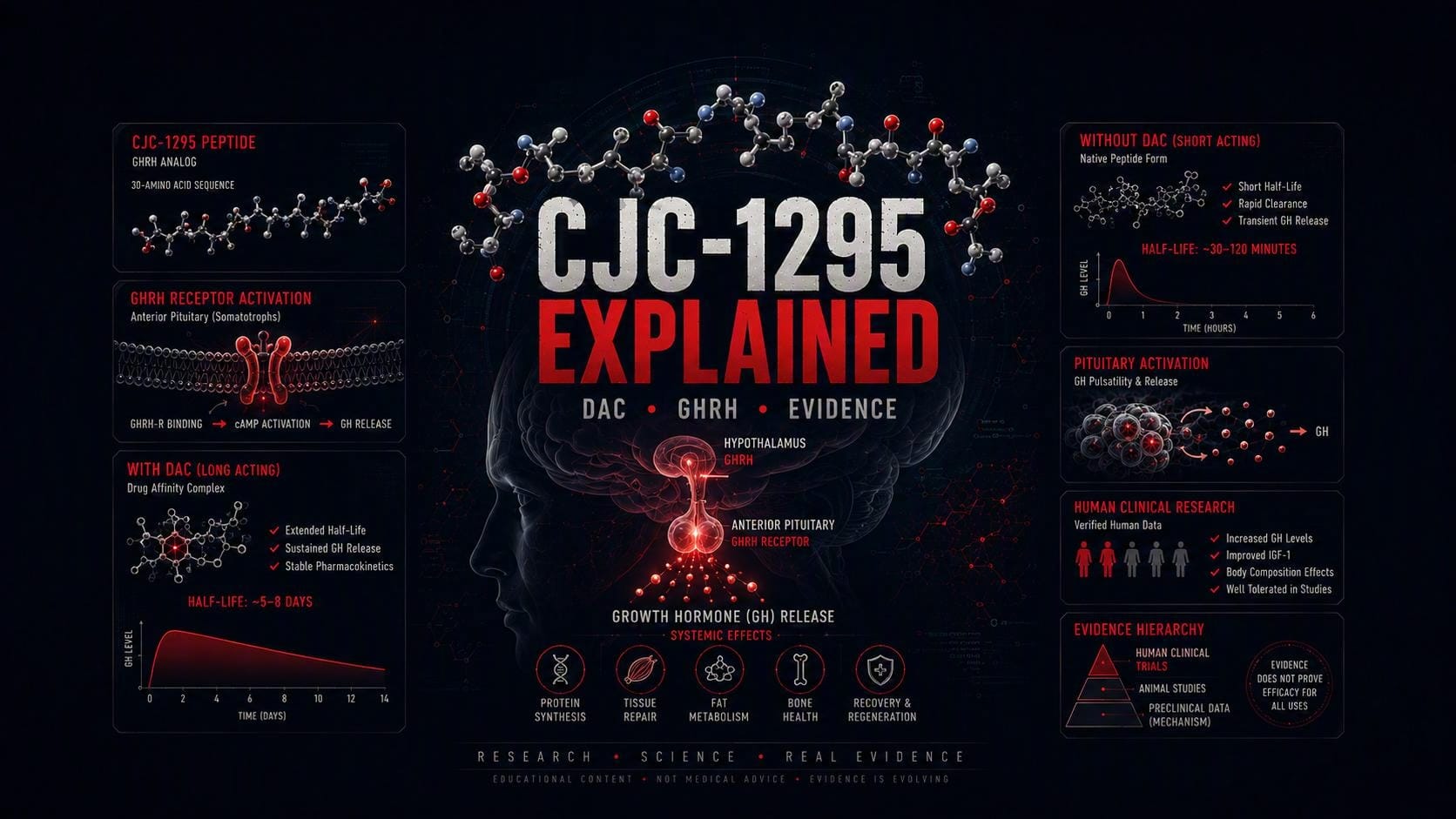
CJC-1295 EXPLAINED: MECHANISM, DAC VS NO-DAC, AND HUMAN TRIAL EVIDENCE
CJC-1295 is a lab made copy of the hormone that tells your pituitary to release growth hormone. It was built in 2005 to stick to a blood protein called albumin, so one injection keeps working for days instead of minutes (PMID 15817669). In healthy adults, one shot raised growth hormone 2 to 10 times for six days or more, and IGF-1 1.5 to 3 times for 9 to 11 days (PMID 16352683). That is the whole human record. It is twenty years old, and it comes from two small trials.
This page explains it the way a coach would: plain words, every number from a PubMed abstract or a regulator page. You will learn what the DAC version is and why the no DAC version is a different drug, what the CJC-1295 ipamorelin stack has and has not been tested in, how it compares with sermorelin and tesamorelin, what people report in the gym, and the CJC-1295 side effects on record. Syringe arithmetic for your own vial is on the peptide calculator.
CJC-1295 in brief
Three numbers tell most of the story. How long one shot lasts, what it did to the overnight hormone rhythm, and how many human trials the popular stack has.
How long CJC-1295 with DAC keeps working after one injection under the skin
Two placebo controlled trials in healthy adults aged 21 to 61 ran for 28 and 49 days. One shot raised growth hormone 2 to 10 times for six days or more. IGF-1 rose 1.5 to 3 times for 9 to 11 days. After repeat doses, IGF-1 stayed up for as long as 28 days (PMID 16352683).
How much the lowest points of the overnight growth hormone rhythm rose one week after a single dose
Healthy men had blood drawn every 20 minutes through the night, before and one week after 60 or 90 micrograms per kilogram. The number and size of hormone pulses did not change. The gaps between pulses rose 7.5 times, average growth hormone rose 46 percent and IGF-1 rose 45 percent (PMID 17018654).
Published human studies of CJC-1295 combined with ipamorelin, the product most people actually buy
A 2026 review for sports doctors found the combination has only been tested in mice with steroid induced muscle loss. Human dose, frequency and duration are unknown (PMID 41476424). Ipamorelin on its own failed its only phase 2 trial in people (PMID 25331030).
Every figure on this page about CJC-1295 comes from a PubMed abstract or a regulator document listed at the end. Doses appear only where a trial abstract states them. What gym users do with the CJC-1295 ipamorelin stack is reported as vendor guides and forum posts, never as a recommendation.
What this CJC-1295 guide covers
What CJC-1295 is: the GHRH 1-29 backbone, the albumin hook called DAC, and why the no DAC product sold today is a different drug.
The two human trials, with every number their abstracts give, and the one biomarker follow up that closed the human record in 2009.
CJC-1295 ipamorelin: what ipamorelin is, what its own trials showed, and what the blend has and has not been tested in.
CJC-1295 vs sermorelin, tesamorelin and MK-677, what users report in the gym, and the CJC-1295 side effects with the FDA and anti doping record.
Not covered
A dose, schedule or cycle for you. No regulator has approved either peptide and no human trial has tested the blend. This page gives no protocol.
Growth hormone deficiency as a disease. That belongs to endocrinology. The trials here were in healthy volunteers.
The rest of the peptide field. That sits on what are peptides and the peptides hub.
What is CJC-1295? One backbone, two products
Your brain makes a signal called growth hormone releasing hormone, or GHRH. It tells the pituitary gland to release growth hormone. The first 29 building blocks of that signal carry all of its activity. That fragment, GHRH 1-29, has been sold for decades as sermorelin. Its problem is speed. Enzymes in the blood cut it apart within minutes (PMID 15817669).
CJC-1295 was a Montreal company's fix for that problem. Four of the 29 building blocks were swapped so enzymes could not cut them. A chemical hook called a maleimide group was added at one end. Once injected, that hook bonds to albumin, the most common protein in your blood, and rides along with it for days (PMID 15817669). The letters DAC stand for Drug Affinity Complex. That is the hook.
The rat work that picked the molecule shows what the design bought. Against plain GHRH 1-29, CJC-1295 gave a four times larger growth hormone response over two hours. It was still in the blood after 72 hours, and it was attached to albumin within 15 minutes of injection (PMID 15817669).
That last point is the most important thing on this page. Vendors sell a product called CJC-1295 no DAC, also known as modified GRF 1-29. It is the same 29 building block peptide with the four swaps, but without the albumin hook. It clears from the blood in under an hour. The human trials never used it. They used the DAC form.
A 2026 endocrinology review lists CJC-1295 with DAC and CJC-1295 without DAC as two separate drugs in the GHRH class, next to sermorelin and tesamorelin (PMID 42395176). When a Norwegian lab analysed a seized vial in 2009, it found a 29 building block peptide matching what was being sold as CJC-1295. The lab noted it is banned by WADA and used in the bodybuilding community (PMID 21204297). Where these molecules sit in the wider family is on types of peptides.
What has been measured on CJC-1295, and in whom
The human record is small enough to list in full. Two clinical papers from 2006 and one blood protein follow up. Then the animal papers that created the molecule, and the human trials of ipamorelin on its own. Then the doping and regulatory papers that grew up around the black market. The table sorts them by what each one can support.
| What was found | Who or what | Type of evidence |
|---|---|---|
| One CJC-1295 shot: growth hormone up 2 to 10 times for 6 days or more, IGF-1 up 1.5 to 3 times for 9 to 11 days, half-life 5.8 to 8.1 days, no serious adverse reactions, best tolerated at 30 or 60 µg/kg (PMID 16352683) | Healthy adults 21 to 61, two trials of 28 and 49 days | Randomised, placebo controlled, phase 1 |
| One week after 60 or 90 µg/kg: pulse number and size unchanged, trough GH up 7.5 times, average GH up 46 percent, IGF-1 up 45 percent, no difference between doses (PMID 17018654) | Healthy men 20 to 40, overnight sampling | Pharmacodynamics |
| Blood protein changes one week after a dose in 11 young men: possible markers of growth hormone action (PMID 19386527) | 11 healthy men | Biomarker study |
| Rats: 4 times larger GH response than GHRH 1-29, in plasma beyond 72 hours, bound to albumin within 15 minutes (PMID 15817669) | Rat | Animal, discovery |
| Mice lacking GHRH: once daily CJC-1295 for 5 weeks restored normal body weight and length; every 48 or 72 hours worked less well (PMID 16822960) | Mouse | Animal |
| Ipamorelin infusions: half-life 2 hours, one GH pulse peaking at 40 minutes then fading at every dose (PMID 10496658) | Healthy men, 8 per dose | Pharmacokinetics |
| Ipamorelin 0.03 mg/kg into a vein twice a day after bowel surgery: no better than placebo, 25.3 vs 32.6 hours to first meal, p = 0.15 (PMID 25331030) | 114 surgical patients | Randomised phase 2, negative |
| CJC-1295 plus ipamorelin: stronger muscle contraction in mice with steroid induced muscle loss; human dose, frequency and duration unknown (PMID 41476424) | Mouse, in a 2026 review | Animal only |
| Growth hormone peptides including CJC-1295 and ipamorelin remain experimental, with uncertain safety, product quality concerns and anti doping bans (PMID 42160466) | Review of 2020 to 2025 papers | Review |
| Class side effects reported in self use: raised prolactin and cortisol, appetite change, blood sugar problems, water retention, muscle and joint pain, injection site reactions (PMID 42395176) | Narrative review | Review |
| Tesamorelin 2 mg daily for 26 weeks: belly fat down 15.2 percent vs up 5.0 percent on placebo, IGF-1 up 81 percent, blood sugar unchanged (PMID 18057338) | 412 patients with HIV lipodystrophy | Randomised phase 3, approved drug |
| GHRH 1-29 analog 10 µg/kg nightly for 16 weeks: 12 hour GH output up 107 percent in men and 70 percent in women, IGF-1 up 28 percent (PMID 9360512) | 19 healthy elderly people | Randomised, single blind |
| Seized vial identified as CJC-1295, a WADA banned growth hormone releasing factor sold before trials finished (PMID 21204297) | Forensic analysis, Norway | Anti doping |
| Black market vials held altered versions of ipamorelin, GHRP-2 and GHRP-6 instead of the named peptides (PMID 29864719) | Seized products | Product quality |
| CJC-1295 found in horse plasma at 180 picograms per millilitre; the DAC form raises GH for more than six days in humans (PMID 30938069) | Racehorse doping control | Detection method |
| CJC-1295 and ipamorelin placed in Category 2 of the FDA 503A list in September 2023: significant safety risks, not allowed for compounding | United States | Regulator |
| CJC-1295 in athletes or anyone using it for muscle, fat loss or sleep; any human study of the no DAC form; any human study of the ipamorelin blend | No study exists | Not measured |
Read the middle column first. The two human rows for CJC-1295 are healthy volunteers given the DAC form once or a few times. The ipamorelin human row is a failed surgery trial. The tesamorelin and GHRH 1-29 rows belong to other drugs. Nothing in this table measured a lifter, a fat loss result, or the blend.
The two CJC-1295 human trials, in plain words
The safety study was published in 2006 in the Journal of Clinical Endocrinology and Metabolism. It was two randomised, placebo controlled, double blind trials at two sites, lasting 28 and 49 days, in healthy people aged 21 to 61 (PMID 16352683). In the first trial, people got one of four rising single doses. In the second, they got two or three doses a week or every two weeks.
After one shot, average growth hormone rose 2 to 10 times for six days or more. Average IGF-1 rose 1.5 to 3 times for 9 to 11 days. Both effects grew with the dose. The half-life was 5.8 to 8.1 days. After several doses, IGF-1 stayed above normal for up to 28 days, and the drug built up in the body (PMID 16352683).
The safety line is the one most often quoted, and least often quoted in full. No serious adverse reactions were reported. The drug was safe and relatively well tolerated, particularly at 30 or 60 micrograms per kilogram (PMID 16352683). That word, particularly, means the higher doses were tolerated less well. No phase 2 or phase 3 trial ever followed. The company was aiming at belly fat in HIV patients, and the programme stopped.
The second paper answered a biology question. Growth hormone comes out in pulses, and the pulses are thought to matter. A drug that pushes all the time might flatten the rhythm. Healthy men aged 20 to 40 gave blood every 20 minutes across a 12 hour night. They did it once before, and once a week after, a single dose of 60 or 90 micrograms per kilogram (PMID 17018654).
The pulses survived. Their number and size did not change. What changed was the floor. The low points between pulses rose 7.5 times, average growth hormone rose 46 percent, and IGF-1 rose 45 percent. The two doses gave the same result. The IGF-1 rise tracked the higher floor, not the pulses (PMID 17018654).
A 2009 follow up in 11 of those men looked for blood proteins that track growth hormone action. The idea was a better doping test, because IGF-1 varies too much between people. One week after CJC-1295, some proteins fell and others rose, and one of them tracked IGF-1 closely (PMID 19386527). That paper closed the human record. Two dosing studies and one biomarker paper, all in healthy volunteers, all with the DAC form, all done by 2009.
CJC-1295 ipamorelin: what the stack is and what has been tested
The CJC-1295 ipamorelin combination pairs two different signals. CJC-1295 acts on the GHRH receptor, which tells the pituitary to make and release growth hormone. Ipamorelin is a five building block peptide that acts on the ghrelin receptor, which boosts the release. Stacking the two makes sense on paper, and that paper logic is why they are sold together. What has actually been tested is much thinner.
Ipamorelin's human data comes from a 1999 study. Five infusion rates were given over 15 minutes to eight healthy men each. The half-life was 2 hours. Each dose produced one growth hormone pulse that peaked at 40 minutes and then faded to nothing (PMID 10496658).
Its only efficacy trial in people had nothing to do with muscle. In a phase 2 study of 114 patients after bowel surgery, 0.03 mg/kg into a vein twice a day for up to seven days was well tolerated. But it did not shorten the time to a first meal, 25.3 hours against 32.6 on placebo, p = 0.15. No efficacy measure differed (PMID 25331030). Side effects happened in 87.5 percent on ipamorelin and 94.8 percent on placebo, which says more about bowel surgery than the peptide (PMID 25331030).
The combination itself has one line of evidence, and it is in mice. A 2026 primer for sports medicine doctors reviewed the popular injectable peptides. It found that CJC-1295 with ipamorelin improved muscle contraction strength in mice with steroid induced muscle loss. It also found that the results are limited to animals, and that human dose, frequency and duration remain unknown (PMID 41476424).
A structured review of the 2020 to 2025 literature landed in the same place. Growth hormone peptides such as CJC-1295, ipamorelin and tesamorelin remain experimental, with uncertain safety, product quality concerns and wide anti doping bans (PMID 42160466). The other half of the stack has its own page: ipamorelin explained.
One practical point follows from all this. The trials used CJC-1295 with DAC. The blend vials sold with ipamorelin use the no DAC form. So the CJC-1295 ipamorelin product shares nothing with the CJC-1295 trial data. Different molecule on the CJC side, untested combination, and a partner peptide whose only human efficacy trial failed. The syringe arithmetic for a two peptide vial is on the peptide calculator. The arithmetic is the only part of the stack with a right answer.
CJC-1295 vs sermorelin, tesamorelin and MK-677
Four names share the search results. The differences are half-life, evidence and legal status, not mechanism. Three are GHRH analogs acting on the same receptor. The fourth is a pill that acts on the ghrelin receptor.
| Compound | What was measured | Status |
|---|---|---|
| Sermorelin (GHRH 1-29) | The plain fragment, cleared in minutes. An analog at 10 µg/kg nightly for 16 weeks raised 12 hour GH output 107 percent in elderly men and 70 percent in women, and IGF-1 28 percent (PMID 9360512). In children with GH deficiency it raised growth speed, but less than GH itself (PMID 8329826) | Formerly approved, withdrawn from the US market for business reasons |
| CJC-1295 with DAC | Albumin bound analog, half-life 5.8 to 8.1 days. GH up 2 to 10 times for 6 days, IGF-1 up 1.5 to 3 times for 9 to 11 days after one shot (PMID 16352683). Trough GH up 7.5 times, pulses kept (PMID 17018654) | Phase 1 only, development stopped, FDA Category 2 |
| CJC-1295 no DAC | The same swapped peptide without the albumin hook. Listed as a separate drug in the 2026 class review (PMID 42395176). No human study of any kind | Not tested in humans |
| Tesamorelin (Egrifta) | Stabilised full length GHRH. 2 mg daily for 26 weeks in 412 patients cut deep belly fat 15.2 percent against a 5.0 percent rise on placebo, raised IGF-1 81 percent, improved triglycerides, blood sugar unchanged (PMID 18057338) | FDA approved for HIV lipodystrophy |
| PEG-GHRH | GHRH attached to polyethylene glycol. Single doses of 0.25 to 4 mg raised GH for 12 hours in young men. Repeat doses in the elderly raised GH and IGF-1 and slightly worsened glucose tolerance (PMID 16061831) | Phase 1, never marketed |
| Ipamorelin | Ghrelin receptor agonist, half-life 2 hours, one GH pulse (PMID 10496658). Failed phase 2 trial after bowel surgery (PMID 25331030) | Phase 2, development stopped, FDA Category 2 |
| MK-677 (ibutamoren) | Oral ghrelin mimetic, not a GHRH analog. Not part of this page's evidence | See its own profile |
Sermorelin vs CJC-1295. Same 29 building blocks, with four of them changed for durability. Sermorelin is taken daily or nightly because it clears in minutes. CJC-1295 with DAC was designed for weekly or two weekly shots because it rides on albumin (PMID 15817669, PMID 16352683). The elderly volunteer data shows what a nightly short acting analog does over four months. GH output rose 70 to 107 percent and IGF-1 rose 28 percent (PMID 9360512). The CJC-1295 data shows what one long acting dose does over a week: IGF-1 up 45 percent (PMID 17018654). Nobody has compared the two head to head.
Tesamorelin vs CJC-1295. Tesamorelin is the drug CJC-1295 was meant to become. Both were developed for belly fat in HIV patients. Tesamorelin finished its phase 3 programme and was approved. CJC-1295 stopped after phase 1. The tesamorelin abstract records that side effects matched placebo, but more people on the drug quit because of one (PMID 18057338). A CJC-1295 abstract never got far enough to contain a sentence like that.
CJC-1295 in the gym: what users report, and what is measured
The trials cannot write this section, so it reports two things separately. First, how users and the vendors who sell to them describe the CJC-1295 ipamorelin stack. Second, the measured data that any of it could rest on. Nothing in the first part is evidence. It is a description of a habit, and a habit people describe is not a dose anyone should copy.
What users describe. The product in forum logs and vendor listings is a blend vial of CJC-1295 no DAC with ipamorelin. It is usually sold as 5 mg of each or 10 mg of each per vial. Users mix it with bacteriostatic water and draw it on an insulin syringe (vendor guides, forum posts).
The dose users most often describe is 100 micrograms of each peptide per shot, which they call a saturation dose. They inject it under the skin of the belly one to three times a day, before bed and on waking, sometimes before training. They insist on an empty stomach, because they believe food blunts the growth hormone pulse (forum posts). Runs are described in blocks of eight to twelve weeks, sometimes five days on and two off, with breaks between (forum posts, vendor guides). The DAC form, when used at all, is described as a once or twice weekly shot (vendor guides).
The reasons users give are consistent: fat loss during a diet, deeper sleep, better recovery, and a fuller look they put down to water and IGF-1. Most describe running it alongside testosterone, not instead of it (forum posts). The complaints are just as consistent. One user who ran the stack for a year called the result minimal, with more weight lost from the wallet than the body. Flushing after a shot is described as normal and very common, and one post reports a raised heart rate (forum posts).
Where the reasons come from. The fat loss idea is borrowed from tesamorelin, where 2 mg daily for 26 weeks cut deep belly fat 15.2 percent in HIV patients (PMID 18057338). That is a different drug, a different group of people, and a daily dose watched in a phase 3 trial. The sleep and recovery ideas rest on growth hormone biology and on the 7.5 times rise in overnight trough GH (PMID 17018654). That is a hormone number, not a sleep or recovery result. The empty stomach rule has a basis in how insulin affects growth hormone release. No trial has tested whether it changes anything on this stack.
What is measured that a lifter could use. Two things. First, IGF-1 goes up and stays up. It rose 1.5 to 3 times for 9 to 11 days after one DAC shot, and it builds with repeat doses (PMID 16352683). Anyone who runs this peptide and then gets blood work should expect a high IGF-1. What that number normally means is on blood tests before steroids. Second, the class has recorded metabolic effects. Blood sugar problems, raised prolactin and cortisol, water retention and joint pain are reported in self use (PMID 42395176). Elderly people on repeat PEG-GHRH had worse glucose tolerance (PMID 16061831).
CJC-1295 side effects, by the evidence
CJC-1295 side effects come from three places: the hormone system it drives, the product in the vial, and the rules around it. The molecule itself caused no serious adverse reactions in the two phase 1 trials. The only tolerability detail is that it was relatively well tolerated, particularly at 30 or 60 micrograms per kilogram (PMID 16352683). Everything beyond that is class data, product data and regulator data.
| Effect | Strongest evidence | Read it as |
|---|---|---|
| Tolerability in the trials | No serious adverse reactions in healthy adults. Safe and relatively well tolerated, particularly at 30 or 60 µg/kg (PMID 16352683) | Phase 1, DAC form |
| Long lasting IGF-1 rise | 1.5 to 3 times for 9 to 11 days after one dose, above normal for up to 28 days after repeat doses, with build up (PMID 16352683) | The intended effect, and the one to watch |
| Loss of the growth hormone floor | Trough GH up 7.5 times, pulses kept (PMID 17018654) | Constant stimulation |
| Blood sugar and insulin | Blood sugar problems listed as a class side effect (PMID 42395176). Worse glucose tolerance in elderly people on repeat PEG-GHRH (PMID 16061831). No change on tesamorelin (PMID 18057338) | Class signal, not measured on CJC-1295 |
| Prolactin, cortisol, appetite, water retention, joint and muscle pain, injection site reactions | Reported side effects of GH peptides in self use (PMID 42395176). More injection site reactions than placebo with PEG-GHRH (PMID 16061831) | Class review |
| Cell growth concern | Plausible but unproven, per the 2026 review (PMID 42395176). More pituitary cells in GHRH deficient mice on daily dosing (PMID 16822960) | Mechanism and animal |
| Compounding status | CJC-1295 and ipamorelin placed in Category 2 of the FDA 503A list in September 2023 for significant safety risks, immune reactions, impurities and little human data. Not allowed for compounding | FDA |
| What is in the vial | A seized vial was CJC-1295 by mass spectrometry (PMID 21204297). Other black market GH peptide products held altered versions of ipamorelin, GHRP-2 and GHRP-6 instead of the named peptides (PMID 29864719) | Product identity |
| Anti doping | Banned under WADA section S2 as a GH releasing factor (PMID 21204297). Detectable in plasma by mass spectrometry (PMID 30938069) | Tested athletes |
| Long term use in humans | No study beyond 49 days (PMID 16352683) | Not measured |
The honest summary is this. The peptide behaved well in 49 days of supervised dosing twenty years ago. Everything known about longer use comes from the class, not the compound. Two concrete risks are on record. One is what a long lasting IGF-1 rise does over years, which nobody has measured for this drug. The other is what is really in a vial bought online, which two labs have measured and found unreliable. The general page on peptide side effects covers the injection site and sterility problems shared by every mixed peptide.
Five mistakes people make about CJC-1295
1. Quoting the 2006 trials for the no DAC product
Both human studies used CJC-1295 with the albumin hook, with half-lives of 5.8 to 8.1 days (PMID 16352683). The no DAC peptide in the blend vial is a different drug (PMID 42395176) with no human study.
2. Calling the CJC-1295 ipamorelin stack clinically proven
The combination has been measured in mice with steroid induced muscle loss and nowhere else. Human dose, frequency and duration are unknown (PMID 41476424). Ipamorelin alone failed its phase 2 trial (PMID 25331030).
3. Treating it as a gentle version of growth hormone
It is not gentle at the floor. Trough growth hormone rose 7.5 times, and IGF-1 stayed high for 9 to 11 days after one dose, longer with repeat doses (PMID 17018654, PMID 16352683). The class carries recorded blood sugar, water retention and hormone problems (PMID 42395176).
4. Trusting the label on the vial
Labs testing black market GH peptides found altered versions in place of the named compounds (PMID 29864719). The FDA cited impurities and immune reactions when it barred compounding of both peptides in 2023.
5. Confusing it with tesamorelin
Tesamorelin is the approved GHRH analog with a 412 patient phase 3 trial and a label (PMID 18057338). CJC-1295 was built for the same condition and stopped after phase 1. The fat loss numbers people quote belong to the other drug.
Verdict: a clever molecule with a twenty year old phase 1 record, sold as something else
Judged by the abstracts rather than the vendor pages, CJC-1295 is a clever piece of engineering. It is a GHRH fragment that bonds to your own albumin within minutes (PMID 15817669). One shot raises growth hormone for six days and IGF-1 for nine to eleven (PMID 16352683). It does that without flattening the pulses, by lifting the gaps between them 7.5 times (PMID 17018654). It was safe for 49 days in healthy adults, and then its development stopped. Nothing has been measured in humans since 2009.
For readers here, the practical conclusion is simple. The CJC-1295 ipamorelin blend has no human data. The CJC-1295 side effects worth taking seriously come in two kinds. The ones a long lasting IGF-1 rise might carry over years, which nobody has measured. And the ones a mislabelled vial carries today, which two labs and the FDA have. The approved drug in this class is tesamorelin, covered with the rest of the growth hormone peptides. The other half of the stack is on ipamorelin. The syringe arithmetic for any vial is on the peptide calculator.
CJC-1295: frequently asked questions
What does CJC-1295 do?
It copies the hormone that tells your pituitary to release growth hormone. In the DAC form it bonds to albumin in the blood, so the signal lasts for days. In healthy adults, one shot raised growth hormone 2 to 10 times for six days or more. IGF-1 rose 1.5 to 3 times for 9 to 11 days. The half-life was 5.8 to 8.1 days (PMID 16352683). One week after a dose, the gaps between growth hormone pulses were 7.5 times higher and IGF-1 was up 45 percent (PMID 17018654).
What is the difference between CJC-1295 with DAC and no DAC?
DAC stands for Drug Affinity Complex. It is a chemical hook that bonds the peptide to albumin in your blood and stretches its half-life from minutes to days (PMID 15817669). The no DAC product, also sold as modified GRF 1-29, is the same peptide without that hook, and it clears fast. The 2026 class review lists them as separate drugs (PMID 42395176). Both human trials used the DAC form (PMID 16352683, PMID 17018654). The no DAC form has no human study.
Is CJC-1295 ipamorelin proven to work?
No. The combination has one piece of evidence: stronger muscle contraction in mice with steroid induced muscle loss. A 2026 review for sports doctors says human dose, frequency and duration remain unknown (PMID 41476424). Ipamorelin alone has a 2 hour half-life and gives one growth hormone pulse per dose (PMID 10496658). It did not beat placebo in its phase 2 trial (PMID 25331030).
What CJC-1295 dosage was used in the studies?
The safety trials gave healthy adults four rising single doses under the skin, then two or three doses a week or every two weeks. Tolerability was best at 30 or 60 micrograms per kilogram (PMID 16352683). The overnight study used one dose of 60 or 90 micrograms per kilogram, with no difference between them (PMID 17018654). Those are trial doses of the DAC form in volunteers, not a dose for any use. No trial has dosed the no DAC form or the ipamorelin blend. The 100 microgram figures online are vendor guides and forum posts.
What are the side effects of CJC-1295?
In the two phase 1 trials there were no serious adverse reactions. The drug was relatively well tolerated, particularly at 30 or 60 micrograms per kilogram (PMID 16352683). Beyond 49 days nothing has been measured. Class reviews list blood sugar problems, raised prolactin and cortisol, appetite change, water retention, joint and muscle pain and injection site reactions (PMID 42395176). A related long acting GHRH worsened glucose tolerance in elderly people (PMID 16061831). The FDA barred compounding of CJC-1295 and ipamorelin in 2023, citing safety risks, immune reactions and impurities.
Is CJC-1295 legal and FDA approved?
It is not FDA approved for anything. In September 2023 the FDA placed CJC-1295 and ipamorelin in Category 2 of the 503A bulk drug substances list, which effectively stops pharmacies from compounding them. Neither was among the peptides the advisory committee reviewed in July 2026. It is banned in sport under WADA section S2 as a growth hormone releasing factor (PMID 21204297). It can be detected in plasma by mass spectrometry (PMID 30938069).
CJC-1295 or sermorelin: what is the difference?
Sermorelin is the plain GHRH 1-29 fragment. It clears in minutes and is taken daily or nightly. A GHRH 1-29 analog at 10 micrograms per kilogram nightly for 16 weeks raised IGF-1 28 percent in healthy elderly people (PMID 9360512). CJC-1295 is the same fragment with four changes and an albumin hook. One dose raised IGF-1 45 percent at one week, and the effect lasted 9 to 11 days (PMID 17018654, PMID 16352683). No trial compares the two head to head.
How do bodybuilders use CJC-1295 and ipamorelin?
Forum logs and vendor guides describe a blend vial of CJC-1295 no DAC and ipamorelin, usually 5 mg or 10 mg of each. Users mix it with bacteriostatic water and inject 100 micrograms of each peptide one to three times a day. They do it before bed and on waking, on an empty stomach, in blocks of eight to twelve weeks, often alongside testosterone (vendor guides, forum posts). That is a description of a habit, not evidence. No human study has tested the blend, the no DAC form, or CJC-1295 in anyone training. The same threads report minimal results and flushing after shots.
Sources and further reading
Every figure on this page about CJC-1295 comes from one of the 18 sources below. Seventeen are papers checked against their PubMed abstracts on 24 October 2026, and one is the FDA compounding list. How users describe the stack is labelled as vendor guides and forum posts in the text and carries no reference number. Animal studies are cited as animal studies, never as human results. Reference links are dofollow to support open science.
Verified
Verified
Verified
Verified
Verified
Verified
Verified
Verified
Verified
Verified
Verified
Verified
Verified
Verified
Verified
Verified
Verified
Regulator
Keep reading
Four pages around CJC-1295: the other half of the stack, the class it belongs to, the syringe arithmetic for a blend vial, and how to read peptide research without overreaching.
Final Educational Note
This article is educational and is not medical advice. It reports what the two human trials, the animal studies, the class reviews and the FDA and anti doping record say about CJC-1295. It reports how some users describe the CJC-1295 ipamorelin stack as a description of a habit, not as guidance. Doses appear only as a trial abstract states them. The page gives no schedule, cycle or protocol, and does not recommend either peptide for any use. It is not an encouragement to use research chemicals or performance enhancing drugs, which carry serious health and legal risks. More guides sit on the peptides hub.
Some signs need a doctor at once. Lasting headache, changes in vision, swelling of the hands or feet, numbness or tingling, rising fasting blood sugar, or a reaction that spreads from an injection site. Read more about how this site works on the about page and in the full disclaimer.