Rusfertide: The Hepcidin Peptide, Explained
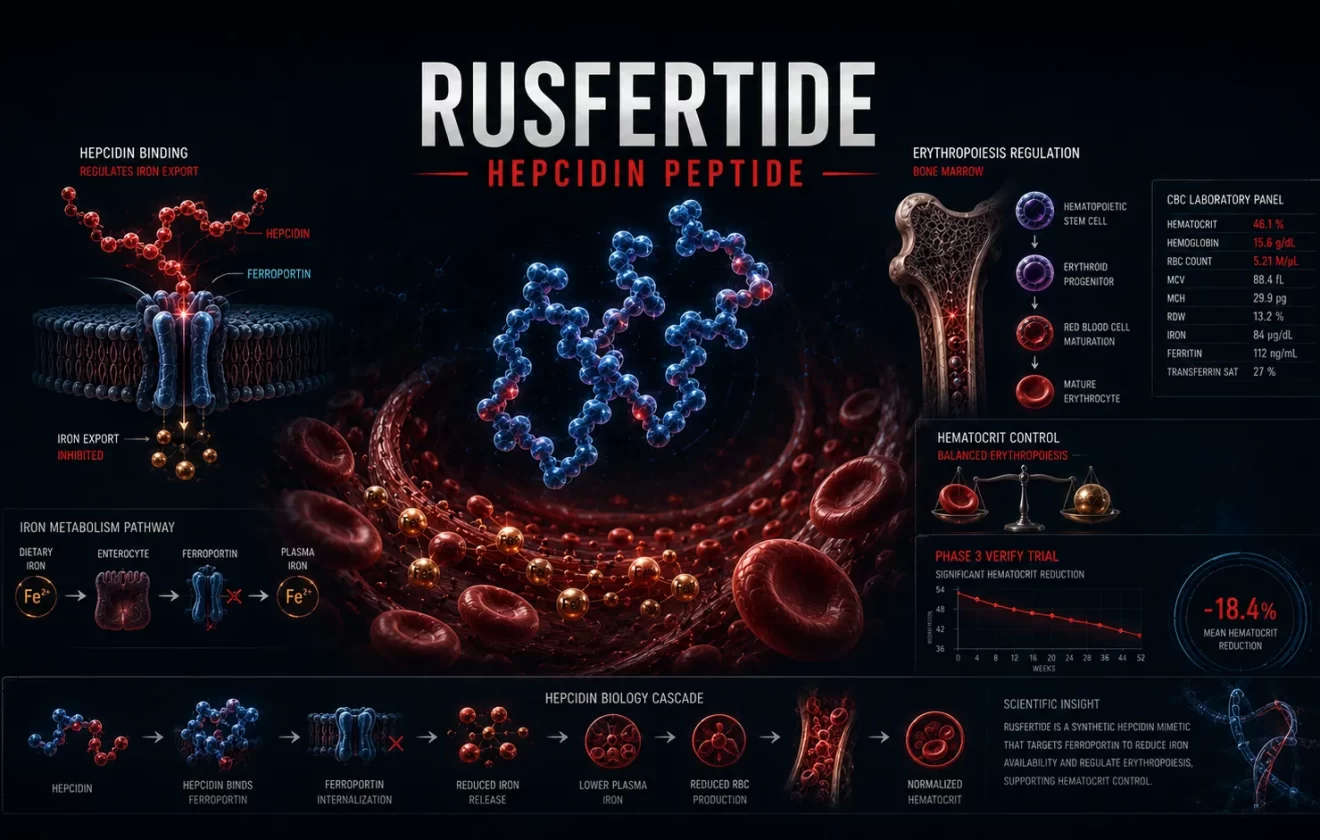
Rusfertide: the peptide that turns iron against your red blood cells
Rusfertide is a first-in-class hepcidin-mimetic peptide built to do one thing: quietly starve overactive bone marrow of the iron it needs to overproduce red blood cells. It is being developed for a blood cancer called polycythemia vera, but the machinery it hijacks is the exact same machinery that testosterone bends out of shape when your hematocrit creeps up on TRT or a cycle. Here is what it is, what the trials actually show, and the honest limits of the TRT connection.
Rusfertide in one screen
If you only read one section, read this one. Rusfertide (developer code PTG-300, also seen as TAK-121) is an injectable peptide that copies a natural hormone called hepcidin. Hepcidin is your body’s iron traffic controller. By mimicking it, rusfertide restricts how much iron reaches the bone marrow, and marrow that is short on iron simply cannot crank out red blood cells as fast. The result is a controlled, dialled-down hematocrit, without repeatedly draining blood.
A first-in-class, once-weekly subcutaneous hepcidin-mimetic peptide from Protagonist Therapeutics, partnered with Takeda. Not a steroid, not a growth-hormone peptide, it works on iron.
Polycythemia vera (PV), a bone-marrow cancer that overproduces red cells and thickens the blood. It is designed to replace or reduce the need for repeated therapeutic phlebotomy.
Investigational. The FDA accepted its application and granted Priority Review in March 2026, with a decision targeted for the third quarter of 2026. Not yet approved
Hepcidin is the gatekeeper standing between your iron and your blood
To understand rusfertide you have to understand hepcidin, and hepcidin is easier than it sounds. Your body stores iron in your gut lining and inside white-blood-cell “warehouses” called macrophages. To leave those cells and enter the bloodstream, iron has to pass through a doorway protein named ferroportin. Hepcidin is the hormone that closes that doorway.
When hepcidin is high, ferroportin doorways get pulled shut and destroyed. Iron gets locked in storage, blood iron drops, and the bone marrow, the factory that builds red cells, runs short on raw material. Fewer red cells get built. When hepcidin is low, the doorways stay wide open, iron floods the blood, and the marrow can build red cells at full tilt.
That is the whole lever rusfertide pulls. It is a synthetic stand-in for hepcidin, so injecting it is like turning the iron doorways down on purpose. Doctors call the end result functional iron restriction: there is still iron in the body, but the marrow can’t easily get at it, so red-cell output falls.

How hepcidin controls red-cell production. Rusfertide sits on the right-hand side: it acts like extra hepcidin, closing the iron doorways so the marrow runs short on raw material. Simplified schematic for explanation.
What rusfertide actually is
Rusfertide is a short, engineered peptide, a small chain of amino acids designed to be a stable, long-lasting copy of hepcidin. Natural hepcidin breaks down within hours, which makes it useless as a drug. Protagonist Therapeutics re-engineered the molecule so it survives long enough to be given as a once-weekly subcutaneous self-injection, similar in feel to how many people already inject testosterone or GLP-1 drugs at home.
It is genuinely first-in-class: no approved medicine before it works by mimicking hepcidin. Protagonist discovered and developed it through Phase 3, and in January 2024 signed a worldwide licence and collaboration with Takeda, which now leads the U.S. regulatory push. You will see it referred to by its research codes PTG-300 and TAK-121 in older papers.
One thing to be crystal clear about, because our audience will ask: rusfertide is not an anabolic, not a steroid, and not a growth-hormone secretagogue. It won’t build muscle, raise testosterone, or improve recovery. It does the opposite of what most performance peptides are marketed for, it exists to reduce a physiological output, not amplify one.
Polycythemia vera, and why it is not the same as high hematocrit on TRT
Polycythemia vera is a myeloproliferative neoplasm: a slow-growing blood cancer. Most cases are driven by a mutation in a gene called JAK2, which jams the marrow’s “make red cells” signal permanently in the on position. The marrow overproduces red cells no matter what the body actually needs, the blood thickens, and the risk of clots, stroke and heart attack climbs. The classic first-line management is therapeutic phlebotomy, literally removing blood on a schedule to keep hematocrit under about 45%, often alongside cytoreductive drugs.
This is where a careful distinction matters. The high hematocrit that shows up on a lifter’s or a TRT patient’s bloodwork is usually secondary erythrocytosis, the marrow is being pushed hard by an outside signal (testosterone), not by a cancerous mutation inside the marrow itself. Same number on the lab report, very different underlying cause. Rusfertide was designed and tested for the PV version. Everything below about the TRT connection is mechanism and reasoning, not an approved use.
Rusfertide is being developed for a blood cancer, not for testosterone-driven high hematocrit. It is not approved for anyone, and it has never been tested in TRT users or bodybuilders. Nothing here is a suggestion to seek it out. It is here so you understand the science, and the limits.
What the trials actually showed
The headline data come from VERIFY, a global Phase 3, randomized, double-blind, placebo-controlled trial of 293 PV patients, in which rusfertide was added on top of their existing standard care. The primary question was simple: what share of patients get their disease controlled, defined as no longer needing a phlebotomy, during weeks 20 to 32?

VERIFY Phase 3 topline results, presented at ASCO 2025 and ASH 2025. These figures are in polycythemia vera patients, not TRT users.
Rusfertide more than doubled the response rate and roughly cut phlebotomy needs to a fraction. It also met its key secondary endpoints: keeping hematocrit under 45%, and improving patient-reported fatigue and disease symptoms. Before VERIFY, a smaller Phase 2 study published in the New England Journal of Medicine in 2024 had already shown that adding rusfertide let patients hold hematocrit below 45% and slashed how often they needed blood drawn compared with the year before. In short: the mechanism works in humans, and the big confirmatory trial backed it up.
Is it safe? The cancer scare, and what happened next
Rusfertide’s safety history has one chapter worth telling honestly, because it is often quoted out of context. On 17 September 2021, the FDA placed a clinical hold on the program after a routine animal study, a 26-week test in a strain of mouse (rasH2) bred to be hypersensitive to cancer-causing agents, turned up benign and malignant tumors under the skin. That understandably paused everything.
The hold was lifted less than a month later, on 11 October 2021. Reviewing the human safety database, investigators found no matching signal, no wave of new cancers in the patients already treated, and trials resumed with tightened monitoring. Crucially, the large VERIFY trial that followed reported no evidence of an increased cancer risk in people. The mouse strain used is deliberately tumor-prone, and its results did not translate to humans.
Day to day, the side-effect profile in trials has been mild: the most common issue is grade 1-2 injection-site reactions, redness or irritation where the needle goes in. A dedicated cardiac-safety study (a “thorough QT” trial in healthy volunteers) looked specifically at whether it disturbs heart rhythm. None of this means rusfertide is risk-free, no drug is, and long-term data in a cancer are still accumulating, but the picture from the pivotal trials is reassuring rather than alarming.
Testosterone, hepcidin and hematocrit: the real connection
Here is why a polycythemia-vera drug ended up on a testosterone site. One of the best-documented reasons testosterone raises your hematocrit is that testosterone suppresses hepcidin. Landmark work from Bachman and colleagues showed that giving men testosterone drives hepcidin down, which throws the iron doorways open and feeds the marrow, a direct mechanism for testosterone-induced erythrocytosis. Follow-up work showed testosterone does it from both ends at once: it lowers hepcidin and raises erythropoietin (EPO, the “make red cells” hormone), effectively resetting your body to a new, higher red-cell set point.

Why testosterone pushes hematocrit up: it raises EPO and lowers hepcidin at the same time. Rusfertide targets only the hepcidin arm of this picture.
Line that up against what rusfertide does and the appeal is obvious. Testosterone drops your hepcidin; rusfertide is hepcidin. On paper it looks like the perfect counter-punch to the exact mechanism causing your rising hematocrit. That is a real, mechanistically sound observation, and it is why researchers in the iron field have openly speculated about hepcidin-based drugs for testosterone-driven erythrocytosis.
But there is a large, honest asterisk. Testosterone does not raise red cells through hepcidin alone. When Bhasin’s group tested it directly, they found hepcidin is not essential for testosterone’s effect on red-cell production, testosterone still drove erythropoiesis through other routes, including that direct EPO push. In plain terms: rusfertide would be attacking one of several levers testosterone is pulling, while the others keep pulling. It could blunt the problem; it is far from guaranteed to switch it off.
Why the dose changes everything: the “thinner thread” idea
This is the part that separates a TRT patient from a bodybuilder on a blast, and it is the most important thing to understand. The harder testosterone drives the marrow, the more precarious any iron-based control becomes, and the less predictable a hepcidin mimetic would be.
Think of it as a thread holding back a weight. At a physiologic level, a well-managed TRT dose, the extra push on the marrow is modest and reasonably close to the range your iron system evolved to police. The thread is thick; iron restriction has a fighting chance of holding the line. Now scale up to supraphysiologic bodybuilding doses. The EPO drive is enormous, the hepcidin suppression is deeper, and testosterone is also working through those non-hepcidin routes. The push on the marrow is huge, the thread controlling it is stretched thin, and whether adding a hepcidin mimetic would meaningfully hold, or how the body would respond, is genuinely unknown territory.

A concept, not a clinical result: the red curve is how hard testosterone drives red-cell production as the dose climbs; the dashed line is the shrinking margin in which a hepcidin-based lever could plausibly keep control. The gap widens at high doses, which is exactly where there is no human data.
For a bodybuilder on high doses, how rusfertide would behave is essentially a black box, nobody has studied it, and the marrow is being driven far harder than any trial population. For a TRT patient the perturbation is smaller and closer to normal physiology, but it is still unstudied and unapproved. “Mechanistically plausible” is not the same as “shown to work and safe.”
What this means if your hematocrit is climbing right now
If you are reading this because your last blood panel showed a hematocrit creeping toward 52-54%, the practical answer is straightforward: rusfertide is not an option you can act on. It is investigational, approved for no one, priced for a rare cancer, and never tested in your situation. Chasing a “research” version of a complex engineered peptide from a grey-market vial would be a genuinely bad idea, you would have no idea of the dose, purity, or what it is doing to your iron.
The good news is that the levers that actually work for testosterone-driven high hematocrit are well understood and boring. Injection dose and frequency matter enormously, smaller, more frequent doses tend to spike hematocrit less than large weekly slugs. Hydration and draw timing can swing the number several points on their own. And when genuine reduction is needed, therapeutic phlebotomy or blood donation under a doctor’s guidance remains the direct tool. We cover the full playbook in our guide to high hematocrit on TRT, and you can sanity-check where your own number sits with the hematocrit calculator.
Where rusfertide is genuinely interesting for our world is as a signpost. It is the first drug to prove, in a large trial, that you can control red-cell overproduction by working on iron alone, without a single phlebotomy. If it clears the FDA for polycythemia vera, it opens the door for researchers to eventually ask the question that matters to us: could a hepcidin-based approach help testosterone-induced erythrocytosis too? That study does not exist yet. When it does, this is the page we will update.
Rusfertide FAQ
Is rusfertide FDA approved?
Can I use rusfertide for high hematocrit caused by TRT?
Is rusfertide a steroid or an anabolic?
How is it taken?
Does it cause iron deficiency?
What about the cancer signal in mice?
How is it different from just donating blood?
Key takeaways
- Rusfertide is a first-in-class hepcidin-mimetic peptide that controls red-cell overproduction by restricting iron, not a steroid or a muscle-building peptide.
- It is designed for polycythemia vera (a blood cancer) and is investigational: FDA Priority Review granted in 2026, no approval yet.
- In the Phase 3 VERIFY trial it beat placebo decisively (77% vs 33% response) and cut phlebotomy needs, with mostly mild injection-site side effects.
- The TRT link is real but mechanistic: testosterone lowers hepcidin (and raises EPO) to push hematocrit up, and rusfertide is essentially replacement hepcidin.
- Testosterone also drives red cells through non-hepcidin routes, so a hepcidin mimetic attacks only part of the problem, and the harder the dose drives the marrow, the less predictable that would be.
- It is not available or tested for TRT or bodybuilding use. For high hematocrit now, use dose/frequency, hydration, and doctor-guided phlebotomy.
References
Primary literature and regulatory sources used for this article. Study links go to PubMed.
The takeaway
Rusfertide is a quietly important drug. It proves you can rein in runaway red-cell production by controlling iron alone, a clean, mechanism-first idea that worked in a serious trial. For polycythemia vera patients that is potentially life-changing. For the testosterone world, it is a fascinating signpost rather than a solution: the same hepcidin lever it pulls is the one testosterone bends, but the connection is mechanism and hypothesis, not an approved, tested therapy.
Keep it in the “watch this space” column. The science is real; the TRT application is not proven; and the higher the dose, the thinner the thread of certainty. Keep managing your bloodwork with the tools that are actually validated today.
This is education, not medical advice
Rusfertide is an investigational drug that is not approved by the FDA and is not available outside clinical trials. It has never been studied or approved for testosterone replacement therapy, steroid use, or bodybuilding, and nothing on this page should be read as a recommendation to obtain or use it for those purposes.
High hematocrit and other bloodwork changes on testosterone are real medical issues that should be managed with a qualified clinician. Do not start, stop, or change any medication or protocol based on this article.
Explore more evidence-based explainers in our peptides hub and TRT & hormones hub.