Peptide Research vs Human Use: Reading the Evidence Accurately
Reading the evidence without the hype
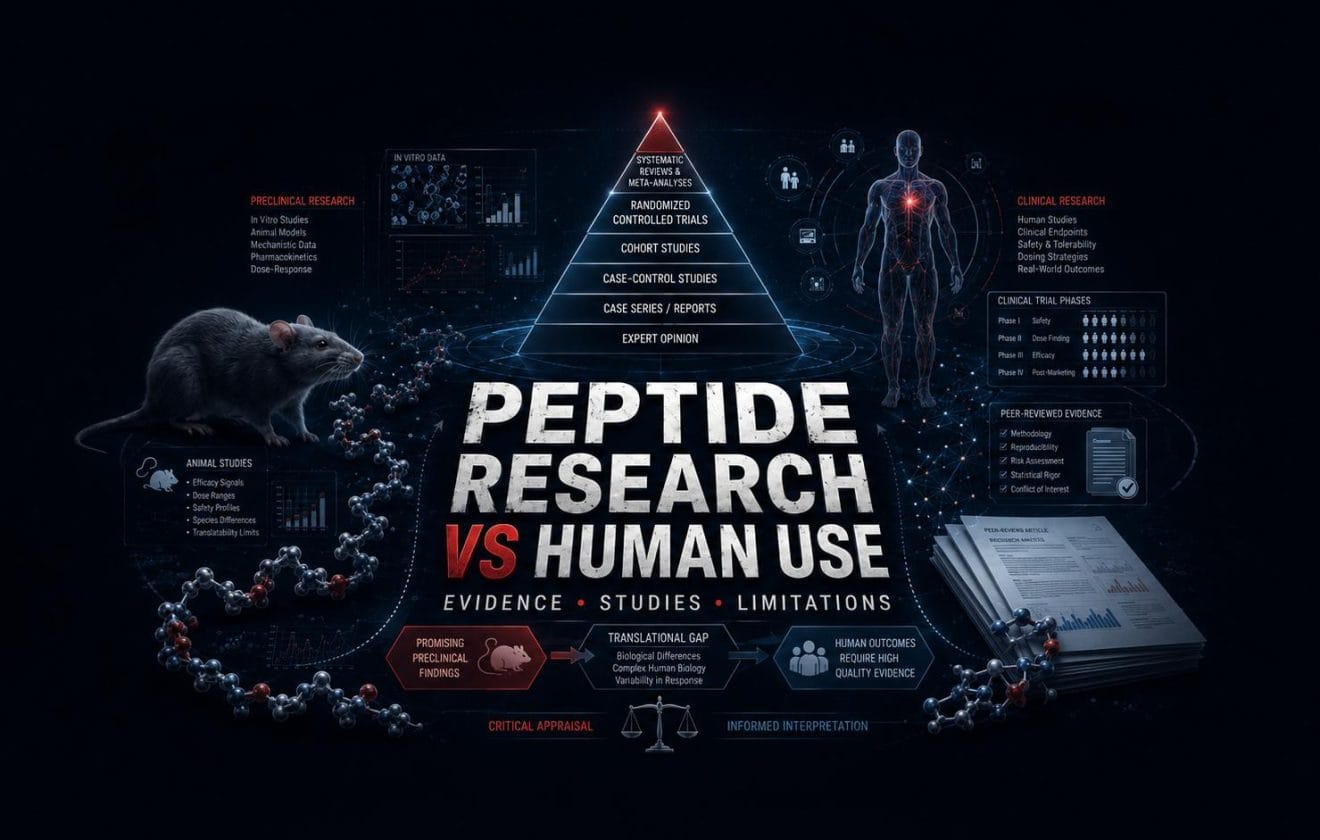
Peptide research is predominantly animal data. The vast majority of published studies on BPC-157, TB-500, and related healing compounds were conducted in rodent models under conditions that do not replicate human physiology, dosing, or administration routes. GH secretagogue peptide research includes human pharmacokinetic data, but those trials were designed to measure GH response - not long-term safety endpoints. Reading this evidence accurately requires identifying what type of study produced it, what it measured, and what it cannot tell you about human use.
For instance, the peptide rusfertide has completed the full clinical-trial process for polycythemia vera - the legitimate path most research peptides never finish.
Peptide Research: Three Things to Verify Before Reading Any Study
Before drawing conclusions from any published study on peptides, verify these three things about the source.
Species and Model
Most published peptide research uses rat or mouse models, often with surgically induced injuries or pharmacologically created disease states that do not occur naturally in humans. Compound doses per kilogram in rodent studies are typically far higher than what would be relevant in a human context, and rodent physiology differs meaningfully in GH pulsatility, metabolic rate, and tissue repair kinetics. Confirming whether a study used animals or humans is the first step before evaluating any result in the peptide research literature.
Endpoint Measured
Human peptide research for GH secretagogues was designed to measure pharmacokinetics - how much GH and IGF-1 was released, over what time course, and with what dose-response relationship. These trials were not designed to measure long-term outcomes, body composition changes, or adverse event profiles over months of use. The endpoint a study measured is the only thing it can validly support as a conclusion. Extrapolating from a 4-week PK study to long-term efficacy is not a valid use of that data.
Who Conducted It and Why
Context matters as much as methodology when evaluating peptide research. Academic pharmacology studies, pharmaceutical development trials, and independently produced animal experiments have different levels of rigor, conflict-of-interest risk, and regulatory oversight. The BPC-157 human data that exists comes almost entirely from one research group. GH secretagogue studies conducted during pharmaceutical development were subject to Good Clinical Practice protocols. Knowing who produced a study and under what framework is essential for evaluating its reliability.
What This Guide Covers
Covered in This Guide
- How evidence tiers work in peptide research and what each tier can claim
- Why animal studies do not translate directly to human outcomes
- What human clinical peptide research actually exists for GH secretagogues
- The actual scope of human evidence for BPC-157 and TB-500
- Why anecdotal community reports are not equivalent to controlled data
- How to identify the study design when reading any claim about peptides
- 5 mistakes when reading and citing peptide research
Not Covered Here
- Compound-specific side effect profiles - covered in the Peptide Side Effects guide
- Dosing or protocol guidance - this guide does not provide use recommendations
- Marketing claims from vendors - outside the scope of evidence review
- Approved pharmaceutical peptides (GLP-1 agonists, insulin) - different regulatory context
- Peptide synthesis and manufacturing - chemistry context, not evidence evaluation
Related guides. This article is part of the Peptides hub. For compound classification context relevant to reading peptide research, see Types of Peptides. For the healing compound evidence base, see Healing Peptides. For GH secretagogue mechanisms referenced in human studies, see Growth Hormone Peptides.
Five topics covering how to read, tier, and evaluate peptide research accurately.
Evidence Tiers in Peptide Research
Published peptide research falls into a hierarchy of evidence tiers that determines how much confidence any single study can support. The tier determines not whether a study is good or bad, but what kind of claim it can validly justify. A well-conducted rodent study of BPC-157 is valid evidence for its model - it tells you what happened in those conditions, at that dose, in that species. It does not tell you what will happen in a human at a different dose with different physiology. Misapplying conclusions beyond their evidence tier is the most common error when citing peptide research outside academic contexts.
The tiers relevant to evaluating peptide research run from in vitro cell culture at the lowest translation level, through animal models, to human pharmacokinetic studies, controlled clinical trials, and systematic reviews. Each step up the hierarchy adds translational validity but requires substantially more investment. This is why most peptide research for unapproved compounds stays at the preclinical level and does not reach controlled human trials. The regulatory and financial cost of human development is why compounds without a clear commercial path accumulate only animal data, regardless of how promising early signals appear.
- T1
In Vitro Cell Culture Studies
In vitro studies test a compound on isolated cells or tissues outside a living organism. They confirm whether a compound can interact with a target receptor or pathway under controlled laboratory conditions. This is the starting point for mechanistic understanding but has the lowest translational validity in the peptide research hierarchy - cells in culture do not replicate the metabolic environment, blood flow, immune context, or pharmacokinetic profile of a living organism. A positive in vitro result supports further investigation; it does not predict human efficacy or safety.
- T2
Rodent and Animal Model Studies
Animal models are the primary tier at which BPC-157, TB-500, and most unapproved compounds have been studied. These demonstrate biological activity - changes in wound healing rate, inflammatory markers, or motor recovery - under controlled conditions in a living organism. The translational limitation is significant: rodent GH pulsatility differs from human, metabolic rates differ by orders of magnitude, and surgically induced injury models do not replicate the chronic tissue damage seen in human populations. This is the evidence tier that defines the bulk of the healing peptide research base.
- T3
Human Pharmacokinetic Studies
Human PK studies measure what happens in the body after administration: absorption, distribution, metabolism, elimination, and which biomarkers respond over what time course. The human peptide research for GH secretagogues - covering ipamorelin, CJC-1295, and related compounds - is largely at this tier. These studies confirm that a compound produces its intended receptor response in humans at studied doses. They are not designed to measure long-term outcomes, safety over months of use, or clinical endpoints like body composition. PK data answers the pharmacology question, not the long-term efficacy or safety question.
- T4
Controlled Human Clinical Trials
Randomized, placebo-controlled trials with defined endpoints, pre-registered protocols, and independent monitoring represent the standard for establishing human efficacy and safety. For unapproved compounds, this tier of peptide research is almost entirely absent. The ipamorelin phase II trial (Beck et al., 2014) is a rare example - conducted in post-surgical patients for a specific clinical indication, not in healthy subjects for athletic applications. No randomized controlled trial data exists for BPC-157 or TB-500 in any human population.
- T5
Systematic Reviews and Meta-Analyses
Systematic reviews synthesize multiple controlled studies to assess the strength and consistency of evidence. For unapproved compounds, this tier of peptide research is nearly absent because there are insufficient controlled human trials to synthesize. The 2018 review by Sigalos and Pastuszak - the most comprehensive synthesis of GH secretagogue data to date - concluded that available human evidence was insufficient to recommend these compounds for off-label clinical use. A systematic review of predominantly preclinical peptide research does not elevate that data to clinical evidence tier; it summarizes animal findings at scale.
Why most peptide research stays preclinical. Advancing any compound from animal studies through phase I, II, and III human trials costs hundreds of millions of dollars. Compounds without a viable commercial pathway - naturally occurring, off-patent, or legally ambiguous - do not attract that investment. This is the structural reason most published peptide research on unapproved compounds is rodent data. It is not because the compounds failed human testing - it is because human testing was never funded or initiated.
What Animal Peptide Research Shows vs What It Proves
Animal model data has produced the most extensive published record for healing compounds, particularly BPC-157. Hundreds of rodent studies document effects including accelerated wound closure, tendon-to-bone attachment improvement, reduced inflammatory markers in colitis models, gastric mucosal protection under NSAID-induced damage, and effects on dopaminergic pathways in CNS injury models. This is a substantial preclinical peptide research base - and it is also almost entirely rodent data, generated predominantly by a single research group, not replicated under Good Laboratory Practice conditions by independent investigators.
The gap between animal findings and human outcomes is not a theoretical concern - it is an empirically documented problem across pharmacology. The majority of compounds that show strong preclinical signals fail to replicate those findings in human trials. Rodent models systematically overestimate effect sizes and underestimate toxicity due to differences in metabolic rate, immune function, and GH biology. This limitation applies directly to the BPC-157 and TB-500 data and is the central reason why preclinical signals, however consistent, cannot substitute for controlled human evidence.
What Animal Peptide Research Can Support
- Proof of receptor binding or pathway interaction at studied doses
- Biological activity in the specific injury or disease model used
- Dose-response relationships within the animal model
- Mechanistic hypotheses worth investigating in human trials
- Acute toxicity signals at very high doses (no-observed-adverse-effect level)
- Identification of candidate compounds for further clinical development
What Animal Peptide Research Cannot Support
- Human efficacy at equivalent or lower doses
- Human safety at doses used in non-clinical contexts
- Long-term outcomes in humans from chronic administration
- Equivalence between surgically induced rodent injury and human athletic injury
- Dose translation - rodent mg/kg doses do not convert linearly to humans
- Absence of immunogenicity from unregulated compound batches
The BPC-157 Evidence Situation
BPC-157 represents the most extensively studied healing compound in preclinical models and simultaneously the clearest illustration of the translation gap in peptide research. Over 500 animal studies have been published as of 2025. Human data for BPC-157 consists of fewer than a handful of pilot-level reports - all involving fewer than 30 subjects in total, all from a single academic group, none randomized or placebo-controlled. The 2025 narrative review by McGuire et al. in Current Reviews in Musculoskeletal Medicine concluded that the absence of controlled human data prevents any conclusion about clinical efficacy or safety. This is the current state of the evidence: biologically active at the preclinical level, unknown at the human level.
Replication and the single-group problem. A significant concern in the BPC-157 peptide research base is that the majority of animal studies were produced by one research group and have not been independently replicated under GLP-compliant conditions. In pharmacology, independent replication is a prerequisite for elevating preclinical findings to established evidence. The concentration of BPC-157 data in one academic program means that even the preclinical base carries a replication limitation that would normally be resolved before advancing to human trials.
Human Clinical Peptide Research: What Exists
The human clinical evidence base for these compounds is substantially smaller than the preclinical literature and is concentrated almost entirely in GH secretagogues. For healing compounds, controlled human data does not exist in any meaningful quantity. Understanding the exact scope of what human peptide research has been conducted - and what questions those studies were designed to answer - is essential before evaluating any efficacy or safety claim made about unapproved compounds.
For GH secretagogues, human data includes pharmacokinetic and pharmacodynamic studies measuring GH and IGF-1 response in healthy volunteers and in specific patient populations. The 2018 systematic review by Sigalos and Pastuszak - the most comprehensive synthesis of this literature - identified that the available human evidence was limited to short-term PK studies and two small clinical trials, concluding that the evidence base was insufficient to recommend these compounds for off-label clinical use. That assessment has not changed materially since publication.
PK and PD Studies in Healthy Volunteers
The primary category of human evidence for GH secretagogues is pharmacokinetic and pharmacodynamic studies in healthy adult volunteers. These confirm GH and IGF-1 elevation following administration, characterize dose-response relationships, and document the time course of hormonal response - typically over a single dose or multi-dose period of 1-4 weeks. These studies confirm that the compounds do what they are designed to do at studied doses. They do not confirm efficacy for athletic, anti-aging, or recovery applications - none of which were measured. This is where the GH secretagogue peptide research base for humans currently stands.
Clinical Trials in Patient Populations
A small number of clinical trials have studied GH secretagogues in specific patient populations: postoperative recovery, age-related GH decline, and similar defined indications. The ipamorelin phase II trial (Beck et al., 2014) evaluated bowel motility in post-surgical patients. These studies use compound-specific doses in defined patient groups - neither the population nor the dosing is equivalent to healthy adult use in athletic or anti-aging contexts. Results from patient-population trials do not translate directly to healthy-adult applications. This is the highest-quality human data that currently exists for any compound in this class.
BPC-157: Fewer Than 30 Human Subjects Total
Human data for BPC-157 consists of a small number of pilot-level observational reports involving fewer than 30 subjects in total, all produced by the same Zagreb research group that authored the majority of the preclinical literature. None of these reports are randomized controlled trials. None were pre-registered. None included placebo controls. The 2025 review by McGuire et al. concluded that the absence of controlled human data prevents any conclusion about clinical efficacy or safety. This is the complete scope of what currently exists: fewer than 30 subjects, no controls, no independent replication.
TB-500: No Published Human Data
TB-500 is a synthetic fragment of thymosin beta-4, a naturally occurring regenerative protein. Thymosin beta-4 itself has been studied in clinical trials for wound healing and cardiac applications - but TB-500, the specific fragment used as a research compound, has no published controlled human data. These are different molecules with different molecular weights, pharmacokinetics, and potentially different receptor interactions. Citing thymosin beta-4 clinical evidence as support for TB-500 is a category error. As Goldstein et al. (2012) documented in their review of thymosin beta-4 biology, even the parent protein's full clinical profile was not yet established at that time - extrapolating that literature to a synthetic fragment is not a valid interpretation.
Long-term human safety data does not exist for any unapproved research compound. The longest human studies for GH secretagogues ran for weeks, not months or years. No controlled human trial has measured the effects of chronic use over 6, 12, or 24 months in healthy adults. Claims about long-term safety reflect the absence of data, not the presence of a safety record. This gap cannot be filled by anecdotal reporting.
Why Anecdotal Reports Are Not Controlled Evidence
Anecdotal reports from forums, social media, and user communities represent a significant volume of what circulates as information about compound effects in practice. These reports are not controlled evidence. Understanding why requires understanding what makes a data source capable of supporting a causal conclusion - and what structural features of anecdotal reporting make it incapable of doing so regardless of how many individual accounts are collected.
The core problem is the absence of controls. In a controlled trial, half the participants receive a placebo. Without this control, there is no way to distinguish a compound's effect from placebo response, regression to the mean, natural recovery, co-interventions (training, nutrition, sleep, other compounds), expectation bias, or selective recall. When someone reports that a compound accelerated their injury recovery, there is no comparison group of individuals with identical injuries who did not use it. The report cannot establish whether recovery differed from what would have occurred without the compound - which is the only question that matters for evaluating efficacy in an honest review of the available peptide research.
Volume does not solve this problem. Ten thousand anecdotal reports of subjective improvement are not equivalent to one controlled study because the limitation is structural, not statistical. Adding more uncontrolled observations produces a larger anecdotal database, not a higher evidence tier. The transformation from anecdote to controlled evidence requires a methodological step - a control group, pre-registration, independent verification - not simply more accounts of the same type. The size of online communities using these compounds tells you nothing about efficacy.
Additional Confounds in Research Compound Reports
Anecdotal reporting on unapproved compounds carries additional confounds beyond those present in general self-experimentation. The products used come from an unregulated market where purity, concentration, and identity cannot be verified without independent laboratory testing. A person reporting on their experience with "BPC-157" may have administered a correctly labeled product, a mislabeled compound, an impure batch, or a substance that is partially or entirely different. The reported effect - positive or negative - cannot be attributed to the stated compound with any confidence. This source uncertainty is absent from controlled studies, where compound identity and purity are verified before administration as a basic methodological requirement.
The legitimate role of anecdotal observation. User reports are not without value - they can generate hypotheses worth investigating in controlled studies, flag adverse effects that warrant systematic monitoring, and identify dose ranges for formal evaluation. What they cannot do is serve as the endpoint of an evidence evaluation. The appropriate role of anecdotal observation is to motivate controlled study design, not to substitute for it.
5 Mistakes When Reading Peptide Research
These five mistakes appear consistently when published data on these compounds is cited outside of academic contexts.
- Mistake 1
Citing Animal Studies as Evidence of Human Efficacy
The most common error when discussing healing compounds is presenting rodent study results as though they are evidence of human efficacy. "BPC-157 healed tendon injuries in rats" is a valid summary of a specific preclinical finding. "BPC-157 heals tendon injuries" removes the model qualifier and implicitly claims human applicability that the study does not support. The vast majority of compounds with positive preclinical signals fail to replicate those findings in humans. Understanding this distinction is fundamental to reading peptide research accurately - animal findings support hypotheses worth investigating in controlled human trials, they do not establish human outcomes.
- Mistake 2
Applying Patient-Population Trials to Healthy Adults
Clinical trials for GH secretagogues were conducted in specific patient populations: elderly adults with age-related GH decline, post-surgical patients with impaired bowel motility, individuals with defined GH deficiency. Compound doses, administration schedules, and outcome measures were selected for those populations and those indications. Applying these results to healthy young adults using compounds for athletic enhancement involves at least two extrapolations the published data does not support: from the patient population to healthy adults, and from the clinical endpoint measured to the athletic endpoint sought. Both go beyond what the published evidence contains.
- Mistake 3
Treating the Parent Protein's Evidence as Evidence for the Fragment
TB-500 is the synthetic fragment (amino acids 17-23) of thymosin beta-4. Thymosin beta-4 has a meaningful clinical evidence base, including trials for wound healing and cardiac applications. This literature is routinely cited as support for TB-500 - which is a category error. The fragment and the parent protein are different molecules with different molecular weights, pharmacokinetics, and potentially different receptor binding properties. Data generated on thymosin beta-4 cannot be applied to TB-500 without fragment-specific human data, which does not exist. The same principle applies to any compound that is a fragment or analog of a more extensively studied parent molecule - the evidence bases are not interchangeable.
- Mistake 4
Interpreting No Adverse Events in a PK Study as Safety Evidence
Short-term PK studies in healthy volunteers typically report no significant adverse events at studied doses over the trial duration. This finding is routinely cited as evidence that a compound is safe. The interpretation is not valid. A 2-week study in 20 volunteers measuring GH and IGF-1 response is not designed to detect adverse events with low incidence, delayed onset, or effects that accumulate over months of use. Events missed by a small, short-term study are not events that were studied and not found - they are events that study design could not detect. Absence of adverse event detection is an absence of safety data, not a safety clearance.
- Mistake 5
Equating Publication Count with Strength of Evidence
BPC-157 has over 500 published studies. This number is frequently cited as a marker of evidential strength. Publication count does not determine evidence tier. Five hundred rodent studies remain preclinical data regardless of how many are accumulated. What determines the strength of evidence for a human application is whether controlled human trials measured that application - this is the standard against which all peptide research on unapproved compounds must be evaluated. The BPC-157 published literature is extensive at the preclinical level and essentially nonexistent at the controlled human level. These are two separate categories, and the size of one does not compensate for the absence of the other.
Primary Research Sources
Peer-reviewed references from PubMed used to verify evidence tier descriptions, human data scope, and translational gap analysis in this guide.
- Sigalos JT, Pastuszak AW. The safety and efficacy of growth hormone secretagogues. Sex Med Rev. 2018;6(1):45-53. PMID 28400207
- Pound P, Ritskes-Hoitinga M. Is it possible to overcome issues of external validity in preclinical animal research? Why most animal models are bound to fail. J Transl Med. 2018;16(1):304. PMID 30404629
- Seiwerth S, Milavic M, Vukojevic J, et al. Stable Gastric Pentadecapeptide BPC 157 and Wound Healing. Front Pharmacol. 2021;12:627533. PMID 34267654
- McGuire FP, Martinez R, Lenz A, Skinner L, Cushman DM. Regeneration or Risk? A Narrative Review of BPC-157 for Musculoskeletal Healing. Curr Rev Musculoskelet Med. 2025;18(12):611-619. PMID 40789979
- Goldstein AL, Hannappel E, Sosne G, Kleinman HK. Thymosin β4: a multi-functional regenerative peptide. Basic properties and clinical applications. Expert Opin Biol Ther. 2012;12(1):37-51. PMID 22074294
Tier First, Claim Second
Evaluating published evidence on these compounds accurately requires a fixed sequence: identify the evidence tier, identify what the study measured, then assess whether the conclusion being drawn matches what that study could validly support. Animal data supports mechanistic hypotheses and preclinical signals. Human pharmacokinetic data for GH secretagogues confirms GH-releasing activity at studied doses over short durations. Controlled clinical trials in patient populations exist for a small number of compounds in specific indications - they cannot be applied to healthy adults seeking different outcomes. This is the evidence architecture that defines what honest reading of peptide research can conclude.
The BPC-157 and TB-500 situation is defined by a straightforward fact: over 500 preclinical studies and fewer than 30 human subjects across all uncontrolled pilot reports combined. This is not a case where evidence is mixed or incomplete - it is a case where controlled human evidence does not exist. That fact does not make these compounds dangerous or ineffective; it makes their human profile unknown. The appropriate response is to represent that accurately, not to extrapolate from the preclinical literature to human conclusions, and not to substitute volume of animal data or community reports for the controlled trials that have not been conducted.
The full context for evaluating any specific compound is in the Peptides hub. Classification and mechanism context is in the Types of Peptides guide. The healing compound evidence base is detailed in the Healing Peptides guide. GH secretagogue mechanisms are covered in the Growth Hormone Peptides guide. Side effects documented in human studies are in the Peptide Side Effects guide.
- Peptides Hub - All Guides
- What Are Peptides? - Molecular Basis and Signaling
- Types of Peptides - Classification and Evidence Tiers
- Growth Hormone Peptides - GH Secretagogue Guide
- Healing Peptides - BPC-157 and TB-500 Guide
- Peptide Side Effects - Risk and Evidence Guide
- Peptide Dosage Calculator
- Bloodwork and Health Hub
- Research Hub
- Start Here - Site Navigation Guide
For Educational Purposes Only
This guide is produced for educational purposes. MuscleScience.org does not sell, recommend, or endorse any compound. All content reflects a summary of published research and does not constitute medical advice.
All compounds discussed that are not FDA-approved are research chemicals. Their human safety and efficacy profiles are incompletely characterized. Consult a licensed physician before making decisions about any pharmacological compound.
All author names are editorial pseudonyms. See the full site disclaimer and about page for editorial policy and anonymity disclosure.