Primobolan (Methenolone): What It Is and How It Works
Primobolan (Methenolone)
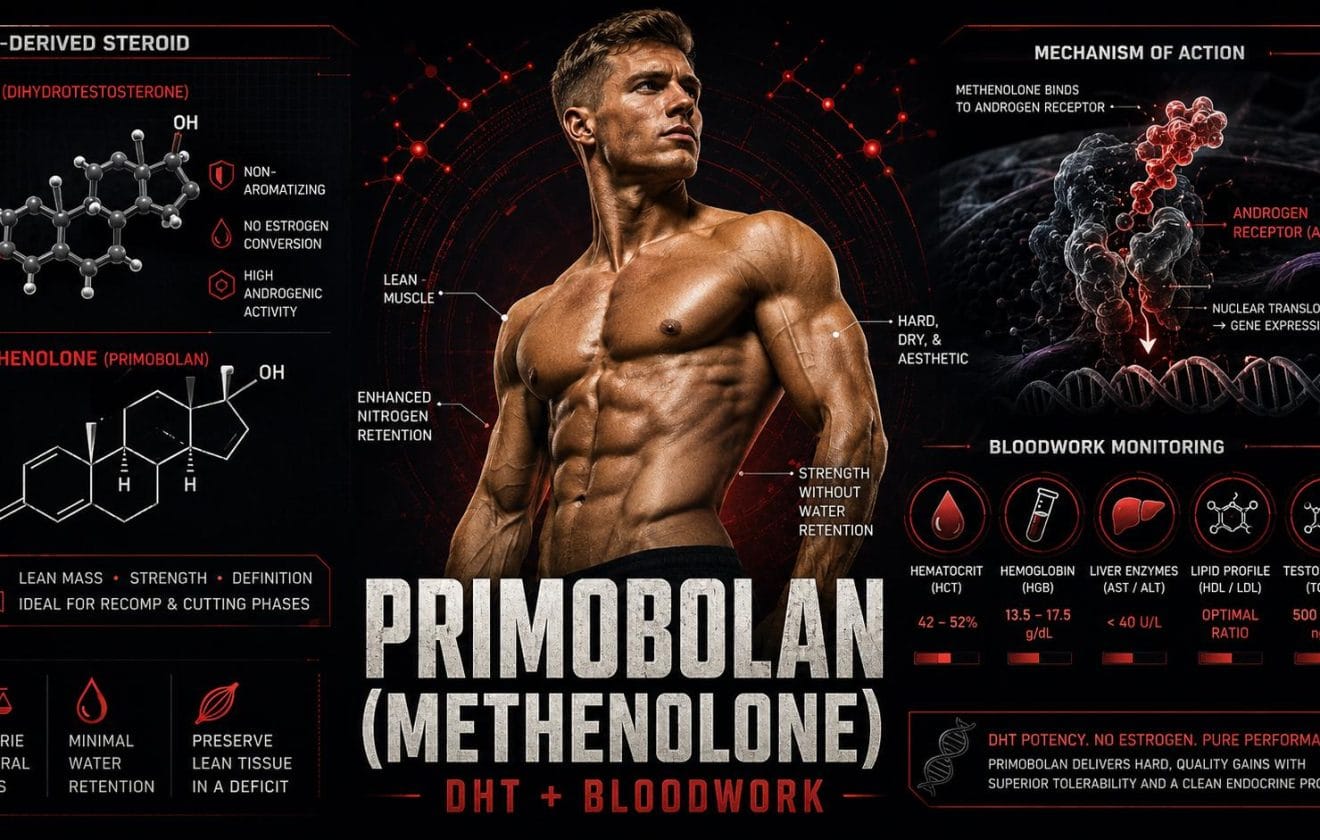
Primobolan is a DHT-derived anabolic-androgenic steroid available in two distinct forms: methenolone acetate (oral) and methenolone enanthate (injectable). Neither form aromatizes to estrogen. The two preparations differ fundamentally in bioavailability, half-life, and practical utility - not just delivery method. This guide covers the pharmacology of primobolan, the structural basis for its mild androgenic profile, why the oral and injectable forms behave differently, and what bloodwork monitoring applies.
Primobolan: Three Core Principles
DHT-Derived, No Aromatization
Primobolan is structurally derived from dihydrotestosterone with a 1-methyl modification that increases metabolic stability. Like all DHT-derived compounds, it cannot aromatize to estrogen. Estradiol elevation is not a risk with primobolan - but estradiol monitoring may still be relevant depending on what else is used alongside it, and HPTA suppression occurs regardless.
Two Forms - Fundamentally Different
Oral primobolan (methenolone acetate) and injectable primobolan (methenolone enanthate) are not interchangeable preparations. The oral form has poor bioavailability because it is not 17-alpha alkylated - a fact that distinguishes it from most oral steroids. The injectable enanthate ester delivers substantially higher active compound per dose and is the clinically established form.
Mild Profile - Not Without Risk
Primobolan has one of the lowest androgenic indices among common injectable steroids and does not aromatize, giving it a reputation as a mild compound. This reputation is partially accurate but incomplete. HPTA suppression is real and complete with sustained use. HDL suppression occurs. Hair loss risk in genetically susceptible individuals is present - the same DHT-tissue limitation that applies to masteron applies to primobolan.
What This Guide Covers
Covered in This Guide
- What primobolan is and how the 1-methyl DHT structure determines its properties
- Oral methenolone acetate: why it is not 17-alpha alkylated and what that means
- Injectable methenolone enanthate: ester mechanics and half-life
- Non-aromatizing profile and estrogen context
- Androgenic activity and hair loss risk as a DHT derivative
- HPTA suppression profile
- Bloodwork markers relevant to primobolan use
- Common interpretation errors specific to this compound
Not Covered Here
- Cycle design or stacking protocols
- Specific dosage recommendations
- Female use protocols
- PCT drugs or recovery protocols
- Sourcing, counterfeiting, or product quality
- Comparison to nandrolone or trenbolone-class compounds
Context: This article is part of a compound library covering individual anabolic steroids in detail. For the broader category of DHT-derived compounds and why the DHT backbone shapes androgenic profile, see DHT-Derived Steroids. For the foundational mechanism of all anabolic steroids, see What Are Anabolic Steroids.
What Primobolan Is and How Its Structure Determines Its Properties
Primobolan is the trade name for methenolone, an anabolic-androgenic steroid derived from dihydrotestosterone. The structural distinction between methenolone and unmodified DHT is a 1-methyl group added to the A-ring of the steroid structure. This single modification has significant pharmacological consequences: it slows hepatic metabolism of the compound substantially, extending its biological half-life far beyond what unmodified DHT achieves, and it contributes to the compound's resistance to further reduction by tissue enzymes. The DHT backbone itself means the compound cannot aromatize to estrogen - aromatase requires the double bond at the 4,5 position of the steroid A-ring, which the 5-alpha reduction that defines DHT eliminates.
Methenolone has a published anabolic-to-androgenic ratio of approximately 88:44-57, measured relative to testosterone's 100:100 baseline. This places primobolan above masteron's anabolic index of 62 and well below testosterone, with an androgenic index that is among the lowest of commonly used compounds. These ratios reflect bioassay measurements and serve as relative comparison tools - they are not direct predictors of individual response. For the full context of how these ratios are derived and what they describe, see What Are Anabolic Steroids.
The lower androgenic index of primobolan does not eliminate androgenic risk in the same way that it does for non-DHT-derived compounds. Because methenolone is a DHT derivative, it acts directly in androgen-sensitive tissues - scalp, skin, and prostate - without requiring further reduction by 5-alpha reductase. Finasteride and dutasteride therefore offer no protective effect against primobolan's androgenic activity at the tissue level, for the same structural reason that applies to masteron. Individuals with genetic androgenic alopecia sensitivity remain at risk regardless of the low androgenic index figure. For the mechanism of DHT-tissue androgenicity, see Hair Loss and DHT on Steroids.
Historical Clinical Context
Methenolone was developed in the late 1950s and brought to market under the Primobolan brand. Its clinical applications - treating muscle wasting, malnutrition, sarcopenia, and in some protocols, paediatric growth deficiencies - reflect the mild androgenic profile that made it one of the few anabolic steroids considered for use in populations where androgenic side effects were a primary concern. This clinical history does not mean primobolan is without pharmacological consequence: it means its androgenic burden is lower relative to testosterone, not absent. Every clinical application still involved HPTA suppression and the systemic effects of sustained androgen exposure.
Oral vs Injectable Primobolan: Why the Difference Matters
Most oral anabolic steroids achieve adequate bioavailability through 17-alpha alkylation - a structural modification at the 17th carbon position that blocks hepatic breakdown on first pass through the liver. This modification is also what makes most oral steroids hepatotoxic. Oral primobolan (methenolone acetate) takes a different approach: it uses a 17-beta acetate ester rather than 17-alpha alkylation. This means oral primobolan does not carry the hepatotoxic burden of alkylated oral steroids - but it also achieves significantly lower bioavailability as a result.
Estimates of oral methenolone acetate bioavailability range from roughly 3% to 7% in some references and as high as 10-15% in others, depending on the measurement methodology. The practical implication is that a substantial portion of each oral dose is metabolised and rendered inactive before reaching systemic circulation. Effective blood levels from the oral form require considerably higher administered doses than the injectable preparation to achieve comparable active methenolone exposure. This is the principal pharmacological reason why injectable primobolan (methenolone enanthate) is considered the clinically relevant preparation: it bypasses first-pass hepatic metabolism entirely, delivering active compound directly into systemic circulation via the ester release mechanism.
Injectable Methenolone Enanthate: Ester Mechanics
Injectable primobolan uses the enanthate ester - the same long-chain ester applied to testosterone enanthate - attached to the methenolone base. Once injected into muscle tissue, the ester is cleaved by plasma esterases, releasing active methenolone into circulation over an extended period. The enanthate ester produces a half-life of approximately 10-14 days, allowing for once or twice-weekly injection schedules with stable blood levels throughout the week. This is the same mechanical principle that governs all long-ester injectable steroids: the ester determines release rate; the base molecule determines pharmacological activity. For the general framework of ester mechanics across compounds, see Injectable vs Oral Steroids.
The enanthate ester also means that after the last injection, active methenolone remains in circulation for several weeks. Blood level decline is gradual, and full clearance from an enanthate-esterified injectable takes approximately three to four weeks post-last injection. This has direct relevance for recovery timeline planning and for interpreting bloodwork taken after primobolan discontinuation - elevated suppression markers will persist for weeks after administration ends, not days.
Primobolan vs Testosterone: Key Parameters Compared
The profile grid below compares oral and injectable primobolan against testosterone cypionate as a reference. The comparison illustrates how the 1-methyl DHT structure produces a non-aromatizing compound with a lower androgenic index than testosterone, and how the two primobolan forms differ only in delivery mechanics - not in the pharmacological properties of the active methenolone molecule.
Half-life values are approximate. Anabolic and androgenic index values are relative to testosterone 100:100 baseline derived from bioassay methodology. Both primobolan forms share identical pharmacological properties - only delivery mechanics differ.
Oral vs Injectable Primobolan: Parameter Breakdown
The table below captures the practical differences between methenolone acetate and methenolone enanthate in the parameters that determine how each form behaves in use. The active molecule is identical; the differences in administration, bioavailability, and clearance determine which form is appropriate for a given context.
| Parameter | Methenolone Acetate (Oral) | Methenolone Enanthate (Injectable) |
|---|---|---|
| Preparation | Oral tablet | Oil-based injection |
| Alkylation Type | 17-beta acetate ester - NOT 17-alpha alkylated | Enanthate ester at 17-beta position |
| Hepatotoxicity | Low - lacks the 17-alpha modification responsible for hepatotoxicity in most oral steroids. Mild transaminase elevation possible but not comparable to alkylated orals | Minimal - injectable route bypasses first-pass liver metabolism entirely |
| Bioavailability | Low - estimated 3-15% due to first-pass hepatic metabolism without 17-alpha alkylation protection | High - near-complete systemic availability after ester cleavage |
| Half-Life | ~4-6 hours - requires multiple daily doses to maintain levels | ~10-14 days - once or twice-weekly dosing sufficient |
| Blood Level Stability | Pronounced peaks and troughs with infrequent dosing; stable only with frequent daily administration | Stable throughout the week with twice-weekly injections; slow response to dose adjustments |
| Clearance After Last Dose | ~1-2 days post-last tablet | ~3-4 weeks post-last injection |
| Clinical Precedent | Original oral primobolan - Schering brand. Clinical use in wasting conditions and paediatric applications | Primobolan Depot - Schering. The established injectable form and primary reference in the literature |
The oral form's low bioavailability means that equivalent active methenolone exposure requires substantially higher oral doses than injectable doses. This does not make the oral form more androgenic per dose - it means more of each administered dose is metabolised before reaching systemic circulation.
Counterfeiting context: Primobolan is among the most frequently counterfeited anabolic steroids on the underground market, primarily because pharmaceutical-grade methenolone enanthate is expensive to produce. This is a sourcing and product reliability issue, not a pharmacological one - but it is relevant to any discussion of whether real-world outcomes match expected pharmacology. Underdosed or mislabelled preparations are common. This guide covers verified pharmaceutical primobolan pharmacology only.
Androgenic Effects of Methenolone as a DHT Derivative
An androgenic index of 44 relative to testosterone's 100 makes methenolone one of the least androgenic compounds in common use. This figure is accurate - but it requires the same structural qualification that applies to all DHT-derived steroids. The low androgenic index does not mean the compound behaves like a weak androgen at tissue level. Methenolone arrives at androgen-sensitive tissues as an active DHT-equivalent androgen, without requiring further metabolic conversion. The 1-methyl modification that defines its structure increases metabolic resistance - it does not reduce androgenic activity at receptor binding sites in skin, scalp, or prostate tissue.
The consequence of this is that 5-alpha reductase inhibitors - finasteride, dutasteride - provide no mitigation of androgenic activity in scalp and skin tissue with methenolone. These inhibitors work by blocking the conversion of testosterone to DHT by the enzyme 5-alpha reductase. Methenolone is already a DHT-derived structure and is not a substrate for that enzyme. The molecule that reaches hair follicles is the same molecule that was administered. For individuals with genetic androgenic alopecia sensitivity, the low androgenic index number is less relevant than the fact that tissue exposure is to a DHT-equivalent compound without pharmacological mitigation available. For the full mechanism, see Hair Loss and DHT on Steroids.
HPTA Suppression
Methenolone suppresses the hypothalamic-pituitary-gonadal axis through androgen receptor-mediated negative feedback at the hypothalamus. GnRH pulsatility is reduced, LH and FSH secretion falls, and endogenous testosterone production ceases with sustained administration. This suppression is complete - the low androgenic index does not produce partial suppression or a milder HPTA response. Because methenolone does not aromatize, there is no estradiol-mediated contribution to the feedback suppression mechanism. The axis responds entirely to the androgenic signal. For the full HPTA suppression and recovery mechanism, see Hormonal Recovery After Steroids.
No 5-Alpha Reductase Mitigation
Methenolone is a 1-methyl DHT derivative - not a substrate for 5-alpha reductase. Finasteride and dutasteride cannot reduce its androgenic activity at the scalp. Hair loss risk is determined entirely by genetic androgen sensitivity and cannot be pharmacologically reduced with this compound. See Hair Loss and DHT on Steroids.
DHT-Level Sebaceous Stimulation
As a DHT derivative, methenolone stimulates sebaceous gland activity via androgen receptor binding. Acne risk is lower than with testosterone due to the reduced androgenic index, but it is not zero - particularly in individuals with genetic sebaceous gland sensitivity. 5-AR inhibitors offer no mitigation here. See Acne on Steroids.
Complete Suppression Despite Mild Profile
LH and FSH suppression is complete with sustained methenolone use despite the mild androgenic index. The HPG axis responds to the androgenic receptor signal regardless of index magnitude. Recovery after discontinuation follows the same principles as other anabolic steroids - determined by duration of use, not androgenic index. See Hormonal Recovery After Steroids.
Lower Risk - Not Zero Risk
The low androgenic index and clinical history of methenolone in sensitive populations reflects a genuinely lower virilization burden relative to testosterone. It does not mean virilization risk is absent. Voice deepening, clitoral hypertrophy, and other androgenic effects remain possible with sustained use, particularly at higher doses. Risk is dose-dependent and individual.
Non-Aromatizing Profile and Estrogen Context
Methenolone does not aromatize to estrogen. This is a structural property of the DHT backbone - aromatase cannot act on the 5-alpha reduced A-ring structure that defines all DHT-derived compounds. Unlike with testosterone, there is no dose at which aromatization begins, and no conversion pathway that can be triggered by high concentrations. Estradiol elevation is not a risk from methenolone itself.
Unlike masteron, methenolone does not carry significant aromatase inhibitory activity. It is non-aromatizing rather than anti-estrogenic. When used alongside aromatizing compounds such as testosterone, it does not suppress estradiol the way masteron does - it simply does not contribute estradiol of its own. Estradiol levels in a combined protocol will be determined by the aromatizing compounds present, and methenolone will not meaningfully alter that. This distinction matters when managing estradiol in a protocol: there is no double-suppression risk from combining methenolone with an aromatase inhibitor in the way that exists with masteron.
When used without any aromatizing compound, estradiol will fall as endogenous testosterone production is suppressed. The body's primary source of estradiol in men is aromatization of endogenous testosterone - when HPTA suppression eliminates that testosterone, the estradiol that depended on it also falls. Sub-physiological estradiol can result from prolonged methenolone use without any exogenous estrogen source or aromatizing compound. For a full overview of estradiol physiology and why sub-physiological levels carry health consequences, see Estradiol Before Steroids.
Key distinction: Methenolone is non-aromatizing - it does not convert to estrogen and does not inhibit aromatase. Masteron is anti-estrogenic - it actively inhibits aromatase and suppresses estradiol when used alongside aromatizing compounds. These are different pharmacological properties with different monitoring implications. Non-aromatizing is not the same as anti-estrogenic.
Bloodwork Markers to Monitor on Primobolan
The non-aromatizing, mild androgenic profile of methenolone does not eliminate bloodwork monitoring requirements. HPTA suppression is complete, hematocrit rises with sustained androgen exposure, lipid panels are affected, and androgenic tissue effects occur. The monitoring framework for methenolone follows the same structure as any injectable anabolic-androgenic steroid - the mild profile changes degree, not category.
| Marker | What It Shows | Methenolone Context |
|---|---|---|
| Estradiol (E2) | Circulating estrogen - aromatization product | Methenolone does not produce estradiol directly and does not inhibit aromatase. When used without aromatizing compounds, E2 will fall as endogenous testosterone is suppressed. Sub-physiological estradiol carries its own health consequences. Monitoring confirms E2 stays within physiological range. See Estradiol Before Steroids. |
| Total and Free Testosterone | Endogenous testosterone - suppressed by all exogenous androgens | Methenolone suppresses endogenous testosterone via HPTA feedback. When used without exogenous testosterone, total testosterone will approach zero. If used alongside testosterone, the result reflects exogenous dose only. See Total vs Free Testosterone. |
| LH / FSH | Pituitary gonadotropins - confirm HPTA suppression status | Both values approach zero with sustained administration despite the mild androgenic profile. Useful as a suppression confirmation marker and as a recovery tracking tool after discontinuation of the injectable enanthate form, where clearance extends over three to four weeks. |
| Hematocrit / Hemoglobin | Red blood cell volume and oxygen-carrying capacity | Androgen receptor-mediated erythropoiesis stimulation occurs with methenolone as with all androgens. The effect may be more modest than with testosterone due to the lower androgenic index, but hematocrit elevation accumulates with sustained use. Values above 52-54% require attention. See Hematocrit and Hemoglobin. |
| Lipid Panel (HDL, LDL) | Cardiovascular risk markers altered by androgen exposure | HDL suppression occurs with methenolone as a DHT-derived compound. The degree of suppression may be less pronounced than with testosterone, partly because there is no estradiol production from aromatization to partially offset lipid-adverse androgen effects. A full lipid panel before and during use is required. See Lipid Panel. |
| AST / ALT | Liver enzyme markers | Injectable methenolone enanthate does not carry 17-alpha alkylation hepatotoxicity. Oral methenolone acetate also lacks 17-alpha alkylation, making it lower hepatotoxicity than most oral steroids - but mild transaminase elevations remain possible. Baseline and follow-up liver panels are recommended for the oral form. See Liver Markers. |
Establish a baseline panel before starting. Recheck at 8-12 weeks. When methenolone is used without any aromatizing compound, pay attention to estradiol - HPTA suppression eliminates endogenous testosterone and the estradiol that depends on it.
5 Mistakes in How Primobolan Is Interpreted
- Mistake 1
Believing the Mild Profile Means No HPTA Suppression
The most persistent misconception about methenolone is that its mild androgenic index translates to partial or absent HPTA suppression. This is incorrect. The HPG axis responds to androgen receptor occupancy regardless of the compound's position on an androgenic index scale. Sustained methenolone administration suppresses LH and FSH completely and shuts down endogenous testosterone production in the same way as compounds with higher androgenic indices. Recovery after discontinuation depends on duration of use and individual variability - not on how mild the compound is rated. See Why Steroids Cause Testosterone Suppression.
- Mistake 2
Treating the Oral Form as Equivalent to the Injectable
Oral methenolone acetate and injectable methenolone enanthate are not equivalent preparations at equal milligram doses. The oral form's bioavailability is estimated at 3-15% due to first-pass hepatic metabolism without 17-alpha alkylation protection. An oral dose and an injectable dose of identical milligram weight will produce fundamentally different systemic exposure levels. Individuals who use the oral form and expect results equivalent to the injectable preparation at the same dose will be disappointed - not because the compound is ineffective, but because far less active molecule reaches systemic circulation from the oral route.
- Mistake 3
Assuming Finasteride Protects Against Hair Loss
Methenolone is a DHT-derived compound. Finasteride and dutasteride block 5-alpha reductase, which converts testosterone to DHT in tissue. Methenolone does not require this conversion - it is already a DHT-equivalent structure. Finasteride has no pharmacological pathway by which to reduce methenolone's androgenic activity at the scalp. Individuals with genetic hair loss sensitivity who use this compound are exposed to DHT-level androgen activity in follicle tissue without available mitigation. The low androgenic index may reduce the absolute androgenic burden compared to testosterone, but it does not create a pathway for finasteride to work. See Hair Loss and DHT on Steroids.
- Mistake 4
Confusing Non-Aromatizing With Anti-Estrogenic
Methenolone does not aromatize and does not inhibit aromatase. Masteron does not aromatize and actively inhibits aromatase. These are different pharmacological properties with different implications. When methenolone is added to a testosterone plus aromatase inhibitor protocol, it does not compound estradiol suppression the way masteron would. The distinction matters for estradiol management - combining methenolone with an AI does not require the same reassessment of AI dose that combining masteron with an AI does. Treating the two compounds as interchangeable in their relationship to estrogen is a category error.
- Mistake 5
Ignoring Lipid Impact Because of the Mild Reputation
The reputation of methenolone as a mild or well-tolerated anabolic steroid creates an expectation that its cardiovascular risk profile is minimal. In practice, HDL suppression occurs with all androgenic compounds, including DHT-derived steroids with low androgenic indices. Because methenolone does not aromatize, there is no estradiol production to partially offset the lipid-adverse effects of androgen receptor activation - an offset that testosterone provides through its aromatization. A full lipid panel before and during use is non-negotiable regardless of androgenic index. See Lipid Panel.
- Blood Tests Before Steroids: 7 Markers to Check - the 7-marker baseline panel to run before starting
Published Research Referenced in This Guide
- Kicman AT. Pharmacology of anabolic steroids. Br J Pharmacol. 2008. pubmed.ncbi.nlm.nih.gov/18500378
- Bhasin S, Storer TW, Berman N, et al. The effects of supraphysiologic doses of testosterone on muscle size and strength in normal men. N Engl J Med. 1996. pubmed.ncbi.nlm.nih.gov/8637535
- Hartgens F, Kuipers H. Effects of androgenic-anabolic steroids in athletes. Sports Med. 2004. pubmed.ncbi.nlm.nih.gov/15248788
- Anabolic steroids overview. NCBI Bookshelf / StatPearls. ncbi.nlm.nih.gov/books/NBK482418
- Androgen physiology, pharmacology, use and misuse. NCBI Bookshelf / Endotext. ncbi.nlm.nih.gov/books/NBK279000
What Primobolan Teaches About Mild Anabolic Steroids
Methenolone occupies a specific position in the pharmacological landscape: a DHT-derived compound with a genuinely low androgenic index, no aromatization, and no aromatase inhibitory activity. The mild reputation is grounded in real structural properties. But "mild" in the context of an anabolic steroid describes a degree of risk reduction relative to testosterone - not an absence of the pharmacological effects that define this class of compounds. HPTA suppression is complete. Lipid panels are affected. Androgenic tissue effects occur. The monitoring obligations are the same as for any anabolic steroid; only the expected magnitude differs.
The oral versus injectable distinction is more consequential with methenolone than with most compounds, because the oral form's non-alkylated structure produces fundamentally lower bioavailability rather than simply a different delivery route. Understanding this difference - and the anti-estrogenic versus non-aromatizing distinction between methenolone and masteron - is essential for interpreting both pharmacological expectations and bloodwork results accurately.
- DHT-Derived Steroids - the full category overview of DHT-based compounds and why the DHT backbone shapes androgenic profile across all related steroids
- What Are Anabolic Steroids - androgen receptor binding, mechanism of action, and how anabolic-to-androgenic ratios are derived and interpreted
- Injectable vs Oral Steroids - ester mechanics, 17-alpha alkylation, and how oral bioavailability differs between alkylated and non-alkylated preparations
- Estradiol Before Steroids - why estradiol monitoring matters even with non-aromatizing compounds, and what sub-physiological E2 means for health
- Hair Loss and DHT on Steroids - how DHT drives follicle miniaturization and why finasteride cannot protect against DHT-derived compounds
- Lipid Panel - HDL, LDL, and triglyceride reference ranges and the cardiovascular implications of steroid-related lipid changes
- Hematocrit and Hemoglobin - how androgens drive erythropoiesis and what hematocrit thresholds mean for blood viscosity risk
- Hormonal Recovery After Steroids - how the HPG axis recovers after suppression and the factors that determine recovery timeline
- Why Steroids Cause Testosterone Suppression - the mechanism of HPTA feedback suppression and why mild androgenic index does not reduce it
- Steroids Hub - full compound library and category guides for evidence-based steroid education
For Educational Purposes Only
This article discusses primobolan (methenolone) for educational and harm-reduction purposes. It does not constitute medical advice and is not a substitute for consultation with a qualified physician. The information provided reflects published research and pharmacological reference data and is intended to support informed decision-making, not to encourage or facilitate the use of controlled substances.
MuscleScience.org does not sell any compounds, medications, or supplements. All author names are pseudonyms. Author photographs are stylized portraits, not images of real individuals. See our About page and Disclaimer for full disclosure on editorial policy and anonymity.