Equipoise (Boldenone): Pharmacology, Hematocrit Risk, and Bloodwork Guide
Slow gains and the hematocrit risk
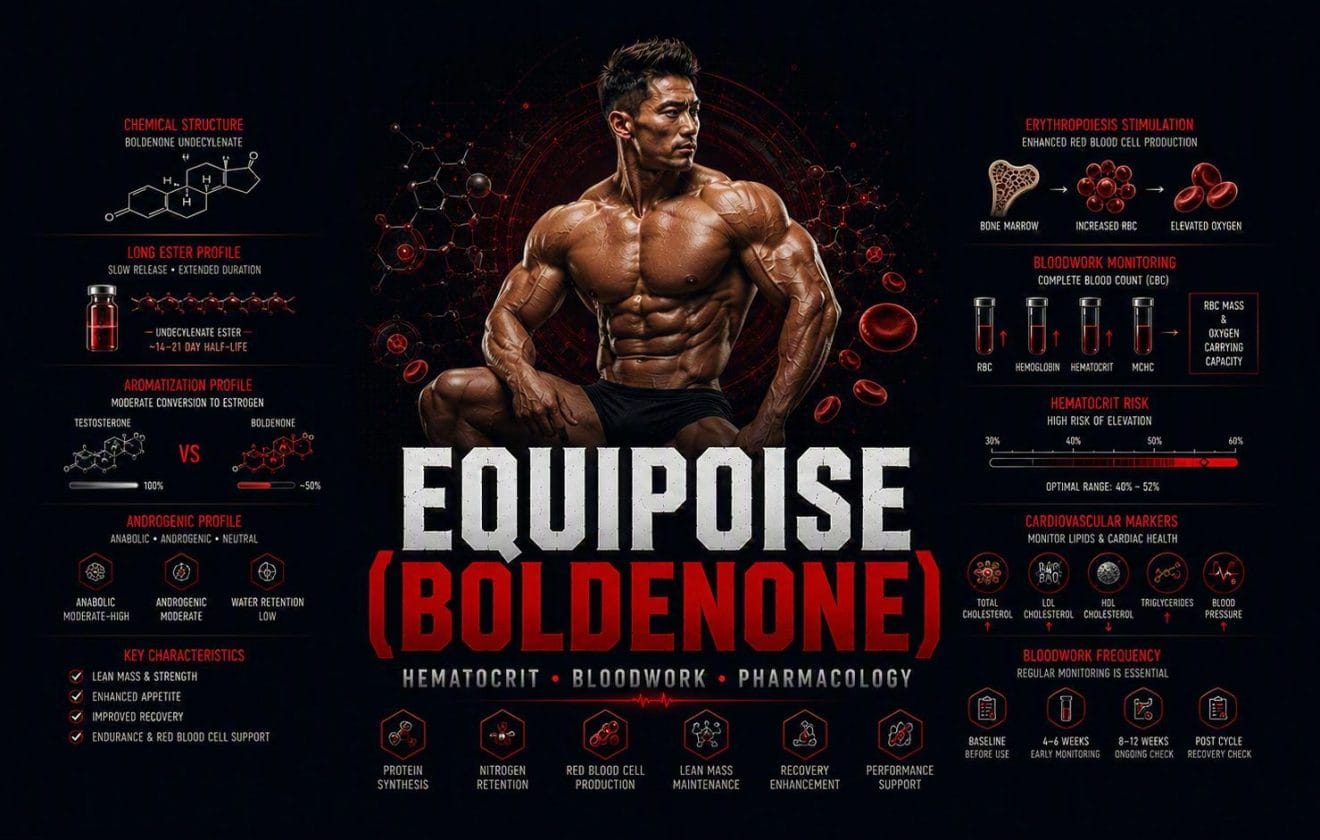
Equipoise (boldenone undecylenate) is an injectable anabolic-androgenic steroid developed for veterinary use and later adopted in performance contexts. Boldenone aromatizes at approximately half the rate of testosterone - moderate estrogenic activity, not absent. Its most clinically significant risk is hematocrit elevation: the equipoise drives red blood cell production more aggressively than any other injectable in common non-medical use. The undecylenate ester gives equipoise a 14-day half-life, forcing cycle lengths of 16 weeks or more for meaningful exposure.
Boldenone: Three Facts That Define Its Risk Profile
Partial Aromatization - Not Zero
Equipoise aromatizes at roughly 50% the rate of testosterone. At typical performance doses of 400-600 mg per week, this still produces meaningful estradiol elevation. The common claim that the compound "barely aromatizes" understates its real estrogenic activity - especially when stacked with testosterone, which adds full-rate aromatization on top. Estradiol monitoring is not optional.
Highest Hematocrit Risk of Common Injectables
Equipoise stimulates erythropoiesis more aggressively than testosterone, nandrolone, or most orals at comparable doses. Hematocrit above 52-54% creates measurable cardiovascular risk from blood viscosity. Users who skip mid-cycle bloodwork are taking a specific, preventable risk that has no early warning symptoms. This is the single most important safety variable to monitor on boldenone.
Half-Life Forces 16+ Week Cycles
The undecylenate ester has a half-life of approximately 14 days. Blood levels take 4-6 weeks to stabilise after the first injection. A standard 12-week cycle leaves only 6-8 weeks of productive exposure. Meaningful use requires a minimum of 16 weeks - a longer suppression window that directly increases the complexity of hormonal recovery and PCT planning after the cycle ends.
What This Guide Covers
Covered in This Guide
- The structural origin of equipoise - boldenone vs testosterone at the C1-2 double bond
- Aromatization rate with comparative data across common injectables
- Why boldenone elevates hematocrit more than other compounds - the erythropoietic mechanism
- Lipid impact: HDL suppression in context
- The 14-day half-life and its minimum cycle length implications
- Appetite stimulation: mechanism and practical context
- Bloodwork monitoring panel - 8 key markers
- 5 common errors in how equipoise is understood and used
Not Covered Here
- Specific doses or cycle protocols
- Stacking recommendations
- PCT drug selection after boldenone use
- Sourcing or compound availability
- Female use
- WADA detection windows or competition testing
Foundation reading: For the hematocrit monitoring context relevant to boldenone use, see Hematocrit and Hemoglobin. For the cardiovascular connection, see Blood Pressure Before Steroids. For the suppression and recovery framework, see Hormonal Recovery After Steroids.
What Equipoise Is: Structure, Origin, and How Boldenone Differs from Testosterone
Equipoise is the brand name for boldenone undecylenate, originally developed by Ciba and later used in veterinary medicine - primarily in horses - before being adopted in performance contexts. Structurally, boldenone is testosterone with an additional double bond at the C1-C2 position of the steroid nucleus. This single structural modification has significant downstream effects on pharmacological behaviour.
The C1-2 double bond reduces boldenone's affinity for 5-alpha reductase. Unlike testosterone, which converts readily to the more androgenic DHT in tissues expressing 5-alpha reductase, the compound does not undergo meaningful 5-alpha reduction to a more active metabolite. This reduces the androgenic burden at the scalp, prostate, and skin compared to testosterone at equivalent doses. The same double bond is responsible for the reduced aromatization rate - though it does not eliminate estrogenic activity.
The undecylenate ester is one of the longest used in common injectable compounds. It gives boldenone a half-life of approximately 14 days - longer than decanoate (~15 days for nandrolone in practice but with a different concentration curve), and considerably longer than enanthate (~7 days) or cypionate (~8 days). This extended half-life is not a minor pharmacokinetic detail. It fundamentally changes how cycles must be structured and how long suppression continues after the last injection.
Boldenone vs Testosterone: The Four Key Differences
The practical differences that matter for harm-reduction planning can be summarised across four variables. Testosterone aromatizes at 100% reference rate; boldenone at ~50%. Testosterone converts to DHT via 5-alpha reduction; boldenone does not follow this pathway meaningfully. Testosterone's half-life (enanthate ester) is 7-8 days; boldenone undecylenate is 14 days. And testosterone's erythropoietic effect - stimulation of red blood cell production - is meaningful but measurably less potent than boldenone's. These four differences explain the distinct clinical risk profile that makes equipoise stand apart from other injectable compounds. For the structural comparison of injectable forms, see Injectable vs Oral Steroids.
Equipoise Aromatization: What "Half the Rate of Testosterone" Actually Means
The most frequently misrepresented aspect of boldenone is its aromatization. The compound is routinely described as "low estrogen" or "barely aromatizing" - descriptions that are accurate only in relative terms and misleading in practical terms. Boldenone aromatizes at approximately 50% the rate of testosterone. What this means in practice depends on the dose.
At 400 mg per week, the aromatization load from boldenone is roughly equivalent to running 200 mg per week of testosterone in terms of estradiol produced. At 600 mg per week, the estrogenic load is comparable to 300 mg testosterone. Most users who encounter problems with estradiol on a boldenone cycle are running doses that - despite the reduced rate - still produce clinically significant estrogen elevation, particularly when the compound is stacked with testosterone. The claim that equipoise does not require estradiol management is not supported by the pharmacology.
| Compound | Aromatization Rate | Estradiol Risk at 400 mg/wk | AI Typically Needed? |
|---|---|---|---|
| Testosterone | 100% (reference) | High - significant E2 elevation expected | Often yes, dose-dependent |
| Equipoise (Boldenone) | ~50% | Moderate - E2 monitoring required | Situationally, especially stacked with testosterone |
| Deca-Durabolin (Nandrolone) | ~20% | Low direct E2 - progestogenic activity is the separate concern | Rarely for E2 alone |
| Masteron (Drostanolone) | 0% | None - DHT-derived, no aromatization pathway | No |
| Primobolan (Methenolone) | <5% | Negligible at typical doses | Rarely |
| Trenbolone | 0% | None - progestogenic; does not elevate E2 directly | No, for E2 specifically |
Equipoise sits in a distinct middle position - meaningfully lower than testosterone, meaningfully higher than most other common injectables. This position requires estradiol monitoring rather than the assumption of no estrogenic activity. For the full estradiol monitoring framework, see Estradiol Before Steroids.
Why Stacking Equipoise With Testosterone Amplifies Estradiol Risk
A common cycle structure pairs Equipoise with a testosterone base. In this context, both compounds contribute to aromatization simultaneously. At 500 mg testosterone plus 400 mg Equipoise per week, the combined load is equivalent to roughly 700 mg of testosterone in terms of estradiol production. Users who expect the stack to reduce estrogen - because Equipoise aromatizes less than testosterone alone - misunderstand additive aromatization. The total exposure from all compounds must be considered as a whole. For estradiol behaviour in androgen context, see Estradiol on TRT.
Equipoise and Hematocrit: The Highest Erythropoietic Risk Among Common Injectables
Hematocrit elevation is the most clinically significant risk of equipoise use - more than any other compound in common non-medical injectable use, including testosterone and nandrolone. This is a known pharmacological property that distinguishes equipoise from structurally similar androgens, not an anecdotal observation. Understanding the mechanism explains why this risk is compound-specific, dose- and duration-dependent, and why mid-cycle bloodwork is not optional.
The Mechanism: How Equipoise Drives RBC Production
All anabolic-androgenic steroids stimulate erythropoiesis through androgen receptor activation in the kidneys, which increases erythropoietin (EPO) secretion. EPO signals the bone marrow to increase red blood cell production. Boldenone elevates this effect beyond what testosterone produces at equivalent doses. The specific mechanism is not fully isolated - it may involve unique receptor binding kinetics, a distinct metabolite profile, or a direct EPO-stimulating pathway not shared to the same degree by testosterone. The clinical result is consistent: equipoise users running 400-600 mg per week typically show more pronounced hematocrit elevation than comparable testosterone users.
Hematocrit in the 52-54% range is where cardiovascular risk from blood viscosity becomes clinically meaningful. Above 54%, the risk of thrombotic events increases substantially. Boldenone users who run 16+ week cycles without mid-cycle bloodwork can cross this threshold silently - elevated hematocrit produces no noticeable symptoms until it reaches levels associated with acute risk. Monitoring is the only reliable safeguard.
Relative Erythropoietic Potency - Common Injectables
Bar lengths represent relative erythropoietic activity based on pharmacological data and clinical observation - not absolute RBC counts, which depend on dose, duration, and individual response.
Managing Hematocrit on a Boldenone Cycle
Because boldenone cycles run long and hematocrit elevation is progressive, a single pre-cycle baseline is insufficient. Mid-cycle bloodwork at weeks 6-8 is the minimum monitoring standard - this is when sustained boldenone exposure produces measurable hematocrit change. If the reading at week 8 is approaching 50-51%, the trajectory across another 8 weeks can be estimated and managed. Therapeutic phlebotomy is the most straightforward intervention when hematocrit exceeds safe thresholds. For the full CBC and hematocrit monitoring context, see Hematocrit and Hemoglobin.
Equipoise Half-Life: Why 14 Days Forces a Different Cycle Framework
The 14-day half-life of boldenone undecylenate is the most structurally important pharmacokinetic feature of the compound - and the most frequently ignored. A 14-day half-life means that after a single injection, half the active boldenone remains in circulation 14 days later. It takes approximately 4-5 half-lives to reach steady-state blood levels, which means 8-10 weeks pass before concentrations stabilise. For a compound where the productive phase of the cycle requires stable blood levels, this creates a minimum cycle length problem that does not exist with shorter esters.
In a standard 12-week cycle of boldenone, steady-state is not reached until weeks 8-10. This leaves 2-4 weeks of genuinely stable, productive blood levels before the last injection is administered. The remaining 8-10 weeks of the cycle are spent either building toward steady state or declining from it. Users who compare results from a 12-week boldenone cycle unfavourably to other compounds are frequently comparing against a situation where the compound was never used at its effective steady-state concentration for long enough to produce its characteristic effects.
Minimum Effective Cycle Length: 16 Weeks
A 16-week cycle of equipoise allows approximately 8-10 weeks at steady-state concentrations. This is the minimum structure that produces outcomes consistent with the compound's pharmacological profile. Some users run 20-week cycles to extend the productive plateau further. The trade-off is a proportionally longer suppression window: at 16 weeks of boldenone use plus the 14-day half-life, the compound is not fully cleared until approximately 6-8 weeks after the last injection, depending on dose. This directly affects when PCT can begin and how long the total suppression duration lasts. For the recovery framework, see When to Start PCT and Hormonal Recovery After Steroids.
Clearance comparison: Testosterone enanthate clears in approximately 3-4 weeks after the last injection at which point PCT can begin. Boldenone undecylenate at the same dose requires 6-8 weeks to clear to a level where HPG axis recovery can initiate. This extended clearance window is a direct consequence of the 14-day half-life - not a compound quality problem but a pharmacokinetic reality that must be planned for before the cycle begins.
Two Underappreciated Effects: Appetite Stimulation and HDL Suppression on Equipoise
Appetite Stimulation: The Mechanism Behind the Effect
Boldenone is consistently reported to increase appetite - a property that distinguishes it from compounds like trenbolone, which can suppress appetite in some individuals. The mechanism is not fully established in the literature but is attributed to boldenone's androgenic activity acting on hypothalamic appetite regulation pathways, potentially through ghrelin sensitisation or direct androgen receptor activity in appetite-regulating nuclei. The effect is not universal - it correlates with dose and individual response - but it is sufficiently consistent to be considered a characteristic feature of the compound in practice.
In a mass-gaining context, appetite stimulation from equipoise is typically welcomed. In a calorie-controlled or cutting context, it can complicate adherence. Users running boldenone during a deficit should account for the appetite drive the compound introduces, as it can work against dietary discipline in a way that other commonly used cutting compounds - masteron, primobolan, winstrol - do not. This is not a side effect in the conventional sense but a physiological effect that requires contextual awareness.
HDL Suppression: Meaningful but Compound-Dependent
Equipoise suppresses HDL cholesterol - this is consistent across androgens and boldenone is not an exception. The degree of HDL suppression from boldenone at typical doses is moderate: less severe than oral 17-alpha alkylated compounds (Winstrol, Dianabol, Anavar), which produce pronounced HDL reduction through hepatic lipase upregulation, but meaningful enough to require a lipid panel at baseline and mid-cycle. Users who stack boldenone with an oral compound compound the lipid burden significantly.
One practical note on lipid timing with boldenone: because the half-life is 14 days, mid-cycle lipid assessment at week 6-8 reflects a point when blood levels are still rising toward steady state. The lipid profile at peak steady-state (weeks 10-12 of a 16-week cycle) will typically be worse than the week-8 mid-point reading. This is the opposite of what users expect from compounds with shorter half-lives, where mid-cycle bloodwork captures near-peak conditions. Plan for a second lipid check at week 12 if the baseline mid-cycle reading is approaching concern thresholds. For the full lipid monitoring framework, see Lipid Panel.
8 Bloodwork Markers to Monitor on an Equipoise Cycle
Boldenone's pharmacological profile - erythropoietic potency, partial aromatization, HDL suppression, long half-life - determines which markers require the most attention and when. The following eight markers constitute the minimum monitoring framework for a boldenone cycle. Each checkpoint (baseline, mid-cycle, post-cycle) carries different priorities.
Hematocrit and Hemoglobin
The single most important marker on an equipoise cycle. Elevated hematocrit is the compound's primary clinical risk and it progresses silently. Baseline establishes the starting point. Mid-cycle at week 6-8 detects trajectory. Post-cycle confirms normalisation. Safe range: hematocrit below 50% throughout. Therapeutic phlebotomy (blood donation) is the intervention when it rises above threshold. See Hematocrit and Hemoglobin.
Estradiol (E2)
Boldenone aromatizes at ~50% testosterone's rate, producing meaningful E2 elevation at performance doses. Estradiol should be checked at baseline, mid-cycle, and post-cycle. When boldenone is stacked with testosterone, the combined aromatization load is additive and E2 management becomes more complex. Over-suppression with aggressive AI use is as problematic as under-management. See Estradiol Before Steroids.
Lipids (HDL, LDL, Total Cholesterol)
Boldenone suppresses HDL to a degree comparable to injectable testosterone. HDL is the most sensitive lipid marker - it drops first and most significantly with androgen exposure. Mid-cycle lipid assessment at week 8 of a 16-week cycle reflects pre-peak conditions; consider a second check at week 12. Stack with an oral 17-aa compound and the HDL impact is substantially amplified. See Lipid Panel.
Blood Pressure
Hematocrit elevation increases blood viscosity, which directly increases blood pressure. On a boldenone cycle, blood pressure monitoring is not independent of hematocrit monitoring - it is a downstream consequence of it. Elevated blood pressure in conjunction with rising hematocrit is a compound signal requiring intervention. Home monitoring weekly during the cycle is more informative than a single clinic reading. See Blood Pressure Before Steroids.
Total Testosterone and LH/FSH
During the cycle, LH and FSH will be suppressed to near zero - this is expected and confirms that HPTA suppression is complete. Post-cycle, LH and FSH recovery confirms HPG axis reactivation. If LH and FSH remain low 6-8 weeks post-cycle after PCT, this signals incomplete recovery requiring further assessment. Total testosterone post-cycle should return toward the individual's baseline range. See Why Steroids Cause Testosterone Suppression.
RBC Count and MCV
Red blood cell count and mean corpuscular volume (MCV) provide additional context alongside hematocrit. An elevated RBC count with normal MCV and rising hematocrit confirms androgen-driven erythropoiesis rather than dehydration or other causes. This distinction matters for interpreting mid-cycle bloodwork correctly - a hematocrit of 51% from boldenone-driven erythropoiesis carries a different risk implication than the same value from dehydration before the blood draw.
Liver Enzymes (AST, ALT)
Boldenone is an injectable compound without 17-alpha alkylation, so direct hepatotoxicity is not a primary concern at standard doses. However, baseline liver enzymes should always be established before any cycle, and mid-cycle assessment is required if any oral 17-aa compound is stacked. Elevated AST and ALT in the context of a boldenone-only cycle is more likely attributable to intense resistance training (muscle-derived AST elevation) than hepatotoxicity. See Liver Markers.
Kidney Markers (Creatinine, eGFR)
Kidney markers are not a primary concern specific to boldenone at standard doses, but baseline creatinine and eGFR establish the pre-cycle renal function reference point. Elevated hematocrit and increased blood viscosity create secondary cardiovascular load that includes renal perfusion. In long cycles (16-20 weeks), post-cycle kidney marker assessment provides reassurance that sustained elevated blood viscosity has not produced subclinical renal stress. See Kidney Markers.
5 Mistakes in How Equipoise Is Used and Understood
- Mistake 1
Running a 12-Week Boldenone Cycle
A 12-week boldenone cycle is structurally inadequate. With a 14-day half-life, steady-state is not reached until week 8-10. This leaves 2-4 weeks of productive exposure at stable concentrations before the last injection - not enough to form a meaningful assessment of what the compound actually does at effective levels. Users who conclude that equipoise "doesn't do much" from a 12-week cycle are frequently evaluating a pharmacokinetic problem rather than a compound efficacy problem. The minimum effective structure is 16 weeks, and this needs to be decided before the cycle starts - not retrofitted after insufficient results.
- Mistake 2
Skipping Mid-Cycle Bloodwork on a Long Boldenone Cycle
Boldenone drives hematocrit elevation progressively across the cycle - the effect compounds over time. A 16-20 week cycle without mid-cycle bloodwork leaves the most clinically significant risk completely unmonitored for the duration most likely to produce dangerous elevation. Unlike acute side effects that produce noticeable symptoms, elevated hematocrit is clinically silent until it reaches thrombotic risk levels. Mid-cycle CBC at week 6-8 is not optional on a boldenone cycle - it is the only mechanism by which the primary risk is detected while there is still time to intervene. See Blood Tests Before Steroids.
- Mistake 3
Treating "Less Aromatization Than Testosterone" as "No Estradiol Management Needed"
Boldenone aromatizes at roughly 50% the rate of testosterone. At 400-600 mg per week - the range most commonly used in performance contexts - this still produces meaningful estradiol elevation. When stacked with testosterone (the most common equipoise cycle structure), the combined aromatization load is additive. Users who skip estradiol monitoring because boldenone "barely aromatizes" will not detect E2 elevation that is influencing water retention, mood, libido, and cardiovascular risk in real time. The relative comparison with testosterone is accurate; the practical conclusion that no management is needed is not.
- Mistake 4
Not Accounting for the Extended Clearance Window When Planning PCT
Users familiar with testosterone enanthate or cypionate are accustomed to a 2-3 week wait after the last injection before starting PCT. Boldenone undecylenate requires 6-8 weeks post-last-injection before blood levels drop to a point where PCT can effectively support HPG axis recovery. Starting PCT 2 weeks after the last boldenone injection - as one would with a testosterone enanthate cycle - is starting too early. Exogenous boldenone is still present at suppressive levels. The correct clearance window must be calculated from the 14-day half-life before the cycle structure is finalised. See Bloodwork Before and After PCT.
- Mistake 5
Donating Blood Mid-Cycle Without Understanding the Impact on Blood Level Interpretation
Therapeutic phlebotomy (blood donation) is the standard intervention for hematocrit that exceeds safe thresholds on an equipoise cycle. However, donating blood also removes a volume of boldenone-saturated red blood cells - effectively reducing the boldenone concentration in circulation. Some users report that blood donation mid-cycle produces a temporary but noticeable dip in effects. This is not a reason to avoid donation when hematocrit requires intervention - elevated hematocrit is the more serious risk - but it is information worth understanding. Post-donation bloodwork should account for this when interpreting mid-cycle boldenone levels or estradiol readings taken within 1-2 weeks of phlebotomy.
Published Research Referenced in This Guide
- Kicman AT. Pharmacology of anabolic steroids. Br J Pharmacol. 2008;154(3):502-521. pubmed.ncbi.nlm.nih.gov/18500378
- Bhasin S, Storer TW, Berman N, et al. The effects of supraphysiologic doses of testosterone on muscle size and strength in normal men. N Engl J Med. 1996;335(1):1-7. pubmed.ncbi.nlm.nih.gov/8637535
- Shahidi NT. A review of the chemistry, biological action, and clinical applications of anabolic-androgenic steroids. Clin Ther. 2001;23(9):1355-1390. pubmed.ncbi.nlm.nih.gov/11589254
- Coviello AD, Kaplan B, Lakshman KM, et al. Effects of graded doses of testosterone on erythropoiesis in healthy young and older men. J Clin Endocrinol Metab. 2008;93(3):914-919. pubmed.ncbi.nlm.nih.gov/18160461
- Anabolic steroids overview. NCBI Bookshelf / StatPearls. ncbi.nlm.nih.gov/books/NBK482418
What Equipoise Demands From Anyone Using It
Boldenone is a compound that punishes short-cycle thinking and rewards pharmacokinetic planning. Its 14-day half-life means that a structurally incorrect cycle - anything under 16 weeks - will not produce a meaningful assessment of what the compound actually does. Its erythropoietic potency means that skipping mid-cycle bloodwork is not an inconvenience but a specific risk taken against the compound's most dangerous property. And its partial aromatization means that the "it barely aromatizes" framing, while relative to testosterone, is not license to skip estradiol management at the doses most users actually run.
Equipoise is neither uniquely dangerous nor uniquely mild among the injectables in common use. It is a compound with a well-characterised pharmacological profile that requires a monitoring framework calibrated to its specific risks - not the monitoring habits built around shorter-ester, lower-erythropoietic compounds. The bloodwork panel above, applied at baseline, mid-cycle, and post-cycle, covers all of those risks systematically.
- Hematocrit and Hemoglobin - the primary risk marker on a boldenone cycle, how to interpret CBC results, and when to intervene
- Blood Pressure Before Steroids - how hematocrit elevation connects to blood pressure risk and cardiovascular load
- Lipid Panel - HDL suppression context, what the numbers mean, and why timing of the test matters on long cycles
- Estradiol Before Steroids - baseline E2 and why it matters before any aromatizing compound including boldenone
- Blood Tests Before Steroids - the full pre-cycle baseline panel that applies before any injectable cycle
- Why Steroids Cause Testosterone Suppression - the HPTA suppression mechanism that applies equally to boldenone cycles
- Hormonal Recovery After Steroids - how the HPG axis recovers after long-cycle suppression and what determines timeline
- When to Start PCT - clearance windows by ester and why boldenone requires a longer wait than short-ester compounds
- Bloodwork Before and After PCT - the post-cycle monitoring framework confirming HPG recovery after boldenone use
- Injectable vs Oral Steroids - how injectable compounds differ structurally, in hepatotoxicity, and in monitoring context
For Educational Purposes Only
This guide discusses boldenone undecylenate (equipoise) for educational and harm-reduction purposes. It does not constitute medical advice and is not a substitute for consultation with a qualified physician. Anabolic-androgenic steroids are controlled substances in many jurisdictions. All content is intended for informational purposes only.
MuscleScience.org does not sell any compounds, medications, or supplements. All author names are pseudonyms. Author photographs are stylized portraits, not images of real individuals. See our About page and Disclaimer for full editorial disclosure.