What Builds Muscle
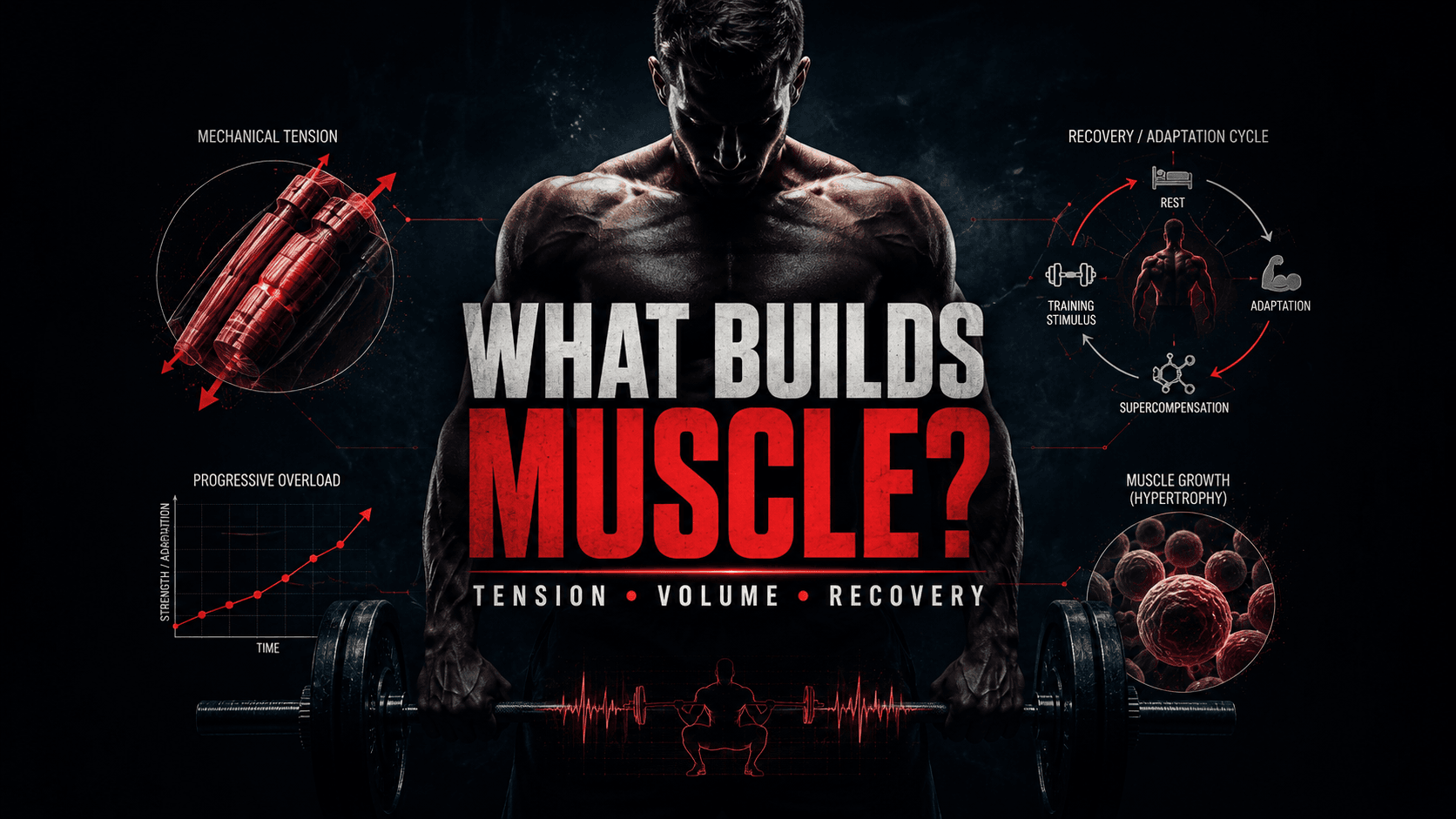
WHAT BUILDS MUSCLE: 7 PROVEN FACTS ON HOW MUSCLES GROW
What builds muscle is mechanical tension on a muscle fibre, repeated often enough that the protein the fibre makes after each session outpaces the protein it breaks down. A hard session raises muscle protein synthesis by 112 percent at 3 hours, 65 percent at 24 hours and 34 percent at 48 hours (PMID 9252485); after about three weeks of training that response starts to track with how much the muscle grows, with a correlation near 0.9 (PMID 27219125). Mechanical signals are the prime candidate for the initiating stimulus, and exercise-induced damage is probably not required (PMID 30335577). That is what builds muscle in one paragraph; the rest of this page is the evidence behind it.
This guide answers how do muscles grow at the level of the fibre, the nucleus and the week: what the three proposed mechanisms have and have not been shown to do, why the first two weeks of a programme are mostly swelling, what satellite cells and myonuclei contribute, why 30 percent and 80 percent loads grow the same muscle, what protein, calories, creatine and sleep add, why 585 people gained anywhere from minus 2 to plus 59 percent on the same programme, and what anabolic steroids measurably change. Every figure comes from a PubMed abstract listed at the end. The series lives on the training hub.
What builds muscle in brief
Three numbers frame what builds muscle: when real growth starts, how much protein the process can use, and how differently two people respond to the same programme.
After only two sessions the thigh measured 3.46 percent larger, almost certainly from oedema; the next significant rise over that inflated baseline came at week 3, strength followed at week 4, and the thigh was 9.60 percent larger by week 8 (PMID 21409401). Fibre size in a separate biopsy study rose only at week 10, not at week 3 (PMID 27219125).
Protein supplementation during resistance training added 0.30 kg of fat-free mass, 2.49 kg on the one-repetition maximum and 310 square micrometres of fibre area on average, with no further gain in fat-free mass beyond a total intake of 1.62 g/kg/day (PMID 28698222). The benefit was larger in trained people and shrank with age.
Size changes ran from minus 2 to plus 59 percent and strength gains from 0 to 250 percent in the largest study of its kind; men gained 2.5 percent more size than women, while women gained more relative strength (PMID 15947721). The people who grew most had more satellite cells before they ever trained (PMID 18436694).
Every figure on this page about what builds muscle is taken from a PubMed abstract listed at the end. Where a mechanism of how do muscles grow is proposed but not demonstrated in people, the page says so. Where lifters describe something on forums, it is reported as a description, not as evidence.
What this guide to what builds muscle covers
The stimulus: mechanical tension, muscle damage and metabolic stress, what each has been shown to do, and why post-workout hormone spikes are not what builds muscle.
How do muscles grow at the cell level: protein synthesis after a session, satellite cells, myonuclei, ribosomes, and the difference between a bigger fibre and a fibre with more contractile protein.
Timeline, load, fuel and people: when growth starts, why load barely matters for size, what protein, calories, creatine and sleep add, why responses vary so much, and what anabolic steroids measurably change.
Not coveredHow many sets to do. The dose-response curve for weekly sets is on training volume explained; loading progression is on progressive overload explained.
Diet in detail. Daily targets and meal patterns are on protein intake explained, calories and energy balance and meal timing explained.
Programmes. The splits that deliver the stimulus are on 3 day workout split and full body dumbbell workout.
What builds muscle: the stimulus, and the three mechanisms that are usually named
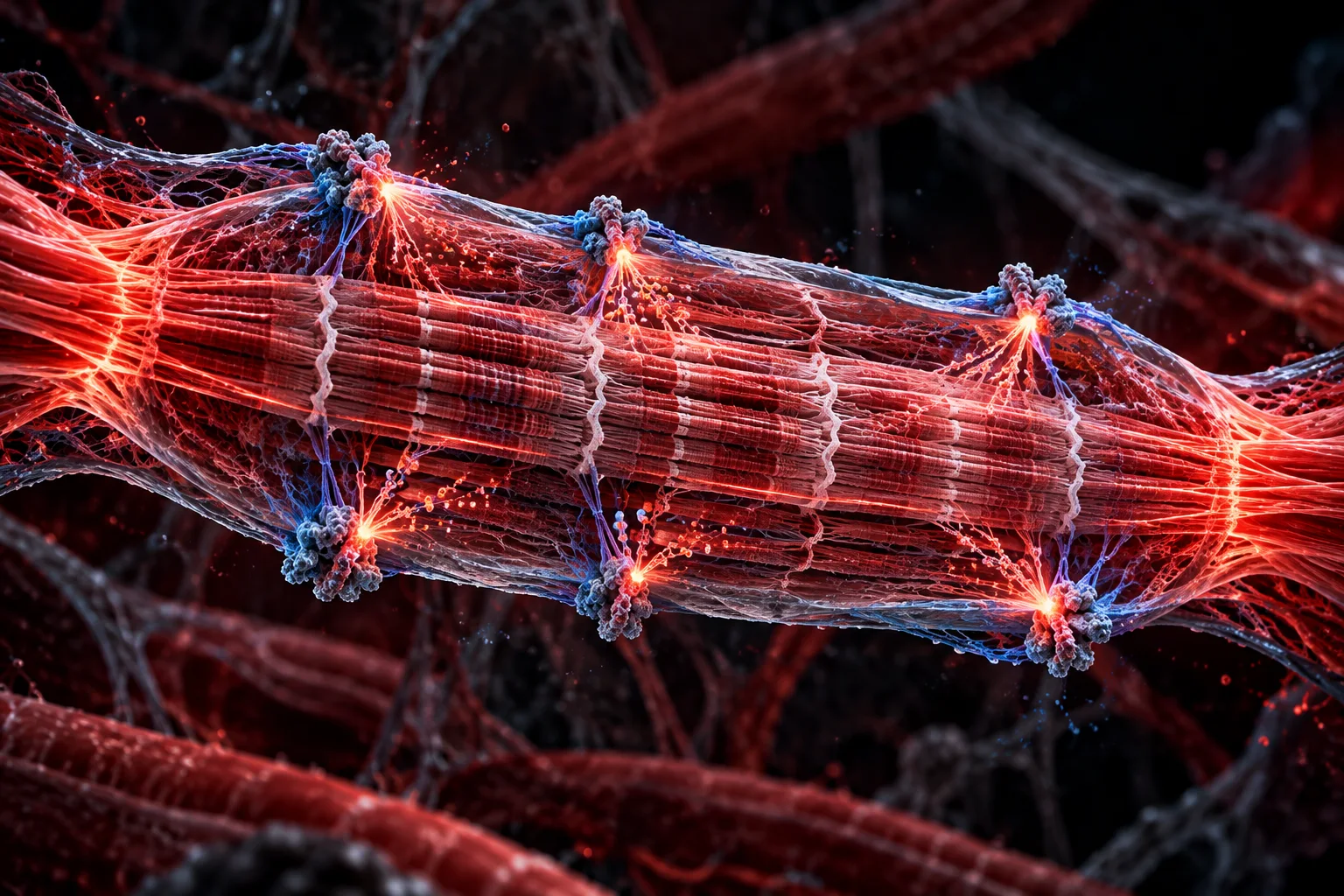
Ask a textbook what builds muscle and it will name three mechanisms: mechanical tension, muscle damage and metabolic stress (PMID 20847704). Ask the 2019 review that tried to pin down the actual initiating signal and the answer narrows. Mechanical signals are the prime candidate for the hypertrophy stimulus, sensed through structures such as filamin-C and BAG3, costameres and nuclear deformation; exercise-induced damage is probably not essential, and metabolite candidates rest on indirect evidence from blood-flow-restricted training and are poorly characterised (PMID 30335577). The downstream pathway is better known than the trigger: an mTORC1-mediated rise in protein synthesis is the key, though not the only, route by which lifting makes a fibre bigger (PMID 30335577).
The damage mechanism has been tested directly and failed. In 10 young men biopsied across 10 weeks, muscle damage was highest after the first session, when protein synthesis was also highest, and neither related to how much the muscle eventually grew; only the synthesis measured at weeks 3 and 10, when damage had faded, correlated with growth, at r of about 0.9 (PMID 27219125). The review built on that data concludes that damage is not the process that mediates or potentiates hypertrophy, and that protocols which cause little damage grow muscle just as well (PMID 29282529). Soreness, in other words, is a cost of what builds muscle, not the cause.
| Candidate | What was measured | Read as |
|---|---|---|
| Mechanical tension | Named the prime candidate for what builds muscle, with filamin-C-BAG3 regulation of mTORC1 as the most plausible sensor (PMID 30335577); 30 percent and 80 percent loads to failure grew the same muscle, so tension per fibre, not bar weight, is the variable (PMID 22518835, PMID 27174923) | What builds muscle |
| Muscle damage | Highest after session one and unrelated to growth; synthesis predicted growth only after damage faded (PMID 27219125); low-damage protocols grew muscle equally (PMID 29282529) | A side effect, not the driver |
| Metabolic stress | Low-load training with blood flow restriction matched high-load training for muscle mass across the meta-analysis, with less strength (PMID 29043659); the review calls the metabolite evidence indirect (PMID 30335577) | Can substitute for load; mechanism unclear |
| Post-workout hormone spikes | Arms trained with or without a large leg session afterwards, which raised growth hormone, IGF-1 and testosterone, grew 10 and 12 percent with no difference (PMID 19910330); no correlation between any hormone rise and growth in 49 trained men (PMID 27174923) | Not what builds muscle |
| Protein synthesis after the session | How do muscles grow after a session: synthesis up 112 percent at 3 hours and still 34 percent at 48 hours after one bout (PMID 9252485); correlated with growth from week 3 onward (PMID 27219125) | The pathway tension works through |
What the stimulus looks like on the bar is covered on progressive overload explained. The rest of this page follows the signal inward, from the session to the fibre to the nucleus, and then back out to the week.
How do muscles grow after a session: protein synthesis, breakdown and the 48-hour window
How do muscles grow is, at the shortest timescale, a question about the two days after a session.
How do muscles grow between one session and the next? By making more protein than they lose. In eight untrained adults who did 8 sets of 8 at 80 percent of their maximum, mixed muscle protein synthesis was 112 percent above resting at 3 hours, 65 percent at 24 hours and 34 percent at 48 hours; breakdown also rose, by 31 percent at 3 hours and 18 percent at 24 hours, and was back to resting by 48 hours (PMID 9252485). Net balance was better than rest at every point, and whether the reps were concentric or eccentric made no difference to any of it (PMID 9252485).

That acute response is not, by itself, what builds muscle. The same men do not grow 112 percent. In the 10-week biopsy study, the synthesis response after the first session was the largest of the programme and had no relationship to eventual fibre growth; the responses at weeks 3 and 10 were smaller, similar to each other, and strongly correlated with growth (PMID 27219125). The authors conclude that hypertrophy is the result of accumulated intermittent rises in synthesis, counted only once damage has been attenuated (PMID 27219125). How do muscles grow, then, is a question about weeks of repeated 48-hour windows, not about any single one.
Protein in the diet changes the size of the window. After a session, 80 g of whey given as 4 doses of 20 g every 3 hours raised myofibrillar synthesis more over 12 hours than 8 doses of 10 g or 2 doses of 40 g, by 31 to 48 percent (PMID 23459753). The practical side of that is on protein intake explained and meal timing explained.
Inside the fibre: what builds muscle at the level of satellite cells, myonuclei and ribosomes
A muscle fibre is a single cell with hundreds of nuclei, and each nucleus can only run so much cytoplasm. That domain sets a limit on growth at the cell level, and getting past it is a question of adding nuclei.
In 66 adults trained for 16 weeks, fibre growth averaged 58 percent in extreme responders, 28 percent in modest responders and 0 percent in non-responders; satellite cells, the stem cells that donate nuclei, rose 117 percent in the extreme group only, and myonuclei per fibre rose 26 percent there and 9 percent in the modest group (PMID 18436694). Both growing groups expanded their myonuclear domain to around 2,000 square micrometres per nucleus, which the authors read as the demand that drives nuclear addition (PMID 18436694).

The extreme responders had more satellite cells before they lifted a weight, with no difference in fibre size at baseline (PMID 18436694). That is one measured reason the same programme produces such different bodies. A second part of what builds muscle is ribosomes, the machinery that turns the synthesis signal into protein. In 34 untrained people training one leg with 3 sets and the other with 1 set, the 3-set leg gained more size and strength, and the people who benefited most from the extra volume were those whose muscle accumulated more total RNA in the first two weeks; every 1 percent more RNA raised the odds of a size benefit by 7 percent (PMID 31813190).
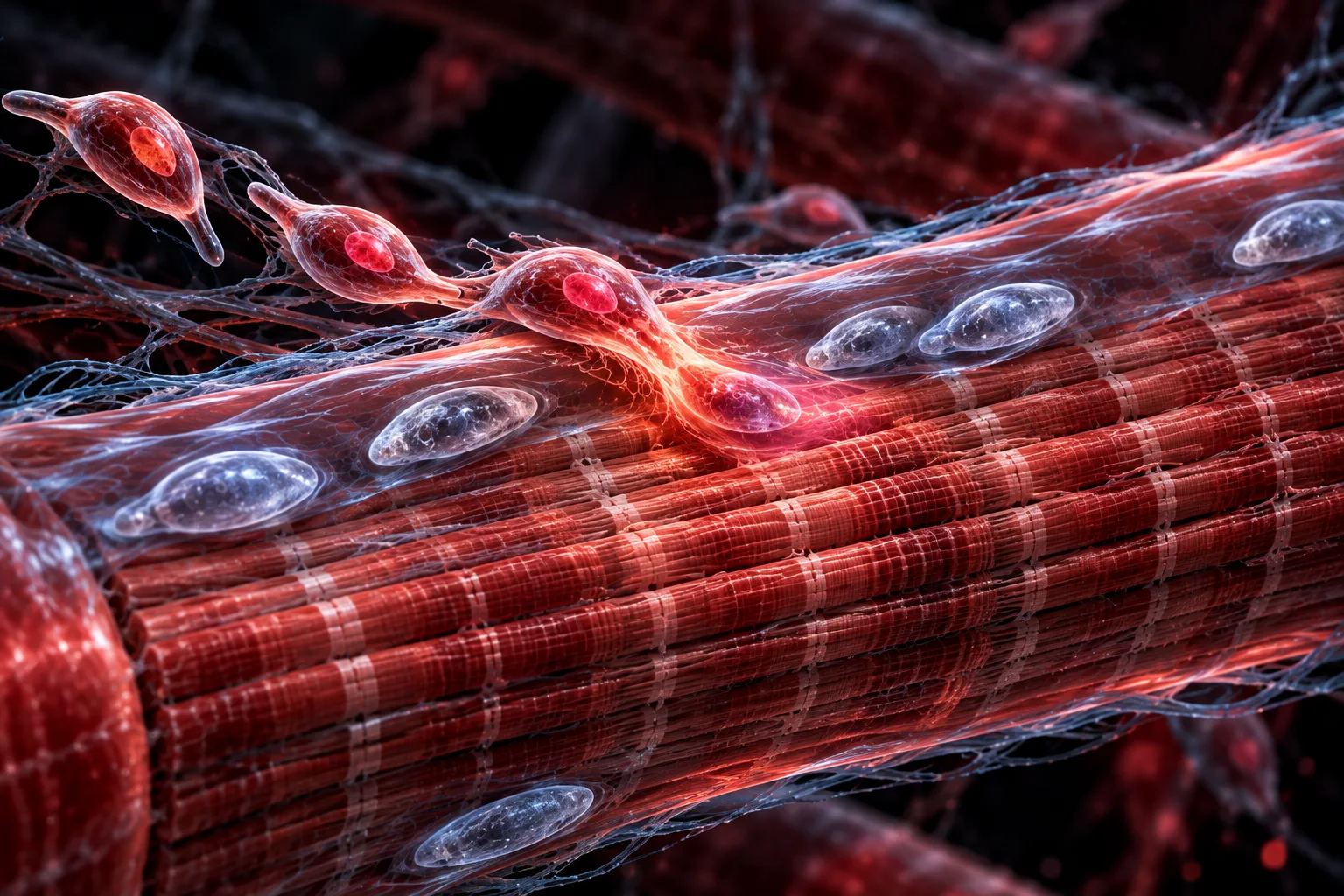
Nuclei, once added, appear to stay, which matters for what builds muscle back after a layoff. In mice, new myonuclei were added before any major increase in fibre size during overload, and both old and new nuclei were retained through severe atrophy afterwards, protected from the cell death seen in inactive tissue; the authors propose the nuclei as the substrate for muscle memory and note that anabolic steroids facilitate more of them (PMID 20713720). That is animal data, but it fits the human finding that retraining after a 3-week break grew muscle at least as fast as continuous training (PMID 23053130).
One more cellular distinction matters for what builds muscle mass that lasts. In 30 trained men doing 6 weeks of very high volume, the 15 whose fibres grew did so by 23 percent, yet actin and myosin concentrations fell by about 30 percent and sarcoplasmic proteins, mostly glycolytic enzymes, rose; 8 days after the last session the sarcoplasmic fraction was still 66 percent above baseline and contractile protein still about 50 percent below (PMID 31166954). A bigger fibre in a short high-volume block is not necessarily a fibre with more contractile protein in it.
How long do muscles take to grow: what builds muscle in the first ten weeks
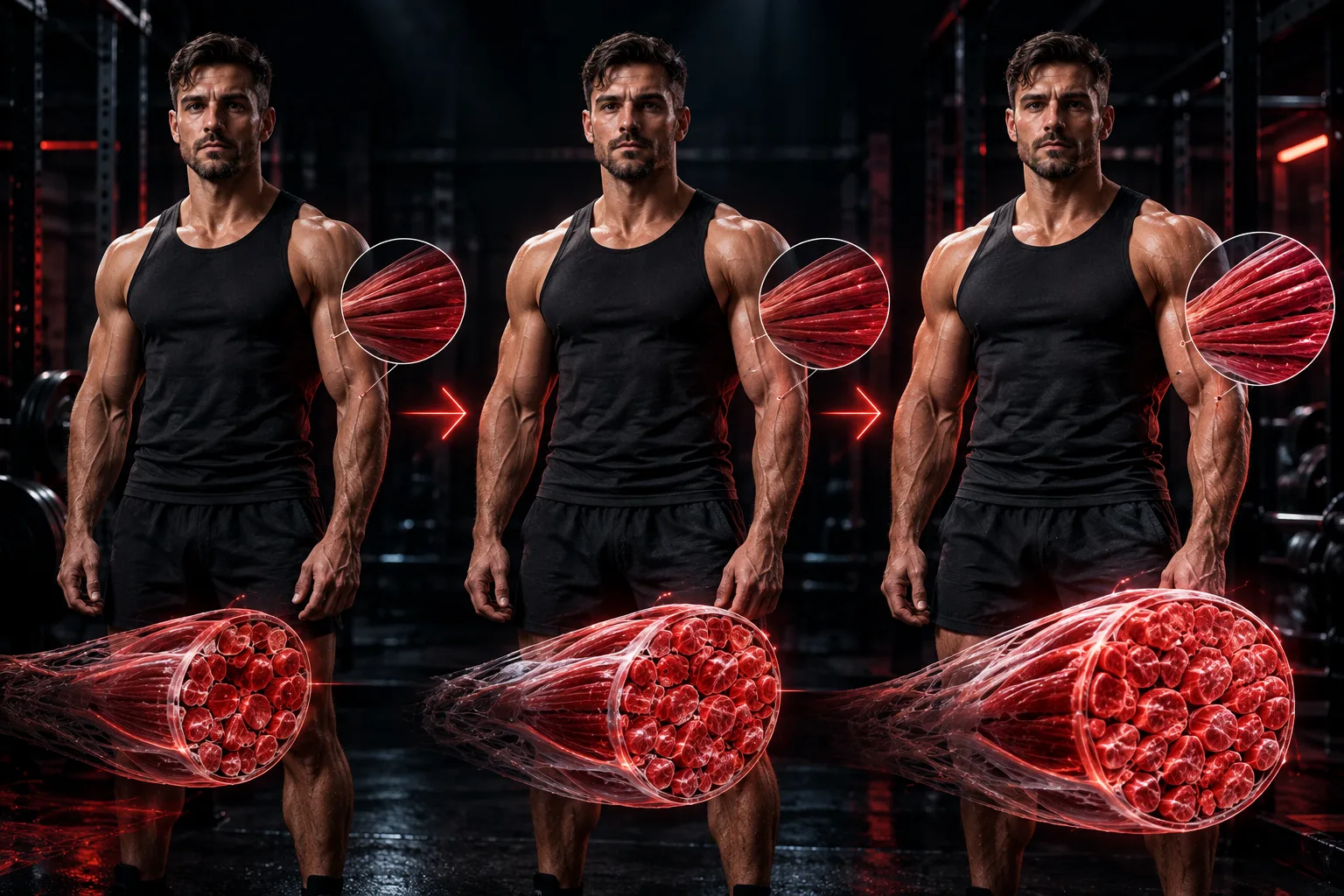
How do muscles grow across a programme, and when can you see it? In 25 sedentary men scanned every week for 8 weeks, thigh cross-sectional area was already 3.46 percent larger after two sessions, an increase the authors attribute mostly to oedema; treating week 1 as the inflated baseline, the next significant increase came at week 3, strength first rose at week 4, and by week 8 the thigh was 9.60 percent larger (PMID 21409401). The biopsy study of how do muscles grow found the same pattern at the fibre: no significant fibre growth at week 3, clear growth by week 10 (PMID 27219125).

The review that pooled these data proposes three phases: through the first four sessions the rise in cross-sectional area is mostly damage-induced swelling, after about 10 sessions a modest degree of real hypertrophy appears, and only after about 18 sessions is true hypertrophy observed (PMID 29282529). What builds muscle in month one is therefore invisible for most of month one; the tape measure moves before the muscle does, then stalls while the real work starts. A lifter who judges a programme at two weeks is judging water.
Growth also slows. In 14 men training the bench press for 24 weeks, size and strength rose steadily for the first 6 weeks and the rate then fell in the continuous group, while the group that took 3 weeks off after every 6 weeks regrew at the original rate each cycle and finished with the same total (PMID 23053130). The first weeks of any block are the fast ones, and the slowdown is part of the normal course of what builds muscle, not a sign that the programme stopped working. The individual variation in that rate is covered below; the recovery side is on recovery and fatigue.
Load, reps, failure, range of motion: what changes what builds muscle
Bar weight is the variable lifters argue about most, and the one the hypertrophy data care about least. In 18 young men training one leg at 30 percent of maximum for 3 sets and the other at 80 percent for 1 or 3 sets, all to failure, muscle volume rose 6.8, 3.2 and 7.2 percent, with no significant difference; the light leg grew as much as the heavy 3-set leg, and strength favoured the heavy load (PMID 22518835).
In 49 trained men over 12 weeks, 20 to 25 reps at 30 to 50 percent and 8 to 12 reps at 75 to 90 percent, all to failure, produced the same lean mass and fibre growth (PMID 27174923).
Across 28 studies and 747 adults, hypertrophy did not differ between loads above 15, 9 to 15 and 8 or fewer reps when sets went to failure, while strength favoured heavier loads (PMID 33433148).
| Variable | Evidence | Read as |
|---|---|---|
| Load, sets to failure | 30 percent and 80 percent loads grew muscle equally in untrained (PMID 22518835) and trained men (PMID 27174923); no difference across 28 studies (PMID 33433148) | Not what builds muscle; what builds strength |
| Proximity to failure | Trivial advantage for any set-failure definition, effect size 0.19; none for true momentary failure, 0.12 (PMID 36334240) | Close counts; grinding adds little |
| Eccentric versus concentric | Eccentric 10.0 percent versus concentric 6.8 percent across 15 studies, difference 0.25, not significant (PMID 28486337); synthesis after one bout did not differ by contraction type (PMID 9252485) | Keep both; lowering may add a little |
| Muscle length and range of motion | Seated leg curls grew the hamstrings 14 percent against 9 percent prone, the difference in the biarticular heads (PMID 33009197); full or initial-range partials beat end-range partials for quadriceps, biceps and triceps (PMID 36662126) | Train the stretched position |
| Blood flow restriction, low load | Matched high-load training for muscle mass across the meta-analysis, with smaller strength gains (PMID 29043659) | Equal for size when load is impossible |
| Mode of resistance | Free weights, machines, isokinetic and isometric training all produced hypertrophy at comparable rates given enough frequency, intensity and volume; no mode shown superior (PMID 17326698) | Equipment is not what builds muscle |
The one range-of-motion effect on what builds muscle that holds across muscles is length: the hamstrings grew 14 percent with the hip flexed and 9 percent with it extended under identical loads, sets and reps (PMID 33009197), and the review of 11 range-of-motion studies found that training at longer lengths, through full range or partials in the stretched half, tends to produce more growth in the quadriceps, biceps and triceps (PMID 36662126). How sets add up across a week is the subject of training volume explained; the calculators that turn a set into an estimated max are the bench press calculator and squat 1RM calculator.
Protein, calories, creatine and sleep: what builds muscle mass outside the gym
Protein is the only nutrient with a measured dose-response for what builds muscle mass, and the answer to how do muscles grow on more protein has a ceiling. Across 49 randomised trials and 1,863 people, protein supplementation during resistance training added 0.30 kg of fat-free mass, 2.49 kg on the one-repetition maximum, 310 square micrometres of fibre area and 7.2 square millimetres of mid-thigh area; the effect was larger in trained people, smaller with age, and disappeared once total intake passed 1.62 g/kg/day (PMID 28698222). Distribution matters within the day: 4 doses of 20 g every 3 hours beat 8 doses of 10 g and 2 doses of 40 g for synthesis over 12 hours after training (PMID 23459753).
| Input | Evidence | Read as |
|---|---|---|
| Total protein | +0.30 kg fat-free mass with supplementation; no further gain beyond 1.62 g/kg/day across 49 trials (PMID 28698222) | Up to about 1.6 g/kg builds; beyond adds nothing measured |
| Protein pattern | 20 g every 3 hours raised synthesis 31 to 48 percent more than 10 g every 1.5 hours or 40 g every 6 hours (PMID 23459753) | Spread into several real doses |
| Energy surplus | In 17 trained lifters over 8 weeks, a 15 percent surplus raised bench press more than maintenance but mainly increased skinfolds; body mass gain predicted fat gain, R squared 0.49, and only weakly predicted biceps thickness (PMID 37914977) | Larger surpluses mostly build fat |
| Creatine | Pooled effect 0.11 on direct imaging measures across 10 trials, 0.10 to 0.16 cm more muscle thickness, slightly larger in younger adults (PMID 37432300) | Small, real, measured |
| Sleep | One night of total sleep deprivation cut postprandial muscle protein synthesis by 18 percent, raised cortisol 21 percent and lowered testosterone 24 percent in 13 young adults (PMID 33400856) | One bad night blunts the pathway |
| Age | Protein effect on fat-free mass fell 0.01 kg per year of age (PMID 28698222); older adults needed a higher weekly dose than the young to keep fibre size (PMID 21131862); resistance exercise still builds lean mass in older adults with a dose-response to volume and intensity (PMID 21396499) | Same process, more input needed |
Calories are the input lifters overestimate when they ask what builds muscle mass. In the surplus trial the high-surplus group gained the most body mass and the most skinfold thickness, and the regression across all 17 lifters found that faster body-mass gain mainly predicted fat gain rather than muscle thickness or strength (PMID 37914977). Enough food to train hard and recover is part of what builds muscle; a large surplus is mostly a different project. The arithmetic is on calories and energy balance and bulking vs cutting nutrition; creatine timing on creatine before or after workout.
Why the same programme builds different muscle: what builds muscle mass in one person and not another
The widest study of what builds muscle mass in real people trained 585 men and women on the same 12-week arm programme. Biceps size changed from minus 2 to plus 59 percent, strength from 0 to 250 percent; the coefficient of variation for size change was about 0.5 in both sexes, and men gained 2.5 percent more size while women gained more relative strength (PMID 15947721). Some people doubled their strength and added over 10 square centimetres; some gained nothing measurable. The meta-analysis of 10 studies found no sex difference in hypertrophy, effect size 0.07, with females showing a larger relative upper-body strength effect (PMID 32218059).
Two of the measured reasons what builds muscle differs between people have appeared already: baseline satellite cell count (PMID 18436694) and early ribosome accumulation (PMID 31813190). Age is a third. The protein effect on fat-free mass shrank with every year of age (PMID 28698222), adults aged 60 to 75 could not hold trained fibre size on the reduced doses that kept it in 20 to 35 year olds (PMID 21131862), and the ability to create new myonuclei is impaired in the elderly, which the mouse data suggest is why training young leaves a durable nuclear legacy (PMID 20713720). Resistance exercise still works in older adults, with a clear dose-response to volume and intensity (PMID 21396499).
None of this changes what builds muscle; it changes how much a given dose builds in a given person. The lifter who gained nothing in 12 weeks in that study was not on the wrong programme in any way the data can show; the dose that works for most people, and the volume that works for the individual, is the subject of training volume explained. Body-composition arithmetic is on the lean body mass calculator and FFMI calculator.
What builds muscle on anabolic steroids: what men describe and what was measured
Testosterone is the one input to what builds muscle with a measured dose-response that runs the same direction as training. In 61 healthy men aged 18 to 35 whose own production was suppressed, weekly testosterone enanthate at 125 mg, 300 mg or 600 mg for 20 weeks raised fat-free mass by 3.4, 5.2 and 7.9 kg, with trough blood levels of 542, 1,345 and 2,370 ng/dL; the two lowest doses, 25 mg and 50 mg, produced levels of 253 and 306 ng/dL and no gain, and the whole relationship was linear against log testosterone, r 0.73 (PMID 11701431). No training programme was part of that study (PMID 11701431).

Combined with training, what builds muscle on the drug adds to what builds muscle in the gym rather than replacing it. In 43 normal men, 600 mg of testosterone enanthate a week for 10 weeks without exercise grew the triceps by 424 square millimetres and the quadriceps by 607 against a loss on placebo, and with a three-day lifting programme the same dose added 6.1 kg of fat-free mass and 1,174 square millimetres of quadriceps area, more than either no-exercise group and more than placebo plus exercise (PMID 8637535). Testosterone without training built more muscle than training without testosterone in that trial (PMID 8637535).
What men describe. On forums, enhanced lifters describe muscle appearing within the first weeks of a cycle, strength rising session to session, tolerance for far more weekly sets, fuller muscles from water and glycogen, and a loss of some size and most of the extra strength in the months after stopping (forum posts). They describe the gains as easier to rebuild on a second cycle (forum posts).
What is measured. Fat-free mass rises with dose in a linear fashion and training adds to it (PMID 11701431, PMID 8637535). In mice, anabolic steroids facilitate the addition of myonuclei, and nuclei added during overload are retained through later atrophy, which the authors note has implications for how long a doping advantage might last (PMID 20713720). No trial on this page has measured myonuclear retention after a steroid cycle in humans, so the forum description of easier regrowth is consistent with the animal data and not confirmed by human data. The mechanism by which the drug builds muscle, more nuclei and more synthesis per nucleus, is the same mechanism as training; the drug turns the dial further.
Nothing here is a protocol. The pharmacology is on what are anabolic steroids and the steroids hub, the specific ester used in both trials on testosterone enanthate, and what the axis does afterwards on post-cycle therapy.
What lifters describe about what builds muscle that the trials have not measured
The gym vocabulary for what builds muscle and how do muscles grow is older than the biopsy data and some of it still points at real gaps. Nothing in this section is evidence; it is a record of what lifters report, kept apart from what has been measured.
What lifters describe. The pump as a sign a session worked; soreness as proof of stimulus; mind-muscle connection; newbie gains that run for six to twelve months; hard gainers who eat and lift and do not grow; muscle memory after a layoff; and the belief that heavy compound lifts build more total muscle than isolation work because they raise hormones (forum posts).
What is measured. Soreness and damage are highest when they predict nothing (PMID 27219125, PMID 29282529). The hormone rationale for compound lifts has been tested twice and failed twice (PMID 19910330, PMID 27174923). Newbie gains have a measured shape, fast for 6 weeks and then slowing (PMID 23053130), and a measured spread, from nothing to 59 percent in 12 weeks (PMID 15947721).
What is measured, continued. Hard gainers exist in the data as non-responders with fewer satellite cells (PMID 18436694) and less early ribosome accumulation (PMID 31813190). Muscle memory has a cellular candidate in retained nuclei, so far shown in mice (PMID 20713720), and a measured human analogue in retraining speed (PMID 23053130). The pump and the mind-muscle connection are not measured by any trial on this page.
Five mistakes about what builds muscle that the trials expose
Each comes from treating one signal as the whole answer to what builds muscle.
1. Chasing soreness. Damage was highest after session one and unrelated to growth; the synthesis that predicted growth came later, after damage faded (PMID 27219125). Protocols that cause little damage grow muscle just as well (PMID 29282529).
2. Chasing the hormone spike. Heavy leg work after arm training raised growth hormone, IGF-1 and testosterone and did not add a millimetre to the arm (PMID 19910330); no post-exercise hormone correlated with growth in 49 trained men (PMID 27174923). Compound lifts are worth doing for other reasons.
3. Judging what builds muscle at two weeks. The thigh was 3.46 percent larger after two sessions, mostly from oedema; real growth started at weeks 3 to 4 (PMID 21409401). Fibre size had not moved at week 3 and had by week 10 (PMID 27219125).
4. Believing the bar weight is what builds muscle. It is what builds strength. Size was the same at 30 percent and 80 percent of maximum when sets went to failure, in untrained and trained men and across 28 studies (PMID 22518835, PMID 27174923, PMID 33433148).
5. Eating for a number on the scale. Faster body-mass gain mainly predicted fat gain in trained lifters (PMID 37914977), and protein beyond 1.62 g/kg/day added no fat-free mass (PMID 28698222). One sleepless night cut synthesis 18 percent (PMID 33400856), which no surplus repairs.
Verdict: what builds muscle is tension, repeated, fed and slept on
Read from the mechanism reviews and the biopsy studies rather than from any single rule, what builds muscle and how do muscles grow come down to this. Mechanical tension on the fibre is the stimulus (PMID 30335577); it works through a rise in protein synthesis that lasts about two days (PMID 9252485) and that begins to predict growth only after the damage response of the first weeks has faded (PMID 27219125, PMID 29282529). Growth needs new nuclei from satellite cells and more ribosomes to use them, and people differ in both before they start (PMID 18436694, PMID 31813190). Real size appears at weeks 3 to 4 and is unmistakable by week 8 to 10 (PMID 21409401, PMID 27219125).
Load does not change what builds muscle if the set is hard (PMID 22518835, PMID 27174923, PMID 33433148), hard means close to failure rather than at it (PMID 36334240), and the stretched position grows more (PMID 33009197, PMID 36662126). Protein up to about 1.6 g/kg/day adds to the result, a large surplus mostly adds fat, creatine adds a little, and one night without sleep subtracts (PMID 28698222, PMID 37914977, PMID 37432300, PMID 33400856). Testosterone turns the same dial further, in a straight line with dose (PMID 11701431, PMID 8637535).
For readers here the practical reading is that how do muscles grow has a short answer and a long one. Short: train each muscle hard, close to failure, through a long range, often enough that the 48-hour windows overlap, eat about 1.6 g/kg of protein (PMID 28698222), sleep, and wait past week three before judging. Long: the rest of this page. The dose side of the question is on training volume explained and the loading side on progressive overload explained; when the calories change, cutting vs bulking training covers what the same stimulus does. The hub is training hub.
What builds muscle: frequently asked questions
What builds muscle?
Mechanical tension on a muscle fibre, repeated often enough that protein synthesis after each session outpaces breakdown. Synthesis rises 112 percent at 3 hours and is still 34 percent up at 48 hours after one bout (PMID 9252485), and from about week 3 of a programme the size of that response predicts growth (PMID 27219125). Mechanical signals are the prime stimulus candidate and damage is probably not required (PMID 30335577). Load is not what builds muscle when sets are hard: 30 percent and 80 percent of maximum grew the same muscle (PMID 22518835, PMID 27174923).
How do muscles grow at the cell level?
How do muscles grow at the cell level is by adding protein and, past a point, by adding nuclei. In 66 adults trained for 16 weeks, the fibres of extreme responders grew 58 percent and gained 26 percent more myonuclei from satellite cells, modest responders grew 28 percent with 9 percent more nuclei, and non-responders grew 0 percent with no change (PMID 18436694). Ribosome content in the first two weeks predicted who benefited from more volume (PMID 31813190). In mice, nuclei added during growth were kept through later atrophy (PMID 20713720).
How long does it take to build muscle?
Real growth starts around weeks 3 to 4, which is when what builds muscle becomes visible. In 25 untrained men scanned weekly, the thigh was 3.46 percent larger after two sessions, mostly oedema; the next significant rise came at week 3, strength at week 4, and the total at week 8 was 9.60 percent (PMID 21409401). Fibre size by biopsy had not changed at week 3 and had by week 10 (PMID 27219125). The review of these data puts modest growth at about 10 sessions and true hypertrophy at about 18 (PMID 29282529).
How do you know if your muscles are growing?
Not by soreness and not by the first two weeks; what builds muscle is slower than that. Damage was highest after session one and unrelated to growth (PMID 27219125), and the early size increase was mostly swelling (PMID 21409401). Measured size changes in the first 8 weeks of a beginner programme were 9.60 percent for the thigh (PMID 21409401), and 12-week biceps changes ranged from minus 2 to plus 59 percent in 585 people (PMID 15947721). Strength first rose at week 4 in the weekly-scan study (PMID 21409401); a tape measure or scan at 8 to 12 weeks is the honest test.
Does lifting heavy build more muscle than lifting light?
Not when both are taken to failure; load is not what builds muscle mass, it is what builds strength. Legs trained at 30 percent of maximum for 3 sets grew 6.8 percent against 7.2 percent at 80 percent for 3 sets (PMID 22518835); trained men on 20 to 25 reps and 8 to 12 reps gained the same lean mass and fibre size (PMID 27174923); 28 studies of 747 adults found no difference in hypertrophy between loads (PMID 33433148). Heavy loads build more strength in every one of those studies. Blood-flow-restricted light training also matched heavy training for mass (PMID 29043659).
How much protein do you need to build muscle?
Up to about 1.6 g/kg of body weight a day (PMID 28698222). Across 49 trials and 1,863 people, protein supplementation added 0.30 kg of fat-free mass and 2.49 kg on the one-repetition maximum, and intakes beyond 1.62 g/kg/day added no further fat-free mass (PMID 28698222). Spreading it helps: 20 g every 3 hours raised synthesis more than 10 g every 1.5 hours or 40 g every 6 hours over 12 hours after training (PMID 23459753). The protein effect shrinks with age and is larger in trained people (PMID 28698222).
Do testosterone and growth hormone spikes after a workout build muscle?
No, the spike is not what builds muscle. Arms trained with a heavy leg session afterwards, which raised growth hormone, IGF-1 and testosterone for 30 minutes, grew 10 percent against 12 percent in arms trained alone, with no difference in fibre size (PMID 19910330). In 49 trained men no post-exercise hormone rise correlated with growth or strength (PMID 27174923). Sustained testosterone is different: administered weekly for 20 weeks it raised fat-free mass in a straight line with dose, 3.4 to 7.9 kg (PMID 11701431).
Is muscle memory real?
The human data say retraining is fast and the animal data offer a reason, which makes muscle memory part of what builds muscle back. Men who took 3 weeks off after every 6 weeks of bench training regrew at the original rate each cycle and finished 24 weeks with the same size as continuous training (PMID 23053130). Young adults kept trained fibre size for 32 weeks on one ninth of the dose (PMID 21131862). In mice, nuclei added during overload were retained through severe atrophy and are proposed as the memory substrate (PMID 20713720); that step has not been measured in people.
Sources and further reading
Every figure on this page about what builds muscle comes from one of the 32 papers below, each checked against its PubMed abstract on 5 October 2026. One mouse study is included and labelled as such in the text. Forum descriptions are reported as descriptions and carry no reference number. Reference links are dofollow to support open science.
Keep reading
Four pages from the training series: how many sets deliver the stimulus, how to load it, how to recover from it, and why a sore tendon does not follow muscle rules.
Final Educational Note
This article is educational and is not medical or coaching advice. It reports what randomised trials, biopsy studies and meta-analyses say about what builds muscle, and it reports how some lifters describe their own experience, including on anabolic steroids, as a description of practice, not as guidance. Drug doses appear only as the trials used them; the page gives no programme or protocol, does not recommend any drug, and is not an encouragement to use performance-enhancing drugs, which carry serious health and legal risks. More guides sit on the training hub.
Joint pain that changes how a lift is performed, loss of strength across several sessions, persistent fatigue, disturbed sleep or dark urine after training are reasons to stop and consult a physician or a qualified coach. Individual response to training varies widely. Read more about how this site works on the about page and in the full disclaimer.