Types of Peptides: GH Secretagogues, Healing, Metabolic and Cosmetic Classes
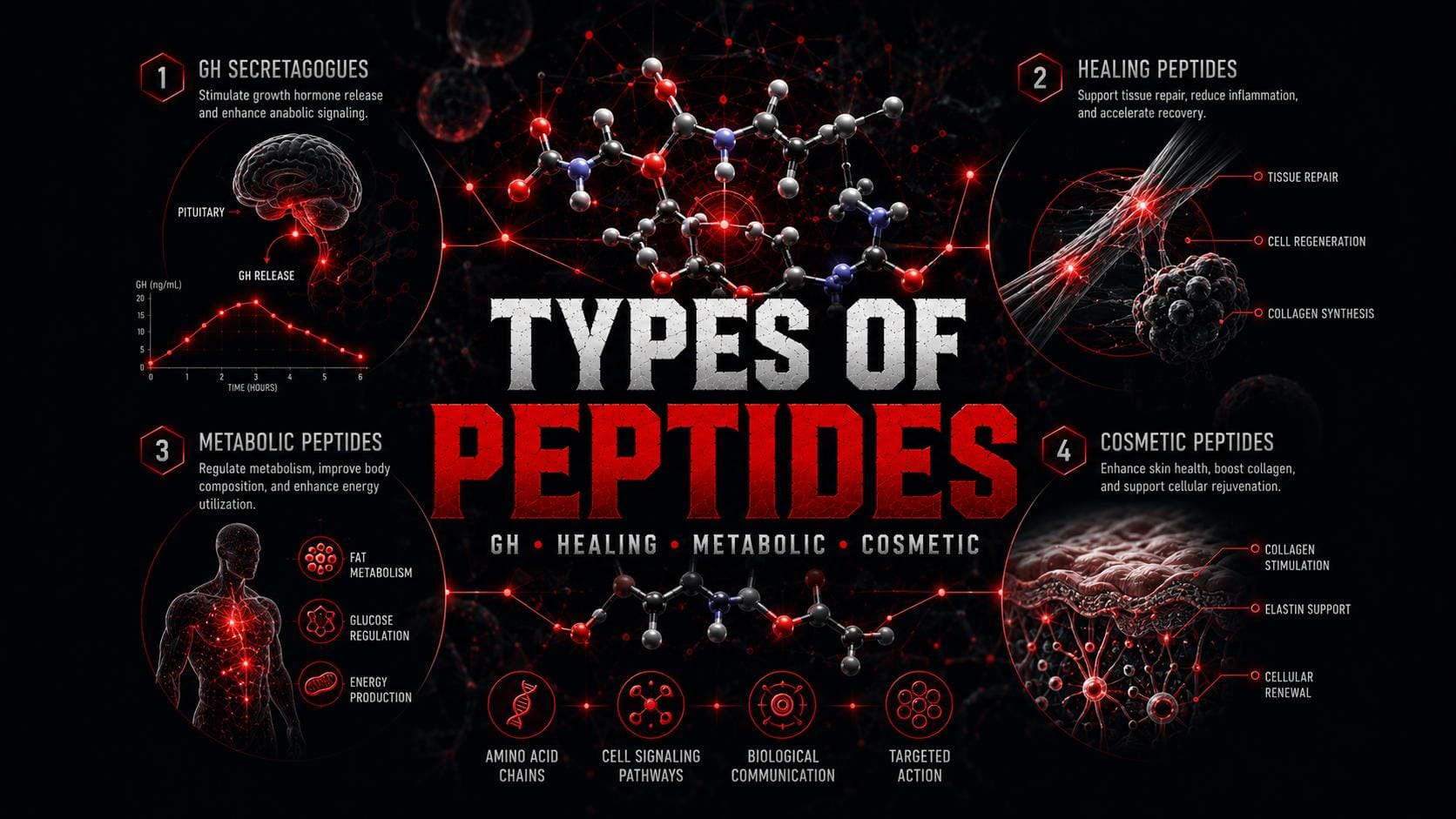
TYPES OF PEPTIDES: GH SECRETAGOGUES, HEALING, METABOLIC AND COSMETIC CLASSES
There are thousands of peptides in your body and more than 80 on pharmacy shelves (PMID 33536635). The ones people search for fit into four types by what they do: metabolic peptides that cut appetite and weight, growth hormone peptides that push your pituitary, healing peptides sold for tendons and joints, and skin peptides in creams and powders. This page is the list of peptides and what they do, sorted into those types, with one honest line on each: what human trials have shown and whether any regulator has approved it.
Plain words, every number from a PubMed abstract or a regulator page. Twenty peptides in one table, then a section on each type, then the FDA approved list and the ten most searched. Each compound with its own deep page on this site is linked as you go. If you need the basics first, start with what are peptides.
Types of peptides in brief
Three numbers tell most of the story. How many types matter in practice. How many of the 20 listed peptides are approved for anything. And how big the gap is between the best studied and the most hyped.
Metabolic, growth hormone axis, healing, and skin and other. Almost every peptide people search for fits one of them
Sorting by what a peptide does is the only sort that tells you what to expect from it. A GLP-1 copy cuts appetite. A GHRH copy raises growth hormone. A healing peptide is meant to move cells into a wound. Nothing in one type does the job of another.
Peptides in the list below that a regulator has cleared for at least one human use today
Insulin, semaglutide, tirzepatide, liraglutide, tesamorelin and oxytocin. Sermorelin was approved and later withdrawn. The other 13 are research chemicals, cosmetic ingredients, a supplement, or a hormone that is not a drug. Approved means for one condition, not for muscle or anti ageing.
Tirzepatide's main obesity trial against every human study of the TB-500 fragment
Tirzepatide cut body weight 20.9 percent at the top dose over 72 weeks in 2539 adults (PMID 35658024). TB-500, sold for healing, has been given to rats and horses and never to a person in a published study. Both are peptides. That is the range this list covers.
Every figure on this page comes from a PubMed abstract or a regulator document listed at the end. No dose, schedule or protocol appears for any unapproved compound. Nothing here is a recommendation to use any peptide.
What this guide covers
Three ways to sort peptides: by where they come from, by what they do, and by how much evidence they have.
The list of 20 peptides and what they do, in one table, with human trial results and approval status.
One section per type, the FDA approved list, and the ten most searched, each linked to its own page where one exists.
Not covered
Doses or protocols. The unapproved peptides have no human dose. This page gives no protocol for anything.
Where to buy anything. This site does not sell or source peptides and does not link to sellers.
The basics of what a peptide is. That is on what are peptides. The whole field sits on the peptides hub.
Three ways to sort the different types of peptides
By where they come from. Some are your own hormones, made in your body: insulin, ghrelin, oxytocin, GLP-1. Some are drugs built by copying or editing those hormones: semaglutide is edited GLP-1, tesamorelin is stabilised GHRH. And some are research chemicals: molecules that went into a lab programme, usually stalled, and are now sold online without approval. CJC-1295, ipamorelin, BPC-157 and TB-500 are all in that last group.
By what they do. This is the sort that matters for a reader, and it is how this page is organised. Metabolic peptides act on appetite and blood sugar. Growth hormone peptides tell the pituitary to release growth hormone. Healing peptides are meant to move cells into damaged tissue. Skin peptides are meant to signal more collagen. A peptide from one type does not do the job of another, no matter what a stack guide says.
By how much evidence they have. At the top, approved drugs with trials of thousands of people. In the middle, compounds with small human trials or a failed programme. At the bottom, compounds with rat studies or nothing. The table below puts every peptide on all three axes at once.
The chart shows the pattern across the different types of peptides. The metabolic type is almost all approved medicine. The growth hormone type has one approved drug and six research chemicals. The healing type has none. Skin and other is a mix of your own hormones, cosmetic ingredients and two research chemicals. When someone talks about peptides as if they were one thing, this chart is the answer.
The list of peptides and what they do
Here is the list. Read the fourth column before anything else. It says whether anyone has measured what the peptide does in people, and in how many.
| Peptide | Type | What it does | Best human evidence | Status |
|---|---|---|---|---|
| Semaglutide (Ozempic, Wegovy) | Metabolic | Edited GLP-1 copy; cuts appetite, raises insulin after meals | Body weight down 14.9 percent vs 2.4 percent on placebo over 68 weeks in 1961 adults (PMID 33567185) | Approved |
| Tirzepatide (Mounjaro, Zepbound) | Metabolic | Hits GLP-1 and GIP receptors | Body weight down 20.9 percent at 15 mg vs 3.1 percent on placebo over 72 weeks in 2539 adults (PMID 35658024) | Approved |
| Liraglutide (Saxenda, Victoza) | Metabolic | Daily GLP-1 copy | Lost 8.4 kg vs 2.8 kg on placebo over 56 weeks in 3731 patients (PMID 26132939) | Approved |
| Retatrutide | Metabolic | Hits GLP-1, GIP and glucagon receptors | Body weight down 24.2 percent at 12 mg vs 2.1 percent on placebo over 48 weeks in 338 adults, phase 2 (PMID 37366315) | In phase 3 trials, not approved |
| Tesamorelin (Egrifta) | Growth hormone | Stabilised GHRH; raises growth hormone and IGF-1 | Deep belly fat down 15.2 percent vs up 5.0 percent on placebo in 412 HIV patients (PMID 18057338) | Approved for HIV belly fat only |
| Sermorelin | Growth hormone | First 29 amino acids of GHRH (PMID 15817669) | Lean mass up in older men but not women over 16 weeks nightly (PMID 9141536) | Formerly approved, withdrawn for business reasons |
| CJC-1295 | Growth hormone | GHRH copy with an albumin hook, lasts a week | GH up 2 to 10 times for 6 days after one shot in healthy adults; hormones only (PMID 16352683) | Research chemical; FDA Category 2 |
| Ipamorelin | Growth hormone | Ghrelin receptor agonist, one GH pulse per dose (PMID 9849822) | One drug level study; failed phase 2 after bowel surgery (PMID 25331030) | Research chemical; FDA Category 2 |
| GHRP-6 | Growth hormone | Ghrelin receptor agonist, strong hunger | Released about 3 times the GH of GHRH alone in men; raised cortisol and prolactin at top dose (PMID 2108187) | Research chemical |
| Hexarelin | Growth hormone | Most potent GHRP | Prolactin up to 180 percent, cortisol about 40 percent in men (PMID 8954038) | Research chemical |
| MK-677 (ibutamoren) | Growth hormone | Oral ghrelin receptor agonist; not a peptide | Lean mass +1.1 kg vs -0.5 kg over a year in 65 older adults; no strength gain; glucose up (PMID 18981485) | Research chemical |
| BPC-157 | Healing | 15 amino acid piece of a stomach protein | Three uncontrolled studies, 30 people, poor quality (PMID 42885452) | Research chemical; FDA Category 2 |
| TB-500 | Healing | 7 amino acid piece of thymosin beta 4 (PMID 23084823) | No human study of the fragment; one rat tendon study (PMID 42542926) | Research chemical |
| Thymosin beta 4 | Healing | The full 43 amino acid protein TB-500 is cut from (PMID 17947592) | Phase 2 trials for leg ulcers and dry eye; no approval yet | In trials, not approved |
| GHK-Cu | Skin and other | 3 amino acid copper peptide (PMID 29986520) | Lab and gene studies; thin controlled human data | Cosmetic ingredient |
| Collagen peptides | Skin and other | Collagen broken into 2 to 3 amino acid fragments | Skin hydration and elasticity better than placebo across 26 trials and 1721 people (PMID 37432180) | Food supplement |
| Insulin | Skin and other | 51 amino acid blood sugar hormone (PMID 34404937) | A century of use since 1922 | Approved |
| Oxytocin | Skin and other | 9 amino acid labour and bonding hormone (PMID 24888645) | Used in hospitals to start labour | Approved |
| Melanotan II | Skin and other | Tanning peptide hitting melanocortin receptors | Case reports of kidney injury and rhabdomyolysis (PMID 31953620) | Research chemical, unapproved |
| AOD-9604 | Skin and other | Fragment 177 to 191 of growth hormone sold for fat loss (PMID 25208511) | Obesity programme stalled at phase 2; banned by WADA | Research chemical |
Two patterns jump out. First, the four metabolic peptides have trials with 338 to 3731 people each, and three are approved. Second, the seven growth hormone peptides and three healing peptides have one approved drug between them. The most popular ones, CJC-1295, ipamorelin, BPC-157 and TB-500, have hormone curves, 30 people, or nothing.
Metabolic peptides: the GLP-1 family
These are the peptides that made the word famous. GLP-1 is a gut hormone released after a meal. It tells the pancreas to release insulin, slows the stomach, and tells the brain you are full (PMID 29617641). The drugs are edited copies that last a day or a week instead of minutes.
Semaglutide is a 31 amino acid copy with two swapped amino acids and a fatty acid tail that binds albumin. In 1961 adults with obesity, 2.4 mg a week for 68 weeks cut body weight 14.9 percent against 2.4 percent on placebo (PMID 33567185). Tirzepatide hits GLP-1 and a second gut hormone receptor, GIP. In 2539 adults, 15 mg a week for 72 weeks cut body weight 20.9 percent against 3.1 percent on placebo. More than half lost a fifth of their body weight (PMID 35658024). Liraglutide is the older daily version: 8.4 kg lost against 2.8 kg on placebo over 56 weeks in 3731 patients (PMID 26132939).
Retatrutide is the next one, hitting three receptors. In a phase 2 trial of 338 adults, 12 mg a week for 48 weeks cut body weight 24.2 percent against 2.1 percent on placebo. Gut side effects and a rise in heart rate came with it (PMID 37366315). It is in phase 3 and not approved. Vendors already sell it. That is the research chemical market at work: a real drug, a real trial, and a vial with no quality control.
Growth hormone peptides: GHRH copies and GHRPs
These peptides do not contain growth hormone. They ask your pituitary to release more of its own. Two doors lead in. GHRH copies, sermorelin, tesamorelin and CJC-1295, use the GHRH receptor. Growth hormone releasing peptides, GHRP-6, hexarelin and ipamorelin, use the ghrelin receptor. MK-677 is a pill that uses the ghrelin receptor and is not a peptide at all (PMID 18981485).
They reliably raise growth hormone. One CJC-1295 shot raised it 2 to 10 times for six days in healthy adults (PMID 16352683). GHRP-6 released about three times what GHRH released in normal men (PMID 2108187). What they have not shown is that the extra hormone becomes muscle. Growth hormone itself added about 2 kg of lean mass without strength or muscle size gains in fit adults who train (PMID 18347346). Only MK-677 has a body composition trial: 1.1 kg of lean mass in a year in older adults, no strength, worse blood sugar (PMID 18981485).
The one approved drug in the type is tesamorelin, for belly fat in HIV patients. It cut deep belly fat 15.2 percent over 26 weeks in 412 people (PMID 18057338). The rest are research chemicals, and CJC-1295 and ipamorelin were placed in FDA Category 2 for compounding in 2023. The full ranking is on growth hormone peptides, with deep pages on CJC-1295, ipamorelin and tesamorelin.
Healing peptides: BPC-157, TB-500 and thymosin beta 4
These are sold for tendons, joints, gut and recovery. The idea is that they move cells into damaged tissue and grow new blood vessels. In rats, both BPC-157 and TB-500 have done exactly that. In people, the record is close to empty.
BPC-157 is a 15 amino acid piece of a stomach protein. A 2026 systematic review found three human studies with 30 patients between them, all uncontrolled, all rated poor quality (PMID 42885452). TB-500 is a 7 amino acid piece of thymosin beta 4 (PMID 23084823). The fragment has never been given to a person in a published study. Its one healing result is a rat tendon study from 2026 (PMID 42542926). Thymosin beta 4 is the full 43 amino acid protein (PMID 17947592). It has real phase 2 trials for leg ulcers and dry eye, and no approval yet.
The type has no approved member. BPC-157 sits in FDA Category 2. Both BPC-157 and TB-500 are banned in tested sport. The group is on healing peptides, with deep pages on BPC-157 and TB-500.
Skin peptides and the rest
Collagen peptides are collagen broken into fragments you swallow. This is the one supplement in the whole field with decent human data. Hydration and elasticity were better than placebo across 26 trials and 1721 people (PMID 37432180). GHK-Cu is a three amino acid copper peptide in creams and, lately, injectable vials. Its evidence is mostly cell and gene studies (PMID 29986520). Melanotan II is a tanning peptide that also causes erections and nausea. It is unapproved and has case reports of kidney injury and muscle breakdown (PMID 31953620). AOD-9604 is a fragment of growth hormone sold for fat loss; its obesity programme stalled at phase 2 and WADA bans it (PMID 25208511).
Your own hormones round out the list. Insulin, 51 amino acids, the first peptide drug and still the proof of what a peptide can do (PMID 34404937). Oxytocin, nine amino acids, used in hospitals to start labour (PMID 24888645). They are here to make the point: the word peptide covers insulin and a tanning vial equally. Only the trials tell them apart.
The list of FDA approved peptides, from this page
People ask for a list of FDA approved peptides. The full list runs to more than 80 drugs across diabetes, cancer, HIV, osteoporosis and more (PMID 33536635). From the 20 on this page, six have an approval today: insulin, semaglutide, tirzepatide, liraglutide, tesamorelin and oxytocin. Sermorelin was approved and later withdrawn for business reasons. None of the six is approved for muscle growth, recovery or anti ageing.
The opposite list matters more for a gym reader. In September 2023 the FDA placed BPC-157, CJC-1295 and ipamorelin in Category 2 of its bulk drug substances list for compounding. That is the category for significant safety risks. That effectively stops US pharmacies from compounding them. Clinics still selling them after that date are working around the rule.
The 10 most searched peptides, by type
People ask what the top 10 peptides are. By search volume, here they are, each with its type and its one honest line.
1. Semaglutide, metabolic
Approved. Body weight down 14.9 percent over 68 weeks in 1961 adults (PMID 33567185).
2. BPC-157, healing
Research chemical. 30 humans in three uncontrolled studies (PMID 42885452). Full page.
3. Tirzepatide, metabolic
Approved. Body weight down 20.9 percent over 72 weeks in 2539 adults (PMID 35658024).
4. Collagen peptides, skin
Supplement. Modest real gains in skin hydration and elasticity across 26 trials (PMID 37432180).
5. Retatrutide, metabolic
In phase 3, not approved. Body weight down 24.2 percent over 48 weeks in 338 adults (PMID 37366315).
6. Tesamorelin, growth hormone
Approved for HIV belly fat. 15.2 percent less deep belly fat over 26 weeks (PMID 18057338). Full page.
7. CJC-1295, growth hormone
Research chemical. Two phase 1 trials, hormones only (PMID 16352683). Full page.
8. Ipamorelin, growth hormone
Research chemical. One drug level study, one failed trial (PMID 25331030). Full page.
9. TB-500, healing
Research chemical. Zero human studies of the fragment. Full page.
10. GHK-Cu, skin
Cosmetic ingredient. Lab and gene studies, thin human trials (PMID 29986520).
Five mistakes people make about the types of peptides
1. Treating all peptides as one type
A GLP-1 copy and a GHRH copy share a molecule class and nothing else. One cuts weight in trials of thousands (PMID 35658024). The other raises a hormone in trials of dozens (PMID 16352683).
2. Borrowing the metabolic type's evidence for the rest
Semaglutide's 1961 person trial does not transfer to a healing peptide with 30 people (PMID 33567185, PMID 42885452). The word peptide carries no evidence with it.
3. Reading approved as approved for your goal
Tesamorelin is approved for belly fat in HIV patients (PMID 18057338). It is not approved for muscle in healthy lifters, and nobody has tested it for that.
4. Calling MK-677 a peptide
It is an oral small molecule that hits the ghrelin receptor. It belongs to the growth hormone type by what it does, not by what it is (PMID 18981485).
5. Trusting the type label on a research vial
A doping lab found altered versions of ipamorelin, GHRP-2 and GHRP-6 sold as the named peptides (PMID 29864719). The type on the label is only as good as the lab that made it.
Verdict: four types, one approved type, and a word that hides the difference
Sort the peptides people search for by what they do and the picture is simple. The metabolic type is approved medicine with trials of thousands (PMID 35658024, PMID 33567185). The growth hormone type has one approved drug for one condition and six research chemicals with hormone curves (PMID 18057338, PMID 16352683). The healing type has rat studies and 30 people (PMID 42885452). The skin type has one good supplement and a lot of cream.
For readers here, the practical conclusion is simple. Find the type first, then find the fourth column. The basics are on what are peptides. The muscle type is on growth hormone peptides. The healing type is on healing peptides. How to read a research listing is on peptide research vs human use. The syringe arithmetic for any vial is on the peptide calculator.
Types of peptides: frequently asked questions
What are the different types of peptides?
By what they do, four types cover almost everything people search for. Metabolic peptides such as semaglutide and tirzepatide cut appetite and weight (PMID 33567185, PMID 35658024). Growth hormone peptides such as CJC-1295, ipamorelin and tesamorelin tell the pituitary to release growth hormone (PMID 16352683). Healing peptides such as BPC-157 and TB-500 are sold for tissue repair (PMID 42885452). Skin peptides such as collagen peptides and GHK-Cu are sold for skin (PMID 37432180). Your own hormones like insulin and oxytocin are peptides too.
What is the list of peptides and what they do?
The table on this page lists 20. In short. Semaglutide, tirzepatide, liraglutide and retatrutide cut weight. Tesamorelin, sermorelin, CJC-1295, ipamorelin, GHRP-6, hexarelin and MK-677 raise growth hormone. BPC-157, TB-500 and thymosin beta 4 are sold for healing. Collagen peptides and GHK-Cu are for skin. Melanotan II is for tanning, AOD-9604 is sold for fat loss. Insulin and oxytocin are your own hormones. Six of the twenty are approved for a human use today, none for muscle or anti ageing.
What are the top 10 peptides?
By search volume: semaglutide, BPC-157, tirzepatide, collagen peptides, retatrutide, tesamorelin, CJC-1295, ipamorelin, TB-500 and GHK-Cu. Three are approved drugs, one is in phase 3, and one is a supplement with trial data. Five are research chemicals with hormone data, 30 people, or no human study at all (PMID 35658024, PMID 42885452).
What is the number one peptide?
For evidence, tirzepatide. It cut body weight 20.9 percent over 72 weeks in 2539 adults, the largest effect in the largest trial on this page (PMID 35658024). For search volume, semaglutide. For gym use, BPC-157, which has 30 humans in its entire record (PMID 42885452). Which one is number one depends on whether you count trials or searches.
Which peptides are FDA approved?
From the 20 on this page: insulin, semaglutide, tirzepatide, liraglutide, tesamorelin and oxytocin, with sermorelin approved in the past and withdrawn for business reasons. Across all medicine, more than 80 peptide drugs are approved (PMID 33536635). BPC-157, CJC-1295 and ipamorelin were placed in FDA Category 2 for compounding in 2023, the category for significant safety risks.
Why would a doctor prescribe peptides?
For a condition with an approved peptide. Diabetes or obesity with a GLP-1 drug (PMID 33567185). HIV related belly fat with tesamorelin (PMID 18057338). Labour with oxytocin, diabetes with insulin. A doctor who prescribes BPC-157, CJC-1295 or ipamorelin is prescribing a research chemical outside any approval. In the US since 2023 that is outside the compounding rules as well.
Are injectable peptides different from oral ones?
Most peptides are digested if swallowed, so they are injected. Semaglutide, tirzepatide, tesamorelin and every gym peptide are injections. The exceptions are collagen peptides, which are meant to be digested into fragments (PMID 37432180), and an oral form of semaglutide. MK-677 is a pill because it is not a peptide (PMID 18981485).
What type of peptide is best for muscle growth?
None has shown muscle growth in a human trial. The growth hormone type raises growth hormone. But growth hormone itself added about 2 kg of lean mass without strength or muscle size gains in fit adults who train (PMID 18347346). The only secretagogue with a lean mass result is MK-677. It added 1.1 kg in a year in older adults, with no strength gain and higher blood sugar (PMID 18981485). The ranking is on the growth hormone peptides page.
Sources and further reading
Every figure on this page comes from one of the 30 sources below. 29 are papers checked against their PubMed abstracts on 25 October 2026, and one is the FDA compounding list. Animal studies are cited as animal studies, never as human results. Reference links are dofollow to support open science.
Verified
Verified
Verified
Verified
Verified
Verified
Verified
Verified
Verified
Verified
Verified
Verified
Verified
Verified
Verified
Verified
Verified
Verified
Verified
Verified
Verified
Verified
Verified
Verified
Verified
Verified
Verified
Verified
Verified
Regulator
Keep reading
Four pages that go deeper: the basics, the muscle type, the healing type, and how to read a research listing.
Final Educational Note
This article is educational and is not medical advice. It sorts the peptides people search for by type and reports what trials, reviews and regulators say about each. It gives no dose, schedule or protocol for any compound and does not recommend any research chemical for any use. Research peptides are not approved for human use anywhere and carry serious health and legal risks. More guides sit on the peptides hub.
Anyone considering any injectable compound outside a prescription should talk to a physician first. Read more about how this site works on the about page and in the full disclaimer.