Testosterone Cypionate
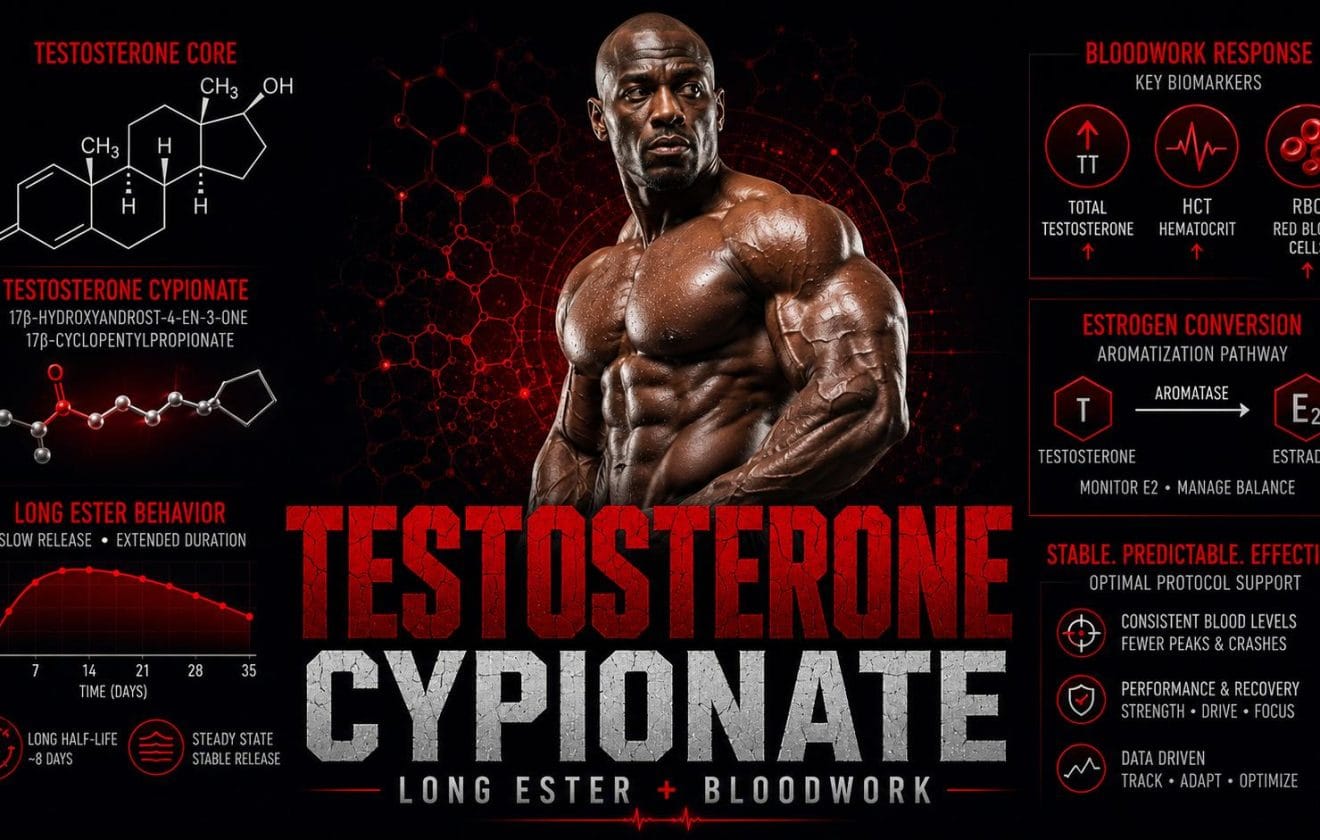
The long-ester testosterone, explained
Testosterone cypionate is a long-ester injectable testosterone with a half-life of approximately 8-12 days, making it one of the most widely used testosterone preparations in clinical and performance contexts. This guide covers the pharmacology of testosterone cypionate, how the cypionate ester differs from enanthate, injection frequency rationale, blood level stability, aromatization, androgenic activity, and the bloodwork markers that require monitoring.
Testosterone Cypionate: Three Core Principles
Long Ester, Stable Levels
Testosterone cypionate has a half-life of approximately 8-12 days. Blood levels rise gradually after injection and decline slowly, allowing once or twice-weekly dosing to maintain stable serum testosterone concentrations throughout the week.
Virtually Identical to Enanthate
Testosterone cypionate and testosterone enanthate differ by a single carbon in the ester chain. Their half-lives, blood level behavior, aromatization rates, and clinical effects are nearly indistinguishable in practice. The distinction is largely one of regional availability and preference, not pharmacology.
Same Monitoring Requirements
The long ester does not reduce the impact of testosterone cypionate on estradiol, hematocrit, lipids, or HPTA suppression. Full bloodwork monitoring applies regardless of ester length. Blood draw timing relative to injection is less critical than with short esters but should still be consistent.
What This Guide Covers
Covered in This Guide
- What testosterone cypionate is and how the ester works
- Half-life, peak timing, and blood level behavior
- Injection frequency and stable concentration rationale
- Detailed comparison to testosterone enanthate
- Aromatization rate and estrogen activity
- Androgenic effects and DHT conversion
- Bloodwork markers relevant to testosterone cypionate use
- Common interpretation errors
Not Covered Here
- Cycle design or stacking protocols
- Specific dosage recommendations
- PCT drugs or recovery protocols
- Sourcing or product quality assessment
- Comparison to non-testosterone compounds
- Testosterone propionate or short-ester protocols
Context: Testosterone cypionate is part of a compound library covering individual anabolic steroids in detail. For the broader category overview of how testosterone esters work, see Testosterone Steroids. For the most direct comparison compound, see Testosterone Enanthate.
What Testosterone Cypionate Is and How It Works
Testosterone cypionate is an anabolic-androgenic steroid consisting of the testosterone molecule esterified at the C17-beta hydroxyl position with a cypionate ester - an eight-carbon chain. Like all testosterone ester preparations, testosterone cypionate functions as a prodrug: the ester temporarily renders the molecule lipophilic and depot-forming when injected intramuscularly, slowing the rate at which active testosterone is released into systemic circulation.
Once injected, testosterone cypionate forms an oil-based depot in muscle tissue. Esterases in the tissue and bloodstream hydrolyze the ester bond at a rate determined by the chain length. The eight carbons of the cypionate ester make this cleavage substantially slower than with propionate (three carbons) or phenylpropionate (four carbons), producing the characteristic long-acting release profile. The resulting free testosterone is pharmacologically identical to endogenous testosterone - it binds androgen receptors, undergoes aromatization to estradiol, converts to dihydrotestosterone via 5-alpha reductase, and suppresses the hypothalamic-pituitary-gonadal axis through negative feedback.
Testosterone cypionate is predominantly associated with US clinical and performance contexts. It is the dominant testosterone formulation in American TRT practice and among the most recognized injectable testosterone preparations globally. This is largely a function of supply and regulatory history rather than any pharmacological advantage over other long-ester testosterone preparations.
Active Testosterone Content per Dose
The cypionate ester accounts for approximately 30% of the molecular weight of testosterone cypionate. This means that a 100 mg dose of testosterone cypionate delivers approximately 70 mg of free testosterone after ester cleavage - slightly less efficient on a per-milligram basis than testosterone propionate (approximately 80-83 mg per 100 mg) but nearly identical to testosterone enanthate (approximately 72 mg per 100 mg). This distinction is clinically minor and rarely relevant in practice, but it explains why equivalent milligram doses of different esters do not produce identical serum testosterone levels. For a detailed breakdown of how ester weight affects active testosterone delivery across preparations, see Testosterone Steroids.
Half-Life and Blood Level Behavior of Testosterone Cypionate
The elimination half-life of testosterone cypionate administered as an intramuscular oil solution is approximately 8-12 days in the published pharmacokinetic literature, with some studies placing it closer to 8 days and others toward 12 depending on the oil vehicle, injection site, and individual metabolism. This places testosterone cypionate among the longer-acting testosterone esters in common use, comparable to testosterone enanthate and substantially longer than testosterone propionate.
Following a single intramuscular injection of testosterone cypionate, serum testosterone begins rising within 24 hours and reaches peak concentration at approximately 2-4 days post-injection. From that peak, levels decline gradually over the following 7-14 days as the depot releases testosterone and the ester is progressively cleaved. The shallow decline curve is what enables once or twice-weekly dosing while maintaining reasonably stable serum testosterone levels - the slow release from the depot counteracts the gradual fall between injections.
Blood Level Stability With Weekly Versus Twice-Weekly Dosing
With a single weekly injection of testosterone cypionate, blood levels follow a moderate arc - rising from the injection toward a peak at days 2-4, then declining toward trough by day 7 when the next injection is due. The peak-to-trough variance with weekly dosing is meaningful but substantially smaller than what occurs with testosterone propionate on a weekly schedule. Twice-weekly injections of testosterone cypionate further flatten this arc, reducing the peak-to-trough swing and producing more consistent serum testosterone throughout the week.
The clinical significance of this variance depends on individual sensitivity to testosterone and estradiol fluctuations. Many individuals tolerate once-weekly testosterone cypionate dosing without noticeable variation in how they feel across the week. Others - particularly those sensitive to estradiol changes - benefit from splitting the dose to twice weekly. Neither schedule changes the pharmacology of testosterone cypionate itself; both deliver the same weekly testosterone load with different stability profiles.
Bloodwork Timing: With testosterone cypionate, blood draws are ideally taken at trough - just before the next scheduled injection. Unlike testosterone propionate, where the steep peak-to-trough curve makes timing critical within hours, testosterone cypionate's long half-life means a draw one or two days early produces results reasonably close to true trough. Consistency across tests matters more than precision on any single draw. For TRT-specific bloodwork context, see TRT Bloodwork and TRT Injection Frequency.
Testosterone Cypionate vs Testosterone Enanthate: What Actually Differs
Testosterone cypionate and testosterone enanthate are functionally the closest pair among commonly used testosterone esters. The cypionate ester has eight carbons; enanthate has seven. The difference in half-life is approximately one to three days depending on study and methodology. In clinical practice, this distinction produces no meaningful difference in blood level behavior, estradiol response, hematocrit elevation, HPTA suppression, or any other biological endpoint. The two compounds are routinely used interchangeably in clinical settings when one becomes unavailable.
The primary differences between testosterone cypionate and testosterone enanthate are geographic and practical rather than pharmacological. Testosterone cypionate dominates clinical and underground availability in North America. Testosterone enanthate is more common in Europe, the UK, and many other markets. This distribution reflects regulatory and manufacturing history, not any therapeutic advantage of one over the other.
| Parameter | Testosterone Cypionate | Testosterone Enanthate | Testosterone Propionate |
|---|---|---|---|
| Ester Carbon Length | 8 carbons (cypionate) | 7 carbons (enanthate) | 3 carbons (propionate) |
| Half-Life | ~8-12 days | ~7-10 days | ~2-3 days |
| Peak Concentration | 2-4 days post-injection | 2-4 days post-injection | 24-36 hours post-injection |
| Typical Injection Frequency | Once or twice weekly | Once or twice weekly | Every other day to daily |
| Active Testosterone per 100 mg | ~70 mg | ~72 mg | ~80-83 mg |
| Time to Near-Clearance | ~3-5 weeks post-last injection | ~3-4 weeks post-last injection | ~5-7 days post-last injection |
| Primary Market | North America | Europe, global | Performance, short-cycle use |
| Clinical TRT Use | First-line in US | First-line in Europe | Rarely used in TRT |
Half-life values are approximate and vary by individual pharmacokinetics, oil vehicle, and injection site. Active testosterone percentages are calculated from molecular weight ratios.
Why Cypionate Became the US Standard
The dominance of testosterone cypionate in North America is largely a function of the pharmaceutical landscape that developed after testosterone preparations became regulated in the United States. Depo-Testosterone, the branded testosterone cypionate product from Pfizer, became the standard clinical formulation and established market familiarity that persists today. Testosterone enanthate exists in US clinical use but is significantly less available than testosterone cypionate. For the broader category context of how different testosterone preparations relate to each other, see What Are Anabolic Steroids and Injectable vs Oral Steroids.
Aromatization and Estradiol on Testosterone Cypionate
Testosterone cypionate aromatizes to estradiol at the same intrinsic rate as any other testosterone preparation. Aromatase does not interact with the ester - it acts on free testosterone after the cypionate ester has been cleaved. The rate of aromatization therefore depends entirely on the concentration of free testosterone in circulation, which is determined by the dose and injection frequency of testosterone cypionate, not by any property of the cypionate ester itself.
The long half-life of testosterone cypionate produces a slower, more gradual estradiol rise than short-ester preparations. Following a single injection of testosterone cypionate, serum estradiol begins rising as testosterone peaks at days 2-4 and remains elevated in proportion to the sustained testosterone concentration throughout the week. With twice-weekly dosing, estradiol levels are relatively stable across the week because testosterone concentration does not swing sharply between doses. With once-weekly dosing, a mild estradiol arc tracks the testosterone peak-to-trough pattern - elevated in the first half of the week and declining toward the end as testosterone falls toward trough.
Estradiol Monitoring on Testosterone Cypionate
Estradiol monitoring is required with testosterone cypionate regardless of dose or frequency. Aromatization is an intrinsic property of testosterone, not a side effect that can be avoided through ester selection. The consequences of chronically elevated estradiol - fluid retention, gynecomastia risk, lipid effects, and cardiovascular impact - apply to testosterone cypionate at the same mechanistic level as to any other testosterone preparation. For a detailed review of estradiol physiology and monitoring thresholds in the context of androgen use, see Estradiol Before Steroids and Estradiol on TRT.
Blood draw timing for estradiol follows the same principle as for testosterone: trough draws - taken just before the next scheduled injection - provide the most consistent and reproducible baseline across tests. Because testosterone cypionate's long half-life produces a relatively shallow peak-to-trough estradiol curve compared to short esters, timing is less critical within a day or two, but consistent draw timing across tests remains important for meaningful trend analysis.
Androgenic Effects and DHT Conversion With Testosterone Cypionate
Testosterone cypionate carries the full androgenic potential of testosterone. After ester cleavage, free testosterone undergoes conversion to dihydrotestosterone via the 5-alpha reductase enzyme in androgen-sensitive tissues - scalp, skin, and prostate. The cypionate ester has no influence on 5-alpha reductase activity or the rate of DHT conversion. Androgenic effects experienced with testosterone cypionate are mechanistically identical to those produced by any other testosterone preparation delivering equivalent free testosterone concentrations.
At the tissue level, elevated DHT accelerates hair follicle miniaturization in genetically predisposed individuals, stimulates sebaceous gland activity contributing to acne development, and drives prostate tissue growth with prolonged exposure. None of these effects are modified by the choice of ester. Androgenic outcome is determined by the free testosterone concentration achieved, individual 5-alpha reductase activity, and androgen receptor sensitivity in the target tissue - not by whether testosterone was delivered as cypionate, enanthate, or propionate. For a detailed breakdown of DHT mechanisms and androgenic compound profiles, see DHT-Derived Steroids.
HPTA Suppression Mechanism
Supraphysiological testosterone from testosterone cypionate suppresses the hypothalamic-pituitary-gonadal axis through negative feedback. Both testosterone itself and its aromatized product estradiol contribute to this suppression - testosterone acts at the hypothalamic level to reduce GnRH pulsatility, while estradiol reinforces suppression at both the hypothalamus and pituitary. The result is progressive reduction of LH and FSH secretion, approaching near-zero within several weeks of sustained testosterone cypionate administration. Testicular testosterone production ceases in parallel with LH suppression, and testicular volume may decrease with extended use. For full context on how hormonal recovery proceeds after HPTA suppression, see Hormonal Recovery After Steroids.
5-Alpha Reductase Conversion
Free testosterone released from testosterone cypionate is converted to DHT by 5-alpha reductase in scalp, skin, and prostate. Conversion rate and tissue sensitivity are genetically determined. The cypionate ester plays no role in modifying this conversion pathway.
Follicle Miniaturization Risk
Elevated DHT from testosterone cypionate accelerates androgenic alopecia in individuals with the relevant genetic predisposition. The risk is proportional to free testosterone concentration and individual sensitivity - not to ester type. See Hair Loss and DHT on Steroids.
Sebaceous Gland Stimulation
Androgens stimulate sebaceous glands, increasing sebum production and acne risk. This effect tracks total androgen exposure regardless of which ester delivered the testosterone. See Acne on Steroids for mechanism detail.
LH and FSH Suppression
Testosterone cypionate suppresses LH and FSH via dual negative feedback from testosterone and estradiol. Both gonadotropins approach zero within weeks of sustained administration. Suppression duration - not ester half-life - determines recovery timeline after discontinuation.
7 Bloodwork Markers to Monitor on Testosterone Cypionate
Testosterone cypionate requires the same comprehensive bloodwork panel as any testosterone preparation. The long ester does not reduce the compound's biological impact on any marker - it changes only the rate at which free testosterone appears in circulation. Hematocrit, lipids, estradiol, and liver enzymes are all affected by the testosterone itself, not the ester. The following seven markers represent the minimum monitoring standard.
| Marker | What It Shows | Testosterone Cypionate Context |
|---|---|---|
| Total Testosterone | Total circulating testosterone - bound and unbound | Draw at trough - just before the next scheduled injection - for the most reproducible result. Testosterone cypionate's long half-life makes timing less critical by the hour compared to short esters, but consistency across tests is still required for meaningful trend data. |
| Free Testosterone | Bioavailable fraction not bound to SHBG or albumin | Exogenous testosterone suppresses SHBG, increasing the free fraction relative to total testosterone. Free testosterone is more directly relevant to androgenic and anabolic activity than total testosterone alone. See Total vs Free Testosterone. |
| Estradiol (E2) | Estrogen produced via aromatization of testosterone | Rises proportionally with free testosterone concentration. Trough draws give the most consistent baseline. Chronically elevated estradiol contributes to fluid retention, gynecomastia risk, and cardiovascular effects. See Estradiol Before Steroids. |
| LH / FSH | Pituitary gonadotropins - suppressed by exogenous testosterone | Approach near-zero within weeks of sustained testosterone cypionate administration. Useful as suppression confirmation and as a baseline reference when assessing HPG axis recovery after discontinuation. |
| Hematocrit / Hemoglobin | Red blood cell volume and oxygen-carrying capacity | Testosterone cypionate stimulates erythropoietin production, driving progressive hematocrit elevation. Values above 52-54% increase blood viscosity and cardiovascular risk. Monitoring frequency should increase if hematocrit trends upward. See Hematocrit and Hemoglobin. |
| Lipid Panel (HDL, LDL) | Cardiovascular risk markers altered by androgen exposure | Supraphysiological testosterone suppresses HDL and may elevate LDL in a dose-dependent pattern. The effect is present with all testosterone esters and does not diminish with long-ester preparations. See Lipid Panel for reference ranges. |
| AST / ALT | Liver enzyme markers of hepatocellular stress | Injectable testosterone cypionate is not 17-alpha alkylated and does not carry the hepatotoxic profile of oral steroids. Mild transaminase elevations are more likely to reflect intense training than hepatic damage from the compound itself. Baseline liver panel is still recommended. See Liver Markers. |
Establish baseline bloodwork before initiating testosterone cypionate. Recheck at 8-12 weeks after starting or changing dose, then at consistent intervals. Draw timing relative to injection should be documented and replicated across all subsequent tests.
5 Mistakes in How Testosterone Cypionate Is Interpreted
- Mistake 1
Treating Cypionate and Enanthate as Meaningfully Different
A persistent misconception frames testosterone cypionate and testosterone enanthate as distinct compounds with different effects, different tolerability profiles, or different estrogen behavior. In pharmacological terms, they are nearly identical. The one-carbon difference in ester length produces a half-life difference of approximately one to three days - a distinction with no practical clinical significance. Switching between cypionate and enanthate at equivalent doses produces no reliable change in how a person responds to the compound. The choice between them is a matter of availability, not pharmacology.
- Mistake 2
Assuming Long Ester Means No Bloodwork Is Needed
The long half-life of testosterone cypionate is sometimes interpreted as a signal that the compound has a mild or diluted effect - and therefore requires less monitoring. This is incorrect. Hematocrit elevation, estradiol increase, HDL suppression, and HPTA suppression occur with the same mechanistic force with testosterone cypionate as with any other testosterone preparation at equivalent free testosterone levels. The ester determines release timing. It has no bearing on the biological impact of the testosterone once released. Full bloodwork monitoring is required.
- Mistake 3
Using Inconsistent Blood Draw Timing Across Tests
Although testosterone cypionate's long half-life makes exact draw timing less critical than with propionate, inconsistent draw timing still produces misleading trend data. A draw taken 24 hours after injection captures near-peak testosterone and estradiol. A draw taken just before the next injection captures true trough. Comparing peak draws to trough draws across different tests makes it impossible to assess whether levels are stable, rising, or falling over time. All draws should occur at the same phase of the dosing cycle - trough preferred - and that timing should be documented each time.
- Mistake 4
Ignoring Hematocrit Elevation as a Long-Term Risk
Hematocrit elevation with testosterone cypionate is gradual and often asymptomatic in early stages, which leads many individuals to underestimate or overlook it. Erythropoiesis stimulation from testosterone is cumulative - hematocrit rises progressively over months of sustained use, not acutely after the first injection. By the time symptoms of elevated blood viscosity become apparent - headaches, elevated blood pressure, sluggishness - hematocrit may already be at or above thresholds associated with increased cardiovascular risk. Regular hematocrit monitoring throughout a testosterone cypionate protocol is non-negotiable. See Hematocrit and Hemoglobin.
- Mistake 5
Underestimating Clearance Time When Stopping
Testosterone cypionate has a half-life of 8-12 days, meaning meaningful testosterone levels remain in circulation for three to five weeks after the last injection. Individuals who stop testosterone cypionate expecting rapid hormone normalization are frequently surprised by how long supraphysiological levels persist. This prolonged clearance also delays the onset of any HPG axis recovery - the hypothalamus and pituitary remain suppressed as long as exogenous testosterone remains above endogenous baseline. Planning PCT timing or any post-cycle assessment must account for this extended clearance window. See When to Start PCT and PCT Recovery Timeline.
- Blood Tests Before Steroids: 7 Markers to Check - the 7-marker baseline panel to run before starting
Published Research Referenced in This Guide
- Bhasin S, Storer TW, Berman N, et al. The effects of supraphysiologic doses of testosterone on muscle size and strength in normal men. N Engl J Med. 1996. pubmed.ncbi.nlm.nih.gov/8637535
- Bhasin S, Woodhouse L, Casaburi R, et al. Testosterone dose-response relationships in healthy young men. Am J Physiol Endocrinol Metab. 2001. pubmed.ncbi.nlm.nih.gov/11701431
- Finkelstein JS, Lee H, Burnett-Bowie SAM, et al. Gonadal steroids and body composition, strength, and sexual function in men. N Engl J Med. 2013. pubmed.ncbi.nlm.nih.gov/24024838
- Anabolic steroids overview. NCBI Bookshelf / StatPearls. ncbi.nlm.nih.gov/books/NBK482418
- Androgen physiology, pharmacology, use and misuse. NCBI Bookshelf / Endotext. ncbi.nlm.nih.gov/books/NBK279000
Testosterone Cypionate and the Logic of Long-Ester Testosterone
Testosterone cypionate is a long-ester injectable testosterone with an 8-12 day half-life that enables stable blood levels with once or twice-weekly injections. Its pharmacological profile is nearly identical to testosterone enanthate - the one-carbon ester difference produces no clinically meaningful distinction in effects, aromatization, or tolerability. The choice between cypionate and enanthate is determined by availability and convention, not by any therapeutic advantage of one over the other.
Monitoring requirements for testosterone cypionate are the same as for all testosterone preparations: estradiol, hematocrit, lipids, LH/FSH, and liver enzymes must be tracked at appropriate intervals regardless of ester length. The long half-life slows blood level fluctuation but does not reduce the compound's biological impact on any marker. Understanding testosterone cypionate means understanding that ester selection is a delivery logistics decision - once free testosterone is in circulation, the pharmacology is the same.
- Testosterone Steroids - how testosterone esters work as a category and what drives the difference between short and long esters
- Testosterone Enanthate - the closest pharmacological equivalent to testosterone cypionate with direct comparison detail
- What Are Anabolic Steroids - androgen receptor binding, mechanism of action, and compound classification framework
- Injectable vs Oral Steroids - how injectable and oral forms differ in duration, liver impact, and administration considerations
- Total vs Free Testosterone - why free testosterone is the more relevant bioavailable fraction and how SHBG affects it
- Estradiol Before Steroids - why estradiol monitoring matters and what elevated E2 signals in the context of testosterone use
- Hematocrit and Hemoglobin - how testosterone drives erythropoiesis and what hematocrit thresholds mean for cardiovascular risk
- Lipid Panel - HDL, LDL, and triglyceride reference ranges in the context of supraphysiological testosterone
- When to Start PCT - how long-ester clearance time affects PCT timing after testosterone cypionate discontinuation
- Steroids Hub - full compound library and category guides covering anabolic steroids by structure, mechanism, and risk profile
For Educational Purposes Only
This article discusses testosterone cypionate for educational and harm-reduction purposes. It does not constitute medical advice and is not a substitute for consultation with a qualified physician. The information provided reflects published research and is intended to support informed decision-making, not to encourage or facilitate the use of controlled substances.
MuscleScience.org does not sell any compounds, medications, or supplements. All author names are pseudonyms. Author photographs are stylized portraits, not images of real individuals. See our About page and Disclaimer for full disclosure on editorial policy and anonymity.