Proviron (Mesterolone): DHT-Derivative, SHBG Binding, and Bloodwork Guide
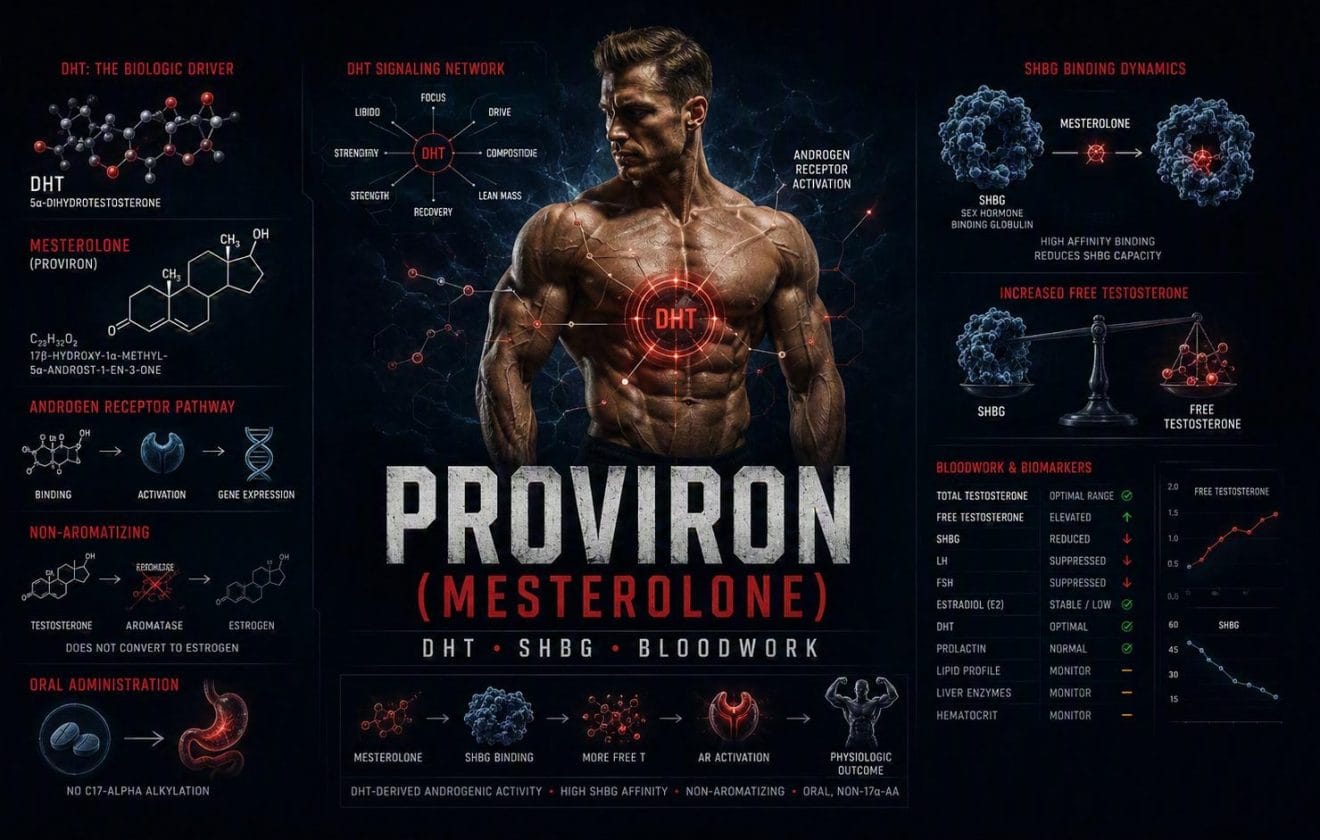
How mesterolone frees up testosterone
Proviron is a synthetic oral androgen derived from dihydrotestosterone, used clinically for male hypogonadism and andropause for decades. Unlike most oral steroids, it carries no C17-alpha-alkylation and minimal liver burden. Unlike most anabolic steroids, it does not meaningfully build muscle - because it is inactivated in muscle tissue by the same enzyme that inactivates DHT. What Proviron does do is bind sex hormone-binding globulin, increase the free fraction of testosterone, and exert mild anti-estrogenic activity. This guide covers the mechanism, the clinical and performance-context distinctions, and the bloodwork markers relevant to its use.
Proviron: Three Facts That Define This Compound
Oral Androgen - Not a Traditional Anabolic Steroid
Mesterolone is an oral androgen with real androgenic activity, but it is not anabolic in skeletal muscle. The enzyme 3-alpha-hydroxysteroid dehydrogenase, present at high levels in muscle tissue, inactivates it before it can act at the androgen receptor. The androgenic effects occur in tissues where this enzyme is less active - skin, prostate, hair follicles - while muscle remains pharmacologically unreached.
No C17-Alkylation - Minimal Hepatotoxicity
Most oral anabolic steroids require C17-alpha-alkylation to survive first-pass liver metabolism. Proviron achieves oral bioavailability through C1-methylation instead - a structural difference that preserves liver passage without the hepatotoxic burden of 17-aa orals. This makes it one of the few oral androgens with a genuinely low liver risk profile, which is reflected in bloodwork: AST and ALT typically show no significant elevation at standard doses.
Does Not Meaningfully Suppress the HPTA
At standard clinical doses, Proviron does not suppress LH and FSH to a degree that would require post-cycle therapy. This distinguishes it from virtually every other anabolic or androgenic compound used in performance contexts. The HPTA suppression question is essentially non-applicable when the compound is used alone - though it remains relevant when used alongside other suppressive compounds in a cycle.
What This Guide Covers
Covered in This Guide
- What Proviron is and how its DHT-derived structure differs from testosterone-based and 19-nor compounds
- C1-methylation vs C17-alkylation - why this distinction matters for liver safety
- Why mesterolone is non-anabolic in skeletal muscle (3-alpha-HSD inactivation)
- SHBG binding activity and the free testosterone mechanism
- Anti-estrogenic properties - aromatase inhibition and androgen receptor competition
- Clinical use: hypogonadism, andropause, and male infertility context
- HPTA suppression profile and why PCT is not typically required
- 6 bloodwork markers for monitoring Proviron use
- 5 common errors in how this compound is understood and applied
Not Covered Here
- Dosing recommendations or cycle length guidelines
- Stacking protocols or compound combinations
- Drug sourcing or acquisition
- Personal medical advice or individualised recommendations
- Comparison with SARMs or other selective androgen modulators
DHT-derivative class context: For the broader structural overview of DHT-derived compounds and how they differ from testosterone-based and 19-nor anabolics as a class, see DHT Steroids. For comparison with other DHT-derived oral androgens, see Winstrol (Stanozolol) and Masteron (Drostanolone).
How Proviron Works: Structure, Bioavailability, and Why It Does Not Build Muscle
Proviron is the brand name for mesterolone - 1-methyl-dihydrotestosterone. Its parent compound is dihydrotestosterone, which means it is already in the fully 5-alpha-reduced state and cannot aromatize to estrogen. The 1-methyl group added at the first carbon position is what allows oral bioavailability: it slows first-pass hepatic metabolism enough for systemic absorption without requiring the more aggressive C17-alpha-alkylation used by oral anabolics such as Dianabol, Anadrol, or Winstrol. This structural distinction is fundamental to understanding why Proviron occupies a different pharmacological category from standard oral anabolic steroids.
C17-alpha-alkylated oral steroids - modified at the 17th carbon to resist liver breakdown - carry hepatotoxic burden as a direct consequence of that modification. Mesterolone's C1-methylation achieves oral survival without producing the same degree of liver stress. Clinically and in bloodwork, this is observable: AST and ALT elevations associated with 17-aa orals are not expected with Proviron at standard doses. The hepatotoxicity comparison is covered in the chart below alongside other common oral compounds.
Relative Hepatotoxicity - Oral Androgens
Hepatotoxicity reflects C17-alpha-alkylation burden. Proviron's C1-methylation achieves oral bioavailability without the same hepatic stress. Relative ratings based on published clinical observations, not absolute enzyme values.
The reason Proviron does not produce meaningful anabolic effects in muscle tissue is enzymatic, not a matter of androgen receptor affinity. DHT and its derivatives - including mesterolone - bind androgen receptors with high affinity. However, skeletal muscle contains high concentrations of 3-alpha-hydroxysteroid dehydrogenase, an enzyme that converts DHT-class compounds into pharmacologically inactive metabolites. Testosterone escapes this inactivation because 3-alpha-HSD has low affinity for testosterone itself; nandrolone escapes it because dihydronandrolone (its 5-alpha-reduced metabolite) is already a weaker androgen, but the 3-alpha-HSD inactivation of dihydronandrolone is less complete than for DHT. Mesterolone, being a DHT derivative, is a high-affinity substrate for 3-alpha-HSD in muscle - meaning the compound is consistently inactivated in the tissue where anabolic effect would otherwise occur. In tissues with low 3-alpha-HSD activity - skin, prostate, hair follicles, bone - the compound remains androgenically active.
C1-Methylation and Oral Bioavailability
The 1-methyl group at carbon-1 allows mesterolone to survive first-pass liver metabolism without C17-alpha-alkylation. This is the structural basis for Proviron's low hepatotoxicity relative to standard 17-aa orals. The C1 modification slows hepatic degradation without producing the enzymatic liver stress that 17-alpha-methylation generates.
3-Alpha-HSD Inactivation in Muscle
Skeletal muscle inactivates DHT-class compounds via 3-alpha-hydroxysteroid dehydrogenase. Mesterolone is a high-affinity substrate - it is converted to inactive metabolites before meaningful androgen receptor activation occurs in muscle tissue. This enzyme is the pharmacological reason Proviron does not build muscle: not receptor affinity, but pre-receptor inactivation at the target site.
Non-Aromatization (Already 5-Alpha-Reduced)
Mesterolone is derived from DHT, which is already in the fully 5-alpha-reduced state. Aromatase cannot act on 5-alpha-reduced androgens - the structural configuration required for aromatization is absent. This means Proviron produces no estradiol through its own metabolism. This property contributes to its anti-estrogenic profile in combination use.
SHBG Binding, Free Testosterone, and Anti-Estrogenic Activity
The pharmacological actions where Proviron produces meaningful effects are outside skeletal muscle. Three mechanisms are relevant: SHBG displacement, weak aromatase inhibition, and androgen receptor competition with estrogen in estrogen-responsive tissues.
SHBG Binding and Free Testosterone
Sex hormone-binding globulin binds testosterone and other androgens in circulation, rendering the bound fraction biologically inactive - only unbound (free) testosterone can enter cells and activate androgen receptors. Mesterolone binds SHBG with high affinity - higher than testosterone itself - displacing testosterone from the protein and increasing the free testosterone fraction. In hypogonadal men with low total testosterone, this mechanism can produce a clinically meaningful increase in free testosterone without raising total testosterone at all. In a performance context alongside a testosterone base, the same mechanism operates: the free fraction of the administered testosterone increases while SHBG-bound testosterone decreases. The practical relevance of this effect depends on the individual's baseline SHBG level - users with naturally high SHBG see a more pronounced shift in free testosterone.
Anti-Estrogenic Properties
Proviron contributes to estrogen management through two pathways, neither of which is as potent as a dedicated aromatase inhibitor. First, mesterolone competitively inhibits aromatase - the enzyme that converts testosterone to estradiol - though weakly relative to pharmaceutical AIs. Second, being a non-aromatizing androgen, it competes with estrogen for receptor occupancy in estrogen-responsive tissues: when androgen receptor binding is high relative to estrogen receptor binding in a given tissue, estrogenic expression is reduced. Neither mechanism eliminates the need for dedicated estrogen management when estrogen-elevating compounds are present, but the combined effect can meaningfully reduce estrogenic side effect burden in the right context. See Gynecomastia Risk on Steroids and Estradiol Before Steroids for the broader estrogen management framework.
Clinical Use and HPTA Suppression Profile
Mesterolone has a long clinical history in the treatment of male hypogonadism, andropause, and as an adjunct in male infertility - where it has been investigated as a support agent for spermatogenesis rather than a primary treatment. Its HPTA suppression profile at clinical doses is the feature that makes it unusual among androgens: LH and FSH are not meaningfully suppressed at standard therapeutic doses. The pharmacological explanation is that mesterolone's weak systemic androgen signal - limited by its rapid inactivation in many tissues - does not produce the sustained hypothalamic feedback suppression that testosterone or nandrolone produce. This is not dose-independent: at very high doses or in combination with other suppressive compounds, HPTA suppression occurs as a combined effect. But used alone at standard doses, Proviron is one of the only androgenic compounds where PCT is pharmacologically unnecessary.
| Parameter | Proviron (Mesterolone) | Comparison Context |
|---|---|---|
| Compound class | DHT-derivative (1-methyl-DHT) | Same class as Masteron, Winstrol; different from testosterone, nandrolone |
| Delivery | Oral (tablet) | Only oral DHT-derivative in common use; Masteron and Winstrol inject or oral Winstrol is 17-aa |
| Oral bioavailability mechanism | C1-methylation | Unlike 17-aa orals (Dianabol, Anadrol, Anavar, Winstrol oral) |
| Hepatotoxicity | Minimal at standard doses | Significantly lower than any 17-aa oral androgen |
| Anabolic effect in muscle | None (3-alpha-HSD inactivation) | Not a mass-building or strength compound |
| Aromatization | Zero (5-alpha-reduced; cannot aromatize) | Testosterone aromatizes at ~0.3%/day; nandrolone ~20% of testosterone rate |
| SHBG binding | High affinity - increases free testosterone | Higher SHBG affinity than testosterone itself |
| Aromatase inhibition | Weak competitive inhibition | Far weaker than anastrozole or exemestane; not a substitute for pharmaceutical AI |
| HPTA suppression (alone) | Minimal at standard doses | PCT not required when used alone at therapeutic doses |
| Half-life | ~12 hours | Requires twice-daily dosing for stable levels |
| Anti-doping detection | Days to weeks (urine) | Shorter detection window than injectable anabolics |
Clinical data on mesterolone is primarily from hypogonadism and andropause trials. Performance-context extrapolations reflect the same pharmacological mechanisms at higher-than-clinical doses. Individual variation applies to all parameters.
6 Markers to Monitor When Using Proviron
The bloodwork framework for mesterolone is narrower than for anabolic steroids with significant hormonal impact - but it is not empty. The DHT-class androgenic activity of Proviron carries androgenic side effect risk in susceptible tissues, and the compound's HDL-suppressive effect through hepatic lipase upregulation is real even at low liver burden. Because the compound does not suppress the HPTA meaningfully when used alone, the post-cycle hormonal recovery panel is largely non-applicable in isolated use. The monitoring priorities below are specific to what this compound actually alters in bloodwork, rather than applying a generic anabolic steroid panel.
SHBG Binding Affinity - Selected Androgens (Relative)
Mesterolone's high SHBG affinity is the pharmacological basis for its free testosterone-elevating effect. Higher SHBG binding displaces testosterone from the protein, increasing the biologically active free fraction. Relative values based on published binding studies; absolute affinity varies by assay conditions.
Free Testosterone and SHBG
The primary pharmacological action of Proviron is SHBG displacement - and the only way to confirm and quantify this effect in an individual is to measure both SHBG and free testosterone directly. Total testosterone alone does not capture the shift: a user may have unchanged total testosterone with significantly elevated free testosterone due to SHBG competition. Pre-use and on-cycle free testosterone and SHBG readings establish whether the compound is producing the intended effect and at what magnitude in that individual's hormonal environment. See Total vs Free Testosterone and SHBG Explained.
HDL Cholesterol
Mesterolone suppresses HDL through hepatic lipase upregulation - the same mechanism as other androgens, though with a lower hepatic burden than 17-aa orals. The HDL suppression effect is real and dose-dependent. Users who add Proviron to a cycle already including testosterone or other anabolic compounds carry a cumulative HDL suppression burden from multiple compounds simultaneously. A lipid panel before and at mid-cycle captures the trajectory. HDL below 35 mg/dL represents meaningful endothelial risk independent of other variables. See Lipid Panel (HDL, LDL, Triglycerides).
Liver Markers (AST, ALT)
While Proviron's hepatotoxicity is substantially lower than 17-alpha-alkylated oral steroids, a baseline AST and ALT measurement remains appropriate - particularly when the compound is used alongside other oral androgens. The C1-methylation that enables mesterolone's oral bioavailability does generate some hepatic processing load, even if it does not produce the enzyme elevations characteristic of 17-aa orals. When used with any 17-aa compound, the liver marker picture reflects both compounds, and mesterolone cannot be assumed to contribute zero load. See Liver Markers (AST, ALT, GGT).
Estradiol (E2)
Proviron does not aromatize and produces no estradiol from its own metabolism. However, when used alongside testosterone - the most common context - estradiol monitoring remains necessary for the testosterone component. The mild aromatase-inhibiting effect of mesterolone may modestly reduce estradiol conversion from testosterone, and this interaction should be tracked rather than assumed. Users who add Proviron to a testosterone cycle and stop managing estradiol because they assume the compound eliminates the aromatization risk are making a clinically incorrect assumption. See Estradiol Before Steroids.
LH and FSH (Isolated Use Only)
When mesterolone is used alone - outside of a cycle with other suppressive compounds - LH and FSH monitoring confirms whether HPTA suppression is occurring at the dose being used. The clinical literature supports low suppression at therapeutic doses, but individual sensitivity varies, and higher doses increase suppression risk. A mid-use LH/FSH reading against a pre-use baseline provides a direct, quantified answer to whether the HPTA is being meaningfully affected in a specific individual, rather than relying on population averages from clinical trials. See Why Steroids Cause Testosterone Suppression.
Blood Pressure
Androgenic compounds can contribute to blood pressure elevation through multiple pathways - increased red blood cell production, vascular tone effects, and fluid dynamics. Mesterolone's contribution in isolation is modest, but when used as part of a cycle with testosterone or other anabolics, the cumulative cardiovascular load compounds. Weekly home blood pressure measurement throughout any cycle that includes Proviron alongside other compounds is a low-effort, high-value monitoring habit. See Blood Pressure Before Steroids.
5 Mistakes in How Proviron Is Understood and Applied
- Mistake 1
Treating Proviron as an Anabolic Compound
The most persistent misconception about mesterolone is that it contributes directly to muscle growth or strength gains. It does not - and the reason is not dosing, but pharmacology. Skeletal muscle contains high concentrations of 3-alpha-hydroxysteroid dehydrogenase, the enzyme that inactivates DHT-class compounds before they can activate androgen receptors in muscle tissue. Proviron is a high-affinity substrate for this enzyme. Users who add it to a cycle expecting it to contribute to mass or strength outcomes are assigning it an effect it is pharmacologically incapable of producing. Its role is hormonal modulation - SHBG reduction, free testosterone elevation, mild anti-estrogenic activity - not direct anabolic action.
- Mistake 2
Using Proviron as a Substitute for a Pharmaceutical Aromatase Inhibitor
Mesterolone has aromatase-inhibiting activity, but it is a competitive inhibitor at a much lower potency than anastrozole, letrozole, or exemestane. At standard doses alongside a testosterone cycle with meaningful aromatization - typical testosterone enanthate or cypionate doses producing moderate estradiol elevation - Proviron does not provide sufficient aromatase inhibition to manage estradiol on its own. Users who rely on it as their primary AI and forgo pharmaceutical aromatase inhibitors will frequently find their estradiol continues to rise. The compound is a useful adjunct to estrogen management, not a replacement for it. Estradiol monitoring confirms whether aromatization is being adequately addressed.
- Mistake 3
Assuming Zero Androgenic Side Effect Risk
Because Proviron is inactivated in skeletal muscle, it is sometimes assumed to be androgenically inert throughout the body. This is incorrect. In tissues where 3-alpha-HSD activity is low - skin, scalp, prostate, sebaceous glands - mesterolone remains androgenically active. Users with genetic sensitivity to androgenic alopecia, acne, or prostate-related symptoms carry those risks with Proviron in the same way as with other DHT-class compounds. The androgenic side effect profile of the compound is real; it is simply tissue-selective. Users who assume safety from androgenic effects because the compound is "non-anabolic" are conflating two separate pharmacological properties. See Hair Loss and DHT on Steroids and Acne on Steroids.
- Mistake 4
Skipping Lipid Monitoring Because the Compound Is "Mild"
Proviron's low hepatotoxicity and minimal HPTA suppression give it a reputation as a benign compound. This reputation, while accurate for liver and hormonal suppression, does not extend to lipids. The compound suppresses HDL via hepatic lipase upregulation - the same pathway as other androgens - and this effect is independent of hepatotoxicity or HPTA suppression. A compound can be simultaneously low-risk for the liver, non-suppressive of LH/FSH, and still produce meaningful HDL reduction. When mesterolone is added to a cycle that already includes other lipid-affecting compounds, the cumulative suppression is additive. Skipping lipid monitoring because the compound is perceived as mild leaves a real cardiovascular risk variable unmeasured.
- Mistake 5
Expecting the Same SHBG Effect Regardless of Baseline SHBG Level
The free testosterone elevation produced by Proviron depends directly on the individual's baseline SHBG level. Users with high SHBG - a common finding in men with naturally low free testosterone relative to total testosterone - experience a pronounced shift in the free testosterone fraction when mesterolone displaces testosterone from SHBG binding sites. Users with already-low SHBG see a much smaller practical effect, because there is less bound testosterone to liberate. This means the real-world benefit of using the compound as a free testosterone amplifier is highly individual - it cannot be predicted without baseline SHBG and free testosterone data. Users who add Proviron without measuring baseline SHBG and free testosterone have no way to determine whether the compound is producing its intended effect in their specific hormonal environment.
- Blood Tests Before Steroids: 7 Markers to Check - the 7-marker baseline panel to run before starting
Published Research Referenced in This Guide
- Dugeroglu H, Yuvanc E, Kisa U, et al. Mesterolone treatment of aging male syndrome improves lower urinary tract symptoms. J Pak Med Assoc. 2014. pubmed.ncbi.nlm.nih.gov/25842579
- Jockenhövel F, Vogel E, Reinhardt W, et al. Influence of various modes of androgen substitution on serum lipids and lipoproteins in hypogonadal men. Metabolism. 1999. pubmed.ncbi.nlm.nih.gov/10337859
- Jockenhövel F, Vogel E, Kreutzer M, et al. Effects of various modes of androgen substitution therapy on erythropoiesis. Eur J Med Res. 1997. pubmed.ncbi.nlm.nih.gov/9233903
- Kicman AT. Pharmacology of anabolic steroids. Br J Pharmacol. 2008;154(3):502-521. pubmed.ncbi.nlm.nih.gov/18500378
- Androgen Physiology, Pharmacology, Use and Misuse. NCBI Bookshelf / Endotext. ncbi.nlm.nih.gov/books/NBK279000
What Proviron Is and Is Not: A Pharmacological Summary
Mesterolone occupies an unusual position in the landscape of androgenic compounds: it is genuinely androgenic in androgenic-sensitive tissues, genuinely effective at SHBG displacement and free testosterone elevation, and genuinely low-risk for liver toxicity and HPTA suppression. None of these properties, however, extend to anabolic effect in muscle. Proviron does not build muscle - not because of inadequate dosing or poor bioavailability, but because the enzyme 3-alpha-HSD in skeletal muscle systematically inactivates it before androgen receptor activation can occur. Users who understand this distinction can deploy the compound accurately: for hormonal modulation in a cycle, not as a mass-building or strength-building compound.
The bloodwork framework for Proviron is narrower than for anabolic steroids, but it is not absent. HDL suppression occurs through hepatic lipase upregulation regardless of the low liver enzyme burden. Free testosterone and SHBG measurements confirm whether the intended pharmacological action is occurring in the individual's specific hormonal context. LH and FSH monitoring, when the compound is used alone, provides direct verification of whether the claimed low HPTA suppression holds at the dose being used. The reputation of this compound as universally benign leads to a common error: skipping bloodwork entirely because the compound is "mild." Mild relative to Anadrol and Dianabol is not the same as pharmacologically inert.
- DHT Steroids - class overview for DHT-derived compounds and the structural basis of their tissue-selective activity
- Masteron (Drostanolone) - injectable DHT-derivative; comparison compound for Proviron's androgenic profile and anti-estrogenic activity
- Winstrol (Stanozolol) - oral and injectable DHT-derivative; comparison for C17-aa oral androgen hepatotoxicity
- SHBG Explained - sex hormone-binding globulin mechanism and why baseline SHBG determines the magnitude of Proviron's free testosterone effect
- Total vs Free Testosterone - understanding why free testosterone is the biologically active fraction and how SHBG binding affects it
- Estradiol Before Steroids - estrogen monitoring framework and why Proviron does not replace pharmaceutical aromatase inhibitors
- Gynecomastia Risk on Steroids - the estrogen and androgen receptor dynamics relevant to Proviron's anti-estrogenic mechanism
- Hair Loss and DHT on Steroids - androgenic alopecia risk for DHT-class compounds including m