Anadrol (Oxymetholone): Pharmacology, Liver Toxicity, and Bloodwork Guide
Big gains, real liver stress
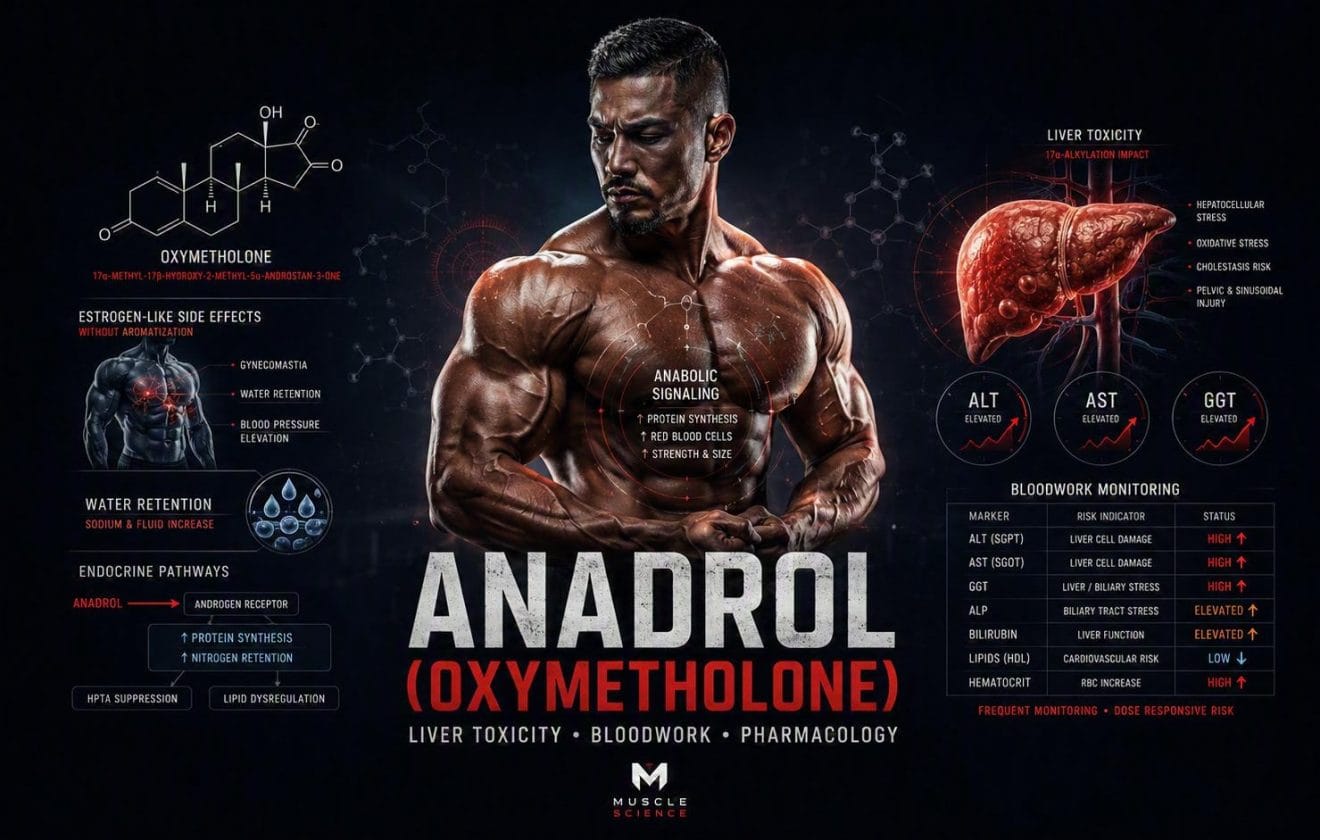
Anadrol (oxymetholone) is a 17-alpha alkylated oral anabolic steroid and the most potent mass-gaining oral in common use. It does not aromatize yet causes estrogenic symptoms - a pharmacological paradox explained by direct estrogen receptor activation. Anadrol produces the most severe hepatotoxicity of any commonly used oral, with AST and ALT elevation detectable within 10-14 days of the first dose. The dose-response relationship is non-linear: above 100 mg per day, side effects increase proportionally but anabolic gains do not.
Anadrol: Three Facts That Override the Common Narrative
Estrogenic Symptoms Without Aromatization
Oxymetholone does not aromatize into estrogen - it has no aromatization pathway. Yet anadrol causes water retention, gynecomastia risk, and sensitivity symptoms consistent with high estrogen. The mechanism is direct activation of estrogen receptors by oxymetholone itself, independent of estradiol conversion. Aromatase inhibitors do not reliably resolve these symptoms because they target aromatization - a process that is not occurring. This distinction changes how estrogenic side effects on anadrol must be managed.
The Most Hepatotoxic Oral in Common Use
Anadrol is 17-alpha alkylated, which enables oral bioavailability but creates direct hepatic stress. It produces more pronounced and faster-onset liver enzyme elevation than Dianabol, Anavar, Winstrol, or Turinabol at typical performance doses. AST and ALT begin rising within 10-14 days. Cycle length and dose are the primary variables - the hepatic burden is dose-dependent and accumulates over time. Liver markers are not optional monitoring - they are the primary safety variable for oxymetholone.
Non-Linear Dose-Response Above 100 mg/day
Anadrol's anabolic effects do not scale proportionally above 100 mg per day. Clinical and observational data consistently show that doses above this threshold produce diminishing anabolic returns while toxicity - hepatic, cardiovascular, and androgenic - continues to increase linearly. This makes anadrol one of the few oral compounds where higher dosing represents a strictly worse risk-to-benefit ratio, not just a marginal one. Understanding this relationship is central to understanding why oxymetholone is used in short bursts at moderate doses rather than escalated across a cycle.
What This Anadrol Guide Covers
Covered in This Guide
- Structural origin of anadrol - oxymetholone and 17-alpha alkylation
- Why oxymetholone causes estrogenic symptoms without aromatizing - the ER activation mechanism
- Why aromatase inhibitors don't reliably control anadrol's estrogenic effects
- Hepatotoxicity timeline: when AST/ALT rise and what the trajectory means
- The non-linear dose-response above 100 mg/day with data context
- SHBG suppression - one of oxymetholone's most potent and underappreciated effects
- Lipid and cardiovascular impact: HDL suppression and blood pressure
- Bloodwork monitoring panel - 8 key markers with timing guidance
- 5 common errors in how anadrol is understood and used
Not Covered Here
- Specific anadrol doses or cycle structures
- Stacking recommendations
- PCT drug selection after oxymetholone use
- Sourcing or compound availability
- Medical use of oxymetholone (anemia, wasting conditions)
- Female use of anadrol
Foundation reading: For the liver monitoring context central to anadrol use, see Liver Markers (AST, ALT, GGT). For how oral compounds compare structurally to injectables, see Injectable vs Oral Steroids. For the gynecomastia risk framework relevant to oxymetholone's ER-activating mechanism, see Gynecomastia Risk on Steroids.
What Anadrol Is: Structure, Classification, and What Makes Oxymetholone Different
Anadrol is the brand name for oxymetholone, a synthetic anabolic-androgenic steroid developed by Syntex in the early 1960s. It was initially marketed for the treatment of anemia and muscle-wasting conditions - a medical application that remains valid today, particularly in HIV-associated wasting. Structurally, oxymetholone is a derivative of dihydrotestosterone (DHT) with modifications at the 2-position (a hydroxymethylene group) and C17-alpha alkylation. These modifications explain both its potency and its toxicity profile.
The C17-alpha alkylation is the structural feature shared by all common oral anabolic steroids - Dianabol, Anavar, Winstrol, Turinabol, and anadrol. This modification prevents first-pass hepatic metabolism, making the compound orally bioavailable. The trade-off is hepatotoxicity: 17-aa steroids place a direct metabolic burden on liver cells that injectable compounds with ester attachments do not. Among the 17-aa compounds in common non-medical use, oxymetholone produces the most pronounced hepatic enzyme elevation. For the full comparison of oral versus injectable pharmacokinetics, see Injectable vs Oral Steroids.
Oxymetholone is DHT-derived, which means it does not convert via 5-alpha reduction to a more androgenic metabolite - DHT is already the base structure. It also lacks an aromatization pathway: the enzyme aromatase cannot convert oxymetholone to estradiol. This structural fact leads many users to assume anadrol is an estrogen-neutral compound. This assumption is one of the most consequential errors in how the compound is understood, and it is addressed in detail in the next section.
Half-Life and Dosing Window
Anadrol has a half-life of approximately 8-9 hours. This is shorter than Dianabol (~3-6 hours, similar range) and considerably shorter than injectable compounds. The short half-life means that split dosing - dividing the daily dose across two administrations - produces more stable blood levels than a single daily dose. It also means the compound clears relatively quickly after the last dose, which is pharmacokinetically relevant for timing PCT initiation - though suppression from the HPTA perspective persists beyond compound clearance. For the suppression and recovery framework, see Hormonal Recovery After Steroids.
Why Anadrol Causes Estrogenic Symptoms Without Aromatizing
The most pharmacologically distinctive - and practically important - feature of anadrol is what is commonly called its "estrogen paradox." Oxymetholone does not aromatize. No estradiol is produced from oxymetholone metabolism. Yet users of anadrol report water retention, gynecomastia sensitivity, nipple tenderness, and bloating at rates and severity comparable to high-dose testosterone use. Clinical observations support this: patients treated with oxymetholone for medical conditions show estrogenic tissue effects despite no measurable aromatization product in serum.
The mechanism is direct estrogen receptor agonism. Oxymetholone itself - or a metabolite, most likely 17β-methyl-3α,17β-androstenediol - binds to and activates estrogen receptors in tissues. This activation produces the same downstream effects as estradiol binding: water retention in tissues responsive to ERα signalling, proliferative effects on breast tissue glandular cells, and the clinical symptoms users associate with "high estrogen." The estradiol level in bloodwork may be normal or even suppressed on an anadrol cycle while the user is experiencing pronounced estrogenic side effects - because the driver is not circulating estradiol but direct ER activation by the compound itself.
Why Aromatase Inhibitors Do Not Reliably Work on Anadrol
This mechanism has a direct and important clinical implication. Aromatase inhibitors - anastrozole, exemestane, letrozole - work by blocking the aromatase enzyme that converts androgens to estradiol. On a testosterone or Dianabol cycle, they reduce circulating estradiol, which addresses the source of the estrogenic side effects. On an anadrol cycle, there is no aromatization to block. The estrogenic activity comes from oxymetholone's direct ER binding, which aromatase inhibitors do not affect. A user running an AI alongside anadrol and finding that water retention and breast sensitivity persist despite a confirmed low estradiol level in bloodwork is experiencing exactly this pharmacological reality. The intervention required is different: reducing the oxymetholone dose, shortening cycle duration, or switching to a selective estrogen receptor modulator (SERM) that competes at the receptor level rather than blocking upstream estradiol production. For the estrogenic symptom monitoring framework, see Estradiol Before Steroids and Gynecomastia Risk on Steroids.
Standard Aromatization
Aromatase converts androgens to estradiol. Elevated E2 in bloodwork. AI blocks aromatase → reduces E2 → resolves symptoms. Intervention works as expected.
Direct ER Activation
No aromatization. Normal or low E2 in bloodwork. Oxymetholone or metabolite binds ER directly. AI has no target - symptoms persist despite low serum estradiol. SERM or dose reduction is the relevant intervention.
No ER Interaction
No aromatization. No ER binding. No estrogenic symptoms from the compound itself. Estrogenic side effects only present if stacked with aromatizing androgens and E2 rises from those compounds.
Anadrol and Liver Toxicity: The Timeline, the Mechanism, and the Risk Variables
Hepatotoxicity is the primary clinical risk of anadrol use and the parameter that most constrains cycle length and dose. All 17-alpha alkylated oral compounds are hepatotoxic, but oxymetholone produces more pronounced enzyme elevation at typical doses than other common oral anabolics. Understanding the timeline and dose-dependence is what makes rational monitoring possible.
When Liver Enzymes Begin to Rise
AST and ALT elevation from anadrol begins within 10-14 days of the first dose in the majority of users. This is earlier than many users expect, and earlier than typical monitoring timelines for testosterone or injectable compounds would suggest. By week 4 of a continuous anadrol cycle, liver enzymes are typically at or near their peak elevation. This early onset has practical implications: a pre-cycle baseline blood draw is essential, and mid-cycle liver assessment should be scheduled no later than week 3-4 - not week 6-8 as would be appropriate for an injectable compound. For the AST, ALT, and GGT monitoring framework, see Liver Markers (AST, ALT, GGT).
The Dose-Dependent Hepatic Burden
Oxymetholone's hepatotoxicity is dose-dependent: higher daily doses produce greater and faster enzyme elevation. At doses below 50 mg per day, liver enzyme elevation is typically present but moderate in the majority of users. At 100 mg per day, elevation is more pronounced and approaches the range where hepatic stress is clinically meaningful. Above 100 mg per day, the hepatic burden increases substantially while anabolic returns diminish - this is the pharmacological basis for the standard harm-reduction guidance that anadrol cycles be kept short (4-6 weeks maximum) and doses not escalated beyond the point where the dose-response curve flattens.
| Oral Compound | 17-aa Alkylated | Relative Hepatotoxicity | AST/ALT Onset Timeline |
|---|---|---|---|
| Anadrol (Oxymetholone) | Yes | Highest among common orals | 10-14 days |
| Dianabol (Methandrostenolone) | Yes | High | 2-3 weeks |
| Winstrol (Stanozolol) oral | Yes | High (more hepatotoxic than injectable form) | 2-3 weeks |
| Anavar (Oxandrolone) | Yes | Moderate - lowest among common 17-aa | 3-4 weeks |
| Turinabol (4-Chlorodehydromethyltestosterone) | Yes | Moderate | 3-4 weeks |
| Testosterone Enanthate (injectable) | No | Minimal - no 17-aa burden | No significant AST/ALT elevation from compound |
AST elevation from resistance training (muscle-derived) is expected during any cycle and is not a liver indicator in isolation - interpret alongside ALT and GGT, which are more liver-specific.
What Elevated Liver Enzymes on Anadrol Actually Mean
AST and ALT elevation during an anadrol cycle does not automatically indicate liver damage. It indicates hepatic stress - the liver is working harder to metabolise the compound. The clinical question is degree: a 2-3× elevation above the upper limit of normal is common and expected; a 5-10× elevation signals meaningful hepatotoxicity requiring intervention. The intervention is dose reduction or cycle termination - there is no supplement or medication that reliably protects the liver while oxymetholone use continues. TUDCA and UDCA, which have hepatoprotective evidence in drug-induced liver injury contexts, may attenuate but do not eliminate the hepatic burden of 17-aa oral steroids.
The Non-Linear Dose-Response of Anadrol: Why More Is Not Better Above 100 mg
The dose-response curve of anadrol is one of the most important - and most violated - principles in how the compound is used. The clinical data on oxymetholone, including both medical studies in wasting conditions and observational performance use, consistently show the same pattern: anabolic gains increase meaningfully from 25 mg to 50 mg per day, continue increasing from 50 mg to 100 mg per day, and then plateau or produce only marginal additional anabolic benefit above 100 mg per day. Side effects - hepatotoxicity, cardiovascular strain, androgenic effects, fluid retention - do not follow this plateau. They continue to scale with dose beyond 100 mg.
This creates a structural problem for users who follow the common escalation logic applied to other compounds: "if 100 mg works, 150 mg works better." With anadrol, the risk-to-benefit ratio actively worsens above 100 mg per day. The additional hepatic burden, the greater HDL suppression, the more pronounced blood pressure elevation - these costs are real and measurable. The additional anabolic return does not compensate for them. The compound's ceiling for productive use is lower than its ceiling for harm.
Anadrol Dose vs Effect - Relative Response (Illustrative)
25 mg / day
50 mg / day
100 mg / day
150 mg / day
Bar lengths represent relative response based on clinical data and observational patterns - not absolute values, which vary by individual baseline, cycle duration, and co-administration.
Appetite Suppression at High Doses: The Paradox Within the Paradox
Anadrol is paradoxical in a second way beyond its estrogenic mechanism. It is marketed and perceived as a mass-gaining compound that drives appetite - and at moderate doses it can. But at higher doses (above 100 mg per day in many users), oxymetholone causes appetite suppression. The mechanism is not fully characterised but may involve hepatic discomfort from the elevated metabolic burden combined with gastrointestinal effects of high-dose oxymetholone. Users who escalate anadrol dosing looking for greater mass gains and encounter appetite loss are experiencing a dose-dependent effect that works directly against the compound's supposed purpose. This is one of the pharmacological reasons the dose ceiling for productive anadrol use is lower than users accustomed to dose-escalation logic expect.
Two Underappreciated Effects: SHBG Suppression and HDL Destruction on Anadrol
SHBG Suppression: Oxymetholone's Most Potent Systemic Effect
Sex hormone-binding globulin (SHBG) suppression is among the strongest effects of anadrol across all anabolic steroids. SHBG is the carrier protein that binds testosterone (and other androgens) in circulation, rendering the bound fraction biologically inactive. When SHBG is suppressed, the free testosterone fraction increases - the portion available to bind androgen receptors in tissues. Oxymetholone suppresses SHBG more aggressively than most other oral or injectable compounds at comparable doses.
The practical implication is a significant amplification of any testosterone-based compound stacked alongside oxymetholone. When SHBG drops substantially, a cycle that would otherwise produce a moderate free testosterone elevation produces a much larger one - with corresponding amplification of both anabolic and androgenic effects. This is one mechanism by which anadrol "synergises" with testosterone in stacked cycles: not through its own direct androgen receptor affinity alone, but through the SHBG-lowering effect that liberates more of the exogenous testosterone into the active free fraction.
Relative SHBG Suppression - Common Oral Compounds
Relative SHBG suppression based on pharmacological data - absolute changes depend on dose, duration, and individual baseline SHBG level.
HDL Suppression: Severe and Rapid
Anadrol produces among the most severe HDL suppression of any compound used in performance contexts, rivalling oral Winstrol. The mechanism is hepatic lipase upregulation - a consequence of 17-alpha alkylation and oral delivery through the liver. HDL begins to drop within the first 1-2 weeks of oxymetholone use and can reach clinically low levels (below 25-30 mg/dL) within 4-6 weeks at typical doses. This is not a mild or gradual effect: an anadrol cycle without a lipid panel at baseline and mid-cycle leaves a significant cardiovascular risk variable unmonitored. For the full lipid monitoring framework, see Lipid Panel (HDL, LDL, Triglycerides).
The lipid impact of anadrol is further amplified when stacked with other lipid-suppressing compounds, particularly other oral 17-aa steroids. Each oral compound independently upregulates hepatic lipase. The combined HDL suppression from two concurrent orals is not simply additive - it is compounded. Users who run anadrol alongside Winstrol or Anavar are creating a lipid risk profile substantially more severe than either compound alone would produce. Blood pressure elevation follows HDL-driven endothelial dysfunction and the fluid retention from oxymetholone's estrogenic activity - see Blood Pressure Before Steroids for the cardiovascular monitoring context.
8 Bloodwork Markers to Monitor on an Anadrol Cycle
Oxymetholone's risk profile is front-loaded - hepatotoxicity and HDL suppression begin within the first 2 weeks, not at the end of the cycle. The monitoring framework must reflect this. Pre-cycle baseline, week 3-4 mid-cycle, and post-cycle assessments constitute the minimum standard for anadrol. Skipping the mid-cycle check is not a minor omission on a compound that produces its peak liver enzyme elevation by week 4.
AST and ALT (Liver Enzymes)
The primary safety variable for anadrol. Elevation begins at 10-14 days and peaks by week 4. Mid-cycle check at week 3-4 is mandatory - not week 6 as with injectables. A 2-3× elevation above upper limit of normal is expected; 5-10× requires dose reduction or cycle termination. Post-cycle normalisation should be confirmed before any subsequent oral cycle begins. See Liver Markers (AST, ALT, GGT).
HDL Cholesterol
Oxymetholone produces severe and rapid HDL suppression - among the worst of any compound in common use. Baseline HDL establishes the reference point. Mid-cycle HDL at week 3-4 captures the near-peak suppression. Values below 25 mg/dL represent meaningful cardiovascular risk from endothelial dysfunction. Stack with another oral and HDL can be devastated within weeks. See Lipid Panel.
Blood Pressure
Anadrol elevates blood pressure through two concurrent mechanisms: fluid retention from direct ER activation (similar to high-dose testosterone water retention) and cardiovascular strain from HDL suppression. Both contribute to endothelial load. Blood pressure should be monitored weekly at home throughout the cycle - a single clinic reading is insufficient for a 4-6 week oral cycle where both mechanisms are active from week 1. See Blood Pressure Before Steroids.
Estradiol (E2)
On an anadrol cycle, serum estradiol may be normal or suppressed even while estrogenic symptoms are present - because the driver is direct ER activation, not circulating E2. The value of monitoring E2 on an oxymetholone cycle is context-dependent: if stacked with testosterone (which does aromatize), estradiol monitoring remains relevant for the testosterone-derived component. If oxymetholone is run without an aromatizing base compound, a normal E2 does not rule out estrogenic side effects. See Estradiol Before Steroids.
SHBG
Oxymetholone suppresses SHBG more aggressively than most other compounds. Monitoring SHBG mid-cycle provides context for interpreting free testosterone levels, particularly when anadrol is stacked with testosterone. A very low SHBG reading explains amplified androgenic effects even when total testosterone is within the expected range for the dose used. Post-cycle SHBG recovery is also a useful indicator of hepatic and hormonal normalisation.
Total Testosterone and LH/FSH
Anadrol fully suppresses the HPTA - LH and FSH will be undetectable during use regardless of dose. Post-cycle LH and FSH recovery confirms HPG axis reactivation. In the context of a short 4-6 week anadrol cycle typically run as a kickstart alongside a longer injectable base, the suppression picture is determined by the longer compound. Post-cycle assessment should follow the injectable's clearance window. See Hormonal Recovery After Steroids.
GGT (Gamma-Glutamyl Transferase)
GGT is more specific to hepatic stress than AST, which also rises from muscle breakdown during intense training. In an anadrol cycle with concurrent heavy resistance training, AST elevation from muscle-derived sources can obscure the liver signal. GGT elevation alongside AST/ALT provides confirmation that the enzyme elevation is hepatic rather than muscular in origin. This distinction matters for interpreting mid-cycle liver panels accurately. See Liver Markers (AST, ALT, GGT).
Complete Blood Count (CBC)
Oxymetholone was originally developed to treat aplastic anaemia - it stimulates red blood cell production. In a performance context, anadrol can elevate hematocrit and RBC count, though less dramatically than boldenone. A baseline CBC establishes pre-cycle RBC parameters. Hematocrit elevation above 52% adds cardiovascular risk on top of the lipid and hepatic burdens already present on an anadrol cycle. See Blood Tests Before Steroids.
5 Mistakes in How Anadrol Is Used and Understood
- Mistake 1
Using an AI to Manage Estrogenic Side Effects on Oxymetholone
When water retention, nipple sensitivity, or bloating appear on an anadrol cycle, the instinctive response for users familiar with testosterone management is to add or increase an aromatase inhibitor. On anadrol, this intervention targets a process - aromatization - that is not occurring. Oxymetholone's estrogenic effects come from direct ER activation. An AI does not block ER binding; it blocks the aromatase enzyme. The result is a user experiencing persistent estrogenic symptoms despite AI use, then escalating the AI, then potentially crashing estradiol from any testosterone in the stack while the anadrol-driven ER activation continues unaffected. The correct intervention is dose reduction, cycle shortening, or SERM use - not AI escalation. See Gynecomastia Risk on Steroids.
- Mistake 2
Scheduling Mid-Cycle Bloodwork at Week 6 on a 6-Week Cycle
The monitoring schedule appropriate for injectable compounds - baseline plus mid-cycle at week 6-8 - is not appropriate for anadrol. Liver enzyme elevation from oxymetholone peaks by week 4. A mid-cycle blood draw at week 6 of a 6-week anadrol cycle captures the compound's worst hepatic impact point after the productive phase has already ended. It provides information that is too late to act on. Mid-cycle bloodwork on an anadrol cycle should be scheduled at week 3-4 - early enough to assess peak hepatic stress, detect HDL suppression at near-maximum, and make a meaningful decision about continuing or adjusting the cycle. See Blood Tests Before Steroids.
- Mistake 3
Running Anadrol Alongside Another Oral 17-aa Compound
Stacking two oral 17-alpha alkylated compounds simultaneously compounds hepatic lipase upregulation from both, doubles the direct hepatic metabolic burden, and produces HDL suppression substantially more severe than either compound alone. The most common version of this mistake is running anadrol with oral Winstrol or Anavar simultaneously - compounds that users associate with "drier" or "hardening" effects they want to combine with anadrol's mass-gaining properties. The liver and lipid cost of concurrent orals is not additive - it is compounded. If two oral compounds are planned in a cycle, they should be run sequentially (one as a kickstart, one later) rather than concurrently. See Injectable vs Oral Steroids.
- Mistake 4
Escalating Anadrol Dose When Gains Plateau
The dose-response plateau above 100 mg per day is a pharmacological property of oxymetholone, not a sign that the compound "stopped working" or that the user needs to push higher. Users who escalate from 100 mg to 150 mg or 200 mg per day to chase the gains they experienced moving from 50 mg to 100 mg are applying a dose-escalation logic that does not hold for this compound. The anabolic plateau is real. The toxicity escalation above 100 mg is also real. The 150-200 mg range does not produce a proportionally greater anabolic response - it produces a substantially greater hepatotoxic, lipid-suppressing, and cardiovascular burden with marginal additional anabolic return. The correct response to a plateau on anadrol is to end the cycle, not escalate the dose.
- Mistake 5
Running Back-to-Back Anadrol Cycles Without Confirming Liver Recovery
After a 4-6 week anadrol cycle, AST and ALT typically normalise within 4-8 weeks post-cycle, depending on dose and individual hepatic resilience. Users who run a second anadrol cycle - or any 17-aa oral - before liver enzymes have returned to baseline are compounding hepatic stress on a liver that has not completed its recovery from the previous cycle. The cumulative burden across repeated cycles without adequate recovery intervals is a recognised mechanism of drug-induced liver injury. Post-cycle bloodwork confirming AST, ALT, and GGT normalisation is required before any subsequent oral compound use begins - not just before the next anadrol cycle. See Bloodwork Before and After PCT.
Published Research Referenced in This Guide
- Kicman AT. Pharmacology of anabolic steroids. Br J Pharmacol. 2008;154(3):502-521. pubmed.ncbi.nlm.nih.gov/18500378
- Ishak KG, Zimmerman HJ. Hepatotoxic effects of the anabolic/androgenic steroids. Semin Liver Dis. 1987. pubmed.ncbi.nlm.nih.gov/3317860
- Bagatell CJ, Bremner WJ. Androgens in men-uses and abuses. N Engl J Med. 1996;334(11):707-714. pubmed.ncbi.nlm.nih.gov/8594431
- Anabolic steroids overview. NCBI Bookshelf / StatPearls. ncbi.nlm.nih.gov/books/NBK482418
- Androgen Physiology, Pharmacology, Use and Misuse. NCBI Bookshelf / Endotext. ncbi.nlm.nih.gov/books/NBK279000
What Anadrol Requires: Short Cycles, Early Monitoring, and Correct Expectations
Anadrol is not a compound that rewards improvisation. Its toxicity profile is front-loaded - liver enzymes and HDL begin moving in the wrong direction within two weeks of the first dose, not at the end of the cycle. Its dose-response plateaus at a point lower than most users expect. Its estrogenic mechanism is fundamentally different from every other common anabolic steroid, which means management strategies borrowed from testosterone or Dianabol experience do not translate directly. And its hepatotoxicity is the highest of any commonly used oral, which means monitoring timelines must be adjusted accordingly.
Used within its pharmacological constraints - short cycles, doses that respect the non-linear response curve, mid-cycle bloodwork timed to the compound's actual peak toxicity window, and correct understanding of why AIs may not resolve estrogenic symptoms - oxymetholone's effects are predictable and manageable. The gaps in how anadrol is commonly understood are not minor. They are the difference between a compound used productively and one used recklessly.
- Liver Markers (AST, ALT, GGT) - the primary safety variable for anadrol, how to interpret enzyme elevation, and when it requires intervention
- Lipid Panel - HDL suppression context and why oxymetholone produces some of the most severe oral-compound-related lipid impact
- Gynecomastia Risk on Steroids - why anadrol's ER-activating mechanism requires a different management approach than aromatizing compounds
- Estradiol Before Steroids - baseline E2 context and why interpreting estradiol on an oxymetholone cycle requires understanding its non-aromatizing mechanism
- Blood Pressure Before Steroids - cardiovascular baseline and why fluid retention from ER activation compounds HDL-related endothelial risk on anadrol
- Injectable vs Oral Steroids - why 17-alpha alkylation creates hepatotoxicity and how oral compound risk differs structurally from injectable use
- Blood Tests Before Steroids - the full pre-cycle baseline panel and why timing of mid-cycle draws must be adjusted for anadrol's early toxicity onset
- Hormonal Recovery After Steroids - suppression and recovery framework that applies after any anadrol-containing cycle
- When to Start PCT - clearance window guidance and how oxymetholone's short half-life affects PCT timing in context of any injectable base
- Bloodwork Before and After PCT - why confirming liver enzyme and lipid normalisation post-cycle is required before any subsequent oral compound use
For Educational Purposes Only
This guide discusses anadrol (oxymetholone) for educational and harm-reduction purposes. It does not constitute medical advice and is not a substitute for consultation with a qualified physician. Anabolic-androgenic steroids are controlled substances in many jurisdictions. All content is intended for informational purposes only.
MuscleScience.org does not sell any compounds, medications, or supplements. All author names are pseudonyms. Author photographs are stylized portraits, not images of real individuals. See our About page and Disclaimer for full editorial disclosure.