What Are Peptides: How They Work as Biological Signaling Molecules
WHAT ARE PEPTIDES: HOW THEY WORK AS BIOLOGICAL SIGNALING MOLECULES
What are peptides? Short chains of amino acids, the same building blocks that make up protein. Join two amino acids and you have a peptide. Join a few hundred and you have a protein. Your body makes thousands of peptides to carry messages: insulin that tells cells to take up sugar, ghrelin that tells your brain you are hungry, oxytocin that starts labour. Drug companies have copied that idea since 1922, and more than 80 peptide drugs are now on the market (PMID 33536635). Research vendors sell a second, unapproved set of peptides to gym users, and that is where most of the confusion starts.
This page explains it the way a coach would: plain words, every number from a PubMed abstract or a regulator page. You get what a peptide is and how it differs from a protein, what peptides do in the body, the ones you already know, how the gym peptides differ from the prescription ones, the peptides vs steroids question, what the skincare peptides have actually shown, and what the risks are. Each compound that has its own page is linked as you go.
What are peptides, in brief
Three numbers tell most of the story. How long a peptide is, how many peptide drugs exist, and how many humans have been studied on the most famous gym peptide.
The usual size of a peptide; longer chains are called proteins
A peptide is a chain of amino acids joined by peptide bonds. The shortest useful ones are three links long, like the collagen tripeptide. Insulin, at 51 amino acids, sits right at the top of the range and is still called a peptide hormone (PMID 41231146, PMID 34404937).
Approved peptide medicines on the market since insulin, for diabetes, cancer, HIV, osteoporosis and more
Insulin was the first, in the 1920s. Since then more than 80 peptide drugs have reached the market and over 150 more are in human trials (PMID 33536635, PMID 28720325). Semaglutide, the weight loss drug, is a 31 amino acid peptide (PMID 40490042).
Every human ever studied on BPC-157, the most searched gym peptide, across three small studies
A 2026 systematic review found three human studies of BPC-157 with 30 patients between them, all rated poor quality (PMID 42885452). That is the gap between a peptide drug and a research chemical. Same word, different worlds.
Every figure on this page comes from a PubMed abstract or a regulator document listed at the end. Nothing here is a recommendation to use any peptide. Compounds sold as research chemicals are not approved for human use anywhere.
What this guide covers
What a peptide is in plain words, how it differs from a protein, and what a peptide bond is.
What peptides do in your body, with the hormones you already know as examples.
The peptides you have heard of, sorted into approved drugs, your own hormones, and research chemicals, with links to each one's own page.
Peptides vs steroids, peptides in skincare, and the risks, answered from trials rather than ads.
Not covered
Doses or protocols for any peptide. The gym peptides are not approved for any use. This page gives no protocol.
Where to buy anything. This site does not sell or source peptides and does not link to sellers.
The deep dives. The family tree is on types of peptides. Muscle is on growth hormone peptides. Healing is on healing peptides. The whole field sits on the peptides hub.
What is a peptide? Beads on a string
Think of amino acids as beads. There are 20 kinds in your body, each a slightly different shape. A peptide is a short string of those beads. A protein is a long one. The string itself is made of peptide bonds. A peptide bond forms when one amino acid's acid end joins the next one's amine end, and a water molecule drops out. That bond is what the word peptide refers to.
Where does peptide end and protein begin? There is no hard line, only a rule of thumb: under about 50 amino acids is a peptide, above that is a protein. A 2025 review of peptides in muscle wasting listed 87 of them. They ran from a collagen tripeptide at 3 amino acids to insulin at 51 (PMID 41231146). Insulin is usually still called a peptide hormone, because it behaves like one. Proteins such as muscle myosin run to thousands of amino acids and fold into complex machines. Peptides are too short to do that. They are messages, not machines.
The chart shows the range. Red bars are the gym peptides this site covers in depth. GHK-Cu, the skincare peptide, is three amino acids long (PMID 29986520). Ipamorelin is five (PMID 9849822). Oxytocin, your own labour and bonding hormone, is nine (PMID 24888645). BPC-157 is fifteen (PMID 39204186). Ghrelin, your hunger hormone, is 28 (PMID 10604470). Sermorelin is the first 29 amino acids of growth hormone releasing hormone (PMID 15817669). Semaglutide is 31 (PMID 40490042). Thymosin beta 4 is 43 (PMID 17947592). Insulin is 51 (PMID 34404937).
Three things follow from being short. First, peptides are digested like food, so most cannot be swallowed and have to be injected, which is why the vials come with syringes. Second, they clear from the blood fast, in minutes to hours, unless chemists attach something to slow them down. Semaglutide works for a week because a fatty acid chain makes it stick to albumin in the blood (PMID 26308095). Third, they are easy to make in a lab and easy to copy, which is why a research chemical market exists at all.
What do peptides do in the body?
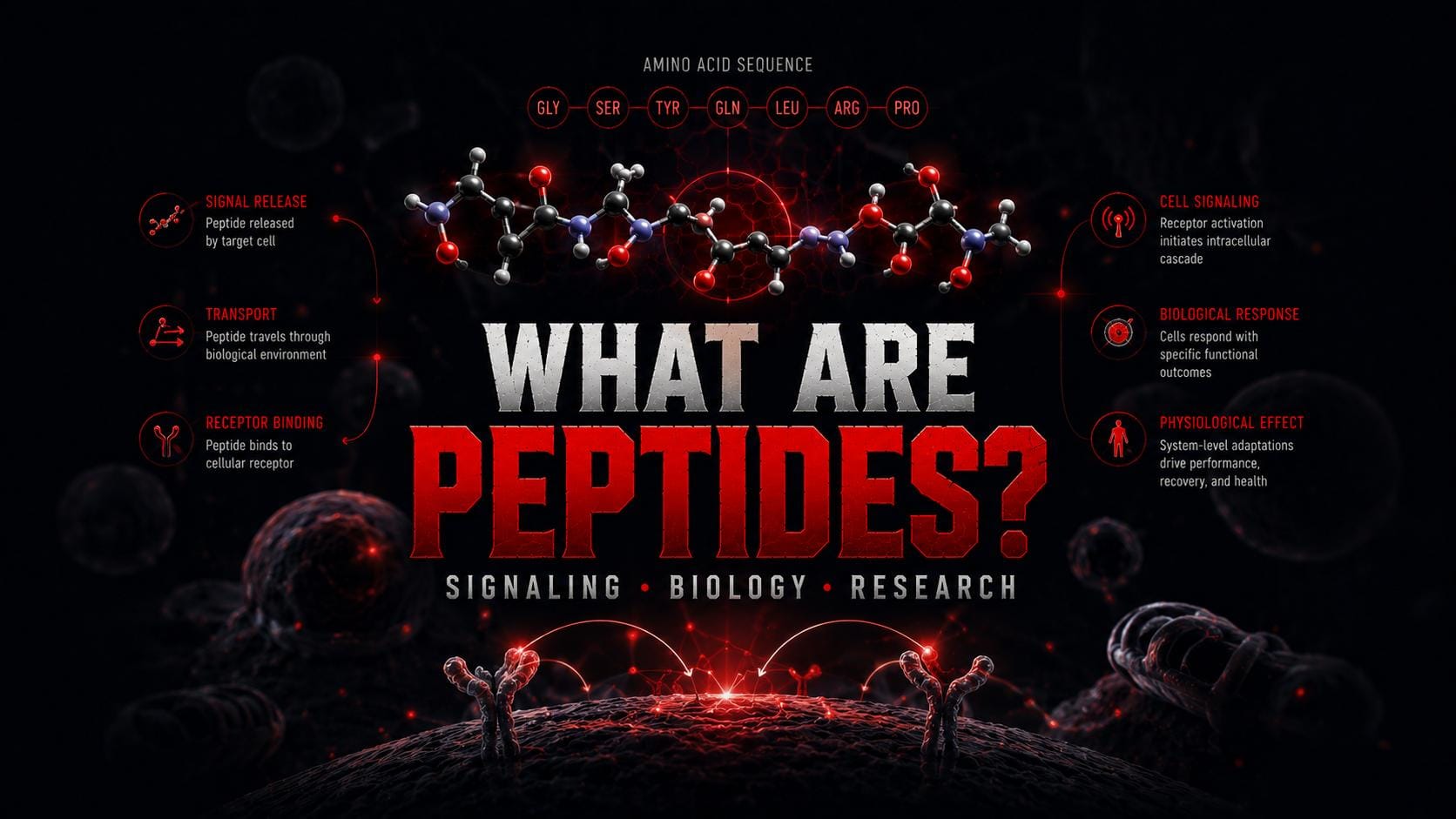
Peptides are messengers. A cell releases one. It travels through the blood or across a gap to another cell. It fits into a receptor on that cell like a key in a lock, and the cell changes what it is doing. That is the whole mechanism. What changes depends on which peptide and which cell.
Insulin tells muscle, fat and liver cells to take sugar out of the blood. Without it, type 1 diabetes was fatal; with it, since 1922, it is a managed condition (PMID 34404937).
Ghrelin is made in the stomach when it is empty. It tells the brain you are hungry and tells the pituitary to release growth hormone. It was discovered in 1999 as the natural key for a receptor that gym peptides like ipamorelin had already been built to hit (PMID 10604470).
GLP-1 is released from the gut after a meal. It tells the pancreas to release insulin and the brain that you are full. Semaglutide is an edited, long lasting copy of it. In 1961 adults with obesity it cut body weight 14.9 percent over 68 weeks against 2.4 percent on placebo (PMID 33567185).
Oxytocin starts labour contractions and milk let down, and works as a signal in the brain (PMID 24888645). Growth hormone releasing hormone tells the pituitary to release growth hormone. Sermorelin, CJC-1295 and tesamorelin are all copies of it (PMID 15817669).
Thymosin beta 4 is inside almost every cell. It holds on to actin, the cell's internal scaffolding, and releases it where the cell needs to move or rebuild (PMID 17947592). It is the protein TB-500 is cut from.
Peptides you already know, and the ones from the ads
The word covers two very different groups. One group is medicine: insulin, semaglutide, oxytocin, tesamorelin. Each has trials with hundreds or thousands of people and a regulator's approval. The other group is sold as research chemicals: BPC-157, TB-500, CJC-1295, ipamorelin. Each has a handful of human studies or none. The table puts them side by side.
| Peptide | Length | What it is | What human trials show | Status |
|---|---|---|---|---|
| Insulin | 51 | Your own blood sugar hormone, made as a drug since 1922 | A century of use; the first peptide drug (PMID 34404937) | Approved |
| Semaglutide (Ozempic, Wegovy) | 31 | Edited copy of GLP-1 that lasts a week (PMID 26308095) | Body weight down 14.9 percent vs 2.4 percent on placebo over 68 weeks in 1961 adults (PMID 33567185) | Approved |
| Tesamorelin (Egrifta) | GHRH copy | Stabilised growth hormone releasing hormone | Deep belly fat down 15.2 percent vs up 5.0 percent on placebo in 412 HIV patients (PMID 18057338) | Approved for one condition |
| Collagen peptides | 2 to 3 per fragment | Broken down collagen, sold as powder | Skin hydration and elasticity improved vs placebo across 26 trials and 1721 people (PMID 37432180) | Food supplement |
| Oxytocin | 9 | Your own labour and bonding hormone (PMID 24888645) | Used in hospitals to start labour | Approved |
| Ghrelin | 28 | Your own hunger hormone (PMID 10604470) | Not a drug; the target that GHRPs and MK-677 hit | Natural hormone |
| Sermorelin | 29 | First 29 amino acids of GHRH (PMID 15817669) | Raised IGF-1 and lean mass in older men over 16 weeks | Formerly approved, withdrawn for business reasons |
| CJC-1295 | 29 plus a hook | GHRH copy that binds albumin for a week | Two phase 1 trials, hormones only: GH up 2 to 10 times for 6 days (PMID 16352683) | Research chemical, FDA Category 2 |
| Ipamorelin | 5 | Ghrelin receptor agonist (PMID 9849822) | One drug level study and one failed surgery trial | Research chemical, FDA Category 2 |
| BPC-157 | 15 | Piece of a stomach protein (PMID 39204186) | Three uncontrolled studies, 30 people, poor quality (PMID 42885452) | Research chemical |
| TB-500 | 7 | Piece of thymosin beta 4, which is 43 long (PMID 17947592) | Zero human studies of the fragment | Research chemical |
| GHK-Cu | 3 | Copper binding skin peptide (PMID 29986520) | Mostly cosmetic and lab studies | Cosmetic ingredient |
Read the fourth column. The approved peptides have numbers from large trials. The research peptides have phrases like hormones only, 30 people, or zero human studies. That column is the only difference that matters, and it is the one the ads leave out.
The gym peptides: what are peptides used for in bodybuilding?
In the gym, peptides means a short list of injectable research chemicals sold for muscle, fat loss, recovery and healing. They fall into two groups by what they do.
Growth hormone peptides make your pituitary release more of your own growth hormone. CJC-1295, sermorelin and tesamorelin copy the GHRH signal. Ipamorelin, GHRP-6 and hexarelin hit the ghrelin receptor. They do raise growth hormone (PMID 16352683). What they have not shown is that the extra hormone becomes muscle. Growth hormone itself added about 2 kg of lean mass without any gain in strength in fit young adults (PMID 18347346). The full ranking by human evidence is on growth hormone peptides, with deep pages on CJC-1295 and ipamorelin.
Healing peptides are sold for tendons, joints and injuries. BPC-157 is a 15 amino acid piece of a stomach protein with dozens of rat studies and 30 humans (PMID 42885452). TB-500 is a 7 amino acid piece of thymosin beta 4 with one rat tendon study and no human study of the fragment. Both are covered on healing peptides, BPC-157 and TB-500.
What they have in common. None is approved for any use. Several, including CJC-1295 and ipamorelin, were placed in FDA Category 2 for compounding in September 2023, the category for significant safety risks. All are banned in tested sport. And a 2018 analysis of black market products found altered versions of ipamorelin, GHRP-2 and GHRP-6 sold in place of the named peptides (PMID 29864719). A 2026 review in Sports Medicine puts it plainly: favourable results in animals, scarce human safety data, potential for serious harm (PMID 41966639).
Peptides vs steroids: are peptides steroids?
No. They are different kinds of molecule that do different things. Anabolic steroids are copies of testosterone, a small fat soluble molecule built from cholesterol. They pass through the cell wall, bind a receptor inside, and switch on genes that build muscle protein. They can be swallowed or injected, and they work: muscle and strength go up, with heart, liver and hormone costs.
Peptides are chains of amino acids. They cannot pass through a cell wall, so they act on receptors on the outside and send a signal in. They are digested if swallowed, so most are injected. And for muscle specifically, the gym peptides have not shown what steroids show. Growth hormone itself added lean mass but no strength or muscle size in fit adults who train (PMID 18347346). Peptides that release growth hormone cannot do better than the hormone they release. The steroid side is on what are anabolic steroids.
Are peptides safer than steroids? Different risks, not fewer. Steroids build muscle and carry known heart, liver and fertility risks. Growth hormone peptides do not build measurable muscle in trials. They carry water retention, joint pain, raised cortisol and prolactin on most GHRPs, and worse blood sugar with months of use (PMID 42395176). Both come from unregulated supply chains that labs have caught mislabelling (PMID 29864719). Calling a compound safer because it has not been shown to work is not the comparison people think they are making.
What are peptides in skincare?
Skincare uses the same word for two different products. One you swallow, one you rub on.
Collagen peptides are collagen protein broken down into fragments of two or three amino acids so the gut can absorb them. This is the one place in the whole field where the supplement has decent human data. A 2023 meta analysis of 26 randomised trials and 1721 people found hydrolysed collagen improved skin hydration and elasticity against placebo (PMID 37432180). An earlier meta analysis of 19 trials and 1125 people, 95 percent women, found the same for hydration, elasticity and wrinkles (PMID 33742704). The classic single trial gave 69 women 2.5 or 5 g a day for eight weeks. Skin elasticity was better than placebo at both doses, with no side effects (PMID 23949208). The effects are modest and the trials have flaws, but they exist.
Copper peptides such as GHK-Cu are three amino acids bound to copper, applied as a cream or serum. The research behind them is mostly cell and gene studies showing more collagen and elastin production in the lab. Most of it comes from one group (PMID 29986520). Human trials with proper controls are thin. The ingredient is legal and widely used; the claims run ahead of the evidence.
Peptides in face creams generally rely on the same idea: short chains that signal skin cells to make more collagen. Whether a given peptide crosses the skin barrier in a useful amount is the open question for most of them. The answer is rarely published.
Are peptides safe? The risks, by the evidence
The question has no single answer because the word covers insulin and a vial from a website. The table splits it by group.
| Group | Main risks | Strongest evidence | Read it as |
|---|---|---|---|
| Approved peptide drugs | Known and listed on the label: low blood sugar with insulin, nausea and gut effects with GLP-1 drugs | Trials of hundreds to thousands of people (PMID 33567185) | Managed with a prescriber |
| Collagen peptides | No side effects reported in the trials | Trial of 69 women, 8 weeks (PMID 23949208); meta analyses of 1721 and 1125 people (PMID 37432180, PMID 33742704) | Low risk food supplement |
| Growth hormone peptides | Water retention, joint pain, raised cortisol and prolactin on most GHRPs, worse blood sugar with months of use | Class review of self administration (PMID 42395176); growth hormone itself raised swelling and fatigue (PMID 18347346) | Real, measured, unapproved |
| Healing peptides | Unknown for the molecule; theoretical blood vessel growth concern | BPC-157: 30 people, no adverse events reported, no controls (PMID 42885452); pathological angiogenesis and carcinogenesis listed as theoretical risks (PMID 42757290) | Not measured |
| All research chemicals | Contamination, impurities, inaccurate dosing, wrong molecule in the vial | Altered versions of ipamorelin, GHRP-2 and GHRP-6 found in black market vials (PMID 29864719); contamination and impurities first on the hazard list (PMID 42757290) | The concrete risk |
| All research chemicals | Legal and sporting | FDA Category 2 for CJC-1295, ipamorelin and BPC-157 in 2023; banned in tested sport (PMID 41966639) | Unapproved, prohibited for athletes |
For the approved drugs, the risks are known, listed, and managed by a prescriber. For collagen powder, the trials found nothing. For the research chemicals, two kinds of risk stack up. The first is the molecule. It has either measured hormone effects, as with the growth hormone peptides, or no human measurement at all, as with the healing peptides. The second is the vial. A 2018 doping laboratory analysis of black market growth hormone products found altered versions of three named peptides sold as the real thing (PMID 29864719). A 2026 review lists contamination, manufacturing impurities and inaccurate dosing as the first three hazards, ahead of anything the peptides themselves do (PMID 42757290).
The 10 most searched peptides, in one line each
People ask what the most popular peptides are. By search volume, here they are, each with the honest one line version.
1. Semaglutide
Approved GLP-1 copy. Body weight down 14.9 percent over 68 weeks in 1961 adults (PMID 33567185). The peptide that made the word famous.
2. BPC-157
15 amino acid piece of a stomach protein. Dozens of rat studies, 30 humans in three uncontrolled studies (PMID 42885452). Full page.
3. Collagen peptides
Broken down collagen powder. Modest, real gains in skin hydration and elasticity across 26 trials (PMID 37432180).
4. Tesamorelin
Approved GHRH copy for belly fat in HIV patients: 15.2 percent less deep belly fat over 26 weeks (PMID 18057338). Full page.
5. CJC-1295
GHRH copy with an albumin hook. Two phase 1 trials, hormones only (PMID 16352683). Full page.
6. Ipamorelin
Five amino acid ghrelin receptor agonist. One drug level study, one failed trial (PMID 9849822). Full page.
7. TB-500
Seven amino acid piece of thymosin beta 4. Zero human studies of the fragment. Full page.
8. Sermorelin
First 29 amino acids of GHRH (PMID 15817669). Formerly a prescription drug; raised lean mass in older men over 16 weeks.
9. GHK-Cu
Three amino acid copper peptide for skin. Lab and gene data, thin human trials (PMID 29986520).
10. Insulin
51 amino acids, the first peptide drug, 1922, and still the one that proves what a peptide can do (PMID 34404937).
Five mistakes people make about peptides
1. Treating peptide as a category of drug
It is a size of molecule, not a type of effect. Insulin and BPC-157 are both peptides. One is a century old medicine, the other has 30 humans in its record (PMID 34404937, PMID 42885452).
2. Borrowing semaglutide's results for the gym vials
Semaglutide has 1961 people in one trial (PMID 33567185). No gym peptide has a trial a tenth that size. The word they share proves nothing.
3. Calling peptides natural
Your hormones are natural. Ipamorelin is a designed molecule with unnatural D amino acids built in a lab (PMID 9849822). CJC-1295 has a chemical hook added to bind albumin (PMID 15817669). Copying nature is not the same as being natural.
4. Thinking peptides are steroids, or safer than steroids
Different molecules, different mechanisms, different risks. Peptides act outside the cell and are digested if swallowed. Steroids act inside the cell and build muscle, which the gym peptides have not shown (PMID 18347346).
5. Trusting the label on a research vial
A doping lab found altered versions of ipamorelin, GHRP-2 and GHRP-6 sold as the named peptides (PMID 29864719). The FDA cited impurities and immunogenicity when it placed several in Category 2.
Verdict: one word, two worlds
What are peptides? Short chains of amino acids that carry messages between cells. Your body makes thousands. Medicine has copied more than 80 of them into approved drugs, from insulin in 1922 to semaglutide today (PMID 33536635). The research chemical market sells a second set under the same word, with hormone curves and rat studies where the trials should be. The molecule type is the same. The evidence is not.
For readers here, the practical conclusion is simple. Judge each peptide on its own trials, not on the word. The family tree is on types of peptides. The muscle question is on growth hormone peptides. The healing question is on healing peptides. The syringe arithmetic for any vial is on the peptide calculator.
What are peptides: frequently asked questions
What are peptides in simple terms?
Short chains of amino acids, the same building blocks as protein, joined by peptide bonds. Under about 50 amino acids is a peptide, above that is a protein. Your body uses them as messengers: insulin, ghrelin, oxytocin and GLP-1 are all peptides. A 2025 review listed 87 of them in muscle alone, from a 3 amino acid collagen fragment to insulin at 51 (PMID 41231146, PMID 34404937).
What do peptides do?
Each one carries one message to one kind of receptor. Insulin tells cells to take up sugar (PMID 34404937). Ghrelin tells the brain you are hungry and the pituitary to release growth hormone (PMID 10604470). GLP-1 tells the pancreas to release insulin and the brain that you are full. Its drug copy semaglutide cut body weight 14.9 percent over 68 weeks (PMID 33567185). There is no general peptide effect, only the specific job of each one.
What is a peptide vs a protein?
Length. Both are chains of amino acids joined by peptide bonds. A peptide is short, roughly 2 to 50 amino acids, and acts as a signal. A protein is long, often hundreds or thousands, and folds into a working structure such as an enzyme or a muscle fibre. Insulin, at 51, sits on the line and is called a peptide hormone (PMID 34404937).
Are peptides steroids?
No. Steroids are small fat soluble molecules built from cholesterol that act inside the cell and build muscle. Peptides are amino acid chains that act on receptors outside the cell and are digested if swallowed. The gym peptides raise growth hormone, but growth hormone itself did not add strength or muscle size in fit adults who train (PMID 18347346). Different molecule, different mechanism, different evidence.
What are peptides used for?
In medicine: diabetes, obesity, cancer, osteoporosis, HIV and more, through over 80 approved peptide drugs (PMID 33536635). In skincare: hydrolysed collagen for hydration and elasticity, with modest gains across 26 trials (PMID 37432180). In the gym: unapproved research chemicals sold for muscle, fat loss and healing, where the human evidence is thin or absent (PMID 41966639).
Are peptides safe?
It depends which. Approved peptide drugs have known, labelled risks managed by a prescriber. Collagen powder reported no side effects in trials (PMID 23949208). Research chemicals carry an unmeasured molecule risk and a measured supply risk. Black market vials have been found to contain altered versions of the named peptides (PMID 29864719). Contamination, impurities and inaccurate dosing lead the hazard list (PMID 42757290).
What are peptides in skincare?
Two things. Collagen peptides are collagen broken into 2 to 3 amino acid fragments you swallow. Meta analyses of 26 and 19 trials found better skin hydration and elasticity than placebo (PMID 37432180, PMID 33742704). Copper peptides such as GHK-Cu are 3 amino acid chains in creams. They are backed mostly by lab and gene studies rather than controlled human trials (PMID 29986520).
Are peptides the same as Ozempic?
Ozempic is one peptide, semaglutide, a 31 amino acid edited copy of GLP-1 (PMID 40490042, PMID 26308095). It is approved, prescription only, and tested in thousands of people (PMID 33567185). Most peptides sold online for weight loss, muscle or healing are different molecules with none of that record. Sharing the word peptide with Ozempic is not evidence.
Sources and further reading
Every figure on this page comes from one of the 26 sources below. 25 are papers checked against their PubMed abstracts on 25 October 2026, and one is the FDA compounding list. Every chain length in the chart is taken from the abstract that states it. Reference links are dofollow to support open science.
Verified
Verified
Verified
Verified
Verified
Verified
Verified
Verified
Verified
Verified
Verified
Verified
Verified
Verified
Verified
Verified
Verified
Verified
Verified
Verified
Verified
Verified
Verified
Verified
Verified
Regulator
Keep reading
Four pages that go deeper: the family tree, the muscle question, the healing question, and how to read a research listing.
Final Educational Note
This article is educational and is not medical advice. It explains what peptides are and reports what trials, reviews and regulators say about the ones people search for. It gives no dose, schedule or protocol for any compound and does not recommend any research chemical for any use. Research peptides are not approved for human use anywhere and carry serious health and legal risks. More guides sit on the peptides hub.
Anyone considering any injectable compound outside a prescription should talk to a physician first. Read more about how this site works on the about page and in the full disclaimer.