NPP (Nandrolone Phenylpropionate): Short-Ester Nandrolone, Progestogenic Activity, and Bloodwork Guide
Fast-acting nandrolone and its trade-offs
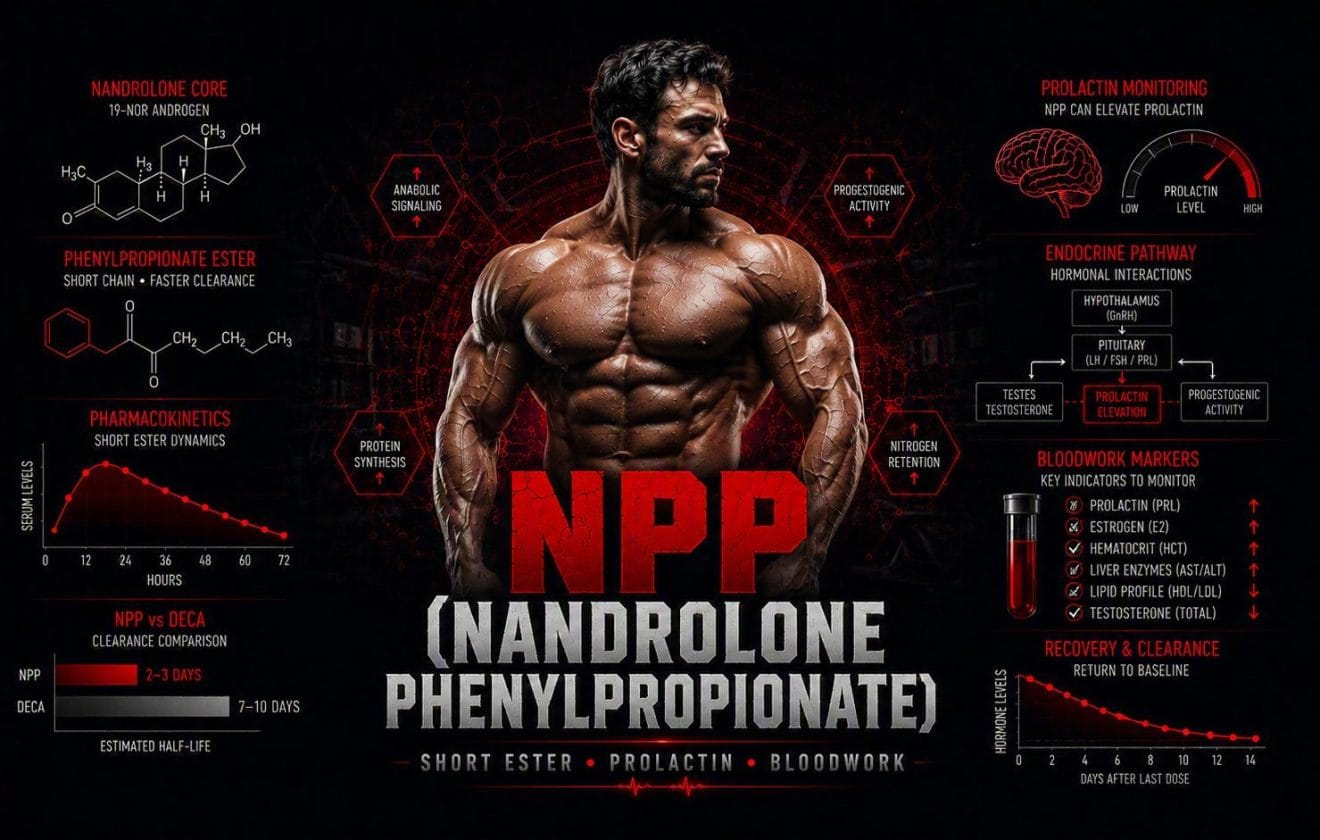
NPP - nandrolone phenylpropionate - delivers the same compound as Deca-Durabolin through a shorter ester with a half-life of approximately 4.5-5 days. The ester affects clearance speed and injection frequency, not pharmacology: the progestogenic activity, prolactin risk, and HPTA suppression profile are identical to Deca. This guide covers the mechanism, the NPP vs Deca distinction, what to monitor, and the five errors that define how this compound is misunderstood.
NPP: Three Pharmacological Facts That Define This Compound
Ester Only - Compound Identical to Deca
NPP and Deca-Durabolin both deliver nandrolone. The phenylpropionate ester releases the compound faster than decanoate - the active nandrolone that reaches circulation is pharmacologically identical in both cases. Choosing NPP over Deca is a kinetics decision, not a compound decision.
Progestogenic - Not Primarily Estrogenic
Nandrolone partially aromatizes at roughly 20% the rate of testosterone, but the dominant hormonal risk is not estrogen-driven. Progesterone receptor agonism can amplify gynecomastia and stimulate prolactin. Prolactin - not estradiol - is the monitoring priority on any nandrolone cycle, and it requires a separate marker in the bloodwork panel.
Faster Clearance, Same Detection Window
NPP's shorter half-life enables earlier PCT timing compared to Deca - this is the primary practical reason to choose the phenylpropionate ester. However, the long-term urinary metabolite of nandrolone persists 12-18 months regardless of which ester was used. For anti-doping purposes, both compounds carry the same extended detection risk.
What This Guide Covers
Covered in This Guide
- What NPP is and how nandrolone phenylpropionate differs from nandrolone decanoate
- 19-nor structure, 5-alpha reduction to dihydronandrolone, and androgenic activity
- Progestogenic activity, progesterone receptor agonism, and prolactin mechanism
- Partial aromatization and why estrogen is not the primary monitoring variable
- NPP vs Deca: half-life, injection frequency, clearance, and PCT timing
- The sexual dysfunction mechanism associated with nandrolone use
- 7 bloodwork markers for monitoring an NPP cycle
- 5 common errors in how NPP is used and understood
Not Covered Here
- Dosing recommendations or cycle length guidelines
- Stacking protocols or compound combinations
- Drug sourcing or acquisition
- Personal medical advice or individualised recommendations
- Comparison with non-nandrolone injectables
Nandrolone class overview: For the full 19-nor structural context and how nandrolone differs from testosterone and DHT-derived compounds as a class, see Nandrolone Steroids. For the direct comparison between NPP and Deca-Durabolin at the compound level, see Deca-Durabolin (Nandrolone Decanoate).
How NPP Works: 19-Nor Structure, Progestogenic Activity, and What the Ester Actually Changes
NPP is nandrolone delivered via the phenylpropionate ester - a short ester chain that releases nandrolone from the injection depot over approximately 4.5-5 days. The ester itself is pharmacologically inert: once cleaved by plasma esterases at the injection site, the nandrolone released into circulation behaves identically to the nandrolone released from decanoate. The entire pharmacological difference between NPP and Deca-Durabolin is the release rate. Everything else - mechanism, receptor binding, hormonal effects, long-term metabolite persistence - is the same compound.
Nandrolone is a 19-nortestosterone derivative. Its structure lacks the 19th carbon methyl group present in testosterone, and this single modification changes its interaction with the major steroid-metabolizing enzymes. While testosterone converts via 5-alpha reductase to dihydrotestosterone - a highly potent androgen - nandrolone converts to dihydronandrolone, a metabolite with substantially weaker androgenic activity than DHT. This is the structural basis for nandrolone's lower androgenic side effect profile compared to testosterone: less scalp hair acceleration, less sebaceous gland stimulation, reduced acne risk at comparable doses. However, dihydronandrolone does still occupy androgen receptors, including those in penile erectile tissue, and this receptor occupancy dynamic is central to understanding the sexual dysfunction associated with nandrolone use - covered in detail in the ester comparison section below.
Nandrolone aromatizes at approximately 20% the rate of testosterone. This partial aromatization produces some estradiol, but the dominant hormonal risk of NPP is not estrogenic - it is progestogenic. Nandrolone is a progesterone receptor agonist, meaning it directly activates progesterone receptors in addition to androgen receptors. Progesterone receptor activation has two clinically relevant consequences in a performance context: it synergizes with estrogen to amplify the risk of gynecomastia even at low estradiol levels that would not cause gynecomastia on a testosterone-only cycle, and it stimulates prolactin secretion from the lactotroph cells of the anterior pituitary. Elevated prolactin is an independent variable on an NPP cycle - it is not captured by estradiol measurement, and it requires its own marker in any bloodwork panel monitoring nandrolone use.
19-Nor Structure and Androgen Receptor Profile
Absence of the C19 methyl group redirects 5-alpha reductase metabolism from DHT to dihydronandrolone - a much weaker androgen. This reduces androgenic side effects relative to testosterone but retains androgen receptor binding in all target tissues, including erectile tissue, with relevance to nandrolone-associated sexual dysfunction.
Progestogenic Activity and Prolactin Risk
Nandrolone activates progesterone receptors directly. This produces two effects: synergistic amplification of gynecomastia risk alongside estrogen (even at low estradiol levels), and stimulation of pituitary prolactin secretion. Prolactin elevation is the primary hormonal side effect variable on an NPP cycle - estradiol monitoring alone does not cover this risk.
Partial Aromatization and the Estrogen Picture
Nandrolone aromatizes at roughly 20% of testosterone's rate, producing meaningful but modest estradiol elevation. In a stack that includes testosterone, estradiol is primarily driven by the testosterone component, not by NPP. The compound's own estrogenic contribution is secondary; its progestogenic contribution is primary and requires separate monitoring.
NPP vs Deca-Durabolin: What the Ester Difference Actually Means in Practice
The case for choosing NPP over Deca-Durabolin is entirely kinetic. Both compounds are nandrolone - the phenylpropionate ester on NPP simply releases the compound faster. This has three practical consequences: injection frequency must increase, stable blood levels are achieved faster, and - critically - the compound clears from circulation faster, which moves PCT timing forward. For users who want the nandrolone compound in a cycle under 12 weeks, or who want to be able to start post-cycle therapy sooner, NPP is the appropriate ester. Deca's long half-life means it lingers in circulation for weeks after the last injection, making PCT timing complex on shorter cycles.
| Parameter | NPP | Deca-Durabolin |
|---|---|---|
| Active compound | Nandrolone (identical) | Nandrolone (identical) |
| Ester | Phenylpropionate | Decanoate |
| Half-life | ~4.5-5 days | ~14-16 days |
| Injection frequency | Every 2-3 days (EOD or 3×/week) | Once weekly or every 10 days |
| Time to stable blood levels | ~2 weeks | ~4-6 weeks |
| Clearance post-cycle | ~3-4 weeks after last injection | ~5-6 weeks after last injection |
| PCT start (oral PCT compounds) | ~2-3 weeks after last injection | ~3-4 weeks after last injection |
| Long-term urinary metabolite | Norandrosterone - 12-18+ months | Norandrosterone - 12-18+ months |
| Progestogenic activity | Present - identical to Deca | Present - identical to NPP |
| Prolactin risk | Identical to Deca | Identical to NPP |
| HPTA suppression | Complete at any practical dose | Complete at any practical dose |
| Minimum practical cycle length | 8-10 weeks (achieves stable levels and effect) | 12-16 weeks (required for Deca's slow buildup) |
Half-lives are estimates based on pharmacokinetic data; individual variation applies. PCT timing guidelines reflect general practice and are not dosing recommendations. Long-term metabolite detection windows apply to anti-doping contexts and are the same for both esters.
The Sexual Dysfunction Mechanism: Why Nandrolone Affects Erectile Function
The sexual dysfunction associated with nandrolone use - commonly referred to in the performance community as "Deca dick," but applicable equally to NPP - has a specific pharmacological basis that is frequently misattributed. The most common misattribution is that the effect is purely estrogenic: suppressed testosterone + some estradiol = low libido. This is incomplete. The mechanism involves three concurrent factors: complete HPTA suppression eliminating endogenous testosterone production; the conversion of nandrolone to dihydronandrolone - which occupies androgen receptors in penile tissue without the high potency of DHT - effectively displacing DHT-driven receptor activity; and prolactin elevation from progestogenic receptor activation, which independently suppresses dopaminergic signalling involved in sexual arousal and erectile response. The combined result is androgen receptor occupancy by a weaker androgen, reduced dopaminergic tone, and absent endogenous testosterone - all simultaneously. This three-variable mechanism explains why the effect can persist even when estradiol is managed, and why prolactin monitoring is not optional on an NPP cycle. See Fertility and Suppression on Steroids for the broader HPTA suppression context.
7 Markers to Monitor on an NPP Cycle
The bloodwork framework for nandrolone phenylpropionate centres on three variables that differ from a standard testosterone-only monitoring approach: prolactin, which requires its own marker and is not captured by estradiol measurement; HDL suppression, which all anabolic steroids produce to some degree; and hematocrit, which rises with erythropoietic stimulation. Because the compound's half-life is approximately 4.5-5 days, mid-cycle bloodwork is appropriate at week 4-6 - early enough to capture steady state and act on results before the cycle's final third.
Relative Prolactin Risk by Compound Class
Prolactin risk reflects progestogenic receptor activity. DHT-derived compounds (Masteron, Winstrol, Proviron) carry no direct prolactin stimulation risk. Trenbolone and nandrolone share the 19-nor progestogenic mechanism.
Prolactin
The single most important NPP-specific bloodwork variable. Progestogenic receptor activation stimulates pituitary prolactin secretion throughout the cycle. Elevated prolactin contributes to sexual dysfunction, suppresses dopaminergic tone, and - in the presence of even modest estradiol - amplifies gynecomastia risk. A pre-cycle prolactin baseline and mid-cycle measurement at week 4-6 are both essential. Prolactin above the upper reference range on any nandrolone cycle is not normal variation - it is a direct pharmacological effect of the compound. See Gynecomastia Risk on Steroids.
Estradiol (E2)
Nandrolone partially aromatizes to estradiol at roughly 20% the rate of testosterone. In a stack where testosterone is the base compound alongside an NPP cycle, the primary driver of estradiol elevation is the testosterone component - not the nandrolone. Estradiol must still be monitored, but interpreting a high E2 reading requires identifying which compound is the dominant source. Managing estradiol without also monitoring prolactin addresses only part of the hormonal picture on this compound. See Estradiol Before Steroids.
HDL Cholesterol
Injectable anabolic steroids suppress HDL, and nandrolone is no exception - though its lipid impact is less severe than 17-alpha alkylated orals. Hepatic lipase upregulation from any anabolic compound suppresses HDL to a meaningful degree at standard doses. A pre-cycle lipid baseline and mid-cycle panel capture the HDL trajectory. HDL below 35 mg/dL during any anabolic cycle represents increased endothelial risk. When the cycle also includes an oral compound, the combined HDL suppression is substantially worse than either alone. See Lipid Panel (HDL, LDL, Triglycerides).
Total Testosterone and LH/FSH
HPTA suppression is complete on any practical nandrolone dose - endogenous LH and FSH will be suppressed to near-zero within the first weeks. Post-cycle LH and FSH recovery confirms HPG axis reactivation. Because the phenylpropionate ester's shorter half-life clears faster than decanoate, PCT can begin sooner - but HPTA recovery is still measured in weeks to months after full clearance, not days. Post-cycle bloodwork timing should follow the PCT start guide. See Hormonal Recovery After Steroids.
Hematocrit and Hemoglobin (CBC)
All anabolic steroids stimulate erythropoiesis - red blood cell production increases during a cycle, raising hematocrit. Nandrolone's erythropoietic effect is moderate relative to boldenone or high-dose testosterone, but a baseline CBC pre-cycle and a mid-cycle check are part of the standard panel. Hematocrit above 52% increases thrombotic risk independent of other cardiovascular variables. See Hematocrit and Hemoglobin.
Blood Pressure
Blood pressure elevation on an injectable nandrolone cycle is primarily driven by fluid retention from estradiol and by HDL-related endothelial effects. Weekly home blood pressure measurement throughout the cycle is more useful than a single clinic reading at cycle end. Users who stack the compound with a testosterone base carry an additive estrogen-driven fluid retention burden. Pre-cycle blood pressure above 130/85 mmHg is a meaningful risk amplifier on any anabolic cycle. See Blood Pressure Before Steroids.
Kidney Markers (Creatinine, eGFR)
Anabolic steroids increase muscle protein synthesis and creatine turnover, raising serum creatinine as a byproduct of increased muscle mass - independent of any nephrotoxic effect. A pre-cycle creatinine and eGFR baseline establishes the individual's reference point before adding the metabolic load of a nandrolone cycle. Without a pre-cycle baseline, an elevated post-cycle creatinine reading cannot be distinguished from training-driven muscle mass increases versus genuine renal stress. See Kidney Markers (Creatinine, eGFR, BUN).
5 Mistakes in How NPP Is Used and Understood
- Mistake 1
Managing Gynecomastia Risk with an Aromatase Inhibitor Alone
Aromatase inhibitors reduce estradiol by blocking aromatase enzyme activity - they have no effect on progesterone receptor activation or prolactin secretion. On a nandrolone cycle, gynecomastia risk has two independent inputs: estradiol acting on estrogen receptors, and progesterone receptor activation synergizing with even low estradiol to produce gynecomastia sensitivity far beyond what that estradiol level alone would predict. An aromatase inhibitor addresses the estrogen input only. Users who keep estradiol in range via an AI and assume gynecomastia risk is managed on an NPP cycle are leaving the progesterone-driven input entirely unmonitored. Prolactin monitoring - not just estradiol - is the complete hormonal picture on this compound.
- Mistake 2
Assuming the Short Ester Reduces the Anti-Doping Detection Window
The phenylpropionate ester means the parent compound clears from circulation within 3-4 weeks of the last injection. This is relevant for PCT timing and blood-level purposes - not for anti-doping detection. The primary long-term urinary metabolite of nandrolone - 19-norandrosterone - is detectable in urine for 12 to 18 months or longer after the last injection, regardless of which ester was used. Any competitive athlete or individual subject to testing who selects NPP over Deca because of its shorter ester in an attempt to shorten the detection window is working from an incorrect assumption. The detection risk is identical between both esters because it is driven by the nandrolone metabolite, not by the ester's clearance speed.
- Mistake 3
Attributing Sexual Dysfunction Entirely to Estradiol Imbalance
The sexual dysfunction that can develop on a nandrolone cycle has a multi-variable mechanism. Users experiencing it commonly attempt to correct it by adjusting estradiol - either raising it if they have been over-suppressing with an AI, or lowering it if they assume excess estrogen is the cause. Both corrections address only one of three concurrent variables: absent endogenous testosterone from complete HPTA suppression; androgen receptor occupancy in erectile tissue by dihydronandrolone - a weak androgen that displaces DHT without matching its potency; and prolactin elevation from progestogenic receptor activation, which independently suppresses dopaminergic signalling involved in sexual arousal. Adjusting estradiol without prolactin data and without accounting for the dihydronandrolone mechanism leaves the root pharmacological causes unaddressed.
- Mistake 4
Running the Cycle Too Short to Reach Effective Steady State
Despite the phenylpropionate ester's faster onset versus decanoate, nandrolone still requires time to reach meaningful tissue saturation and produce its characteristic effects - nitrogen retention, joint fluid increase, and the gradual anabolic response the compound is known for. Cycles under 8 weeks are too short to allow the compound to express its primary benefits before the cycle ends. The shorter ester enables a shorter minimum cycle than Deca (8-10 weeks versus 12-16 weeks), but it does not compress the effective expression window to 4-6 weeks. Users who run a brief NPP cycle expecting rapid mass-building effects comparable to oral kickstarters are misapplying the compound's pharmacological timeline.
- Mistake 5
Skipping the Pre-Cycle Prolactin Baseline
A mid-cycle prolactin reading is only interpretable against a pre-cycle baseline. Prolactin levels vary considerably between individuals - some users have naturally elevated prolactin from stress, poor sleep, or other medications. Without a baseline, a mid-cycle prolactin reading that appears elevated cannot be attributed definitively to the nandrolone cycle versus a pre-existing condition. The pre-cycle prolactin draw requires no additional appointment - it is drawn at the same time as testosterone, LH, FSH, and lipids. Skipping it removes the ability to correctly interpret the most important compound-specific monitoring marker mid-cycle. See Blood Tests Before Steroids.
Published Research Referenced in This Guide
- Patanè FG, Borgio GF, De Salvo R, et al. Nandrolone Decanoate: Use, Abuse and Side Effects. Medicina (Kaunas). 2020. pubmed.ncbi.nlm.nih.gov/33187340
- Kicman AT. Pharmacology of anabolic steroids. Br J Pharmacol. 2008. pubmed.ncbi.nlm.nih.gov/18500378
- Hartgens F, Kuipers H. Effects of androgenic-anabolic steroids in athletes. Sports Med. 2004. pubmed.ncbi.nlm.nih.gov/15248788
- Hartgens F, Rietjens G, Keizer HA, et al. Effects of androgenic-anabolic steroids on apolipoproteins and lipoprotein(a). Br J Sports Med. 2004. pubmed.ncbi.nlm.nih.gov/15155420
- Anabolic steroids overview. NCBI Bookshelf / StatPearls. ncbi.nlm.nih.gov/books/NBK482418
What NPP Requires: Prolactin Monitoring, Accurate Ester Understanding, and a Complete Bloodwork Panel
The phenylpropionate ester makes one thing different from Deca-Durabolin: how fast nandrolone enters and leaves circulation. Everything else - the progestogenic activity, the prolactin risk, the DHT-displacement mechanism in erectile tissue, the extended anti-doping detection window, the complete HPTA suppression - is identical between the two esters. Users who choose NPP to avoid Deca's slow onset and to enable earlier PCT timing are making a pharmacokinetically sound decision. Users who choose it believing the shorter ester also shortens the metabolite detection window, reduces progestogenic activity, or fundamentally changes the compound's risk profile are working from incorrect assumptions about what the ester modification actually does.
The prolactin variable is the single most commonly under-monitored aspect of any nandrolone cycle, and the pre-cycle baseline is the most commonly skipped draw. A mid-cycle prolactin reading without a baseline is uninterpretable. The sexual dysfunction mechanism on a nandrolone cycle operates on three variables simultaneously - absent endogenous testosterone, weak androgen receptor occupancy by dihydronandrolone, and prolactin-driven dopaminergic suppression - none of which is addressed by estradiol adjustment alone. An NPP cycle managed only with an aromatase inhibitor and no prolactin data is monitored for one hormonal variable while two others operate without oversight.
- Nandrolone Steroids - 19-nor class overview and how nandrolone's structure differs from testosterone and DHT-derived compounds
- Deca-Durabolin (Nandrolone Decanoate) - the long-ester nandrolone and how it compares in onset, clearance, and cycle structure requirements
- Gynecomastia Risk on Steroids - estrogen and progesterone receptor mechanism and why progestogenic compounds amplify gynecomastia sensitivity
- Estradiol Before Steroids - estradiol baseline and monitoring context for any cycle that includes partial aromatization
- Lipid Panel (HDL, LDL, Triglycerides) - HDL suppression framework and how injectable compounds affect the lipid profile
- Hematocrit and Hemoglobin - erythropoietic effects of anabolic steroids and hematocrit monitoring thresholds
- Blood Tests Before Steroids - the full pre-cycle panel and why prolactin baseline is non-optional on any nandrolone cycle
- Hormonal Recovery After Steroids - HPTA suppression depth and recovery timeline after complete LH/FSH suppression
- When to Start PCT - clearance window calculation and how the phenylpropionate ester changes PCT start timing versus decanoate
- Fertility and Suppression on Steroids - HPTA suppression depth, sperm production impact, and recovery considerations after nandrolone use
- Injectable vs Oral Steroids - pharmacokinetic and hepatotoxicity differences between delivery routes
For Educational Purposes Only
This article discusses NPP (nandrolone phenylpropionate) for educational and harm-reduction purposes. It does not constitute medical advice and is not a substitute for consultation with a qualified physician. The information reflects published research and is intended to support informed decision-making, not to encourage or facilitate the use of controlled substances.
MuscleScience.org does not sell any compounds, medications, or supplements. All author names are pseudonyms. Author photographs are stylized portraits, not images of real individuals. See our About page and Disclaimer for full editorial disclosure.