Peptide Side Effects: What Research Documents and What Remains Unknown
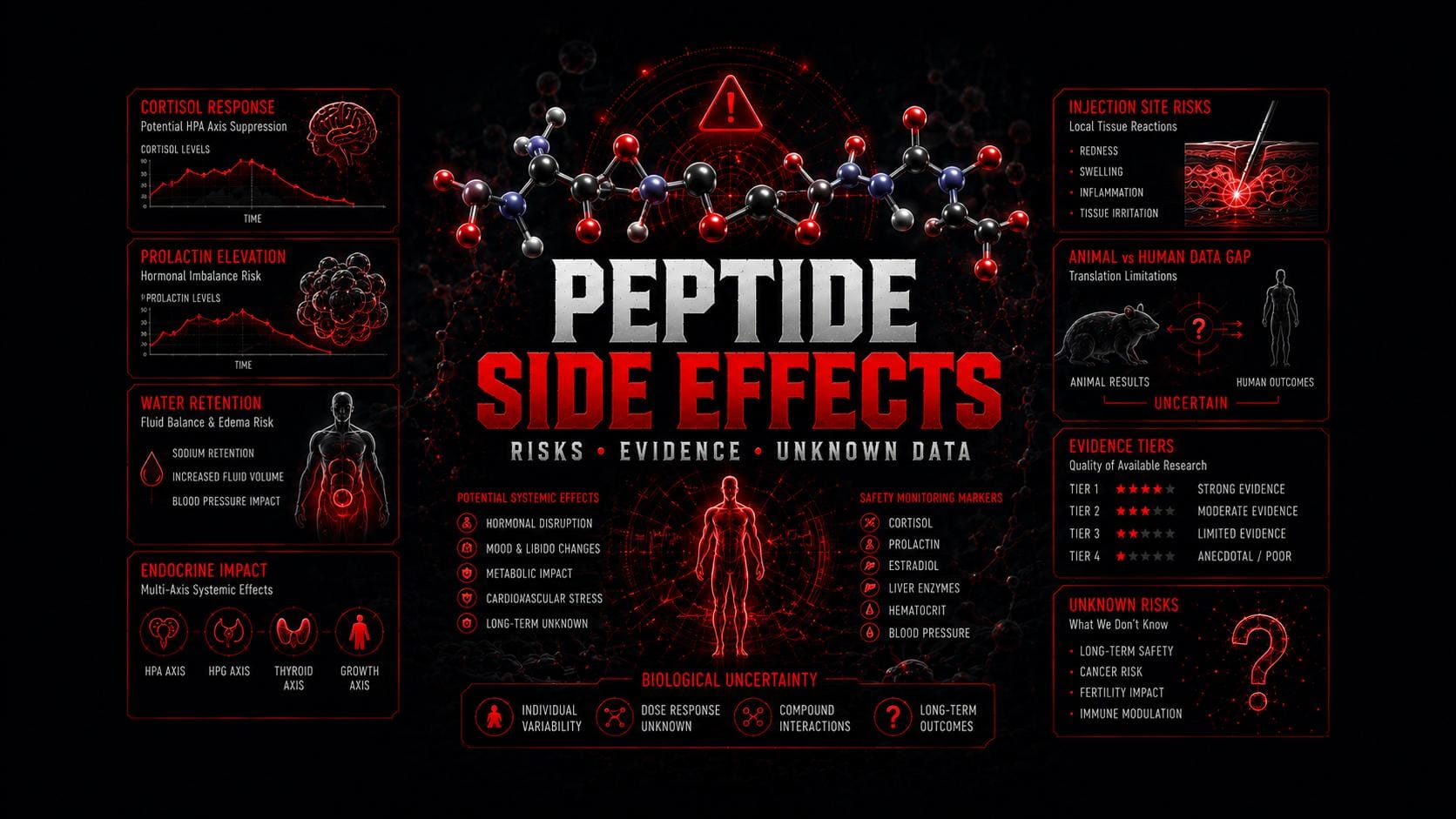
PEPTIDE SIDE EFFECTS: WHAT RESEARCH DOCUMENTS AND WHAT REMAINS UNKNOWN
Are peptides safe? There is no single answer, because the word covers very different drugs. Some peptides have been tested in thousands of people, and their side effects are printed on an FDA label. Others have been tested in a few dozen people, or in nobody at all. For those, the honest answer about peptide side effects is that nobody knows yet.
This page sorts the side effects of peptides by group, in plain words. You get what is known for each group, how many people that knowledge rests on, the extra risks of grey market vials, and who should not use peptides. Every number comes from a PubMed abstract or a regulator document. The basics are on what are peptides.
Peptide side effects in brief
Three numbers show the whole problem with peptide side effects. How many people tested the best known peptide, and how many tested the most hyped one. And how pure the grey market product really was.
Took Wegovy in the three trials behind its FDA label
That is why its side effects are known in detail. Nausea hit 44 percent on the drug and 16 percent on placebo. Diarrhea hit 30 percent against 16 percent (FDA label).
Every human ever studied on BPC-157, in three small studies with no placebo group
No adverse events were reported, but the studies were rated poor quality and the certainty very low (PMID 42885452). Thirty people cannot show a rare or slow side effect.
Best purity found in grey market semaglutide vials that claimed 99 percent
Researchers bought vials from illegal online pharmacies. Purity ran from 7.7 to 14.37 percent, and every sample held bacterial endotoxin (PMID 39509151).
Every figure on this page comes from a PubMed abstract or a regulator document listed at the end. No dose, schedule or protocol appears for any unapproved compound. Nothing here is a recommendation to use any peptide.
What this guide covers
Peptide side effects by group: weight loss peptides, growth hormone peptides, healing peptides, tanning and sexual peptides, and skin and food peptides.
How much is known, measured as the number of people each peptide has been safety tested in.
The extra risks of grey market vials: purity, contamination and dosing mistakes.
Who should not use peptides, what not to mix, and the warning signs that need a doctor.
Not covered
Doses or protocols for unapproved peptides. Approved peptides are dosed by a prescriber.
Where to buy anything. This site does not sell or source peptides and does not link to sellers.
Every single compound. The full map is on types of peptides. Single compounds have their own pages, such as BPC-157 and ipamorelin.
Are peptides safe? The short answer
A peptide is a short chain of amino acids. Insulin is a peptide, and so is semaglutide. So is BPC-157, which no regulator has approved. Asking whether peptides are safe is like asking whether pills are safe. It depends on which one, how much, and who made it.
The useful question is how much we know about the side effects of peptides, one by one. Peptides fall into three groups on that score.
Known. Approved peptides like semaglutide, tirzepatide and tesamorelin were tested in hundreds or thousands of people. Their side effects are listed on the label, with how often each one happens. Most are stomach problems, and most fade with time.
Partly known. Peptides like CJC-1295 and ipamorelin were tested in small, short trials, then shelved. We know what happened in those weeks. We do not know what happens over months or years.
Unknown. BPC-157, TB-500 and melanotan II have almost no human safety data. Rat studies tell you what a drug does in rats. They cannot tell you how often a person gets a side effect.
Side effects of peptides by group
Here are the side effects of peptides, group by group. The last column says how solid the knowledge is. Read the table first, then jump to the section for the group you care about.
| Group | Examples | Most common side effects | How well known |
|---|---|---|---|
| Weight loss (GLP-1) | Semaglutide, tirzepatide | Nausea, diarrhea, vomiting, constipation. Rarer: pancreatitis and gallbladder problems (FDA label) | Well. Thousands of people in trials, listed on the label |
| Growth hormone releasing | Tesamorelin, CJC-1295, ipamorelin | The effects of extra growth hormone: swelling, joint pain, numb fingers and higher blood sugar (PMID 17227934) | Partly. Hundreds of people, mostly in short trials |
| Healing | BPC-157, TB-500 | None reported in 30 people, with no placebo group (PMID 42885452) | Barely. Unknown in practice |
| Tanning and sexual | Melanotan II, bremelanotide | Bremelanotide: nausea, flushing, headache (PMID 31599840). Melanotan II: new or changing moles in case reports (PMID 28266027) | Bremelanotide well. Melanotan II only case reports |
| Skin and food | Collagen peptides, GHK-Cu creams | None reported in the collagen trials (PMID 30609761) | Collagen fairly well; creams little studied |
Two patterns stand out. First, the approved peptides have the longest side effect lists, because they were tested the most. A short list on an unapproved peptide usually means nobody looked. Second, the most common problems are dull ones: an upset stomach, a sore injection site, water retention.
How much is known: people tested for each peptide
This chart counts the people in the trials behind each peptide's safety data. Red bars are approved peptides. Grey bars are not approved. The scale grows by ten times at each step, so a bar half as long means far fewer people, not half as many.
| Peptide | People | Status | Source |
|---|---|---|---|
| Semaglutide (Wegovy) | 3,377 | Approved | FDA label: 2,116 on drug + 1,261 on placebo |
| Tirzepatide | 2,539 | Approved | PMID 35658024 |
| Bremelanotide (Vyleesi) | 1,247 | Approved | PMID 31599840 |
| Tesamorelin | 412 | Approved | PMID 18057338 |
| Ipamorelin | 114 | Not approved | PMID 25331030 |
| Thymosin beta 4 | 40 | Not approved | PMID 20536472 |
| BPC-157 | 30 | Not approved | PMID 42885452, no placebo |
| TB-500 | 0 | Not approved | no human trial |
| Melanotan II | 0 | Not approved | case reports only |
The gap is large. The Wegovy label rests on 3,377 people, with 2,116 on the drug (FDA label). BPC-157 rests on 30 people with no comparison group (PMID 42885452). TB-500 and melanotan II have no trial at all.
So are peptides safe at the scale of a whole population? Numbers matter because rare side effects are rare. A side effect that hits one person in 300 will probably not show up in 30 people. It will show up in a few thousand. That is why regulators ask for large trials before approval.
Weight loss peptide side effects: semaglutide and tirzepatide
The weight loss peptides are the best tested peptides on this page. Their side effects are mostly in the gut, because they slow the stomach and dull hunger. The table shows the Wegovy label numbers.
| Side effect | On Wegovy | On placebo |
|---|---|---|
| Nausea | 44% | 16% |
| Diarrhea | 30% | 16% |
| Vomiting | 24% | 6% |
| Constipation | 24% | 11% |
| Abdominal pain | 20% | 10% |
| Headache | 14% | 10% |
| Fatigue | 11% | 5% |
| Stopped because of side effects | 6.8% | 3.2% |
Notice the placebo column. People on dummy injections also had nausea and headaches. The real side effect is the difference between the two columns. For nausea, that is 28 extra people in every 100.
The stomach effects are why the dose goes up slowly. The Wegovy label starts at 0.25 mg a week and climbs every four weeks to 2.4 mg. In the main trial, nausea and diarrhea were mostly mild to moderate and faded over time (PMID 33567185). Even so, 4.5 percent stopped for stomach reasons, against 0.8 percent on placebo.
Tirzepatide looks similar. In a 72 week trial of 2,539 adults, the common side effects were in the gut and came mostly during dose increases. Side effects made 4.3 to 7.1 percent stop, against 2.6 percent on placebo (PMID 35658024). A 2025 analysis of 13 trials and 26,894 people found more stomach problems on both drugs. Semaglutide also raised gallstones about 2.6 times; neither drug raised liver or pancreas problems significantly (PMID 40189856).
The rarer warnings are on the label. Pancreatitis occurred in trials. Gallstones were reported in 1.6 percent on Wegovy against 0.7 percent on placebo. Severe vomiting can dry you out and hurt the kidneys. The label also asks doctors to watch for low mood and suicidal thoughts.
The label carries a boxed warning: semaglutide caused thyroid C-cell tumors in rodents (FDA label). Whether that happens in people is unknown. A 2026 analysis of 48 trials and 94,245 people found these drugs probably have little or no effect on thyroid cancer (PMID 41359966). The trials were short, so the question stays open.
Growth hormone peptide side effects
Growth hormone peptides tell your pituitary gland to release more growth hormone. That raises IGF-1, the hormone that does much of growth hormone's work. So their side effects are mostly the side effects of extra growth hormone. The full group is explained on growth hormone peptides.
Tesamorelin is the approved one. In a trial of 412 people with HIV, it raised IGF-1 by 81 percent over 26 weeks. Overall side effects did not differ from placebo, but more people on tesamorelin quit because of one (PMID 18057338). More detail is on tesamorelin.
CJC-1295 was tested in healthy adults for up to 49 days. One injection raised growth hormone 2 to 10 times for 6 days or more. No serious adverse reactions were reported (PMID 16352683). Ipamorelin was tested in 114 patients after bowel surgery. Side effects hit 87.5 percent on ipamorelin and 94.8 percent on placebo, because everyone had just had surgery (PMID 25331030). Both are covered in depth on CJC-1295 and ipamorelin.
What does extra growth hormone do over months? A review pooled trials of growth hormone itself in 220 healthy older adults. They gained about 2.1 kg of lean mass and lost 2.1 kg of fat. They also had more swelling, joint pain, carpal tunnel syndrome and breast tissue growth. They were somewhat more likely to develop diabetes or high fasting sugar (PMID 17227934).
Healing and tanning peptides: side effects nobody has measured
This is where the data runs out. BPC-157 has been given to 30 people across three small studies. None reported adverse events, but none had a placebo group and all were rated poor quality (PMID 42885452). TB-500 has never been tested in a human trial. Lab tests of online TB500 products found they did not match their descriptions (PMID 36482504).
The full protein TB-500 is cut from, thymosin beta 4, was tested in 40 healthy volunteers by drip for 14 days. It was well tolerated, with no serious events (PMID 20536472). That result belongs to the full protein, not to the fragment sold as TB-500. More is on healing peptides and TB-500.
Without human data, reviewers can only list possible risks. A 2026 review names unwanted blood vessel growth, cancer, heart strain, contamination and wrong doses (PMID 42757290). These are possibilities based on how the drugs work, not measured rates. The FDA has placed BPC-157 on its list of substances that may pose significant safety risks in compounding (FDA, Category 2).
Melanotan II, the tanning injection, has a worrying case record. A review found new and changing moles in many reports, and four cases of melanoma arising from moles during or soon after use (PMID 28266027). In one case, multiple atypical moles appeared within a week of two injections (PMID 23914578). A kidney infarction has also been linked to it (PMID 31953620).
Compare its approved cousin, bremelanotide. It was tested in 1,247 women in two trials. Nausea, flushing and headache each hit 10 percent or more, more than on placebo (PMID 31599840). The approved drug has a measured list; the unapproved one has case reports.
Grey market peptides: the risk is in the vial
The side effects above assume you get the right drug at the right dose. With grey market peptides, that is not guaranteed. The product can be the bigger risk than the peptide.
A 2024 study bought semaglutide from illegal online pharmacies. Three ordered pens never arrived. The three vials that did arrive held 7.7 to 14.37 percent pure semaglutide, despite labels claiming 99 percent. Every vial contained bacterial endotoxin, a toxin that can cause fever and chills (PMID 39509151).
Dosing mistakes are the other trap. A poison control center reported three people harmed by compounded semaglutide. Two had injected ten times their intended dose, and one confused milliliters, units and milligrams. All had nausea, vomiting and stomach pain, most for days (PMID 37392810).
The arithmetic is easy to get wrong. A vial holds a powder you mix with water, so the strength depends on how much water you add. The peptide calculator shows how milligrams, millilitres and syringe units connect.
Who should not use peptides, and when to see a doctor
Some people should not use certain peptides at all. Others need a doctor involved first. The list below comes from labels and reviews, not from guesswork.
Pregnancy or planning one. The Wegovy label says it may harm a fetus. Stop it at least two months before a planned pregnancy, because it stays in the body that long.
Thyroid cancer history. Weight loss peptides like Wegovy must not be used with a personal or family history of medullary thyroid cancer or MEN 2 (FDA label).
Past pancreatitis. Wegovy has not been studied in people with a history of pancreatitis (FDA label).
Diabetes on insulin or sulfonylureas. Adding a weight loss peptide can push blood sugar too low. The label says the other dose may need cutting.
Cancer history. Growth hormone peptides raise IGF-1, and healing peptides may grow blood vessels. Reviewers list cancer as a possible risk (PMID 42757290). Talk to your oncologist first.
Tested athletes. BPC-157 sits under non-approved substances on the WADA prohibited list, and growth hormone releasing peptides are banned too.

See a doctor the same day for any of these. Severe belly pain that will not ease, sometimes spreading to the back, a possible sign of pancreatitis. Vomiting or diarrhea you cannot stop, which can dry you out and hurt the kidneys. Swelling of the face or throat, a sign of a serious allergic reaction (FDA label).
Book a check for a new or changing mole, numb or tingling hands, or swelling in the ankles.
5 mistakes people make about peptide side effects
1. "Peptides are natural, so they are safe." Your body makes insulin too, and too much insulin can kill. A peptide is a drug. The dose and the source decide the risk.
2. "No side effects were reported." For BPC-157 that sentence rests on 30 people with no placebo group (PMID 42885452). A small study can miss a side effect that hits one person in 300.
3. Reading rat studies as safety in people. A rat study can show a drug heals a tendon. It cannot tell you how often a person gets a headache, a rash or a tumor.
4. Trusting the label on a research vial. Grey market semaglutide vials claimed 99 percent purity and held at most 14.37 percent (PMID 39509151).
5. Mixing up units and milligrams. Ten fold overdoses happened when people dosed in milliliters or units instead of milligrams (PMID 37392810).
Verdict: the side effects you know are the safer ones
Peptide side effects range from well mapped to completely unknown. The approved peptides have long lists, measured in thousands of people. The lists are mostly stomach trouble that fades, plus rare warnings to watch for. Growth hormone peptides bring the known effects of extra growth hormone. Healing and tanning peptides have almost no human safety data. Melanotan II has a worrying record of mole changes (PMID 28266027).
The grey market adds its own risk on top: low purity, endotoxin and dosing errors (PMID 39509151, PMID 37392810). The safest choice is an approved peptide, prescribed and monitored, with blood tests. Unapproved peptides carry risks nobody has measured. Read more on types of peptides and growth hormone peptides.
Peptide side effects: frequently asked questions
Is any peptide 100% safe?
No drug is 100 percent safe, and peptides are drugs. Approved peptides have known side effects listed on their labels. On Wegovy, 44 percent had nausea against 16 percent on placebo (FDA label). Unapproved peptides like BPC-157 and TB-500 are not proven safe; they are simply untested, with 30 and 0 people in human studies (PMID 42885452).
Who should not use peptides?
Pregnant women and anyone planning a pregnancy should avoid weight loss peptides like Wegovy. So should people with a personal or family history of medullary thyroid cancer or MEN 2 (FDA label). People with past pancreatitis, diabetes on insulin, or a cancer history need a doctor first (PMID 42757290). Tested athletes should know that WADA bans BPC-157 and the growth hormone releasing peptides.
What should you not mix with peptides?
Do not combine two weight loss peptides, such as semaglutide with another GLP-1 drug. With insulin or sulfonylureas they can push blood sugar too low. They also slow the stomach, which can change how oral medicines are absorbed (FDA label). Stacking unapproved peptides multiplies unknowns, because no combination has been tested in people.
Is it safe to take peptides every day?
It depends on the peptide. Tesamorelin was injected daily for 26 weeks in a trial of 412 people (PMID 18057338), and insulin is used daily for life. Other approved peptides are weekly. For unapproved peptides, there is no long term daily safety data at all, so nobody can say.
What are the most common side effects of peptides?
For the best studied peptides, the GLP-1 weight loss drugs, they are nausea, diarrhea, vomiting and constipation (FDA label). For growth hormone peptides they are the effects of extra growth hormone: swelling, joint pain and higher blood sugar (PMID 17227934). For unapproved peptides there is no reliable list.
Are peptide injections safe?
Approved peptide injections in prefilled pens are well tested. Grey market vials add risks: semaglutide vials bought online held 7.7 to 14.37 percent purity against 99 percent claimed, and all contained endotoxin (PMID 39509151). Home mixing also invites dosing errors, including ten fold overdoses (PMID 37392810).
Do peptides cause cancer?
For GLP-1 weight loss drugs, probably not. A 2026 analysis of 48 trials and 94,245 people found little or no effect on thyroid, pancreatic, breast or kidney cancer (PMID 41359966). For unapproved peptides that raise growth hormone or grow blood vessels, cancer is a possible risk that has not been measured (PMID 42757290).
What are the side effects of BPC-157?
Nobody knows for sure. Three small human studies with 30 people reported no adverse events, but they had no placebo group and were rated poor quality (PMID 42885452). The FDA lists BPC-157 among compounding substances that may pose significant safety risks. The details are on the BPC-157 page.
Sources and further reading
Every figure on this page comes from one of the 22 sources below. 19 are papers checked against their PubMed abstracts on 25 October 2026, and 3 are regulator documents. Each bar in the chart matches a row of the table under it. Case reports are cited as case reports, never as rates. Reference links are dofollow to support open science.
Regulator
Verified
Verified
Verified
Verified
Verified
Verified
Verified
Verified
Verified
Verified
Verified
Verified
Verified
Verified
Verified
Verified
Verified
Verified
Verified
Regulator
Regulator
Keep reading
Four pages that go deeper: the basics, the full map of peptide types, and the two groups people ask about most.
Final Educational Note
This article is educational and is not medical advice. It reports what trials, reviews, case reports and regulators say about peptide side effects. It gives no dose, schedule or protocol for any unapproved compound and does not recommend any research chemical for any use. Research peptides are not approved for human use and carry serious health and legal risks. More guides sit on the peptides hub.
If you take an approved peptide, follow your prescriber and the label. If you notice a warning sign listed above, stop and get checked. Read more about how this site works on the about page and in the full disclaimer.