Tendonitis vs Tendinosis: Why Rest Does Not Fix Tendon Pain
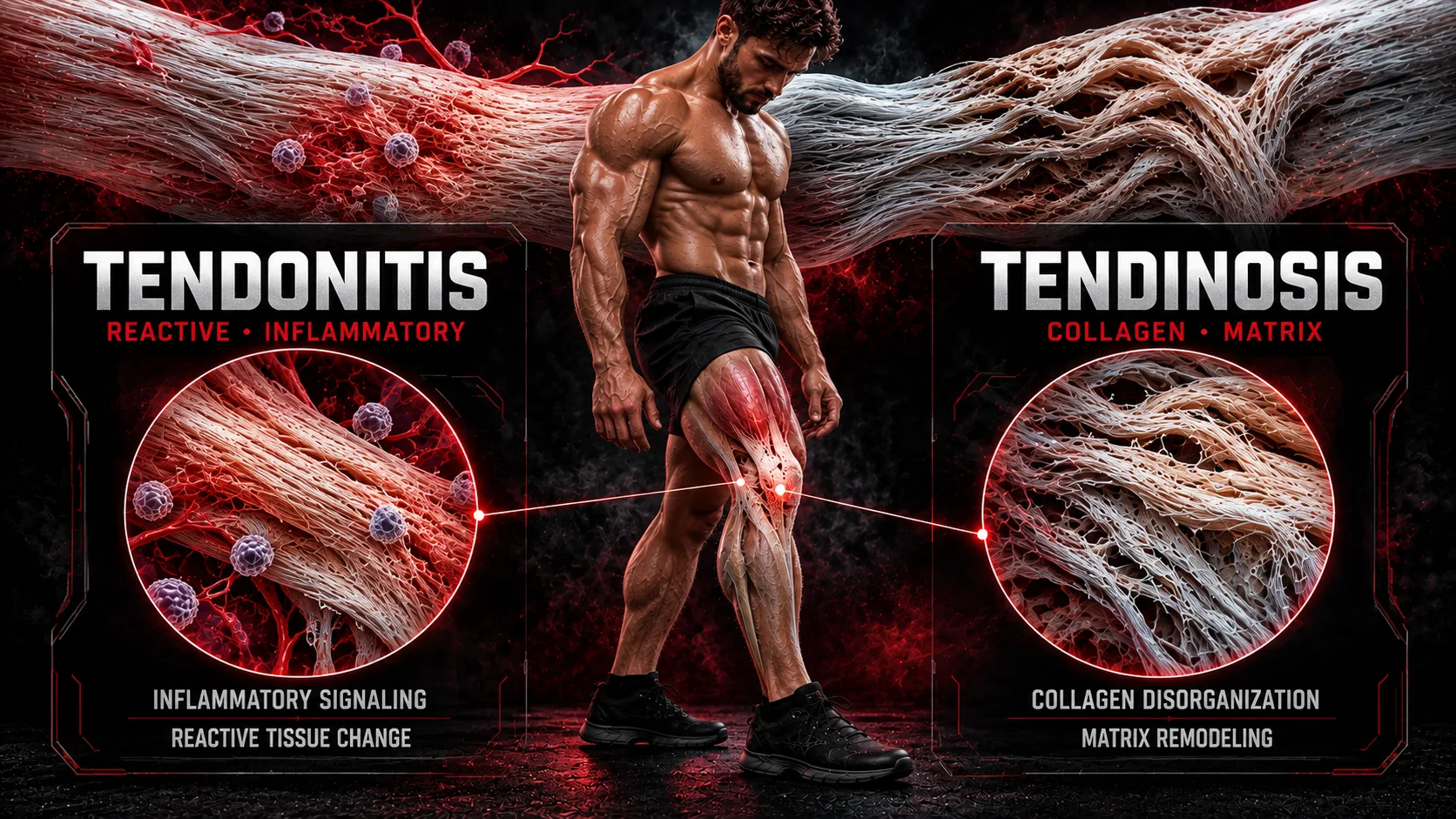
TENDONITIS VS TENDINOSIS: WHY REST DOES NOT FIX TENDON PAIN
Tendonitis vs tendinosis is the difference between a tendon that is inflamed and a tendon that has changed structure, and most tendon pain that has lasted more than a few weeks is the second kind. In 2002 a group of tendon researchers asked clinicians to abandon the tendinitis label because biopsies of painful tendons showed disorganised collagen and new vessels, not inflammatory cells (PMID 11895810), and the current consensus term for the whole picture is tendinopathy (PMID 31399426).
The distinction matters because the treatments differ. Rest and a cortisone injection treat inflammation; in a randomised trial a corticosteroid injection beat placebo for 4 weeks and lost to it at one year, 83 against 96 percent recovered, with recurrence in 54 against 12 percent (PMID 23385272). Loading the tendon slowly and heavily reduced its swelling 12 percent and its abnormal blood vessels 45 percent in 12 weeks and held the result at six months (PMID 19793213).
This guide reads tendonitis vs tendinosis from the trials rather than from the physiotherapy brochure: what the two words mean and why the consensus replaced both, the continuum model that explains why the same tendon can hurt differently in different months, why rest fails a degenerative tendon, how long does tendonitis last at each stage, what isometric holds, heavy slow resistance and eccentric training were measured to do, what injections and painkillers were measured to do, where lifters get it and how often, and the signs that need a clinician rather than a programme change. Every figure comes from a PubMed abstract listed at the end. The series lives on the training hub.
Tendonitis vs tendinosis in brief
Three numbers frame tendonitis vs tendinosis: what loading did to a damaged tendon, how many people recover on exercise alone, and what the quick fix costs a year later.
Thirty-nine men were randomised to a corticosteroid injection, eccentric decline squats or heavy slow resistance for 12 weeks. All three improved by 12 weeks; at the half-year follow-up the injection group had deteriorated while both loading groups held their gains, and heavy slow resistance had reduced tendon swelling 12 percent and vascularisation 45 percent with an increased turnover of collagen (PMID 19793213).
Of 34 patients followed for five years, 27 recovered fully, 22 with no symptoms and 5 with a new episode; 7 had continued symptoms, and only 2 ever received another treatment. Fear of movement correlated negatively with the recovery of heel-rise work, r minus 0.59, which is why the authors recommend a pain-monitoring model rather than rest (PMID 21084657).
In 165 adults with lateral epicondylalgia, the injection produced the best 4-week result and the worst 1-year result: 83 percent recovered or much improved against 96 percent on placebo, recurrence 54 against 12 percent, and adding physiotherapy did not rescue the injected group (PMID 23385272). Across 41 trials the pattern was the same, large short-term benefit reversed by 26 and 52 weeks (PMID 20970844).
Every figure on this page about tendonitis vs tendinosis is taken from a PubMed abstract listed at the end. Where a model is proposed rather than demonstrated, the page says so. Where lifters describe their own tendon pain on forums, it is reported as a description, not as evidence. Nothing here diagnoses; the red flags that need a clinician are listed near the end.
What this tendonitis vs tendinosis guide covers
The words and the model: what tendonitis, tendinosis and tendinopathy mean, what biopsies showed, the continuum from a reactive to a degenerative tendon, and why the tendon core barely renews after adolescence.
How long does tendonitis last: the measured timelines at 45 minutes, 6 weeks, 12 weeks, one year and five years, and what decides which one applies to you.
What was measured to help and to hurt: isometric holds, heavy slow resistance, eccentric training, continuing to train with a pain-monitoring model, corticosteroid injections, and where and how often lifters get tendon pain.
Not coveredJoint by joint. Knee pain when squatting, shoulder pain on the bench, elbow pain on curls and low back pain after deadlifts each get their own guide in this series as they publish; this page is the model they all rest on.
Muscle recovery. Soreness, fatigue and overtraining are a different tissue and a different clock, covered on recovery and fatigue; the blood marker side is on why is my CK high.
Treatment protocols. The page reports what the trials did and measured; it does not prescribe sets, loads or drugs. A tendon that has hurt for months is a clinical problem first and a programming problem second.
Tendonitis vs tendinosis vs tendinopathy: what the three words mean
The suffix carries the meaning. Tendonitis, also spelled tendinitis, means inflammation of a tendon: an acute response with inflammatory cells, swelling and the warmth and redness of any other inflamed tissue. Tendinosis means degeneration of the tendon without that inflammatory picture: collagen fibres that have lost their parallel arrangement, more ground substance and water, new small blood vessels growing into the tendon, and cells that are rounded, fewer or dying (PMID 20308995, PMID 33414454). Tendinopathy is the umbrella term for painful tendon that has lost function and exercise tolerance, whatever the tissue is doing (PMID 33414454).
The reason tendonitis vs tendinosis became a debate is that when researchers looked at painful tendons under the microscope, they did not find the inflammation the name promised. In 2002 Khan, Cook and colleagues published a paper in the BMJ titled simply time to abandon the tendinitis myth, arguing that chronic overuse tendon conditions are degenerative and that treatment built on an anti-inflammatory premise is built on the wrong target (PMID 11895810). The 2019 International Scientific Tendinopathy Symposium consensus on clinical terminology settled on tendinopathy as the preferred clinical term for persistent tendon pain and loss of function related to load (PMID 31399426).
That does not mean inflammation never occurs. The 2021 Nature Reviews primer lists increased immune cells and inflammatory mediators among the features of tendinopathy alongside collagen disorganisation, new vessels, new sensory nerve fibres, a dysregulated matrix and increased cell death (PMID 33414454). The honest summary of tendonitis vs tendinosis is that the painful tendon a lifter brings to the clinic after months of elbow or knee pain is almost never a purely inflamed tendon, and the degenerative changes are what the loading trials were designed to reverse.
| Term | What it claims | Read as |
|---|---|---|
| Tendonitis (tendinitis) | Acute inflammation of the tendon; implies rest and anti-inflammatory treatment | Chronic painful tendons are mainly degenerative, not inflamed (PMID 11895810) |
| Tendinosis | Degeneration: disorganised collagen, more proteoglycan and water, new vessels, rounded or fewer cells (PMID 20308995) | What months-old tendon pain usually is |
| Tendinopathy | Persistent load-related tendon pain with loss of function, whatever the histology (PMID 31399426, PMID 33414454) | The consensus clinical term |
| Paratenonitis, tenosynovitis | Inflammation of the sheath around a tendon rather than the tendon itself | A real inflammatory diagnosis; a clinician separates it from tendinosis |
The continuum: how a tendon moves from reactive to degenerative
The model most clinicians now use to think about tendonitis vs tendinosis is the continuum proposed by Cook and Purdam in 2009. It describes three overlapping stages. A reactive tendon has responded to a sudden increase in load, or to direct compression, with a short-term thickening that is adaptive and largely reversible when the load is reduced. A tendon in disrepair shows a greater breakdown of the matrix, with disorganised collagen, increased ground substance and the ingrowth of vessels and nerves. A degenerative tendon has areas of cell death and matrix breakdown that are not thought to reverse (PMID 18812414).

The authors proposed the model to explain why people of different ages with tendons under different loads present so differently and recover so differently, from tendons that settle with simple changes to tendons that resist every treatment, and to allow treatments to be placed rationally along the continuum; they presented it explicitly for evaluation by clinicians and researchers rather than as a proven sequence (PMID 18812414). The same group revisited it in 2016 and conceded the main criticism: tendinopathy is primarily a pain condition, the relationship between structure, pain and function is not fully understood, and staging a tendon by its scan alone has been challenged (PMID 27127294).
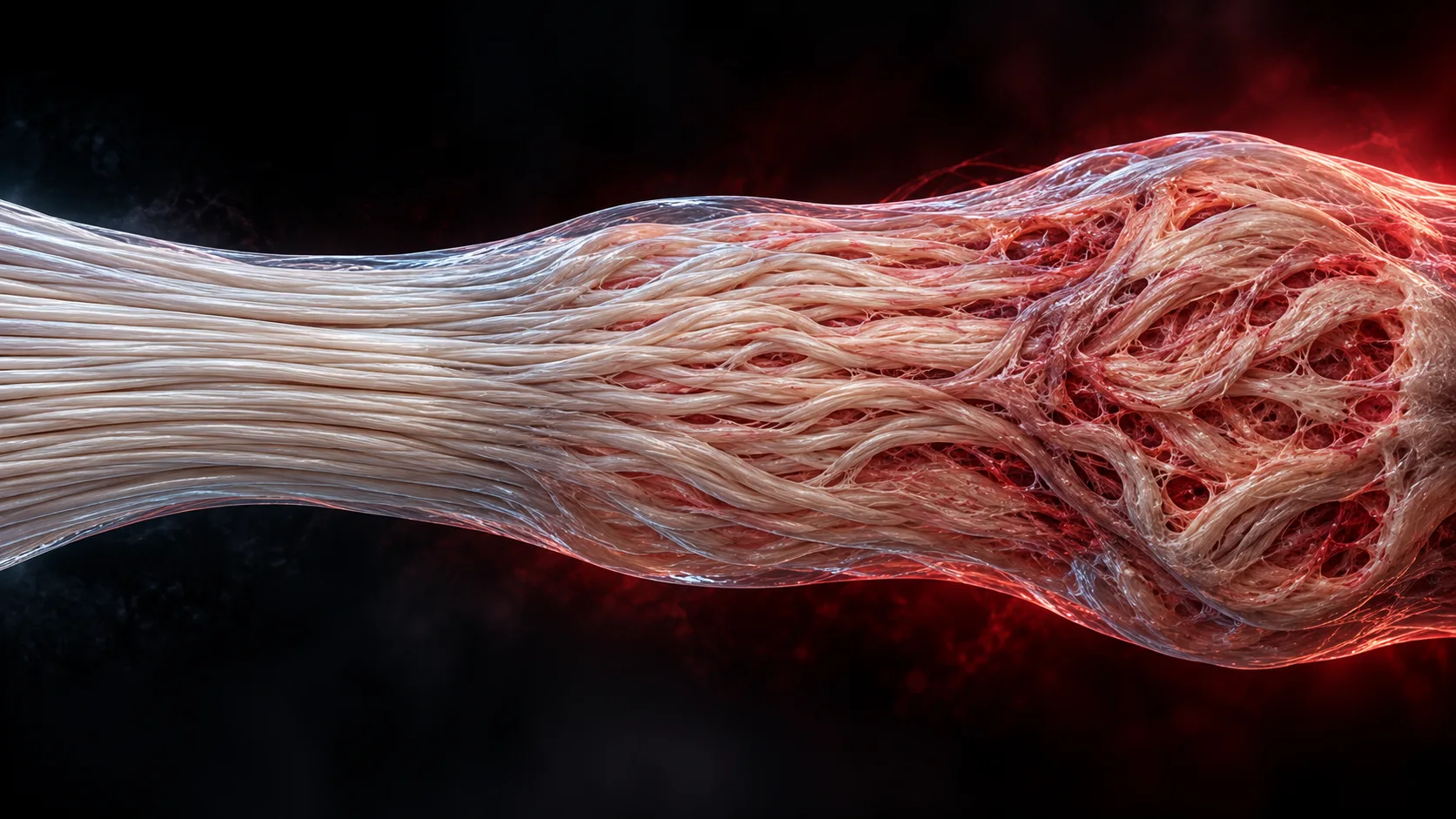
For the question tendonitis vs tendinosis the continuum gives a cleaner answer than either word. The reactive stage is the closest the model comes to tendonitis, and it is the stage in which taking load off briefly makes sense. The dysrepair and degenerative stages are tendinosis, and in those stages the tissue needs load applied in a way it can adapt to, because the structural change does not reverse on its own (PMID 18812414). The histological features in the primer, disorganised collagen, vessels, nerves and apoptosis, are the dysrepair and degenerative picture (PMID 33414454).
Why rest does not fix tendinosis
Rest is the right treatment for a reactive tendon and the wrong one for a degenerative tendon, and two measurements explain why. The first is how slowly tendon tissue turns over. Using the spike in atmospheric carbon 14 from nuclear bomb tests between 1955 and 1963 as a clock, researchers measured the age of collagen in 28 Achilles tendon cores. The tendon retained carbon 14 levels corresponding to the atmosphere decades before sampling, roughly matching the first 17 years of life, which means the tendon core is laid down during growth and essentially not renewed afterwards; muscle from the same donors showed continuous turnover (PMID 23401563).
The second is what loading does to the tissue that does turn over. Mechanical loading of tendon raises collagen expression and synthesis, with the increase peaking around 24 hours after exercise and remaining elevated for about 3 days; degradation also rises but peaks earlier (PMID 20308995). Across 27 intervention studies in healthy adults, tendon stiffness increased with training with a standardised effect of 0.70 and Young modulus by 0.69, cross-sectional area by a smaller 0.24, and the adaptation depended on loading intensity rather than on the type of muscle contraction (PMID 27747846). Tendons adapt to load; they do not adapt to its absence.
The clinical trials show what that means for a painful tendon. In the original eccentric training study, 15 recreational athletes with chronic Achilles tendinosis who could not run were all back at pre-injury running levels after 12 weeks of heavy-load eccentric calf training, while a comparison group of 15 with the same diagnosis treated conventionally with rest, anti-inflammatory drugs, shoe changes and physical therapy failed in every case and all went to surgery (PMID 9617396).
In a randomised trial of 38 Achilles patients, those who kept running and jumping under a pain-monitoring model improved as much as those who rested from those activities for 6 weeks; VISA-A rose from 57 to 85 in the training group and from 57 to 91 in the resting group, with no difference in the rate of improvement (PMID 17307888).
The five-year follow-up of that cohort adds the piece lifters most need. Eighty percent recovered fully on exercise alone, and the factor that predicted worse recovery of heel-rise work was fear of movement, with a correlation of minus 0.59 (PMID 21084657). Resting a tendinosis does not rebuild it; it teaches the person to avoid the load that would. The tendon that hurts on the bench or in the squat is degenerative tissue waiting for a dose, and the dose side of training in general is on progressive overload explained.
Why tendinosis hurts, and why the scan does not say how much
A degenerative tendon is often not a weak tendon. In patellar tendinopathy patients and matched controls, tendon stiffness and modulus were the same at baseline, and a 12-week programme that improved symptoms did not change them in healthy tendons; what differed was the collagen itself, with a lower fibril density and a trend to larger fibrils in the painful tendons (PMID 20154324). Mechanical properties were also similar in healthy and injured tendons in the three-arm trial and unaffected by any treatment, while pain and swelling changed (PMID 19793213).
Structure and pain move on partly separate tracks. In 18 elite Australian footballers with normal Achilles tendons, ultrasound tissue characterisation improved over a 5-month pre-season, consistent with better fibre alignment, and three players developed tendon pain that coincided with a shift in the scan pattern; the authors note that whether the structural improvement means more load capacity is not yet shown (PMID 25943892). The 2016 revisit of the continuum makes the same point from the other direction: structure on imaging does not predict pain well enough to stage a patient by scan alone (PMID 27127294).
The pain itself appears to have a strong nervous-system component. In patellar tendinopathy, isometric contractions reduced pain from 7.0 to 0.17 out of 10 and at the same time released cortical inhibition, the brake the motor cortex keeps on the quadriceps, from 27.5 to 55 percent; isotonic contractions reduced pain less and did not change inhibition (PMID 25979840). The review built on that finding proposes that altered corticospinal control of the muscle contributes to tendon pain recurring, and that externally paced strength training acts on the nervous system as well as on the tendon (PMID 26407586).
For a lifter reading tendonitis vs tendinosis this means three things. A tendon that hurts is not about to snap because it hurts; stiffness was normal in the trials that measured it (PMID 20154324, PMID 19793213). A clear scan does not mean the pain is imaginary, and an ugly scan does not mean the pain is permanent (PMID 27127294). And the fastest change available is in the pain system, not the collagen, which is why the first measured effect of loading arrives in minutes while the structural change takes months (PMID 25979840, PMID 19793213). The muscle-side analogue, why soreness is a poor guide to recovery, is on recovery and fatigue.
How long does tendonitis last: 45 minutes, 6 weeks, 12 weeks, one year, five years
How long does tendonitis last depends on which tendonitis you mean. A reactive tendon after a load spike is described in the continuum model as largely reversible once the load is reduced; no trial on this page timed that stage (PMID 18812414). A tendon that has been painful for more than three months, the entry criterion in most of the loading trials, is a tendinosis, and its timeline is the one the trials measured (PMID 26018970, PMID 9617396).

The first change is fast. A single bout of isometric holds reduced patellar tendon pain from 7.0 to 0.17 out of 10 and the relief lasted at least 45 minutes (PMID 25979840); in a 4-week in-season trial the pain relief in week one correlated with the improvement in tendon function at 4 weeks, r 0.64 (PMID 27513733). Function improves within weeks: in the Achilles trial that let one group keep running, both groups had improved significantly at every evaluation, including the early ones, under a programme that gradually increased the load (PMID 17307888).
Twelve weeks is the length of almost every loading programme in the literature and the point at which trials report their main result. All 15 Achilles tendinosis patients were back to full running after 12 weeks of eccentric training (PMID 9617396); 58 Achilles patients improved significantly in function and pain by 12 weeks on either heavy slow resistance or eccentrics, and the improvement held at 52 weeks (PMID 26018970); 39 patellar tendinopathy patients improved on all three treatments by 12 weeks, and only the two loading groups held the result at six months (PMID 19793213). The eccentric programmes reviewed for jumper knee were mostly 12 weeks of twice-daily home training (PMID 17261559).
The long tail is the part the question how long does tendonitis last usually misses. Five years after a 12-week heel-drop programme, the function score had risen from 49 to 84 and had kept improving between year one and year five, but only 39.7 percent of patients were completely pain free and 48 percent had received at least one other treatment along the way (PMID 22075719). In the pain-monitored cohort, 80 percent had recovered fully at five years and 20 percent had continued symptoms; the two groups did not differ in sex, age or activity level, and the continued-symptoms group had been distinguishable on the function score from year one onward (PMID 21084657).
| Time | What was measured | Read as |
|---|---|---|
| 45 minutes | Pain 7.0 to 0.17 after isometric holds, sustained at 45 minutes; isotonic 6.3 to 3.8 and not sustained (PMID 25979840) | Analgesia, not healing |
| 1 to 4 weeks | Week-one pain relief predicted 4-week function, r 0.64, in 20 in-season athletes (PMID 27513733) | Early response predicts the block |
| 6 weeks | Significant improvement at every evaluation whether or not running continued (PMID 17307888) | Function returns before structure |
| 12 weeks | 15 of 15 back to running (PMID 9617396); swelling and vessels reduced on HSR (PMID 19793213); fibril density up 70 percent (PMID 20154324) | The standard programme length |
| 6 to 12 months | Loading groups held; injection group deteriorated (PMID 19793213); HSR and eccentric results maintained at 52 weeks (PMID 26018970) | The test of whether it was treated |
| 5 years | 80 percent fully recovered on exercise alone (PMID 21084657); 39.7 percent completely pain free after eccentrics (PMID 22075719) | Function back, mild pain may linger |
| Lifters specifically | No loading trial on this page recruited powerlifters or bodybuilders; the timelines are from runners, jumpers and recreational athletes | Assume the same clock, not a faster one |
Isometric holds: what was measured and what was not
Isometric loading entered tendon rehabilitation through a small crossover study in 6 volleyball players with patellar tendinopathy. One bout of isometric quadriceps contractions reduced pain during a single-leg decline squat from 7.0 to 0.17 out of 10, against 6.3 to 3.8 after isotonic contractions; the isometric relief was still present at 45 minutes and the isotonic relief was not, the mean reduction was 6.8 against 2.6 points, and maximal voluntary strength rose 18.7 percent after the isometric bout (PMID 25979840). The holds were performed without pain, which is the practical point for someone whose tendon hurts in every repetition of the lift that caused it (PMID 25979840).
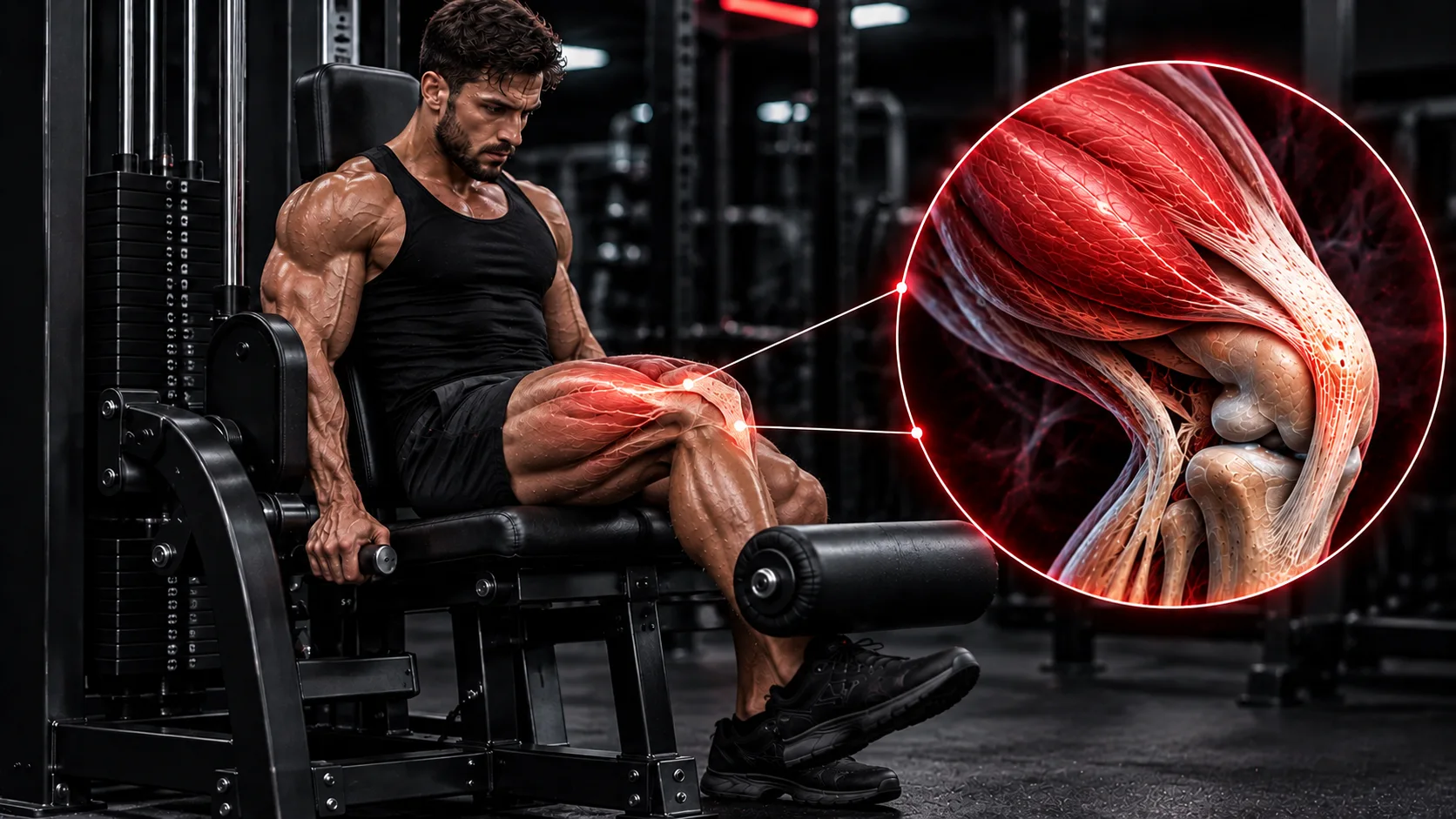
The in-season trial that followed randomised 20 jumping athletes to isometric leg extension holds at 60 degrees of knee flexion at 80 percent of maximal voluntary contraction, or isotonic leg extensions at 80 percent of 8-repetition maximum, four times a week for 4 weeks with time under load matched. Both groups reduced pain, isometric contractions produced significantly greater immediate pain relief throughout the 4 weeks, and the week-one relief correlated with the 4-week function score, r 0.64; the authors suggest greater analgesia may increase the ability to load or to perform (PMID 27513733).
The counterweight is a 2020 systematic review of 10 randomised trials across patellar, rotator cuff, lateral elbow, Achilles and gluteal tendinopathies. On limited evidence, isometric exercise was not superior to isotonic exercise for chronic tendinopathy either immediately or over 12 weeks on any outcome, the response varied within and across tendons, and the authors conclude that isometrics can be used as part of a progressive loading programme because they may help selected individuals, not as a treatment in their own right (PMID 32818059). For tendonitis vs tendinosis the honest reading is that isometric holds are a measured way to turn pain down for the next hour, with the structural work still to be done by heavier loading.
Heavy slow resistance and eccentric training: the loading that changed the tendon
The programmes that changed tendinosis in the trials share one feature: they load the tendon heavily and slowly. The heavy slow resistance protocol tested in Copenhagen used slow, heavy concentric and eccentric repetitions; the eccentric protocol used slow lowering only, on a decline board for the patellar tendon or over a step for the Achilles, typically twice a day (PMID 19793213, PMID 17261559, PMID 9617396).

In the three-arm patellar tendinopathy trial, all 39 men improved by 12 weeks, but at the half-year follow-up the corticosteroid group had deteriorated while both loading groups held their gains. Heavy slow resistance reduced tendon swelling 12 percent and vascularisation 45 percent, raised collagen network turnover, and produced the highest treatment satisfaction; tendon mechanical properties were unchanged by any treatment (PMID 19793213). The companion biopsy study found that after heavy slow resistance the abnormal fibril morphology moved toward normal, fibril density up 70 percent and mean fibril area down 26 percent, most likely from the production of new fibrils, and that these structural changes accompanied the clinical improvement (PMID 20154324).
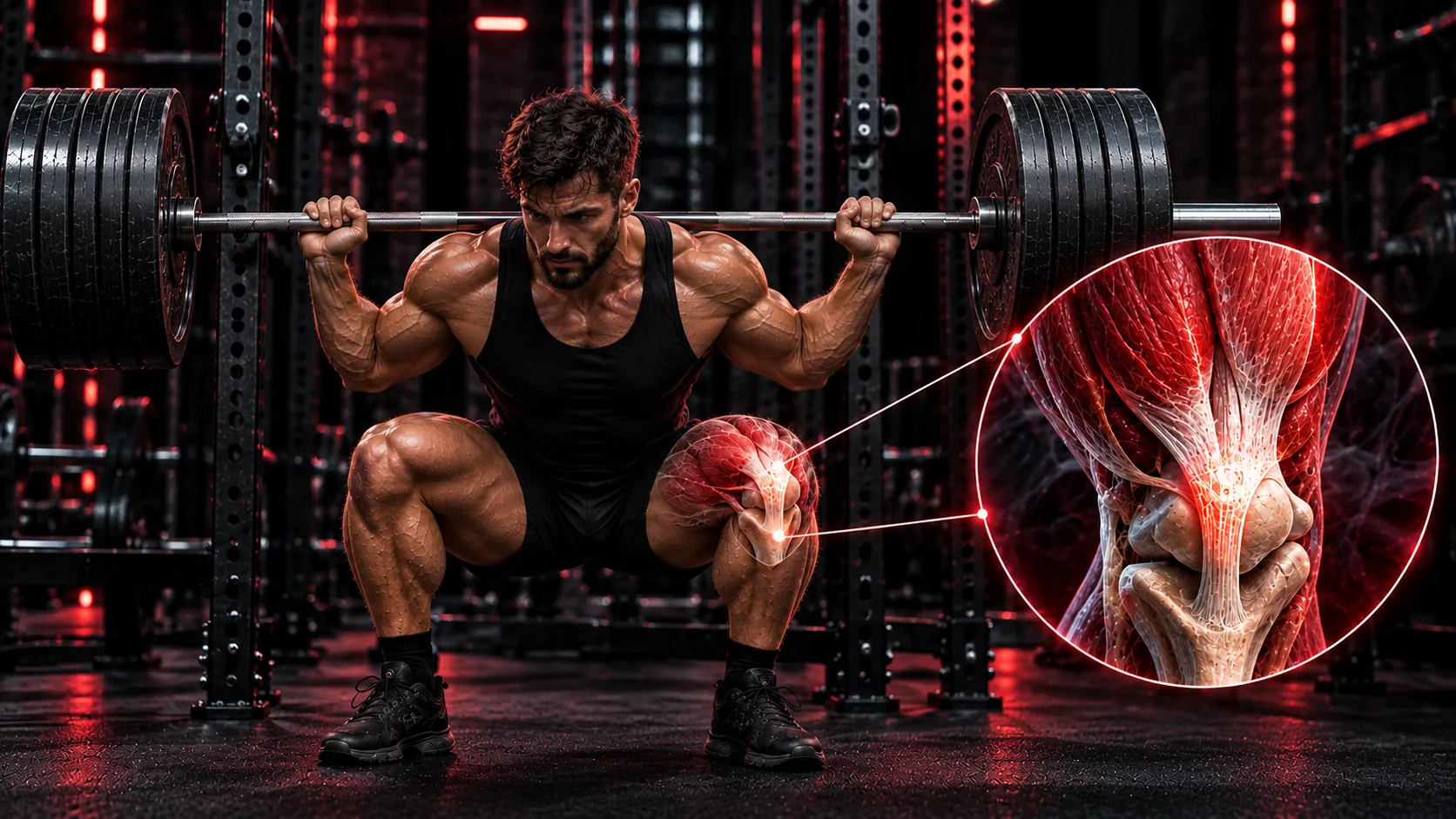
In the Achilles, the two loading programmes tied. Fifty-eight patients with chronic midportion Achilles tendinopathy were randomised to 12 weeks of eccentric training or heavy slow resistance; function and pain improved significantly in both, the gains held at 52 weeks, tendon thickness and neovascularisation fell in both, and none of the clinical or structural improvements differed between groups. Satisfaction at 12 weeks tended to favour heavy slow resistance, 100 against 80 percent, and session compliance was 92 against 78 percent (PMID 26018970).
The systematic review of loading programmes puts the eccentric tradition in perspective. Up to 45 percent of patients may not respond to isolated eccentric training; the evidence that eccentrics beat other loading is limited for the Achilles and conflicting for the patellar tendon (PMID 23494258).
The one mechanism consistently associated with clinical improvement across both tendons was improved neuromuscular performance, torque, work and endurance; and heavy slow resistance in the patellar tendon was associated with reduced Doppler area and thickness and with collagen turnover in a way eccentrics were not (PMID 23494258). The review of jumper knee protocols adds that eccentric programmes work with some discomfort and a decline board, and that the trials removed athletes from sport, a point the Achilles pain-monitoring trial later contradicted (PMID 17261559, PMID 17307888).
| Loading | Evidence | Read as |
|---|---|---|
| Heavy slow resistance | Swelling minus 12 percent, vessels minus 45 percent, collagen turnover up, result held at 6 months (PMID 19793213); fibril density plus 70 percent (PMID 20154324); equal to eccentrics in the Achilles at 52 weeks with 92 percent compliance (PMID 26018970) | The loading with the most structural evidence |
| Eccentric only | 15 of 15 back to running (PMID 9617396); equal to HSR clinically in the Achilles (PMID 26018970); held at 6 months in the patellar tendon without the structural change (PMID 19793213); up to 45 percent non-responders (PMID 23494258) | Works, demanding, not uniquely effective |
| Combined concentric-eccentric with pain monitoring | Gradually increased load with continued sport; equal to active rest at every point, 80 percent fully recovered at 5 years (PMID 17307888, PMID 21084657) | The option that keeps you training |
| Isometric holds | Pain 7.0 to 0.17 for 45 minutes (PMID 25979840); not superior to isotonics over 12 weeks across 10 trials (PMID 32818059) | Pre-session analgesia, part of a programme |
| Loading intensity in healthy tendon | Stiffness adaptation depended on loading intensity, not contraction type, across 27 studies (PMID 27747846) | Heavy is the active ingredient |
Training through it: the pain-monitoring model the trials used
The question lifters actually ask about tendonitis vs tendinosis is whether to stop lifting. The trial that tested it randomised 38 Achilles tendinopathy patients to continue tendon-loading sport, running and jumping, under a pain-monitoring model, or to stop those activities for the first 6 weeks; both groups followed the same gradually progressive loading programme. There was no difference in the rate of improvement, both groups improved significantly at every evaluation, and the authors conclude that no negative effect could be demonstrated from continuing pain-monitored activity (PMID 17307888).
The model the trial used sets a ceiling on pain during activity and requires that it settle afterwards rather than build from week to week, with load progressed as pain allows; the exact thresholds are in the trial protocol, and this page reports the principle rather than prescribing numbers (PMID 17307888). The five-year follow-up gives the reason it matters: fear of movement correlated with worse recovery of calf function, r minus 0.59, and the authors recommend the pain-monitoring model specifically so that patients keep loading instead of guarding (PMID 21084657).
The same logic appears in the in-season patellar tendon trial, where athletes kept playing and training three times a week while loading the tendon, and the pain relief from the loading itself predicted the later improvement (PMID 27513733). For the lifter this is the difference between tendonitis vs tendinosis in practice: a reactive tendon after a sudden jump in volume wants a brief reduction in that load, and a tendinosis that has grumbled for months wants the load kept, reshaped and progressed under a pain rule, not removed. How weekly load is counted and progressed without the spikes that provoke a reactive tendon is on training volume explained.
Injections and painkillers: what the quick fix was measured to do
A corticosteroid injection is the treatment that follows from calling tendinosis tendonitis, and it has been tested more rigorously than any loading programme. The Lancet systematic review pooled 41 randomised trials with 2,672 participants. Corticosteroid injections reduced pain in the short term compared with other interventions, with a large effect for tennis elbow against no intervention at 4 weeks, standardised difference 1.44, but the effect reversed at intermediate and long term, minus 0.40 at 26 weeks and minus 0.31 at 52 weeks, meaning no treatment was better than the injection by then. Serious adverse events were rare, one tendon rupture in 991 injected participants (PMID 20970844).

The randomised trial that followed is the cleanest single result on this page. In 165 adults with tennis elbow of more than 6 weeks, a corticosteroid injection against a placebo injection produced lower complete recovery or much improvement at one year, 83 against 96 percent, and far higher recurrence, 54 against 12 percent; at 26 weeks the figures were 55 against 85 percent. Multimodal physiotherapy made no difference to the one-year result, and adding physiotherapy to the injection did not rescue it (PMID 23385272). In the patellar tendon the injection group improved as much as the loading groups at 12 weeks and had deteriorated by six months (PMID 19793213).
Other injections behave differently and the review warns against generalising: hyaluronate, botulinum toxin and prolotherapy showed benefits over placebo for tennis elbow, while polidocanol, aprotinin and platelet-rich plasma were no better than placebo for the Achilles and prolotherapy was not better than eccentric exercise (PMID 20970844). Anti-inflammatory drugs sit in the same logical place as the steroid, treating an inflammation that chronic tendinosis largely lacks (PMID 11895810); the comparison group in the first eccentric study had all taken them without success before surgery (PMID 9617396). The separate finding that high-dose ibuprofen blunted muscle growth in young adults is on recovery and fatigue.
Tendon pain in lifters: where it happens, how often, and what men describe
Weight training is not a high-injury sport, but the injuries it does produce are tendon and joint injuries. Across 20 epidemiological studies, bodybuilding had the lowest rates, 0.12 to 0.7 injuries per lifter per year, powerlifting and weightlifting sat higher, and strongman and Highland Games highest at 4.5 to 7.5 per 1,000 hours; the shoulder, lower back, knee, elbow and wrist were the most commonly injured sites and strains, tendinitis and sprains the most common types (PMID 27328853). In 245 competitive powerlifters, 43.3 percent reported problems during routine workouts, the injury rate was 0.3 per lifter per year, the shoulder, lower back and knee led, and upper-limb injuries rose significantly after age 40 (PMID 21590644).
The tendon the lifting literature has studied most is not a lifter tendon at all. Jumper knee, patellar tendinopathy, affected 14.2 percent of 613 elite athletes across nine sports, 44.6 percent of volleyball players and 31.9 percent of basketball players, with symptoms lasting 32 months on average and lower prevalence in women (PMID 15722279); among 891 non-elite athletes the prevalence was 8.5 percent, symptoms lasted 18.9 months, and the affected athletes were younger, taller and heavier (PMID 21737835). Those are the populations most of the loading trials recruited, which is why the table above marks lifters as not directly measured.
What men describe. On forums, lifters describe elbow pain on the inside during curls and pull-ups, elbow pain on the outside during pressing and gripping, a front-of-shoulder ache on the bench that sharpens at the bottom, a knee that hurts at the bottom of the squat and feels better once warm, and a tendon that is quiet during the set and loud the next morning; they describe rest making it quiet and the first heavy session bringing it back, cortisone working for a month, and years of switching exercises around it (forum posts). Men on anabolic steroids describe strength rising faster than tendons can follow and tendon injuries clustering in the months after a cycle begins (forum posts).
What is measured. The pattern of pain that eases as the tendon warms and returns the next day is the reactive and dysrepair presentation the continuum describes (PMID 18812414). Cortisone working for a month and failing by a year is the trial result (PMID 23385272). Rest making a tendinosis quiet without changing it is consistent with a tissue that barely turns over without load (PMID 23401563). Upper-limb tendon injury rising with age in powerlifters is measured (PMID 21590644). No trial on this page measured tendon injury rates or tendon properties in men using anabolic steroids, so the described clustering is unquantified; the pharmacology is on what are anabolic steroids and the hormone-side recovery on hormonal recovery after steroids.
What men also try. On the same forums, lifters describe injecting BPC-157 or TB-500 near a sore tendon, running Deca-Durabolin for quiet joints and blaming Winstrol for dry ones, and treating every ache on a cycle as a tendon (forum posts). None of that was measured in the trials on this page. The tendon data behind the two peptides come from rodent injury models, reviewed on BPC-157, TB-500 and healing peptides; the joint reputations of Deca-Durabolin and Winstrol are covered on their own pages as reports rather than trial outcomes; and aching in several joints at once with a dead libido on a cycle is the low-estradiol picture described on low estrogen on cycle, not a tendon problem.
What the trials imply for the next session
Nothing in this section is a protocol; it is what the trials did, read as principles for someone deciding what to do with a painful tendon this week.
Place the tendon on the continuum. Pain that began within days of a jump in volume, a new exercise or a return from a break, in a tendon that was fine before, fits the reactive stage; the model treats it by taking the provoking load down briefly, not by stopping training (PMID 18812414). Pain that has been present for months, warms up and returns the next morning, fits tendinosis; the model treats it by loading (PMID 18812414, PMID 27127294).
Keep training the rest of the body and, under a pain rule, the tendon itself. Continuing tendon-loading sport under a pain-monitoring model did not slow recovery (PMID 17307888), and fear of movement predicted worse outcomes at five years (PMID 21084657).
Use isometric holds as the trials did, as analgesia. Pain-free isometric holds reduced patellar tendon pain for at least 45 minutes and did not reduce strength (PMID 25979840); they were not superior to isotonic work over 12 weeks (PMID 32818059). In the trials they were a way into the session, not the session.
Load slowly and heavily for about 12 weeks. Heavy slow resistance changed tendon structure, held at six months, and was completed at 92 percent compliance (PMID 19793213, PMID 26018970); loading intensity rather than contraction type drove tendon adaptation in healthy adults (PMID 27747846). The slow tempo and the proximity to failure that the volume trials describe are on training volume explained.
Judge the result at 12 weeks and again at a year, not at 4 weeks. Every treatment on this page, including the injection, looked good at 4 to 12 weeks; the loading groups were the ones still improved at six and twelve months (PMID 19793213, PMID 26018970, PMID 23385272).
Expect function back before the last of the pain. Five years after a programme, function had kept improving and 39.7 percent were completely pain free (PMID 22075719); 80 percent were fully recovered on exercise alone (PMID 21084657).
When tendon pain needs a clinician, not a programme change
This page describes load-related tendon pain in otherwise healthy adults, which is what the trials recruited. Several other problems feel like tendonitis and are not, and a lifter cannot sort them out with a pain rule. See a physician or physiotherapist promptly for any of the following.
A sudden snap, pop or tearing sensation with immediate weakness or a visible change in the muscle shape. That is the picture of a tendon rupture or avulsion, a surgical question with a time limit, not a tendinopathy; rupture occurred in 1 of 991 injected participants in the trials that reported it and is rare but not theoretical (PMID 20970844).
Swelling, warmth, redness or fever around the tendon, or pain that is severe at rest and at night. Infection, inflammatory arthritis, gout and other systemic causes present this way and are excluded by a clinician before the continuum model applies (PMID 33414454).
Numbness, tingling or weakness beyond the painful area, which points to a nerve rather than a tendon. Pain after a fall or impact with deformity, or inability to bear weight or lift the arm, which needs imaging for fracture or complete tear. Pain that has not changed after 12 weeks of a structured loading programme, the point at which every trial on this page had measured its effect (PMID 26018970, PMID 19793213).
Anyone taking fluoroquinolone antibiotics or systemic corticosteroids, anyone with diabetes or an inflammatory condition, and anyone over 40 with a new upper-limb tendon problem, the age at which powerlifting upper-limb injuries rose significantly (PMID 21590644), should have the tendon assessed rather than loaded on the basis of a web page. Bloodwork that can accompany that assessment is on bloodwork and health.
Five tendonitis vs tendinosis mistakes the trials expose
Each comes from treating a degenerative tendon as an inflamed one.
1. Resting it until it stops hurting. Conventional treatment including rest failed in all 15 controls who went on to surgery, while 15 of 15 on eccentric loading returned to running (PMID 9617396). The tendon core barely renews without load (PMID 23401563).
2. Taking the injection because it worked last time. It did work, for 4 weeks; at one year the injected group had 83 against 96 percent recovery and 54 against 12 percent recurrence (PMID 23385272).
3. Judging the tendon by the scan. Structure and pain track loosely; stiffness was normal in painful tendons and unchanged by treatment that fixed the pain (PMID 20154324, PMID 27127294).
4. Stopping all training to protect it. Continuing pain-monitored sport did not slow recovery (PMID 17307888); fear of movement predicted a worse five-year outcome (PMID 21084657).
5. Loading it lightly for a long time. Tendon adaptation depended on loading intensity, not contraction type (PMID 27747846); heavy slow resistance, not light pumping, changed fibril density (PMID 20154324).
Verdict: tendonitis vs tendinosis is a question about load, not about rest
Read from the biopsies, the continuum model and the randomised trials rather than from the suffix, tendonitis vs tendinosis works like this. The painful tendon a lifter has carried for months is almost always degenerative rather than inflamed (PMID 11895810, PMID 33414454). It sits somewhere on a continuum from reactive to degenerative, and the stage, not the word, decides the treatment (PMID 18812414). Its core barely renews on its own (PMID 23401563), so rest quiets it without changing it, and the anti-inflammatory treatments that follow from the word tendonitis buy weeks and cost a year (PMID 20970844, PMID 23385272).
What changed tendinosis in the trials was heavy, slow, progressive load applied for about 12 weeks, with isometric holds as a way to turn the pain down first and a pain rule instead of rest, and the result was judged at six months and a year rather than at four weeks (PMID 19793213, PMID 20154324, PMID 26018970, PMID 25979840, PMID 17307888). How long does tendonitis last on that approach is minutes for the first relief, weeks for function, three months for the structural change and years for the last of the pain, with 80 percent fully recovered on exercise alone (PMID 21084657).
For readers here the practical reading is that tendonitis vs tendinosis has an answer, that how long does tendonitis last has a measured timeline, and that the tendon that hurts under the bar is waiting for a dose it can adapt to rather than for time. Place it on the continuum, keep training under a pain rule, load it heavily and slowly, judge the result at twelve weeks and a year, and see a clinician for anything on the red flag list. The muscle side of recovery is on recovery and fatigue, the loading side on progressive overload explained, the dose side on training volume explained; the hub is training hub.
Tendonitis vs tendinosis: frequently asked questions
Is tendonitis or tendinosis worse?
Tendinosis is the more established problem. Tendonitis describes an inflamed tendon, a short-term reactive response that settles when the provoking load is reduced; tendinosis describes a tendon whose collagen has become disorganised, with new vessels and nerves and areas of cell death, changes that do not reverse on their own (PMID 18812414, PMID 20308995). Biopsies of chronically painful tendons show the degenerative picture rather than inflammation, which is why researchers asked clinicians to abandon the tendinitis label in 2002 (PMID 11895810). Tendinosis is not weaker tissue, however; tendon stiffness was normal in painful patellar tendons (PMID 20154324).
Does tendinosis ever go away?
Function usually does; the last of the pain may take years. Five years after a 12 week loading programme, 80 percent of Achilles tendinopathy patients had recovered fully in symptoms and function on exercise alone, and only 2 of 34 ever needed another treatment (PMID 21084657). In a separate five-year follow-up the function score rose from 49 to 84 and kept improving after year one, while 39.7 percent were completely pain free (PMID 22075719). Heavy slow resistance moved abnormal collagen fibril morphology back toward normal in 12 weeks (PMID 20154324).
How long does tendonitis take to heal?
A reactive tendon is described as largely reversible once the load spike is reduced (PMID 18812414). A tendon that has hurt for more than three months follows the trial timeline: pain relief within 45 minutes of isometric holds (PMID 25979840), measurable improvement in function within weeks (PMID 17307888), the main result at 12 weeks, when all 15 patients in the first eccentric study were back to running (PMID 9617396), results held at six months and one year in the loading groups (PMID 19793213, PMID 26018970), and full recovery in 80 percent by five years (PMID 21084657).
Should you rest a sore tendon or keep lifting?
Keep loading it, under a pain rule, unless a red flag is present. In 38 Achilles tendinopathy patients, continuing running and jumping under a pain-monitoring model improved function as fast as resting from sport for 6 weeks, with no negative effect demonstrated (PMID 17307888). Fear of movement predicted worse recovery five years later, r minus 0.59 (PMID 21084657). Conventional treatment built on rest failed in all 15 controls in the first eccentric training study, who went on to surgery (PMID 9617396). A sudden snap with weakness, swelling with warmth or fever, night pain or numbness are reasons to see a clinician instead.
Do cortisone shots fix tendon pain?
They relieve it for about a month and worsen the year. Across 41 randomised trials, corticosteroid injections had a large short-term effect on tennis elbow pain, standardised difference 1.44 at 4 weeks, which reversed to minus 0.40 at 26 weeks and minus 0.31 at 52 weeks (PMID 20970844). In 165 adults, the injection produced 83 percent recovery at one year against 96 percent on a placebo injection, and 54 against 12 percent recurrence (PMID 23385272). In patellar tendinopathy the injected group improved at 12 weeks and had deteriorated by six months while both loading groups held (PMID 19793213).
Does massage or stretching help tendinosis?
Neither was measured in the loading trials on this page, so the honest answer is not established. What the trials did measure was load: heavy slow resistance reduced tendon swelling 12 percent and vascularisation 45 percent (PMID 19793213) and raised fibril density 70 percent (PMID 20154324), and the one mechanism consistently tied to clinical improvement across Achilles and patellar rehabilitation was improved neuromuscular performance, not any passive treatment (PMID 23494258). Tendon adaptation in healthy adults depended on loading intensity rather than on contraction type (PMID 27747846).
Why does tendon pain ease during a workout and return the next morning?
That pattern is the reactive and dysrepair presentation the continuum describes, and part of it is in the nervous system rather than the collagen. One bout of isometric contractions reduced patellar tendon pain from 7.0 to 0.17 out of 10 for at least 45 minutes and released cortical inhibition from 27.5 to 55 percent, while the tendon itself cannot have changed in that time (PMID 25979840). The review built on that finding proposes that altered corticospinal control of the muscle contributes to recurring tendon pain (PMID 26407586). Structure and pain track each other loosely (PMID 27127294).
Can you build muscle while rehabbing a tendon?
The trials suggest the loading that treats the tendon is itself strength training. Heavy slow resistance improved patellar and Achilles tendinopathy and held the result at six and twelve months (PMID 19793213, PMID 26018970); isometric holds raised quadriceps strength 18.7 percent in the same session they relieved pain (PMID 25979840); improved torque, work and endurance was the mechanism most consistently tied to clinical improvement (PMID 23494258). Continuing sport under a pain rule did not slow recovery (PMID 17307888). Hypertrophy itself was not an outcome in these trials.
Sources and further reading
Every figure on this page about tendonitis vs tendinosis comes from one of the 28 papers below, each checked against its PubMed abstract in September 2026. The continuum is a proposed model and is labelled as such in the text. Forum descriptions are reported as descriptions and carry no reference number. Reference links are dofollow to support open science.
Keep reading
Four pages from the training series: the muscle side of recovery, how load is progressed, how weekly dose is counted, and what a high CK reading means in a lifter.
Final Educational Note
This article is educational and is not medical, physiotherapy or coaching advice. It reports what trials, systematic reviews and consensus statements say about tendon pain, tendonitis vs tendinosis and loading, and it reports how some lifters describe their own tendon pain as a description of experience, not as guidance. Loading programmes and injections appear only as the trials used them; the page gives no protocol, does not diagnose, and does not recommend any treatment or drug. More guides sit on the training hub.
A sudden snap or tear with weakness, swelling with warmth or fever, pain at night or at rest, numbness or tingling, pain after a fall with deformity, or tendon pain unchanged after 12 weeks of a structured programme are reasons to consult a physician or physiotherapist. Individual tendons vary widely. Read more about how this site works on the about page and in the full disclaimer.