Proviron (Mesterolone): DHT-Derivative, SHBG Binding, and Bloodwork Guide
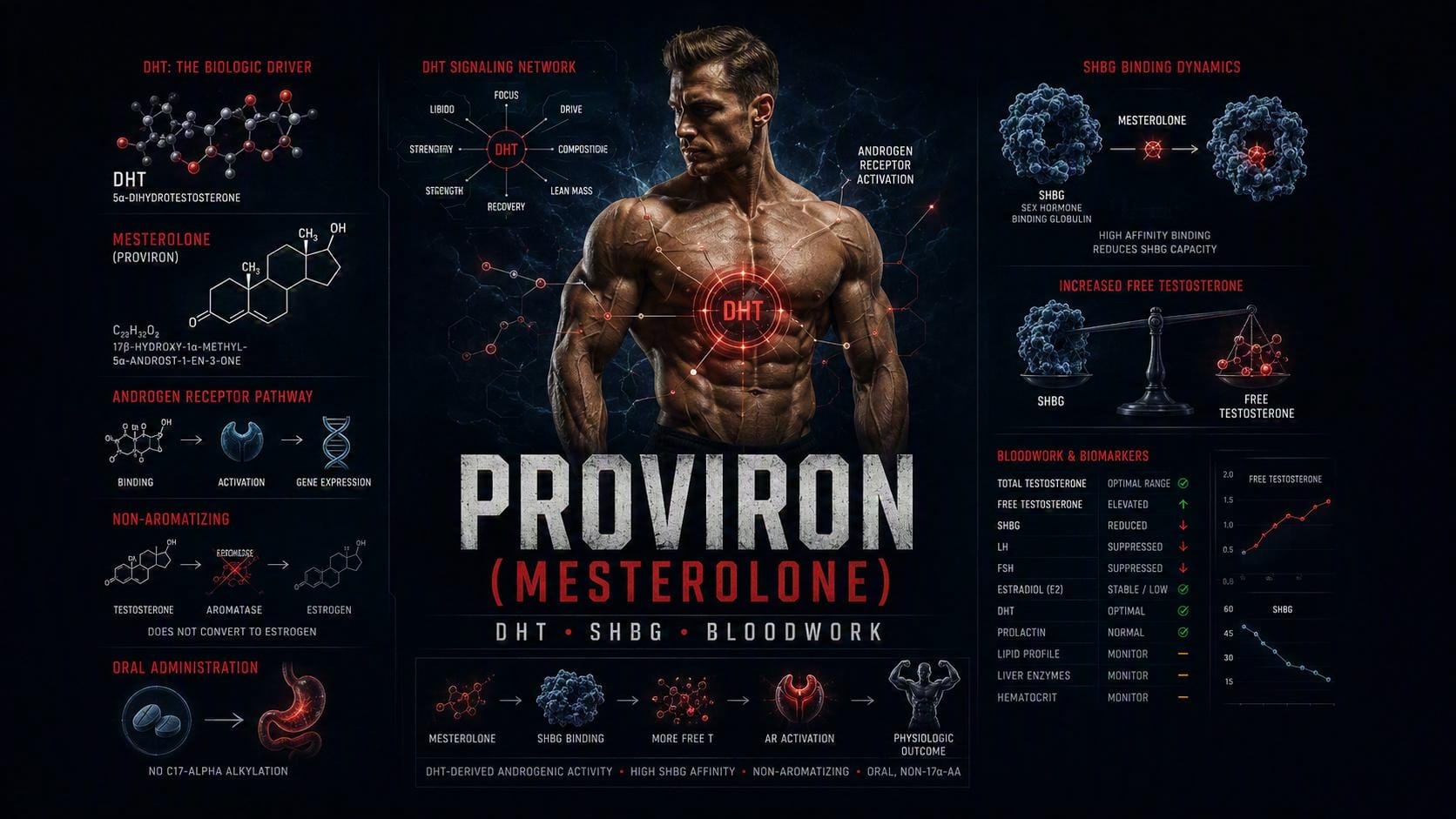
PROVIRON (MESTEROLONE): 7 PROVEN FACTS, SIDE EFFECTS
Proviron is mesterolone, an oral dihydrotestosterone derivative that has been in clinical use since the 1960s and in randomised trials since the 1970s. That makes proviron unusual among the compounds on this site: the claims made about it can be checked. In the largest trial, 248 infertile couples, it did not raise pregnancy rates above placebo (PMID 2680994); in hypogonadal men it did not raise testosterone at all, while HDL cholesterol fell 34.9 percent (PMID 10337859); and in aging men it lowered total testosterone, SHBG and estradiol and left free testosterone unchanged (PMID 25842579).
This profile answers what is proviron in the papers rather than the forums: what it binds, what it did in six randomised fertility trials, what it does to lipids, red cells, bone, mood and libido, and which proviron side effects are measured against which are assumed. No dose or protocol is given. The compound is a prescription drug, and its measured effects, wanted and unwanted, follow the androgen class it belongs to.
Proviron in brief
Three numbers frame proviron: what the largest randomised trial found on the outcome it was prescribed for, what it did to cholesterol in men who had no androgen of their own, and what it did to the hormones a lifter takes it for.
In the WHO trial, 248 infertile couples were randomised to two mesterolone doses or placebo for six months. Pregnancy rates at eight months were 16, 12 and 9 percent, ratios of 1.8 and 1.3 against placebo, neither significant; semen quality did not change (PMID 2680994).
In 55 hypogonadal men randomised to oral mesterolone or three testosterone forms for six months, mesterolone did not raise serum testosterone at all, yet HDL fell 34.9 percent and LDL rose 46.4 percent, the same as on testosterone (PMID 10337859).
Total testosterone, SHBG and estradiol all fell on mesterolone; free testosterone did not change, and only its fraction of the total rose (PMID 25842579). Proviron frees testosterone from a smaller pool.
Every figure is taken from the abstracts of the twenty-six papers at the end. Proviron and mesterolone are named because the papers name them; no dose, schedule or cycle is given here.
What this proviron profile covers
What is proviron: mesterolone, its structure, how it binds the androgen receptor and SHBG, and why the binding numbers matter more than the forum summary of them.
What has actually been measured in six randomised fertility trials, four randomised substitution trials, the mood and potency trials, and the cell work.
Proviron side effects by the evidence behind each: lipids, red cells, bone, the axis, prostate, mood, and the adrenal signal.
The bloodwork that tests the free-testosterone and anti-estrogen claims in one person, and the five mistakes those claims lead to.
Not coveredDoses, cycle lengths, stacks or a protocol. The trials dosed patients for infertility, hypogonadism and depression; nothing here is an instruction.
The other DHT derivatives. Primobolan, Masteron and Anavar have their own pages; Primobolan shares the adrenal finding on this one.
Buying, sourcing or legality. Not on this site, except for one measured fact about what is sold as proviron.
What is proviron? Mesterolone, SHBG and the androgen receptor
What is proviron, chemically: mesterolone, 1-alpha-methyl-dihydrotestosterone, an oral androgen that is not 17-alpha-alkylated and cannot be aromatised into estradiol. Proviron was developed as an androgen substitute and an infertility drug and is still prescribed in some countries for hypogonadism and aging male symptoms (PMID 25842579). In the anti-doping literature the sulfate metabolites of proviron were detectable in urine for up to nine days after a single oral dose (PMID 25601687).
The binding study everyone quotes says less than it is made to say. In rat and rabbit tissue, mesterolone bound sex hormone-binding globulin about four times more avidly than dihydrotestosterone itself, the highest affinity of any steroid tested; but its binding to the androgen receptor in skeletal muscle was weaker than that of testosterone, methenolone and nandrolone (PMID 6539197). The molecule is built to sit on SHBG, not on the receptor that builds muscle.
What that binding does in a person has been measured, and the result is the central fact about proviron. In 34 men treated for aging male syndrome for two months, total testosterone, SHBG and estradiol all fell, free testosterone did not change, and only the free fraction of a smaller total rose (PMID 25842579). In 52 depressed men, mesterolone significantly decreased both plasma and protein-bound testosterone (PMID 6431212). In 55 hypogonadal men it produced no increase in serum testosterone over six months (PMID 10337859). Total vs free testosterone explains why the fraction and the absolute level tell different stories.
What is measured on mesterolone, and in whom
Proviron has more human trials than any other compound in this series, because it was a licensed drug for two conditions with measurable endpoints. The table sorts them by design, and the weight column is the one to read.
| Finding | Design | Weight |
|---|---|---|
| Pregnancy 16 and 12 percent on two mesterolone doses vs 9 percent on placebo, not significant; no change in semen quality (PMID 2680994) | 248 couples, double-blind, WHO | Randomised |
| Pregnancy 26 percent on high-dose mesterolone vs 48 percent on placebo over 12 months; motility and morphology improved in both arms (PMID 1900485) | 52 men, double-blind | Randomised |
| No difference in pregnancy rate against vitamin C in 368 men over nine months; no responding subgroup found (PMID 6398725) | 368 men, randomised | Randomised |
| Seven pregnancies on mesterolone and seven on placebo in a 59-man crossover; no effect beyond placebo (PMID 6364886) | 59 men, double-blind crossover | Randomised |
| No significant rise in sperm concentration or pregnancy on mesterolone; clomiphene raised concentration (PMID 6411497) | 46 men, randomised | Randomised |
| Androgens for idiopathic oligospermia: pregnancy odds ratio 1.10 against placebo across 11 trials and 930 patients (PMID 10796496) | Cochrane review | Systematic review |
| No rise in testosterone; HDL minus 34.9 percent, LDL plus 46.4, triglycerides plus 46.4 over six months (PMID 10337859) | 55 hypogonadal men, randomised to four androgens | Randomised |
| Hematocrit plus 1.8 points, not significant, vs plus 6.4 and 6.5 on injectable and implanted testosterone (PMID 9233903) | Same 55 men | Randomised |
| Bone density plus 0.8 percent vs plus 7.0 on a testosterone implant in primary hypogonadism (PMID 12792150) | 53 hypogonadal men, randomised | Randomised |
| Depression improved on mesterolone and on placebo with no difference between them; plasma testosterone fell (PMID 6431212) | 52 depressed men, double-blind | Randomised |
| Testosterone undecanoate beat mesterolone on libido, erections, ejaculations and mental state at four weeks (PMID 7000879) | 26 hypogonadal men, double-blind | Randomised |
| Total testosterone, SHBG and estradiol fell; free testosterone unchanged; PSA unchanged; symptom scores improved (PMID 25842579) | 34 aging men, uncontrolled | Uncontrolled |
| 250 oligospermic men: no depression of normal FSH and LH, depression in 25 percent when elevated; no liver effect (PMID 2892728) | Uncontrolled series | Uncontrolled |
| Mesterolone, methenolone and mestanolone raised mineralocorticoid and lowered adrenal androgen output in adrenal cells (PMID 31884045) | H295R cells | Cell |
| Muscle hypertrophy with more satellite cells and myonuclei in chickens (PMID 22419647) | Birds | Animal |
| Long-term users: hematocrit 0.50 vs 0.44, HDL 0.69 vs 1.25 mmol/l, coronary disease 17 percent (PMID 35460300) | 51 users vs 21 athletes | Class |
The pattern is unusual and worth stating plainly. Proviron has been tested against placebo more often than almost any anabolic steroid, and in every randomised comparison it lost or drew: on pregnancy, on depression, on libido against testosterone, on bone and red cells against testosterone. The one thing it reliably did in every trial that measured it was move lipids. That is the evidence base, and the rest of this page stays inside it.
The fertility trials: six randomised comparisons, one answer
Proviron was prescribed for idiopathic male infertility for two decades on the theory that an androgen that does not suppress gonadotropins could stimulate the testis. The theory was tested properly. The WHO Task Force randomised 248 infertile couples across seven centres to two mesterolone doses or placebo for six months. Cumulative pregnancy rates at eight months were 9 percent on placebo, 12 on the lower dose and 16 on the higher; the ratios against placebo, 1.3 and 1.8, had confidence intervals that crossed one, and semen characteristics did not change beyond a transient rise in concentration that was largest on placebo (PMID 2680994).
Pregnancy rates in the randomised mesterolone trials. WHO 1989, 248 couples, eight months (PMID 2680994); Gerris 1991, 52 men, twelve months (PMID 1900485).
Neither WHO difference reached significance. In the Gerris trial, motility and morphology improved on mesterolone, and improved just as much on placebo.
The other trials agree. In 52 men randomised to high-dose mesterolone or placebo for a year, the pregnancy rate was 26 percent on the drug and 48 percent on placebo, and the authors wrote that similar semen improvement in the placebo arm cast doubt on the drug (PMID 1900485). In 368 men randomised against vitamin C for nine months there was no difference in pregnancy rate and no subgroup that responded, including men with low-normal testosterone and low sperm density (PMID 6398725). In a 59-man crossover there were seven pregnancies on mesterolone and seven on placebo (PMID 6364886), and in 46 men clomiphene raised sperm concentration while mesterolone did not (PMID 6411497).
The Cochrane review pooled eleven androgen trials with 930 patients and found a pregnancy odds ratio of 1.10 against placebo, with little effect on hormones or sperm parameters (PMID 10796496). The one large positive report is uncontrolled: 250 oligospermic men treated for a year, 46 percent pregnancies, with the useful detail that normal FSH and LH were not suppressed while elevated levels were depressed in a quarter of patients, and liver function did not change (PMID 2892728). Why this matters to a lifter is the next section: the reason proviron does not suppress the axis in these men is the same reason it does not do much of anything else.
Proviron, free testosterone, estrogen and the axis
The claim that proviron raises free testosterone by displacing it from SHBG has one direct human test, and the test is more interesting than the claim. In 34 men treated for two months, SHBG fell, as the binding data predict, but total testosterone and estradiol fell with it and free testosterone did not change; the fraction of free testosterone rose because the denominator shrank, and PSA did not move (PMID 25842579). A smaller pool with a larger free share is not more free hormone.
The older proviron trials measured the same axis from other angles. In 27 men with primary testicular failure, six weeks of mesterolone produced no change in testosterone, estradiol, gonadotropins or prolactin, in contrast to fluoxymesterone, which suppressed testosterone and the LH response (PMID 6437958). In the 250-man series, normal LH and FSH were not depressed and elevated levels were depressed in 25 percent (PMID 2892728). In 52 depressed men, plasma and protein-bound testosterone both fell significantly on high doses (PMID 6431212). In 55 hypogonadal men, serum testosterone did not rise at all over six months, while dihydrotestosterone did (PMID 10337859).
Estrogen follows from that. Mesterolone cannot aromatise, and in the aging-male study estradiol fell alongside total testosterone (PMID 25842579), which is the substrate falling rather than an anti-estrogen acting. No trial has measured proviron against gynecomastia. What exists is a 1989 case series of four bodybuilders who self-treated gynecomastia with tamoxifen, mesterolone and hCG on locker-room theory, whose authors concluded the only treatment supported was stopping the drugs (PMID 27413851). In 100 men on cycles, gynecomastia occurred in 19 percent and fluid retention in 56 percent, with neither dose nor cycle length predicting who got them (PMID 33038020). The measured routes are on high estrogen symptoms on steroids and how to get rid of gyno.
Proviron and the blood: cholesterol, red cells and bone
The best safety data on proviron come from a single German programme that randomised 55 clearly hypogonadal, metabolically healthy men to oral mesterolone, oral testosterone undecanoate, testosterone enanthate injections or a crystalline testosterone implant for six months, after at least three months off any androgen. Proviron was the only arm that did not raise serum testosterone. It moved lipids as much as the others: total cholesterol rose 18.8 percent, LDL 46.4 percent, triglycerides 46.4 percent, and HDL fell 34.9 percent (PMID 10337859).
Two details from that paper matter for anyone reading their own panel. There was no correlation between the testosterone level achieved and the lipid change, and the lipids had not returned to baseline at the follow-up visits after testosterone had, which the authors read as androgen exposure setting a male-type lipid profile that outlasts the drug (PMID 10337859). Against that, a 1979 series of 24 healthy normolipemic men treated with a lower dose of proviron for infertility recorded no change in cholesterol or triglycerides (PMID 420413); the difference between a hypogonadal man and a healthy one, and between doses, is the size of the effect, not its direction.
Hematocrit change on proviron and three testosterone forms over six months, percentage points, same 55 hypogonadal men (PMID 9233903).
Hemoglobin rose 5.6 g/l on mesterolone against 21.1 and 21.7 on the two testosterone depots. The authors concluded that testosterone, not DHT, drives erythropoiesis, dose-dependently.
Red cells and bone tell the same story from the other side. Hemoglobin and hematocrit did not change significantly on mesterolone, while the two testosterone depots raised hematocrit by more than six points; the authors concluded that testosterone, not dihydrotestosterone, stimulates erythropoiesis (PMID 9233903). In the bone arm, 53 hypogonadal men gained 0.8 percent bone density on mesterolone against 7.0 percent on the implant and 4.8 on enanthate, a dose-dependent response to testosterone that mesterolone barely registered on (PMID 12792150). Proviron alone is a weak androgen at the marrow and the skeleton, and a full-strength one at the liver where lipoproteins are made. The panel to read is on lipid panel: HDL, LDL, triglycerides.
Libido, erectile dysfunction and mood: what the trials measured
Proviron for libido and erectile dysfunction is the second most searched use of the drug, and it has randomised data going back to 1980. In 26 hypogonadal men randomised double-blind to testosterone undecanoate or mesterolone, testosterone produced a marked improvement in sexual activity and mental state, and after four weeks it was significantly better than mesterolone on libido, erections, ejaculations and mental state (PMID 7000879). In 17 men aged 45 to 60 with erectile impotence randomised to mesterolone or placebo for eight weeks, potency and psychosomatic scores improved on the drug while LH and testosterone did not differ from controls (PMID 7395237).
Mood on proviron was tested as a primary endpoint. In 52 depressed male outpatients randomised double-blind to high-dose mesterolone or placebo for six weeks, depressive symptoms improved significantly on the drug and also on placebo, with no appreciable difference between them, and plasma testosterone fell during treatment (PMID 6431212). Against amitriptyline in a double-blind parallel design the two were equally effective and mesterolone had fewer side effects (PMID 3880735). In the 34 aging men, aging male symptom scores and prostate symptom scores improved significantly over two months, independent of prostate volume, with PSA unchanged (PMID 25842579).
Read together, the mood and libido trials say that proviron is an androgen with a measurable effect on how a man feels, that the effect is smaller than testosterone in men who lack testosterone, and that in men who do not lack it the effect was indistinguishable from placebo in the one trial that checked. What androgens do to libido across the class, and why the dose-response is not what the forums say, is on libido on steroids.
Proviron side effects by the evidence
Proviron side effects are described on every forum as almost none, and the trials partly agree and partly do not. The table gives each effect with the strongest source that exists and says which kind of source it is. The pattern to notice is that the mild effects are the ones a lifter wants, and the strong effect is the one nobody checks.
| Effect | Strongest evidence | Read as |
|---|---|---|
| HDL fall, LDL and triglyceride rise | HDL minus 34.9, LDL plus 46.4, triglycerides plus 46.4 percent in six months; not reversed at follow-up (PMID 10337859) | Randomised, large |
| Fall in total testosterone and estradiol | Both fell in aging men, free testosterone unchanged (PMID 25842579); plasma testosterone fell in depressed men (PMID 6431212) | Measured |
| Hematocrit rise | Plus 1.8 points, not significant, vs plus 6.4 on injectable testosterone (PMID 9233903) | Randomised, small |
| Axis suppression | No suppression of normal LH and FSH; elevated levels depressed in 25 percent (PMID 2892728); no change in gonadotropins in testicular failure (PMID 6437958) | Mild in patients |
| Prostate | PSA unchanged; prostate volume change not significant; urinary symptom scores improved (PMID 25842579) | Uncontrolled, two months |
| Blood pressure and fluid | Mesterolone raised mineralocorticoid and lowered adrenal androgen output in adrenal cells; authors flagged hypertension (PMID 31884045); fluid retention 56 percent on cycles (PMID 33038020) | Cell, plus class |
| Liver | Not 17-alpha-alkylated; liver function unchanged in 250 men over a year (PMID 2892728); a published case of drug-induced liver injury on mesterolone (PMID 31405534) | Low, not zero |
| Mood | No difference from placebo in depressed men (PMID 6431212); fewer side effects than amitriptyline (PMID 3880735) | Neutral |
| Fertility | No benefit over placebo in six randomised trials; Cochrane odds ratio 1.10 (PMID 10796496); sperm parameters unchanged (PMID 2680994) | No effect either way |
| Gynecomastia prevention | Case series only; authors recommended stopping drugs, not adding mesterolone (PMID 27413851) | Not measured |
| Counterfeit product | Of 601 seized PED samples, mesterolone was among the PCT drugs; 34.9 percent of PCT samples lacked the declared ingredient (PMID 40177353) | Measured, market |
The honest summary of proviron side effects is that the drug is gentle on the marrow, the axis and the prostate in the populations studied, neutral on mood, and as hard on lipoproteins as injectable testosterone, with a laboratory flag for blood pressure it shares with primobolan. A man who takes it for its mildness and does not draw a lipid panel has measured the wrong thing.
Proviron bloodwork: eight markers
Because the claims about proviron are hormonal, the bloodwork that tests them is hormonal too, and it should be drawn before and during, since the lipid trial found no relationship between the hormone level reached and the damage done (PMID 10337859).
| Marker | What the data show | Priority |
|---|---|---|
| HDL, LDL, triglycerides | HDL minus 34.9, LDL plus 46.4, TG plus 46.4 percent (PMID 10337859). Guide: lipid panel | First |
| Total and free testosterone | Total fell, free unchanged (PMID 25842579); no rise in hypogonadal men (PMID 10337859). Guide: total vs free testosterone | First |
| SHBG | Fell in two months (PMID 25842579); the binding claim, tested directly (PMID 6539197) | First |
| Estradiol | Fell with total testosterone (PMID 25842579). Guide: estradiol before steroids | Second |
| LH and FSH | Normal levels not depressed; elevated levels depressed in 25 percent (PMID 2892728) | Second |
| Hematocrit and hemoglobin | Plus 1.8 points, not significant, on mesterolone alone (PMID 9233903); 0.50 vs 0.44 in class users (PMID 35460300). Guide: high hematocrit on TRT | With a stack |
| Blood pressure, sodium, potassium | Mineralocorticoid signal in adrenal cells (PMID 31884045). Guide: blood pressure | Second |
| ALT, AST, bilirubin, PSA | Liver function unchanged in 250 men (PMID 2892728), one case of liver injury (PMID 31405534); PSA unchanged (PMID 25842579). Guide: liver markers | Standard |
Timing follows the trials: SHBG and estradiol had moved by two months (PMID 25842579), lipids by six months and still not back at follow-up (PMID 10337859), so a baseline and a first-month panel would catch the two effects that matter. The baseline set is on blood tests before steroids.
Five mistakes people make with proviron
Each of these comes from reading the binding study and skipping the proviron trials.
1. Expecting more free testosterone. SHBG fell, but so did total testosterone and estradiol, and free testosterone did not change (PMID 25842579). A larger fraction of a smaller pool is the measured result.
2. Using it as an anti-estrogen. It cannot aromatise, which is not the same as lowering estrogen; the fall in estradiol tracked the fall in testosterone (PMID 25842579), and the gynecomastia case series recommended stopping drugs, not adding this one (PMID 27413851).
3. Calling it lipid-safe because it is oral but not alkylated. HDL fell 34.9 percent and LDL rose 46.4 percent, matching injected testosterone, in men whose testosterone it did not raise (PMID 10337859).
4. Taking it for fertility during or after a cycle. Six randomised trials and a Cochrane review found no benefit over placebo (PMID 10796496); it does not suppress a normal axis, but it does not restore a suppressed one either. Recovery is on when to start PCT.
5. Assuming the tablet is what the label says. Among seized post-cycle products, which included mesterolone, 34.9 percent lacked the declared active ingredient (PMID 40177353). A drug whose measured effects are subtle is a drug whose absence goes unnoticed.
Verdict: the most tested mild steroid, and what the tests found
Proviron, after the papers rather than the forums, is a dihydrotestosterone derivative with the highest SHBG affinity of any steroid measured (PMID 6539197) and a clinical record of doing little with it: no pregnancy benefit in six randomised trials (PMID 10796496), no advantage over placebo on mood (PMID 6431212), a clear loss to testosterone on libido and erections in hypogonadal men (PMID 7000879), no rise in testosterone, hematocrit or bone density worth the name (PMID 9233903, PMID 12792150), and one large, consistent, slow-to-reverse effect on lipoproteins (PMID 10337859).
The proviron side effects that matter are the ones a panel catches in the first month: HDL and LDL, total and free testosterone with SHBG, estradiol, and blood pressure. Everything upstream of that panel is on the PED side effects hub and on blood tests before steroids; the DHT derivative with the same adrenal flag and far fewer trials is primobolan.
Proviron: frequently asked questions
What is proviron?
Proviron is the brand name of mesterolone, an oral dihydrotestosterone derivative that is not 17-alpha-alkylated and cannot aromatise. It has been prescribed for hypogonadism, aging male symptoms and, historically, male infertility. In tissue it binds sex hormone-binding globulin about four times more avidly than DHT while binding the muscle androgen receptor more weakly than testosterone (PMID 6539197).
Does proviron increase free testosterone?
Not in the one study that measured it. In 34 men treated for two months, SHBG fell, but total testosterone and estradiol fell too, free testosterone did not change, and only the free fraction of the total rose (PMID 25842579). In 55 hypogonadal men, six months of mesterolone produced no rise in serum testosterone (PMID 10337859).
Does proviron lower estrogen or prevent gyno?
It cannot aromatise, so it adds no estradiol, and in aging men estradiol fell alongside total testosterone (PMID 25842579). No trial has tested it against gynecomastia. A case series of bodybuilders who self-treated gynecomastia with mesterolone, tamoxifen and hCG concluded that the only supported treatment was stopping the drugs (PMID 27413851).
What are the proviron side effects?
The largest measured proviron side effect is on lipids: in hypogonadal men, HDL fell 34.9 percent and LDL rose 46.4 percent in six months, matching injected testosterone (PMID 10337859). Hematocrit rose 1.8 points, not significantly (PMID 9233903); normal LH and FSH were not suppressed (PMID 2892728); PSA did not change (PMID 25842579). Adrenal cell work flags mineralocorticoid excess and blood pressure (PMID 31884045).
Does proviron build muscle?
No human trial has measured it. Its binding to the androgen receptor in skeletal muscle was weaker than testosterone, methenolone and nandrolone (PMID 6539197). In chickens it produced hypertrophy with more satellite cells and myonuclei (PMID 22419647). In hypogonadal men it did not raise testosterone, hematocrit or bone density the way testosterone did (PMID 9233903, PMID 12792150).
Does proviron help libido or erectile dysfunction?
In 26 hypogonadal men randomised double-blind, testosterone undecanoate beat mesterolone on libido, erections, ejaculations and mental state at four weeks (PMID 7000879). In 17 older men with erectile impotence, potency scores improved on mesterolone against placebo over eight weeks without any change in LH or testosterone (PMID 7395237). Symptom scores also improved in 34 aging men (PMID 25842579).
Does proviron affect fertility?
Neither way, in the proviron trials. Six randomised comparisons, including the 248-couple WHO study, found no significant pregnancy benefit over placebo, and the Cochrane pooled odds ratio was 1.10 (PMID 2680994, PMID 10796496). It did not suppress normal LH and FSH in 250 men, but depressed elevated levels in 25 percent (PMID 2892728).
What bloodwork should be checked on proviron?
A lipid panel first, because HDL and LDL moved most and had not reversed at follow-up (PMID 10337859); total and free testosterone with SHBG, to test the free-testosterone claim in one person (PMID 25842579); estradiol; LH and FSH; hematocrit; blood pressure and electrolytes for the adrenal signal (PMID 31884045); and liver enzymes and PSA as standard.
Sources and further reading
Every figure on this page comes from one of the twenty-six papers below, each checked against its PubMed abstract on 30 September 2026. Animal and cell studies are cited as such and never as human results. Reference links are dofollow to support open science.
Keep reading
Four pages around proviron: the free-testosterone question it is taken for, the lipid panel it moves, the DHT derivative with the same adrenal flag, and the libido data across the class.
Final Educational Note
This article is educational and is not medical advice. It reports what randomised trials, case series, cohorts, animal and cell studies measured about mesterolone, a prescription androgen with real lipid and cardiovascular risks. It gives no dose, schedule, cycle or protocol, does not recommend the drug, and is not an encouragement to use anabolic steroids, which carry serious health and legal risks. More guides sit on the PED side effects hub.
A rising blood pressure, chest pain, breathlessness, jaundice or a sharply changed lipid panel during or after androgen exposure are clinical findings that a physician should assess at once. Read more about how this site works on the about page and in the full disclaimer.